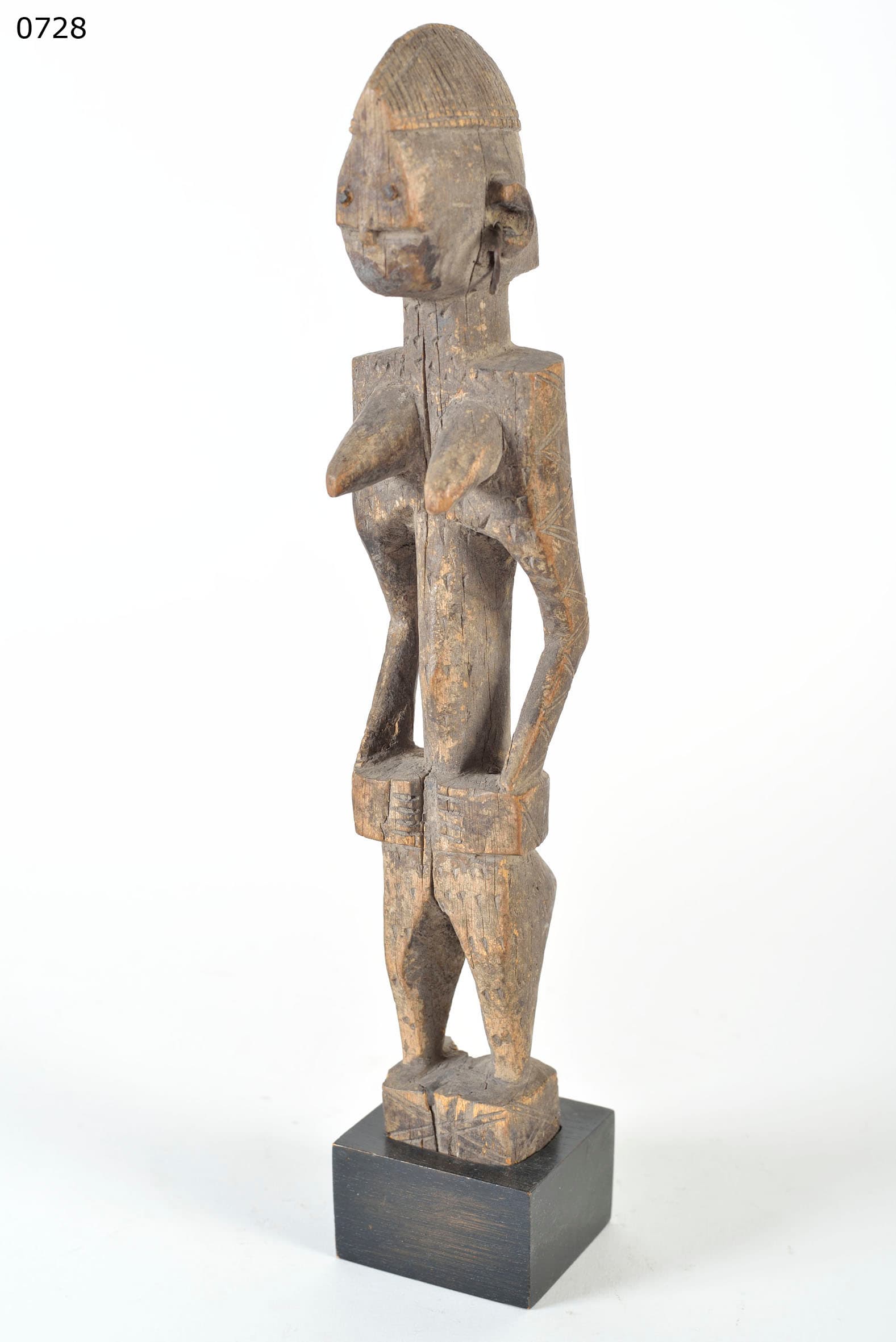
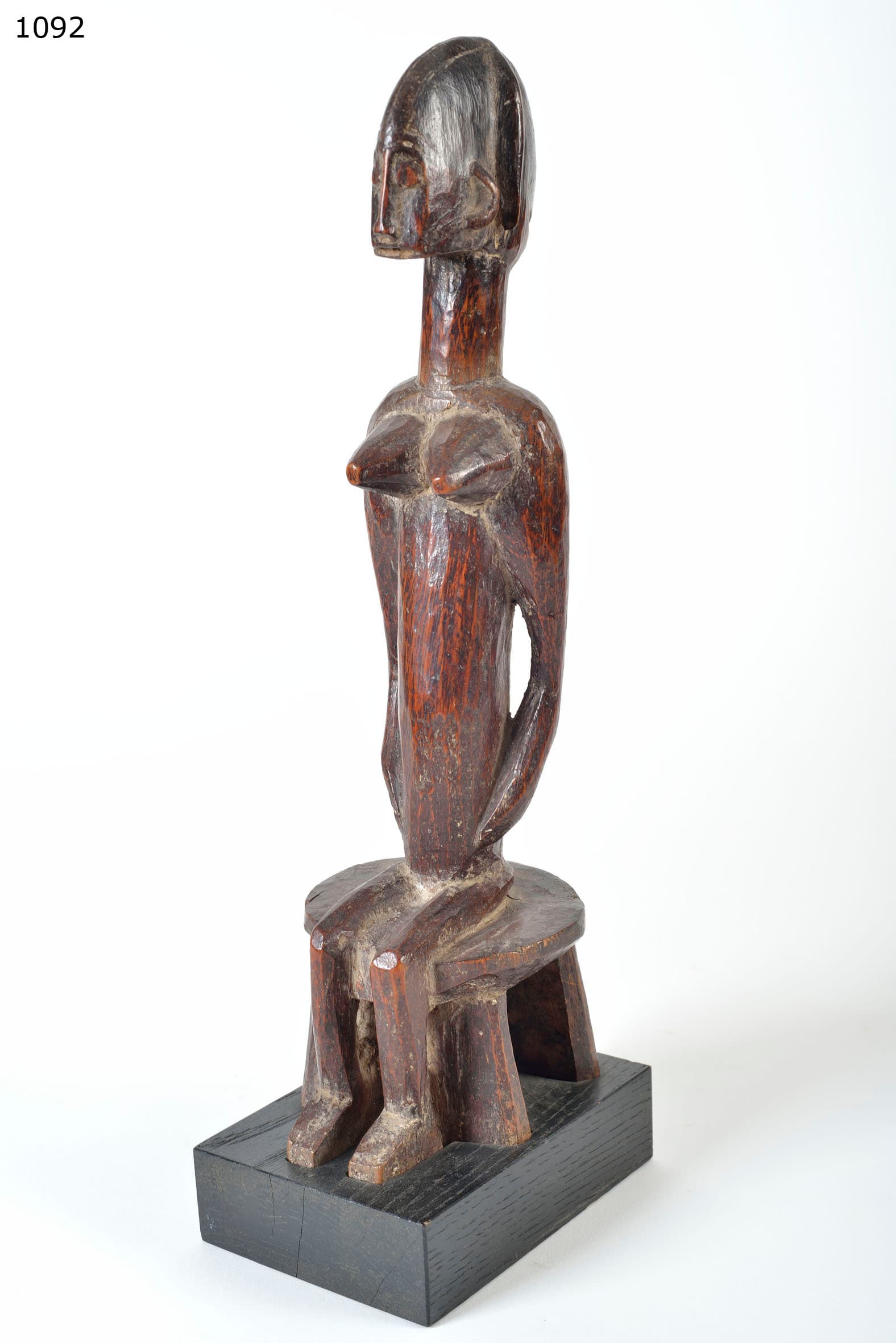
A deeply archaic wooden maternity figure (73 cm) from the Marka of Mali, stylistically attributed to the 16th–18th century — a stylized female with a child almost organically merged with her back, severe elongated proportions, angular projecting profile, and heavily eroded surface bearing a dry crusted patina over degraded geometric carvings.
1. Geometric abstraction in the Niger bend
The Marka (or Dafing) people share cultural and aesthetic ties with the neighboring Bamana, yet their sculpture often pushes geometric abstraction to even greater extremes, revealing stylistic boundaries shared with early Dogon or Tellem influences.
- Architectural Body: The elongated proportions, striking sagittal crest, projecting conical breasts, blocky feet, and simplified volumes render the human form as pure architecture.
- Archetype Over Portrait: The severe stylization strips away naturalism to focus on the essential, archetypal idea of ancestral motherhood rather than any specific woman.
2. Fertility and lineage continuity
In Marka society, maternity figures are idealized embodiments rather than portraits.
- Central to Initiation Cults: Figures of this type anchor associations such as the Jo society — petitioned for successful childbirth, agricultural abundance, and social harmony.
- Child as Metaphor: The highly abstracted child carried on the back is a visual metaphor for the perpetuation of the community through the blessing of the ancestors, not a depiction of a specific infant.
3. Weathering consistent with significant age
The figure's physical condition, marked by massive substance loss such as missing arms and blurred, barely legible facial features, is consistent with significant age.
- Deep Structural Oxidation: West African carvings of this period typically show natural softening of the geometric edges and an organic, unforced patina, which on hard Sahelian woods takes centuries to form.
- Generations of Ritual: Successive libations, environmental exposure, or temporary earth burial have layered the surface in ways that are difficult to replicate — comparable inner Niger Delta sculptures have been radiocarbon-dated to this early period, and such degradation is consistent with a long history of ritual use.
Summary
This Marka maternity figure exemplifies Sahelian abstraction and ancestral veneration. Its deeply eroded surface, consistent with a 16th–18th century attribution, and elegant geometric lines make it a rare and notable example of regional art.
Written with AI assistance from the collection appraisal, object photography and our own research; editorially reviewed. Mistakes are possible — corrections are welcome. How we work →