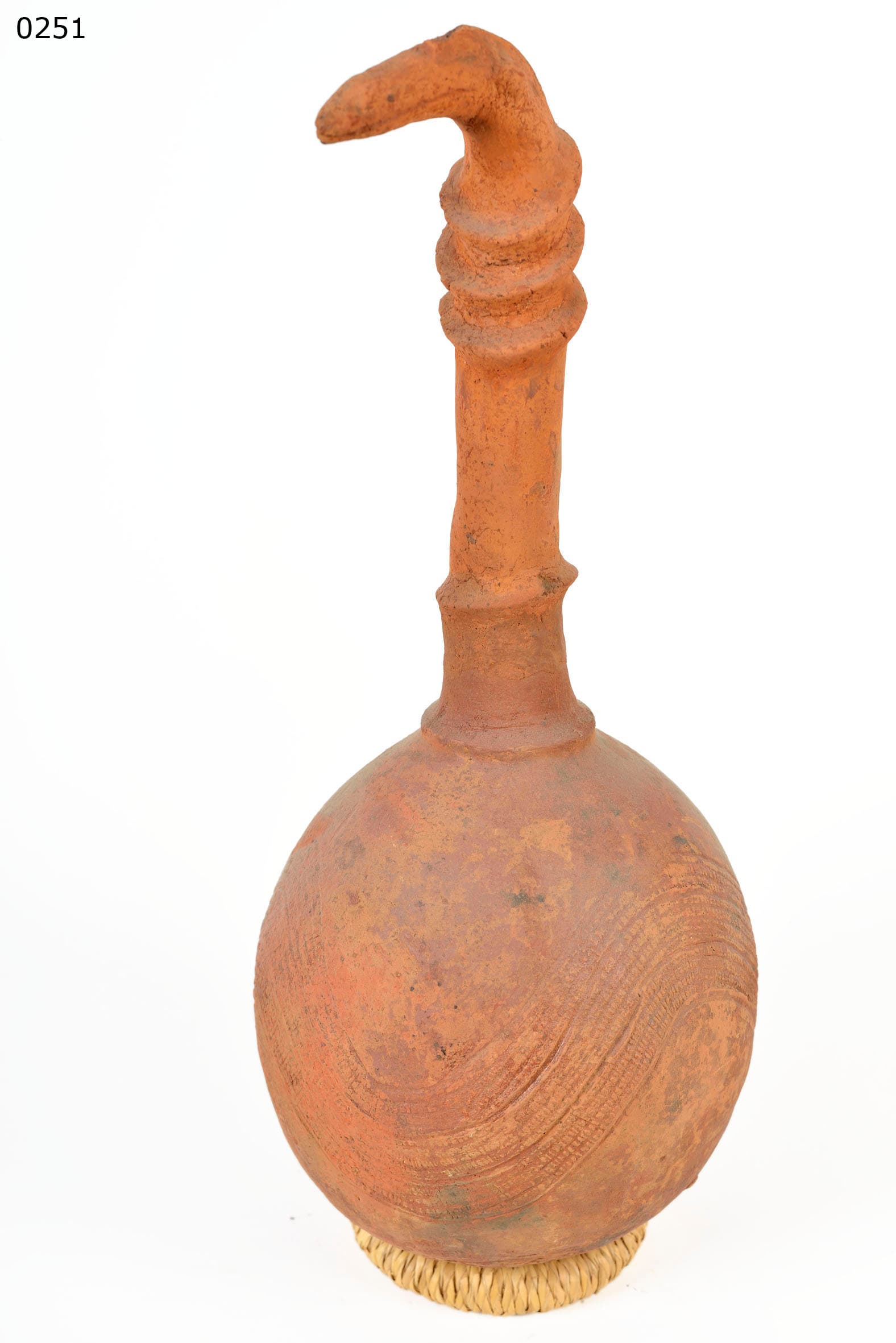
A highly unusual terracotta figure (12th–16th C., 43 cm) from the Bankoni of Mali — a large spherical bulbous base tapering dramatically into a remarkably elongated neck, terminating in a stylized beak-like zoomorphic head, the earthy-orange clay bearing deep ancient firing lines and localized soil encrustations.
1. The alien elongation of Bankoni
The Bankoni style, originating near Bamako and roughly contemporaneous with the Djenne empire (12th–16th centuries), is celebrated for its sweeping almost surreal elongation.
- Tension Without Ornament: Unlike the heavily textured Djenne figures, Bankoni relies purely on the dramatic tension between the massive heavy base and the impossibly long soaring neck.
- Avian Metamorphosis: The beak-like head suggests a human-to-bird transition — linking the ancestor with the liminal spiritual qualities of a bird traversing earth and sky.
2. Rebirth and the tumulus funerary cult
Bankoni figures are predominantly found within ancient tumuli (burial mounds).
- Womb, Seed, Egg: The spherical base strongly evokes a womb or seed form — while the upward thrust of the neck implies growth, ascension, or hatching.
- Metaphor of Reincarnation: Placed alongside the dead, these objects functioned as profound metaphors for reincarnation — signaling the soul's successful transition from the earthly grave up into the celestial ancestral realm.
3. Firing fractures and subterranean aging
The surface is a testament to both ancient technology and centuries of burial.
- Ancient Firing Cracks: The deep dark lines across the neck are stresses from the original open-air pit firing — characteristic defects of pre-kiln ceramic production.
- Earth Fused Into Cracks: The matte chalky surface and the pale Malian earth within these fractures are consistent with a 12th–16th-century entombment.
Summary
A striking exercise in surreal elongation and smooth geometry, this Bankoni tomb figure is a notable example of ancient Malian ceramics. Its avian-like abstraction and subterranean aging are consistent with documented archaeological finds.
Written with AI assistance from the collection appraisal, object photography and our own research; editorially reviewed. Mistakes are possible — corrections are welcome. How we work →