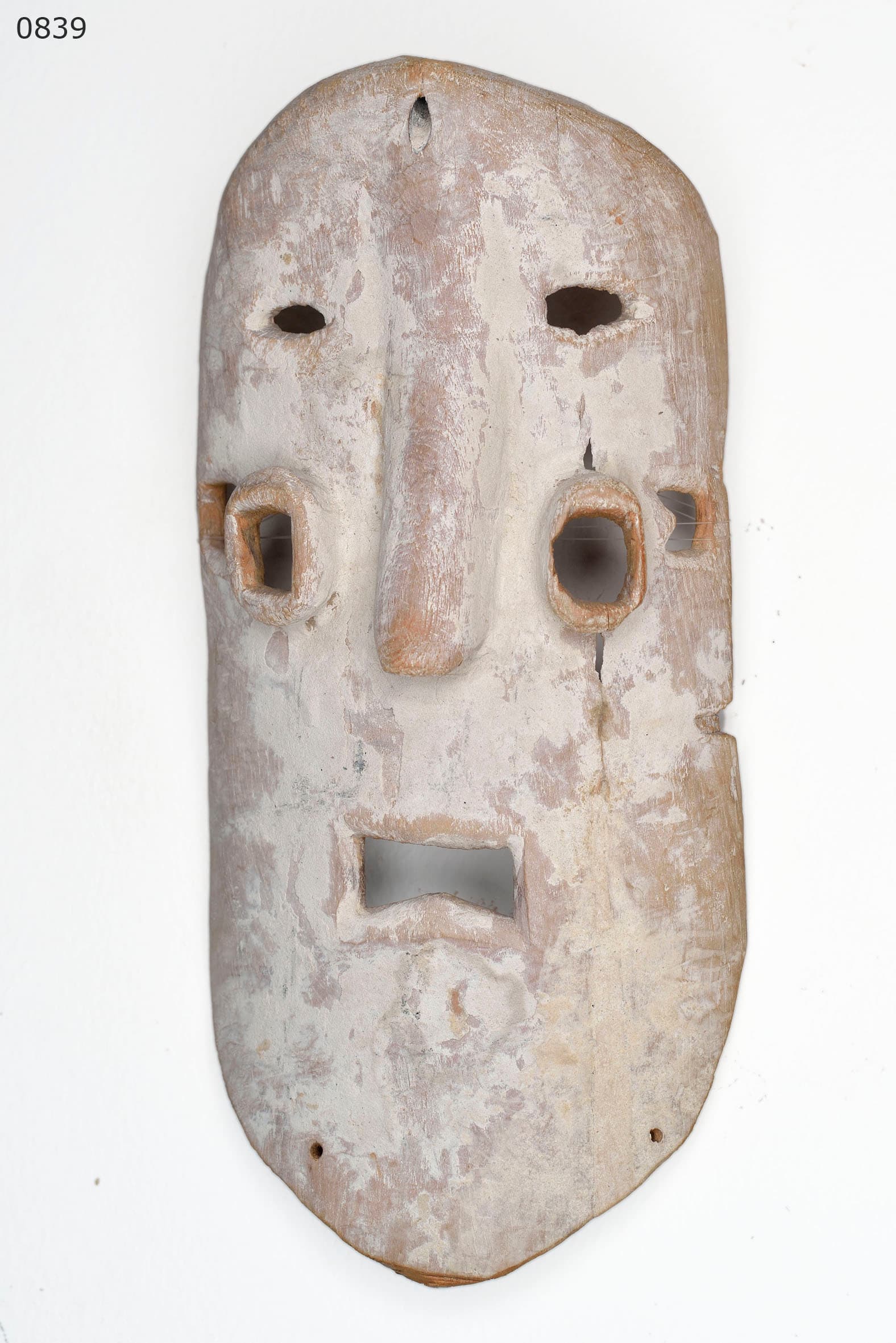
A striking highly geometric Kumu face mask (1st half 20th C., 36 cm) from DR Congo — coated in bright white kaolin with a prominent T-shaped brow and nose line and deeply recessed rectangular eyes, the dark wood visible on the edges and bearing a rich handling patina and wear consistent with extensive performance.
1. Nsembu society geometry
Associated with the Kumu people of the dense Ituri forest, this mask features a stark high-contrast geometry.
- Raised T-Architecture: The face is dominated by a severe raised T-shaped architecture forming the brow and nose — heavily contrasted against the flat recessed chalk-white facial planes.
- Rigid Distinction: This highly specific rigid geometry distinguishes Kumu masks from the softer more rounded forms of neighboring Congolese groups like the Lega.
2. Divination and social control
Masks of this typology are traditionally linked to the secretive nsembu (or nkunda) divination society.
- Nocturnal Performances: Danced during closed nocturnal rituals, the mask acts as an agent of social control.
- White of the Ancestors: The brilliant white kaolin pigment connects the mask directly to the realm of the ancestors and spirits of the dead — utilized by diviners to identify witches, cure intractable illnesses, and enforce the strict moral codes of the forest community.
3. Kinetic wear and kaolin stratigraphy
The surface wear is compatible with an early-20th-century attribution.
- Smoke-Stained Grain: The white kaolin clay is not freshly painted — it is deeply rubbed into the wood grain, showing areas of significant smoke-staining and dirt accumulation from years of kinetic performances in fire-lit clearings.
- Tie-Hole Smoothing: The edges, particularly where the mask was handled and around the tie-holes, have been rubbed completely smooth — revealing the dark oxidized hardwood beneath.
Summary
A striking display of high-contrast geometry and secretive power, this Kumu nsembu mask is a vital artifact of Congolese divination. Its smoke-stained kaolin patina and heavy wear are consistent with an object of significant age and ritual use.
Written with AI assistance from the collection appraisal, object photography and our own research; editorially reviewed. Mistakes are possible — corrections are welcome. How we work →