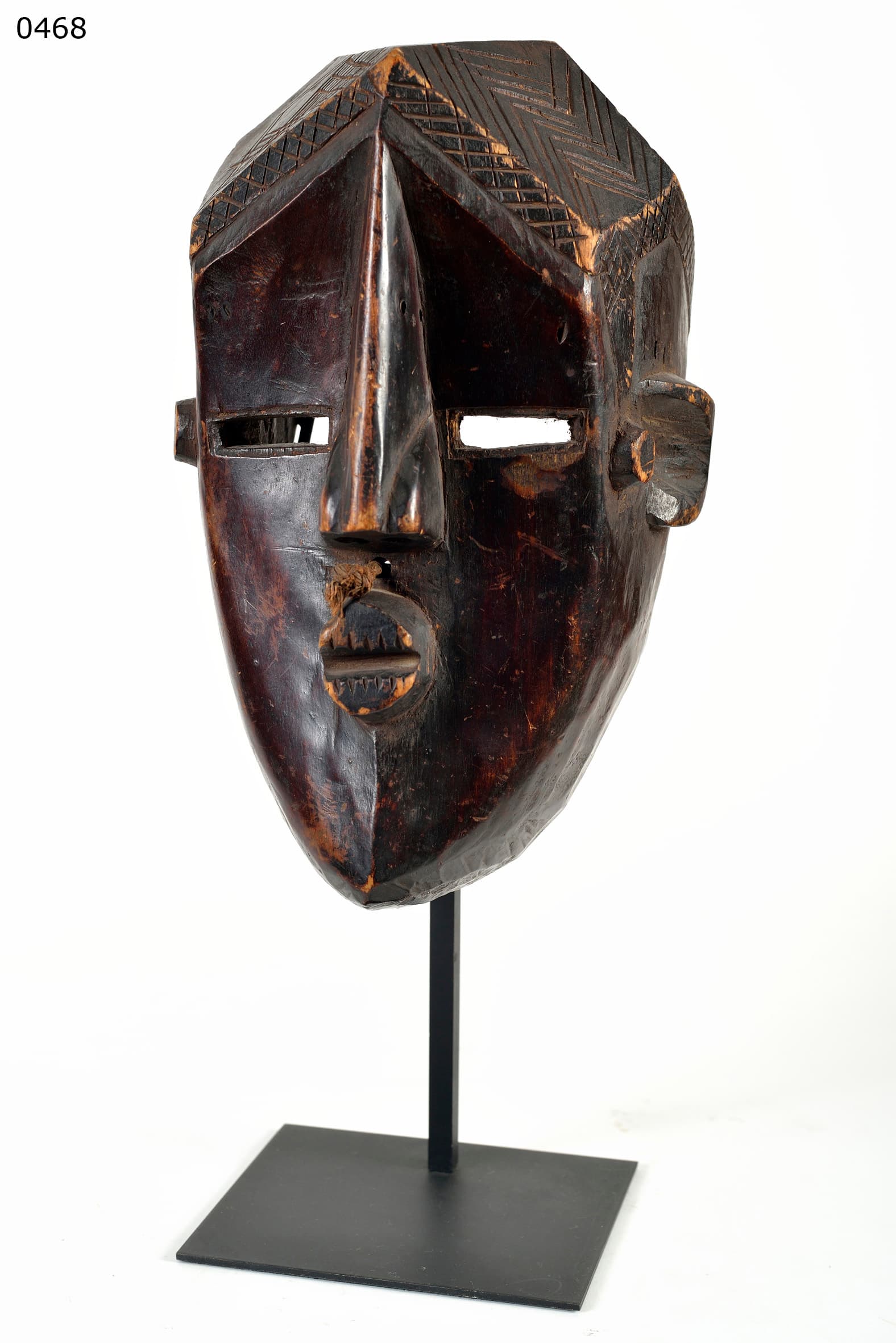
A sharply geometric Lwalwa nkaki / mvondo mask (1st half 20th C., 34 cm) from DR Congo — a striking concave facial plane defined by an extreme sharply projecting triangular nose that spans from brow to mouth, the rectangular protruding mouth and narrow rectangular slit eyes enhancing its cubist architecture, bearing a rich reddish-brown patina with edge wear. Exhibited at the French Embassy, Vienna.
1. The cubist architecture of the Lwalwa
The Lwalwa (or Lwalu) of the DRC borderlands are world-renowned for masks exhibiting some of the most radical avant-garde geometric abstraction in all of African art.
- Intersecting Planes: The sculptor reduces the human face to intersecting planes and sharp angles — the defining feature is the massive wedge-like nose acting as a central architectural ridge that creates deep dramatic shadows.
- Modernist Influence: This aggressive cubism profoundly influenced 20th-century Western sculptors who marveled at the Lwalwa ability to construct a face entirely out of geometric solids.
2. The ngongo society and male initiation
These masks were strictly controlled by the ngongo secret society — which oversaw male initiation and circumcision.
- Phallic / Hornbill Nose: The prominent sharp nose is often interpreted as a phallic symbol or a representation of the hornbill bird — both associated with male potency and aggression.
- Nocturnal Discipline: Danced by initiated men during nocturnal ceremonies to discipline the uninitiated, celebrate the transition of boys into manhood, and honor the hunting prowess of the village's elite men.
3. Provenance and ritual rubbing
Beyond its refined structural design, this mask holds value due to its documented provenance.
- French Embassy Vienna Exhibition: Formally exhibited at the French Embassy in Vienna — securing institutional pedigree.
- Tukula-Oil Patina: The wood was traditionally colored with tukula (red camwood powder) and oil — deeply oxidized over the early 20th century into a rich dark mahogany tone. The softening of the sharp nasal ridge and the dark sweat-stained rim on the interior cavity are consistent with an active life as a danced object before historical collection.
Summary
A fine example of Congolese cubism, this Lwalwa mask demonstrates the radical geometric abstraction that altered global art history. Backed by an exhibition provenance and a patina consistent with performance wear, it is a significant collector's item.
Written with AI assistance from the collection appraisal, object photography and our own research; editorially reviewed. Mistakes are possible — corrections are welcome. How we work →