Overview
A precise ethnographic and art-historical classification of the Bassa represents a recurring taxonomic problem in academic research as well as in museum and private provenance research. The source situation is complicated by a significant triple homonymy, which regularly leads to serious misattributions in the international art trade. The Bassa-Liberia (often transcribed as Gbasso or Basa) discussed here must be strictly differentiated geographically and linguistically from two other groups with the same name but culturally completely distinct: the Bassa-Nge in central Nigeria (a subgroup of the Nupe, who historically migrated after the Fulani jihad and linguistically belong to the Kainji family) and the Bassa in Cameroon (a Bantu-speaking ethnic group of the coastal and littoral region). Any valid interpretation of the material culture discussed here must maintain this selectivity, as the socio-political and ritual structures of these three groups differ fundamentally.
Geographically, the settlement areas of the Bassa-Liberians are concentrated on the central Atlantic coast and the immediately neighbouring wooded hinterland of the Republic of Liberia. The primary demographic centres are located in the current administrative units of Grand Bassa County, Rivercess County, Margibi County and parts of Montserrado County. In the capital Monrovia in particular, they represent the largest cohesive ethnic group due to historical and recent urbanisation processes.
The current demographic data from the Liberia Population and Housing Census of 2022 (LISGIS) confirms the quantitative relevance of this ethnic group within the Liberian nation state. The total population of Liberia is estimated at around 5.25 to 5.43 million individuals in this census. With a share of 13.4 to 13.6 per cent, the Bassa are the second largest indigenous group after the Kpelle (around 20.3 per cent). This corresponds to an absolute population of an estimated 700,000 to 800,000 individuals, with some demographic projections including diaspora communities in Côte d'Ivoire and Sierra Leone assuming up to one million members.
| Demographic indicators (Bassa-Liberia) | Specification |
|---|
| Core Geographic Zones | Grand Bassa, Rivercess, Margibi, Montserrado County |
| Estimated population (Liberia) | approx. 700,000 - 800,000 (2022 census: ~13.4 % of total population) |
| Diaspora populations | Côte d'Ivoire (~65,000), Sierra Leone (~40,000) |
| Linguistic affiliation | Krou family (Kru) within the Niger-Congo phylum |
| Autonyms (self-designation) | Gboboh, Adbassa, Bambog-Mbog |
Linguistically, the Bassa are assigned to the Krou language family (Kru), which forms a distinct branch within the macro-regional Niger-Congo phylum. This categorisation is art-historically relevant in that it isolates the Bassa from the Mande-speaking groups in the north and north-west (such as the Dan, Kpelle and Mende), even though massive cultural exchange took place. The existence of a separate pictographic writing system represents a cultural-historical singularity. This writing system lost importance in the late 19th century, but was rediscovered in the 1890s in the diaspora (Brazil, West Indies) and reconstructed around 1900 by Thomas Flo Darvin Lewis under the name Ehni Ka Se Fa as a character-based script. According to linguistic evidence and oral tradition, the common foreign term "Bassa" is probably derived from the phrase Bassa Sooh Nyombe, which can be translated as "people of the father's stone". Early European navigators and traders shortened this complex term phonetically, from which today's standard term developed. In indigenous contexts, however, the group members themselves often identify themselves as Gboboh, Adbassa or Bambog-Mbog.
The pre-colonial social structure of the Bassa was strictly acephalous and characterised by the absence of a centralised state authority or absolutist kingship. The society was organised into patrilineal kinship groups and lineages. Each of these lineages is ritually bound to a specific totem animal, the consumption of which is subject to strict food taboos. Political, legal and moral decision-making was the responsibility of local councils of elders recruited from the heads of these lineages. In times of crisis or macro-regional conflicts, temporary alliances were formed, which, however, disintegrated back into decentralised, village autonomy once the conflict had been resolved. An essential regulatory mechanism of this acephalous structure were the secret societies, which guaranteed a network-like, cross-border social cohesion and functioned as executive organs of jurisdiction.
The subsistence strategy is primarily based on shifting cultivation in the tropical rainforest zones. At the centre of agricultural production is dry rice cultivation, which forms the basis of food security, supplemented by the cultivation of manioc, yams and various cash crops. The proximity to the coast and large river systems also implements fishing as an essential source of protein, while hunting has ritual connotations.
The relationship with the neighbouring peoples is characterised by a dialectic dynamic of warlike demarcation and an intensive cultural assimilation process. In the north-east, the settlement areas of the Bassa border on those of the Dan and Kpelle, in the west on those of the Mende and Gola, and in the east on those of the Kru and Grebo. The Mande-speaking Dan in particular exerted an enormous stylistic influence on the material culture of the Bassa. This interethnic transfer regularly leads to uncertainties in the classification of museum artefacts - for example in the collections of the British Museum or the Fowler Museum at UCLA. Classification controversies must be explicitly marked where objects originate from the border region: The classification of masks as "Bassa" or "Southern Dan" is often based on minimal morphological variances, as artists of both ethnicities produced commissioned works for the other group.
Cultural context
The religious system of Bassa-Liberia reveals a highly complex cosmological order that differs structurally from the animism concepts of neighbouring Mande groups and requires a nuanced approach. At the top of the spiritual hierarchy, Bassa cosmology postulates a transcendent, unapproachable creator god, who is invoked in the indigenous dialects as Nama or Chang. In line with the religious sociological concept of the deus otiosus, it is assumed that this primary entity created the world and the initial cosmic structure, but subsequently withdrew from the immediate, profane world of human life. Consequently, there is no formalised, direct cult, no dedicated priesthood and no ritualised sacrificial being aimed exclusively at Nama.
Instead, the functional religious practice and the village ritual world focus on a network of ancestor spirits and local nature or spirit beings (Jina), who act as intermediaries between the human sphere and the unattainable divine order. Ancestor worship forms the foundation of family and social continuity. Death is not understood as a final caesura, but as an ontological transition: the deceased is transformed from a participating member of the community into a sanctioning ancestor who monitors the observance of moral norms, taboos and social obligations. These ancestral spirits localise themselves in specific geographical zones, preferably in old trees, sacred groves and watercourses. A particularly present spirit being in the region is the female water entity Tingoi or Njaloi, who stands for ideal beauty, fertility and ritual purity and plays a central role in the initiation rites of the women's unions.
Ritual authority within the acephalous Bassa society does not lie with sacred kings, but is delegated through a system of esoteric alliances (secret societies). These societies administer metaphysical knowledge, initiate the youth and act as executives in legal disputes. The No society and the chu-den-zo society are primarily relevant for the male population. The ritual hierarchy is dominated by highly specialised actors: Divinators, who interpret the will of the ancestors using cowrie snails, stones or animal bones; healers, who have profound pharmacological knowledge of the rainforest flora; and priests, who tend the altars of the covenants.
The role of women in the cult of the Bassa is structurally strongly anchored and stands in clear contrast to patrocentric models in other African regions. The women are organised in the Sande society (also known regionally as Bondo). This organisation has absolute authority over female reproduction, childbirth, ritual purity and the initiation of girls. Unique to western Africa is the fact that women in these societies actively perform their own wooden masks (often called Sowei or Ndoli Jowei, although these terms originate primarily from the Mende). Higher-ranking female initiators in Sande society have significant socio-political power and can block decisions by the male councils of elders, indicating a complex, balanced system of gender dualism.
Central initiation and transition rituals mark the transformation of adolescents. Circumcision and the subsequent physical and symbolic separation in the "bush camp" often last several years. The novices symbolically die the social death of childhood, are instructed by spiritual beings in the bush, learn subsistence techniques, respect for the ancestors and the secret communication codes of the covenants in order to finally be "reborn" into the village as fully-fledged, marriageable adults.
| Components of the Bassa cosmos | Structural function and relevance |
|---|
| Nama / Chang | Creator god (Deus otiosus), no active cult worship. |
| Ancestor spirits | Sanctioning instances, intermediaries, localised in nature. |
| Nature and water spirits (Jina) | Embodiment of ideals (e.g. Tingoi for beauty/fertility). |
| No- / chu-den-zo societies | Male secret societies, bearers of executive power and initiators. |
| Sande / Bondo society | Female society, regulation of birth, law and initiation. |
There is significant research controversy in the specialist literature regarding the exact structural categorisation of these societies, which must be explicitly named (author vs. author). The source situation is ambiguous: Frederick Lamp (1979) argues in his analysis of the coastal peoples that the male alliances of the Bassa ultimately only represent local derivatives of the all-powerful pan-ethnic Poro society of the Mande-speaking peoples and are ideologically subordinate to it. Eberhard Fischer and Hans Himmelheber (1976), on the other hand, emphasise through their early field research that the chu-den-zo of the Bassa is structurally independent and differs radically from the Mande-Poro in its ritual choreography, mask function and musical accompaniment. Fischer postulates that the Bassa rituals have a more intimate, less militaristic character and that ancestor worship predominates over the pure fear of spirits of the Poro. What distinguishes this religion structurally from neighbouring peoples (such as the Gola or Kpelle) is the decentralised, highly autonomous nature of the cult groups, which do not accept a superordinate "grand master" whose power extends beyond village boundaries.
Aesthetic features
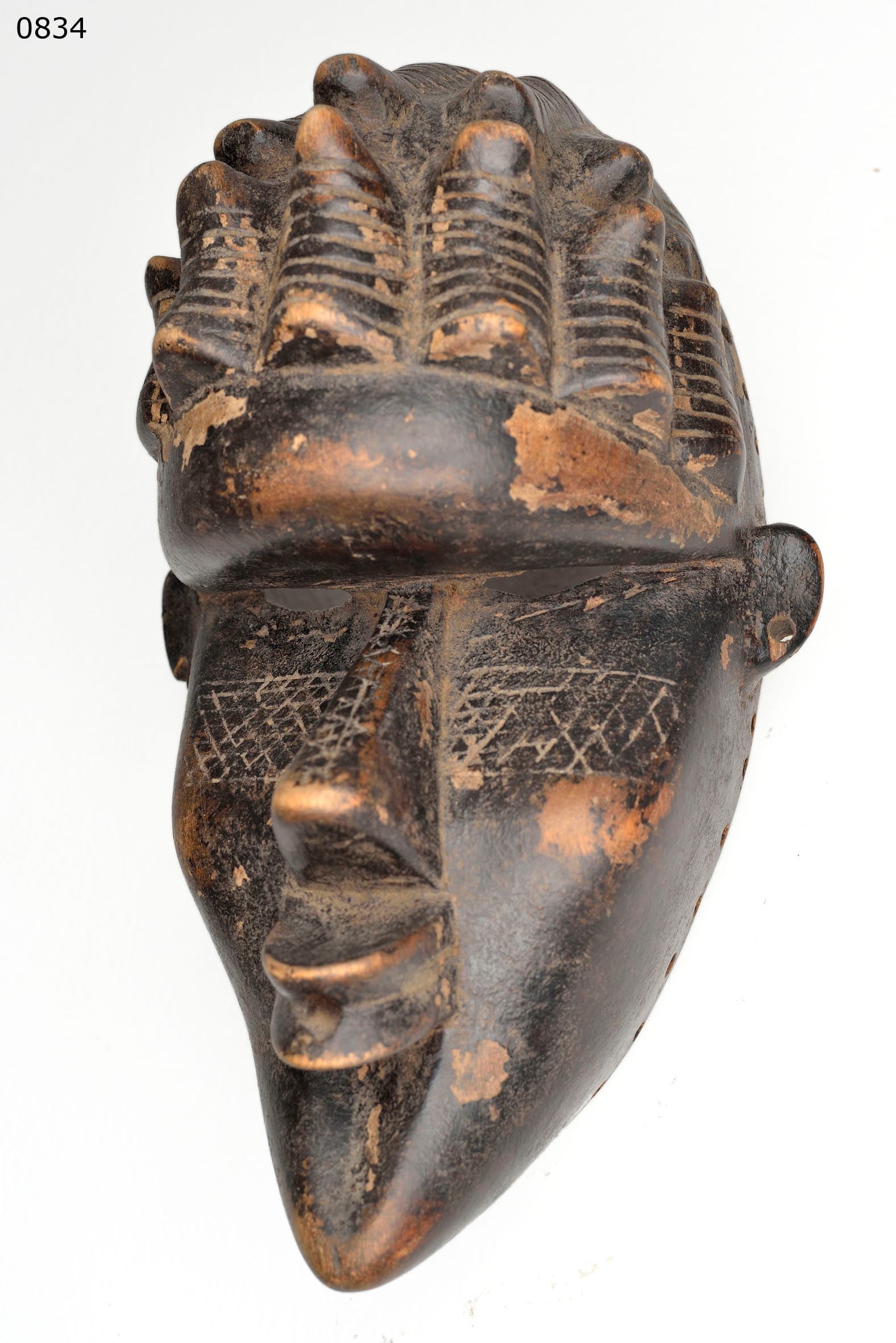
The material culture of the Bassa is characterised by a highly refined, reduced formal language, whose typology is relatively limited, but whose qualitative execution is of outstanding importance for the international art market. The canonical object typology is absolutely dominated by the small, finely carved face mask, which is listed in the literature as Geh-Naw or Gela.
The canon of proportions of the Geh-Naw is unmistakable and reliably distinguishes it from the masks of the neighbouring Dan. The masks have a tapered, conical to oval-shaped chin. The forehead is strongly convex in a hemispherical shape, smoothly polished and iconographically symbolises high intelligence and spiritual clarity. The eye zone is characterised by narrow, horizontally recessed slits, which are surrounded by heavy, voluminous eyelids (so-called coffee bean eyes), often carved in a semi-circle. The nose is small, sharply cut and triangular, the mouth extremely small, circular, strongly protruding and occasionally with animal bone splinters or metal pins applied as teeth. A canonical feature of many specimens is the motif of a centrally placed kauri snail or a diamond-shaped scarification pattern on the forehead. The most striking distinguishing feature, however, is the voluminous, high, multi-lobed plait hairstyle, which often consists of five to nine parallel beads and architecturally finishes the mask at the top. In its iconography, the Geh-Naw embodies the absolute, pacifist ideal of feminine grace and moral beauty.
In addition to the Geh-Naw, the size spectrum also includes miniature masks (so-called ma go or passports), which measure just 4 to 10 centimetres. These act as apotropaic pendants. Another often overlooked subtype are anthropomorphic female ancestor sculptures, which are used for divination purposes, as well as hardwood idiophones (percussion stools), which sometimes have fine human faces at the ends and are used as rhythm instruments in ritual music.
| Typology of Bassa art | Iconographic significance / Proportional features |
|---|
| Geh-Naw / Gela | Pointed chin, high/smooth forehead, slit eyes, elaborate plaited hairstyle, kauri snail motif. Ideal feminine beauty. (Size: 18-25 cm). |
| Ma go (miniature masks) | Exact morphological reduction of the large masks. Apotropaic protection, connection to the helping spirit in a foreign land. (Size: 4-10 cm). |
| Percussion stools (idiophones) | Rhythmic resonating bodies, often with two-sided anthropomorphic faces. Ritual music. (Size: approx. 30-50 cm). |
| Ancestor sculptures | Rare. High forehead, often applied with textiles/beads. Divination and memorial function. (Size: 30-60 cm). |
The choice of material is limited almost exclusively to dense, termite-resistant hardwoods from the coastal forests. The development of the patina is the decisive factor in determining the ritual context. A profound iconographic controversy in research must be named here: The function of the Geh-Naw. The Western art market and early dealers universally categorised these objects as classic "masquerade" helmets. Ethnographic field research, however, reveals a radically different picture. A (e.g. Frederick Lamp and American gallery owners of the 1980s) interpret the masks primarily ritualistically as active components of ghostly apparitions. B (Eberhard Fischer and Hans Himmelheber) date and prove through photographic documentation in the field that the finest Geh-Naw specimens often functioned as profane status symbols. They were not danced in everyday life by dignitaries of the alliances as the incarnation of a spirit, but were worn openly as an elitist sign of wealth, prestige and political rank.
This striking difference between an activated ritual object and a profane status symbol is reflected in the patina. Ritual-activated masks (which actually danced in No society) often display a crusty, matt sacrificial patina created by ritual ablutions, chewing juice and blood. Profane status objects, on the other hand, show an extremely fine, homogeneous and shiny rubbed patina, which is the result of years of handling and rubbing with palm oil and vegetable dyes.
Documented master craftsmen are difficult to identify in the highly anonymised tradition of the Bassa, but local workshops can be identified. Research (e.g. based on the holdings of the Rietberg Zurich or the Musée du quai Branly) shows that travelling artists of the Dan, in particular the legendary Master Zlan of Belewale, had a significant influence on the style of the Bassa. This makes the boundary between a "southern Dan" style and a pure Bassa style often fluid.
Forgery criteria are of the highest market relevance for this ethnic group. As authentic Bassa masks achieve extremely high auction results, they are often copied in workshops in Monrovia. Authenticity criteria are based on the forensics of the patina: recently applied shoe polish or chemical stains do not penetrate deep into the cell structure of the wood and fail under UV reflectometry. Genuine pieces often exhibit historical heartwood cracks caused by extremely slow drying in the African climate, as well as asymmetrically worn edge holes that have been ground out by decades of friction from the fastening cords.
Ritual practice
The ritual practice and the actual performance of the Bassa objects differ radically from Eurocentric notions of a "masquerade". This applies in particular to the wearing and choreographic staging of the Geh-Naw and Gela masks, which did not serve as profane status symbols but actively appeared in the context of No society.
The mask performance is characterised by a complex architecture of wearing. The small face mask is not worn vertically over the male dancer's own face. Instead, the mask is fixed to an elaborate, basket-like frame made of woven rattan by means of the perforations around the edges. This frame is positioned diagonally on the dancer's forehead. The performer's head and upper body disappear completely under a voluminous, multi-layered costume made of dyed cotton fabrics, animal skins and thick skirts made of raffia fibres. The dancer does not orientate himself visually through the carved coffee bean eyes of the wooden mask, but looks through a narrow slit in the cloth that covers his own face. This construction means that the inner back of authentic, danced bassa masks often has none of the sweat deposits or nose abrasions typical of other African masks - a crucial detail for the expertise of collectors.
The ritual activation of the mask begins during the carving process, which takes place in the secrecy of the forest. The wooden object itself is initially a profane vessel. The transformation into a ritually charged artefact only takes place through the initial consecration by the priests of the chu-den-zo or No society. Powerful substances are applied and secret incantations are spoken, inviting the ancestor or nature spirit to take up residence in the wood.
The occasions for the performance of the Gela are primarily of a festive and socially organising nature. The masquerade appears when the initiated boys have completed their years of arduous training in the bush camp and are ceremoniously reintegrated into the village community as fully-fledged men. The mask also performs when high-ranking dignitaries from neighbouring villages visit. The dancer's choreography is characterised by gliding, graceful and extremely controlled movements that imitate the ideal of female grace and visually convey the importance of harmony and social decorum to society. This performance is accompanied by a musical ensemble, including hardwood idiophones (percussion stools), whose percussive rhythms maintain the connection to the spirit world.
The use of the altar manifests itself primarily in the miniature masks (ma go) and the rare anthropomorphic sculptures. These objects are not performed in public, but are kept in the private huts of the dignitaries or in special shrines of the secret societies. The construction of these altars is often simple, but their ritual charge is immense. Offerings are made to secure the protection of the spirits or to perform divination before making important decisions. Regular libations include spitting chewed kola nut juice, local palm wine and, in cases of serious crisis or epidemic, the blood of ritually slaughtered chickens onto the objects. These sacrifices accumulate over decades to form the characteristic, thick encrusted patina that is documented on objects in institutional collections such as the Musée du quai Branly or the Tervuren/RMCA.
In Bassa cosmology, the lifecycle of an active ritual object is organic and finite. An object is not made to last forever. If the wood loses its aesthetic integrity and thus its ritually required "perfection" due to deep termite damage, uncontrolled heartwood cracks or climatic weathering, the vessel is considered uninhabitable for the spirit. It is deactivated and disposed of pragmatically: the spirit is bid farewell through ritual formulas and the physical shell is left to nature in the forest, where it rots away. This cycle was only interrupted by the influence of Western collectors and local dealers (runners); nowadays, deactivated objects are no longer disposed of, but profaned and fed into the international art market.
Historical context
The historical localisation of Bassa art requires the analysis of a profound migration history that was triggered by the pressure of more powerful empires in the African hinterland. From the 15th century onwards, accelerated by the fall of the Mali Empire and later conflicts in the Sudan belt, the Krou-speaking ancestors of the Bassa were forced to migrate successively southwards to the dense, rainforest-covered coast. There is controversy in research regarding the exact dating of these waves; while some historians postulate a steady infiltration, others point to abrupt flight movements as a reaction to the slave trade from the north. What is certain is that the Bassa had already formed firmly established agricultural structures on the so-called Pepper Coast by the time the first European trading fleets arrived.
Liberia's colonial encounter is a special case in global history that had a decisive influence on the art production of the indigenous peoples. The coastal region was never colonised by European powers in the classical sense. Instead, the American Colonisation Society (ACS) bought land from 1822 onwards to settle freed African-American slaves from the USA there. These "Americo-Liberians" quickly established an economic and political hegemony that drastically marginalised the indigenous population, including the Bassa, and in some cases deprived them of their land rights. This conflict escalated violently on several occasions, historically documented in the Bassa attack on the Bassa Cove settlement in 1835. An ivory war horn from this battle is now in the Peabody Essex Museum, with an excellently documented provenance via the Peale Museum. The dominance of the Americo-Liberians led to a cultural retreat of the Bassa; ritual practices and the associated woodcarving art were moved deeper into the forest and into the secret sphere of the covenants in order to evade Christian missionary assimilation.
The market history of Bassa art in the West began relatively late compared to artefacts from the French colonies. It was not until the middle of the 20th century that the fine masks became the focus of systematic field research. The pioneers of this exploration were the Heidelberg doctor and ethnologist Hans Himmelheber, who undertook expeditions to Liberia from 1949, and his son Eberhard Fischer, who documented the region photographically and ethnologically from 1960. Their acquisitions formed the basis for the important holdings of the Museum Rietberg in Zurich. In the USA, scholars such as Frederick Lamp in the 1970s and 1980s (with publications in the African Arts Journals) and curators such as William Siegmann promoted the scientific classification and museum recognition of the Bassa works. It was during this phase that Bassa art achieved its international breakthrough; exhibitions at the Metropolitan Museum of Art (Met) and the Musée du quai Branly cemented its status as masterpieces of reduction.
The price development of recent decades reflects this process of canonisation. While Bassa art was still considered an ethnographic curiosity in the 1960s, top objects now realise astronomical sums; for example, a rare Bassa figurine was offered at auction with an estimated price of USD 5,000, but ultimately fetched USD 75,000.
| Historical and market-relevant phases | Key events and players |
|---|
| Late 15th century | Migration of the Kru groups to the coast, establishment of the Bassa. |
| 1822 - 1847 | Arrival of Americo-Liberians, marginalisation of indigenous culture, Bassa Cove conflict (1835). |
| 1949 - 1960s | Ethnographic cataloguing by H. Himmelheber and E. Fischer; transfer of artefacts to the Rietberg Museum. |
| 1970s - 1980s | Scientific canonisation in the USA (F. Lamp, W. Siegmann, African Arts publications). |
| Present | Massive price explosion on the international auction market, accompanied by massive forgery problems. |
This price explosion led to an extreme forgery problem. Modern workshops, especially in the urban centres of Côte d'Ivoire and Liberia, produce forgeries of Geh-Naw masks that are specially tailored to the visual expectations of Western collectors. Nowadays, authenticity criteria are based on strict forensics and material analysis. Mere superficial termite damage is no guarantee of age, as forgers often deliberately place objects in nests. Authentic ageing can be seen in deep, healed heartwood cracks caused by the extremely slow loss of residual moisture in the tropical wood, as well as in the asymmetry of wear. The perforations around the edges of the masks must show traces of years of mechanical friction caused by attachment to the rattan frame. The patina - be it shiny palm oil on the status objects or crusty blood on the ritual masks - must have migrated deep into the cellular tissue of the wood and must not merely adhere to the surface like a chemical stain or shoe polish. In cases of doubt, the only absolute criterion for verifying a museum masterpiece is complete documentation of provenance (such as confirmation of a collection history dating back to before the major breakthrough exhibitions of the 1970s).