1. overview
The Konso, who are known as Xonsitta in the indigenous nomenclature, represent a Cushitic-speaking ethnic group in south-western Ethiopia. Their primary settlement area is located in the highly rugged peripheral zone of the East African Rift Valley. Linguistically, their language, Afaa Xonso, belongs to the lowland-eastern Cushitic language family, whereby four main dialectal groups (Faashe, Karatte, Tuuro, Xolme) are documented.
The source situation is ambiguous with regard to the exact demographic record: while the official Ethiopian census of 2007 assumes 250,430 individuals, more recent demographic projections for the year 2024 date the population at up to 350,984 members. This statistical discrepancy is largely the result of an administrative redrawing of the boundaries of the Konso Special District in 1994, which geopolitically included various non-Konso groups in the census data.
| Demographic parameters | Specification |
|---|
| Geographical location | South-west Ethiopia, Rift Valley (approx. 2,000 metres above sea level) |
| Linguistic classification | Afro-Asiatic, Lowland East Cushitic |
| Self-designation | Xonsitta |
| Subsistence strategy | Intensive terraced agriculture (sorghum, maize, cotton) |
The social structure of the Konso defies a simple binary classification of acephalous versus centralised-hierarchical. The society is divided into nine strictly exogamous and patrilineal clans, each headed by a formal clan chief. This kinship organisation is flanked by a complex, cyclical system of age groups and generations (Gada), which assigns political and ritual responsibilities in fixed temporal rhythms. The subsistence strategy is based on highly specialised agriculture. Over the centuries, the Konso have developed an indigenous system of stone-framed terraces, which was declared a UNESCO World Heritage Site in 2011, in order to maximise agricultural yields in the semi-arid topography.
The relationship with neighbouring ethnic groups has historically been characterised by competition for resources and complex migration dynamics. In particular, conflicts over grazing land and water access with pastoral groups such as the Oromo and tensions with the Zayse and D'irashe are well documented ethnographically. Within taxonomic research, there is also an ongoing classification controversy regarding the Gato. While some linguists and ethnographers (such as Amborn) define the Gato as a distinct entity of the Burji-Konso cluster, other scholars classify them primarily as a mere regional sub-variant of the Konso core. In the ethnographic mapping and cataloguing of historical collections, exemplified by the holdings of the British Museum (London), this fine-grained local differentiation is often levelled out and the material heritage of the Gato is subsumed under the macro-nomenclature "Konso".
2. cultural context
The Konso religious system is characterised by a structural pluralism in which indigenous religious practices (Waaqeffanna) coexist with Ethiopian Orthodox and increasingly Protestant influences. The indigenous cosmological order is based on the worship of a transcendent creator deity (Waaqa) and a strongly pronounced, space-bound ancestor cult. According to Amborn (2002), the Konso ontology manifests a distinct concept of the soul, in which the immaterial essence of the human being undergoes a gradual transformation after physical death in order to pass into the collective pantheon of ancestral spirits, which guarantees the moral and social cohesion of the living.
Ritual authority is vested in specific functionaries. Among the central actors are the kalla (a supra-regional priest) and the poqalla (lineage elders), who act as mediators between the physical world and the ancestral sphere and lead agri-cultural blessing rituals. There is a documented research controversy regarding the ritual purity laws of these authorities: In his early monograph of 1972, Christopher Hallpike initially assumed an institutional polygyny of the kalla, but corrected this assumption in later publications (2008) after field research revealed that strict monogamy is prescribed to the kalla in the context of his sacred office. Women play a formally subordinate role in institutional cult events and in the politically dominant gada system. Conceptually, however, as Watson (2009) points out, female fertility metaphors are essential to the agricultural symbolism and metaphorical nourishment of the terraced landscape.
Structurally, this religion differs fundamentally from the cosmologies of neighbouring Nilotic and Cushitic pastoralists. While nomadic groups such as the Borana-Oromo cultivate a sacred spatial order centred on mobility, cattle breeding and extensive pilgrimage routes, the Konso religious system is inextricably linked to the static geography of their agricultural terraces, stone fortifications (paletas) and fixed places of worship (mora). This structural divergence is precisely reflected in the museum's collection of objects: in the Museum Rietberg (Zurich), the solid wood, strongly site-bound and permanent ritual material culture of the Konso contrasts clearly with the light, transportable cult objects of the pastoral neighbouring peoples. Rites of passage among the Konso are therefore aimed less at physical initiation into the vastness of space and more at social integration into the rigid, vertical structure of the stone-built settlements.
3. aesthetic features
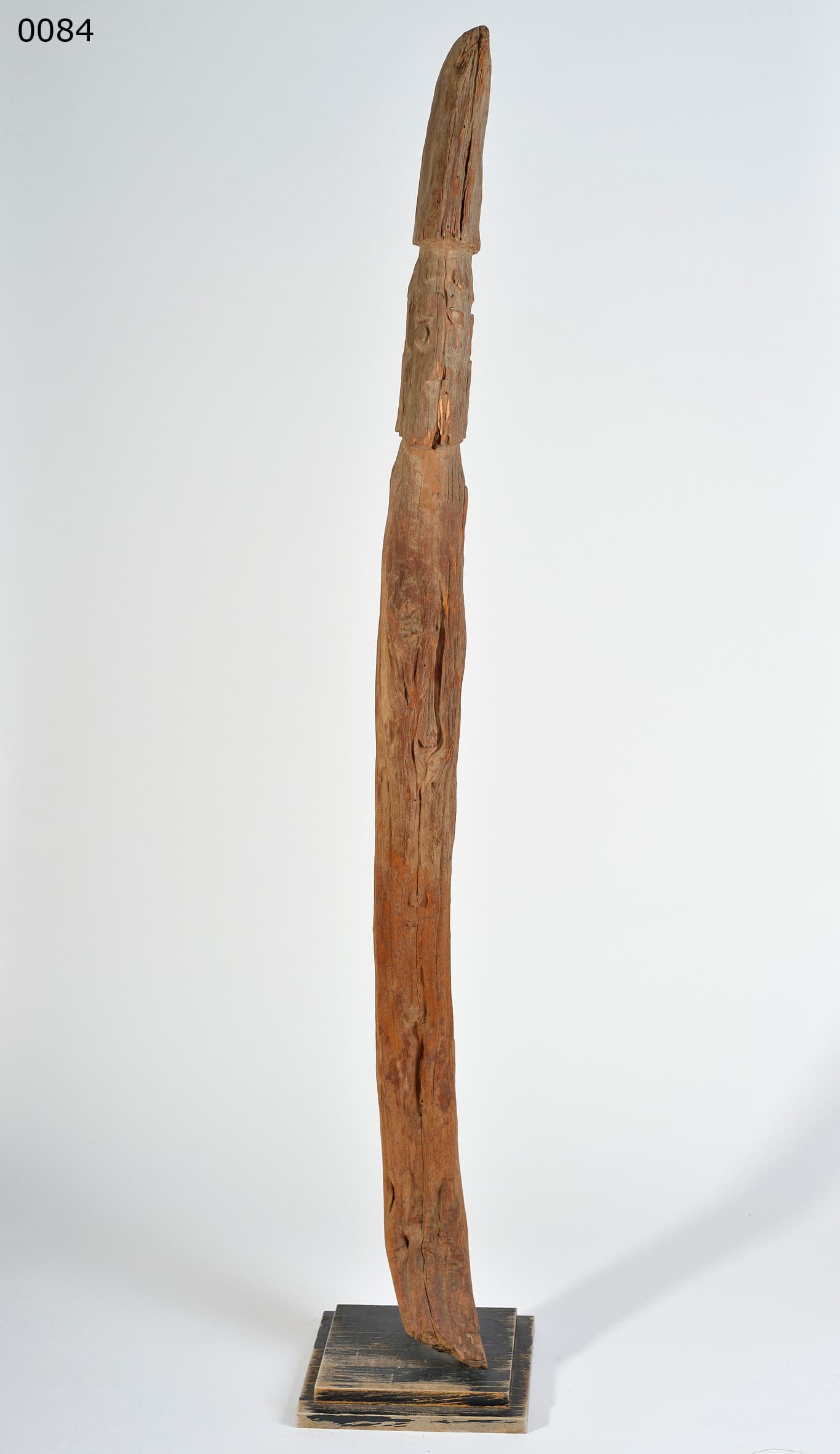
The canonical epicentre of Konso material culture is the waka sculpture (also waaga), a memorial anthropomorphic wooden figure with an average height of 70 to 150 centimetres. These monuments are primarily made from extremely resistant indigenous woods, such as juniper (Juniperus procera), which is considered sacred by the Konso, or the African olive (Olea africana). The canon of proportions of the sculptures is subject to strict stylistic conventions. Girma Moges (1993) documents that the ratio of head to body usually varies between 1:2 and 1:5, which represents a deliberate departure from the natural anatomical proportion (1:8) and places the head at the centre of the aesthetic as the seat of ritual identity.
The iconography is strictly codified and differs significantly between profane carvings and activated ritual objects. The central heroic figure is frontal, rigid and equipped with insignia of social rank. These include specific warrior bracelets and the kallacca - a prominent phallic forehead ornament that identifies the wearer as a ritually accomplished man. The eye areas are often accentuated by inlaid bone discs to materialise the watchful gaze of the ancestor. The ontological difference between wood and sacred waka is realised through a ritual patina: an application of animal blood, local earth and butter seals the figure at the moment of installation and charges it spiritually. Master craftsmen are rarely mentioned by name, but the sculptures are made by specialised craftsmen who are paid in kind (honey, cattle) for their work.
| Iconographic elements of the waka | Meaning in a ritual context |
|---|
| Proportion (1:2 to 1:5) | Focus on head as spiritual centre; deviation from naturalism |
| Callacca (forehead ornament) | Phallic symbol; identification of highest social and ritual rank |
| Red patina (blood/earth/butter) | Spiritual activation and materialisation of ancestral ties |
| Bone inlays (eyes) | Visibility in the spiritual sphere; eternal vigilance |
A significant iconographic controversy exists within ethnographic research. John Hinnant (1972) interprets the waka iconography as historical-realist; the sculptures are literary, biographical portraits of individual heroes and their real deeds. Elizabeth Watson (2009), on the other hand, contradicts this individualistic interpretation. She postulates a typified-archetypal level of meaning and locates the primary symbolism in more abstract concepts of a metaphorical "breastfeeding" (breastfeeding) of the landscape, whereby the figures function primarily as archetypal givers of life. This scientific tension can be exemplified in the collection of the Musée du quai Branly - Jacques Chirac (Paris), where the waka objects presented there, some of which are highly abstracted, underpin Watson's thesis of a supra-individual formal language. Forgery criteria relevant to the art market focus on the patina: modern copies often feature chemical stains instead of the organic blood and butter mixture, and the kallacca is often artificially exaggerated for the tourist market.
4. ritual practice
The ritual practice around the waka sculptures does not constitute a performative mask dance, but a static, landscape-bound altar and memorial utilisation. The figures are installed at exposed, communally used locations, primarily directly on the graves of the deceased, at strategic crossroads or at the central meeting places (mora) of the fortified settlements. The spatial structure follows a strict hierarchical pattern: the monumental figure of the deceased hero is always at the epicentre of the complex. It is symmetrically flanked by functional sub-sculptures representing the man's wives, the enemies killed by him in battle (often symbolised by castrated representations) or large animals killed (lions, leopards). In regional variants, especially in the Gato sub-style, the arrangement of the flanking figures sometimes varies in its geometric rigour and density.
The activation of the sculptural group is an elaborate, socially binding act. After completion by the craftsman, the formal installation takes place as part of a large-scale public ceremony attended by relatives, clan members and representatives of the Gada classes. Ritual offerings are made in the form of sheep, goats and honey. The ritual pouring of the traditional fermented drink cheka serves to anchor the ancestral presence in the wood and to seal the transition from profane material to sacred memorial.
The life cycle of a waka differs radically from Western concepts of preservation. There is no active conservation or ritual deactivation through removal; rather, the physical decay of the wood is programmatically integrated into the ritual logic. The figures remain unprotected in the open air. While the wood gradually degrades through intensive wind erosion (wind polishing), sunlight and termite infestation, the metaphysical integration of the dead into the invisible, omnipresent collective of ancestors takes place in parallel. Once the sculpture has completely decayed, the spirit is considered to be finally absorbed into the landscape and the clan. This planned, natural process of decay presents institutions such as the Royal Museum for Central Africa (RMCA) in Tervuren with considerable conservation and epistemological dilemmas, as the museum conservation behind glass artificially interrupts the indigenously intended, organic process of disposal and dissolution.
5. historical context
The historical localisation of the Konso and their material culture is characterised by complex migratory movements. The oral traditions and genealogical lines of the Konso indicate an immigration from the eastern region of "Liban". While Amborn (2009) archaeologically dates basaltic precursor sculptures with structural similarities to today's wooden waka as early as the 8th century and typologically parallels them with the expansive Indo-Ethiopian "Hero Cult" complex, Hallpike (1972) sees the unbroken continuity of the specific wooden sculpture tradition in its present form as archaeologically and iconographically confirmed only for the later pre-colonial period (from about the 16th/17th century).
The decisive political turning point in more recent history was the military conquest and incorporation of the area into the Ethiopian empire under Menelik II in 1897. While administrative integration led to taxation, religious art production initially remained largely autonomous, as there was no systematic forced Christian-Coptic conversion of the Konso and the colonial penetration was more of an economic nature. Their presence in the Western consciousness and the establishment of a global market history began in the late 19th century. Léon Darragon published the first reports on the sculptures in 1898, followed by pioneering photographic documentation by the British consul Arnold Hodson in the 1920s.
| Historical milestones | Event / Impact |
|---|
| 8th century | Dating of basaltic precursor sculptures (Amborn vs. Hallpike controversy) |
| 1897 | Conquest by Menelik II; beginning of administrative integration |
| 1898 | First western mention by Léon Darragon |
| 1920s | Photographic documentation by Consul Arnold Hodson |
| 2011 | UNESCO recognition of the Konso Cultural Landscape |
| 2011 | Exhibition Heroic Africans (Metropolitan Museum, New York) |
| 2024 | Intensification of the restitution debate under PM Abiy Ahmed |
With increasing demand from the Western art market in the late 20th century, fuelled by early collectors such as Carlo Monzino, the problem of forgery intensified considerably. Today, strict criteria are applied to verify authenticity in forensics: Genuine, ritually used waka exhibit deep, weather-induced heartwood cracks, authentic wind sanding and specific traces of termite feeding on the base sections anchored in the ground, which are checked for their natural origin using radiological methods (X-ray). In the case of market fakes, these deep traces of ageing are missing or are mechanically imitated.
Today, Konso art is also at the epicentre of a far-reaching political restitution debate. Since the 2010s, the Ethiopian government has been systematically calling for the return of stolen cultural artefacts; a dynamic that gained renewed vigour with the diplomatic advances of Prime Minister Abiy Ahmed in 2024. Exhibitions such as Heroic Africans at the Metropolitan Museum of Art (New York) reflect this museum paradigm shift by increasingly expanding the formerly purely formal-aesthetic view of African memorial sculptures to include critical discourses on colonial provenance, the history of looting and current demands for repatriation.