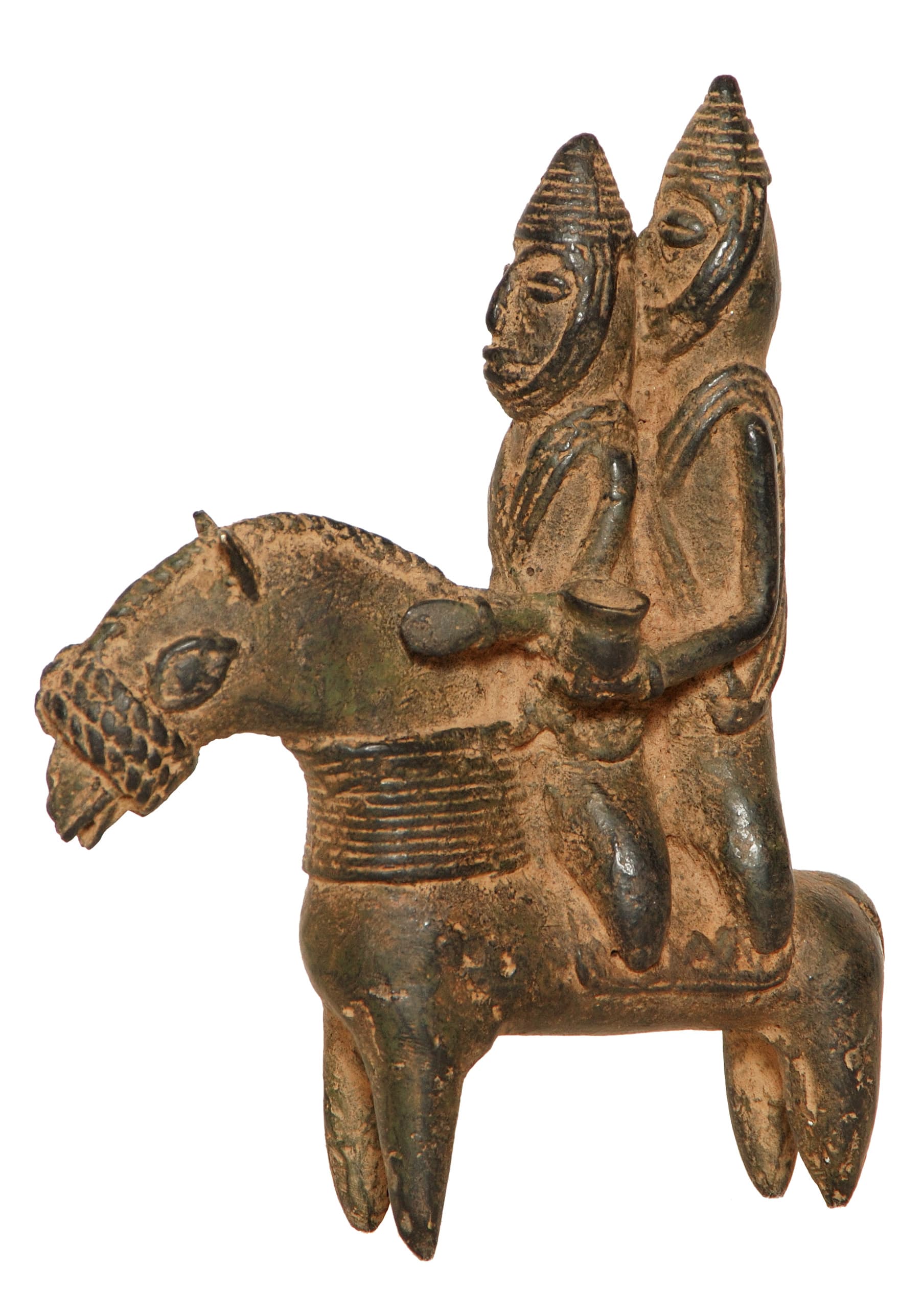
A monumental (150 cm) pair of cast brass male and female figures. They are notably slender and elongated, featuring highly abstracted, almost tubular limbs, and stark, angular facial features.
1. Aesthetic Style and Modernist Abstraction
These figures are attributed to the Shonkoro, a secluded, heavily animistic group residing in the forests north of Foumban on the border to the Tikar region. The aesthetic is highly distinctive. According to Hornek, while they utilized the lost-wax casting technology of their Tikar neighbors, the Shonkoro departed from the volumetric, muscular realism typical of Grassfields brass. Instead, they stretched and simplified the human form into extreme, elongated, almost tubular abstractions. Hornek notes their work "displays very idiosyncratic traits, some of which seem almost modern" — a striking quality that distinguishes them from the artistic canon of the surrounding Bamum and Tikar empires.
2. Ritual Function and the Power of Isolation
As Hornek documents, the Shonkoro people were dismissively referred to by the Bamum as "savages" and "primitive country bumpkins from the bush." However, this deep prejudice acted as a protective shield: it allowed the Shonkoro to live in total isolation, undisturbed by the political machinations of the Foumban Sultanate. These monumental brass figures presumably represent an ancestral couple, anchoring the deeply animistic, secretive rituals of the group. This independence from the homogenizing influence of the Bamum court may have allowed the Shonkoro to develop and utilize this highly idiosyncratic style. Very little is known about specific Shonkoro customs.
3. Patina, Material Weathering, and Surface Characteristics
The brass surfaces display a thick, unpolished, and highly complex patina. Unlike the shiny, frequently dusted prestige bronzes of the Bamum courts, these figures retain a dark, earthy oxidation with significant green verdigris, consistent with being housed in secluded, deeply forested environments. The casting imperfections and the rough, unfiled seams are consistent with an origin in an isolated, traditional foundry operating outside the commercialized royal workshops.
Summary
These rare Shonkoro brass figures are notable examples of elongated abstraction. They serve as compelling examples of how cultural isolation may have allowed a highly distinct artistic tradition to develop in the Cameroonian forests.
Written with AI assistance from the collection appraisal, object photography and our own research; editorially reviewed. Mistakes are possible — corrections are welcome. How we work →