The Bamun are a Cameroon Grasslands people of the Noun Plateau, known for a highly specialized artisan caste and a Foumban workshop tradition featuring calligraphy and drawing.
Overview
The historical kingdom of the Bamun (often referred to as Bamoun in French-language literature, Bamum in Anglophone texts) represents one of the most politically complex and artistically influential cultures of the so-called Cameroon Grasslands. Geographically, its core area extends across the extensive Noun Plateau in what is now the western region of the Republic of Cameroon. The strategic location of the empire is defined by natural borders: In the north and east, the territory is bounded by the Mbam and Mape river systems, while in the west and south-west, the Noun River forms a physical barrier to the neighbouring ethnic groups. This topography places the Bamun in an ecological transition zone between the dense equatorial forest areas in the south and the tropical savannah landscapes in the north, resulting in a climate with two irregular seasons (a long rainy season and a short dry season). Current demographic surveys and estimates put the Bamun population at around 420,000 to 600,000 individuals, with the urban centre and historic royal seat, the walled city of Foumban (historically also known as Mfomben), forming the cultural, administrative and ritual nucleus.
Linguistically, the Bamun are assigned to the Eastern Grassfields-Bantu language family (in particular the Nun subgroup). Their self-designation is Shü Pamom (language of the Bamun) or Shümom. This linguistic categorisation has a remarkable world-historical peculiarity: Under the aegis of Sultan Ibrahim Njoya (ca. 1860-1933), the language underwent an autochthonous scriptualisation from 1896. Between 1896 and 1910, Njoya developed a system in a series of six evolutionary fonts that differed from the pictographic first phase Lewa ("book", 1896-97, with 465 pictograms plus 10 numerals; Variant sources indicate up to 511 characters) via Mbima (1899-1900, 437 characters, left-to-right writing direction), Nyi Nyi Nfa' (~1902, 381 characters) and two further reduction stages (295, 205 characters) to the final syllabary A-ka-u-ku (1910, stable 80 characters, semi-syllabary/alphasyllabary). This written language not only served the administrative consolidation of the empire, but also manifested itself strongly in the visual arts, as calligraphy and drawing became integral components of the Foumban workshop tradition.
The social structure of the Bamun differs drastically from the political organisation of many neighbouring groups. While large parts of the neighbouring Bamileke subgroups or the Nso are characterised by decentralised, partly semi-cephalous chiefdoms (chieftaincies), the Bamun established a highly centralised, strongly stratified kingship. At the top of this hierarchy is the Mfon (king or sultan). Society is divided vertically into different castes and ranks: The royal lineage (Tikar descent), the nobility and holders of princely titles (Nji), elite warrior unions and a highly specialised artisan caste. The ability of this system to integrate is remarkable: even individuals from subjugated foreign groups were able to rise to the centre of palace society through exceptional craftsmanship and attain the Nji title by royal decree. The subsistence economy was primarily based on agriculture. The socio-economic foundation was formed by cooperative labour groups that operated on an eight-day weekly cycle. Historically, slaves and prisoners of war were also used on the extensive plantations of palace officials and dignitaries, which ensured the economic hegemony of the court.
With regard to ethnological and art-historical classification, there is a prominent and ongoing controversy in research that needs to be explicitly highlighted. The source situation is discursively contested when it comes to the exact stylistic and political categorisation of the Bamun. In her inventory catalogues, Tamara Northern (1975) often subsumes the Bamun under the generalising term "Bamileke-Grasland complex", as she refers to the fluid iconographic boundaries, the lively intercultural exchange of Kauri snails and glass beads as well as morphological affinities in mask art. Christraud Geary (1983) and Hans-Joachim Koloss, on the other hand, argue vehemently for a strict separation: the Bamun had assumed a special hegemonic position through their centralised court history in Foumban, the Islamic penetration after 1900 and the dirigiste state art production, which made it analytically inadmissible to equate them with the decentralised Bamileke. Such classification issues materialise to this day in the collection narratives of leading institutions. Early documentation in the Musée du quai Branly - Jacques Chirac (such as the files of the collector Pierre Harter) often assign objects to hybrid registers, while more recent provenance research emphasises the political autonomy of Foumban.
| Feature | Detailed information on the Bamun classification |
|---|
| Geographical core | Noun Plateau, bordered by Mbam and Noun (Cameroon) |
| Demography | approx. 420,000 - 600,000 individuals, centre Foumban |
| Linguistics | Shü Pamom / Shümom (Eastern Grassfields Bantu) |
| Writing system | A-ka-u-ku Syllabary (developed by King Njoya) |
| Research controversy | Part of the Bamileke complex (Northern) vs. independent sultanate (Geary) |
Cultural context
The religious and cosmological system of the Bamun underwent tectonic transformations in the course of the 20th century, but its underlying ontological structure retains deep pre-colonial paradigms. Although large parts of the population gradually converted to Islam under Sultan Njoya, so that today an estimated 90 per cent of the population belong to the Muslim faith (the central mosque in Foumban dominates the cityscape), the traditional foundation is still based on a complex ancestor cult and the worship of animistic forces of nature. Before the syncretic change, the fluid creator deity Nyinyi was at the centre of the pantheistic understanding, whose power was channelled exclusively through the uninterrupted royal line of ancestors. Structurally, this system differs from the neighbouring Tikar or Bafia in the absolute monopolisation of ritual authority in the Foumban palace. The Mfon acts not merely as a political sovereign, but as a divine king, a sacred mediator between the world of the living and the realm of the dead. His physical and spiritual vitality is metonymically equated with the fertility of the entire Noun Plateau.
The cosmological order of the Bamun is defined by a strict animal hierarchy in which certain species function as "royal referents". The king is conceptually intertwined with the leopard and the elephant. These entities not only represent physical strength and judgement, but act as threshold beings mediating between the civilised, human-populated space and the dangerous wilderness (bush). It is ritually believed that the Mfon has the ability to transform into an elephant, while the leopard is considered a being that can take on human form.
Ritual authorities manifest themselves primarily in the form of exclusive, strictly hierarchical secret societies. While divinators and local priests operate at village level, societies such as Mutngu, Giri and Kuosi dominate at state level. A fundamental institution of ritual and political control is the Nguon ritual. Contrary to the Western idea of an absolutist despotism, the Nguon festival, which is held every two years at the beginning of December, is characterised by a complex system of ritual checks and balances. Over the course of three days, initiation and transitional aspects of governance culminate here: ritual leaders first consult the population in secret about the state of the empire. On a fixed Friday, they enter the palace at night, whereupon the monarch must face a public tribunal on Saturday. Charges are read out based on the evidence provided by the ritual authorities. The Mfon can be fined for misbehaviour or - in extremis - deposed. If he receives a new mandate, a ritual oath of allegiance follows, which renews social cohesion. This combination of spiritual cleansing and secular criticism of power is unique in the region in this formalised form.
The role of women in the cult is highly sacrosanct outside of the highly segregated male alliances through the institution of the Queen Mother (Na or Shah-Pou). She oversees agricultural rites, guarantees dynastic continuity and is often the only female figure to be given iconographic presence in canonical palace art through fully sculpted, beaded throne figures. In the context of death and burial (as analysed comparatively in the neighbouring Mbum), the transition to ancestral status is strictly regulated. Ritual libations - the pouring of liquids onto altars or graves - function as the primary vehicle of cultural memory and bind the living to the ancestors, a custom that persists despite Christian and Islamic missionisation.
Research has identified glaring controversies in the interpretation of cosmological iconography. A central and ubiquitous motif in Bamun art is the double-headed snake. Tamara Northern interprets snake motifs in the grasslands primarily as transcendent, cosmological symbols for the duality of life and death as well as the omniscience of the ancestors. However, Christraud Geary and local court historians such as Njiassadans date the genesis of this specific motif (Sânumpût) precisely to the reign of King Mbuembue in the late 18th century. According to this interpretation, the two-headed snake is not a religious symbol, but a secular, military-historical emblem that encodes the simultaneous victory over two enemy factions in a war on two fronts and has since served as the emblem of Foumban's invulnerability. Such discursive tensions are reflected in the exhibition narratives of today's institutions such as the Museum am Rothenbaum (MARKK) or the Linden-Museum Stuttgart, which have to weigh up indigenous court chronicles and Western iconography when reappraising historical provenances.
Aesthetic features
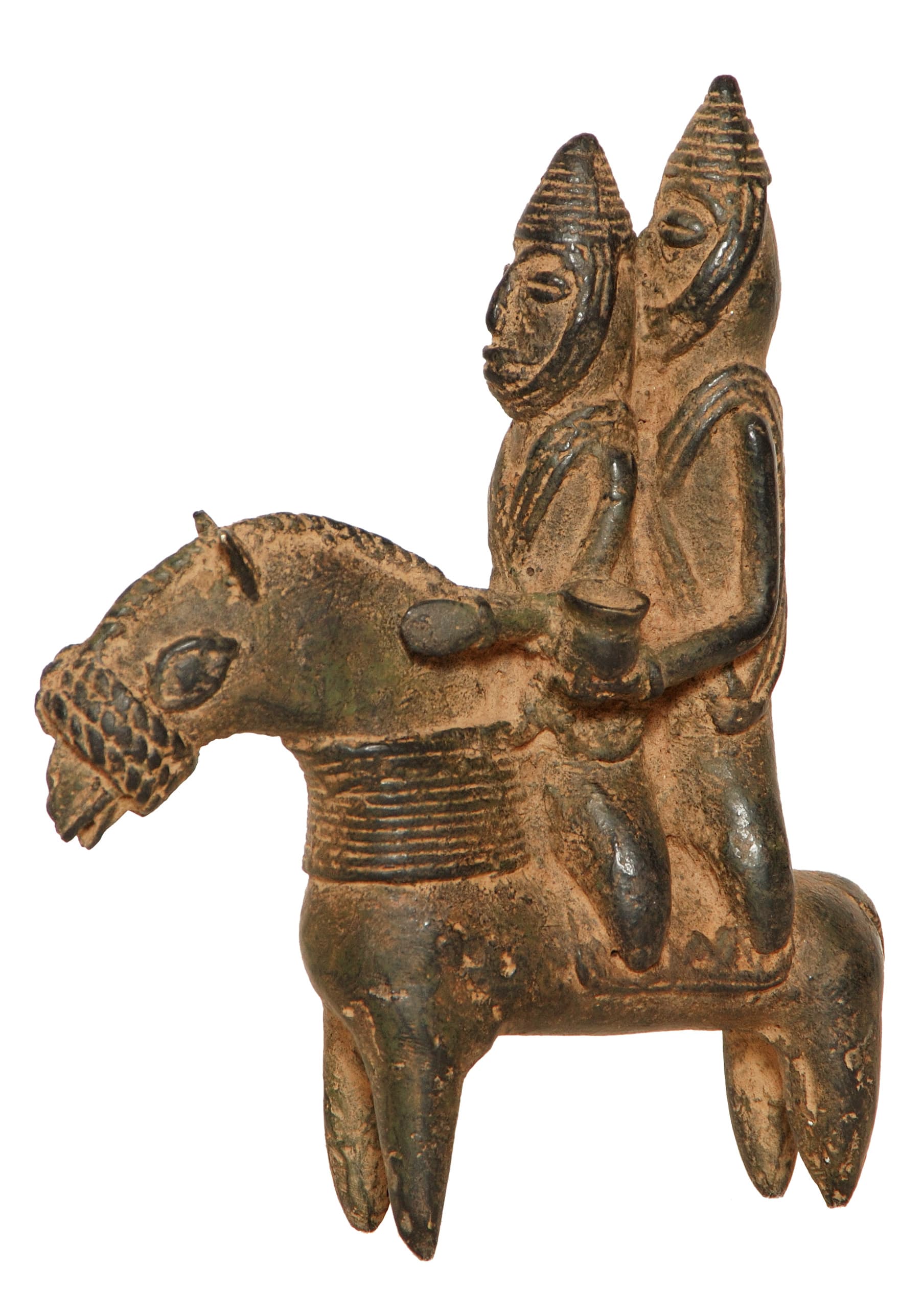
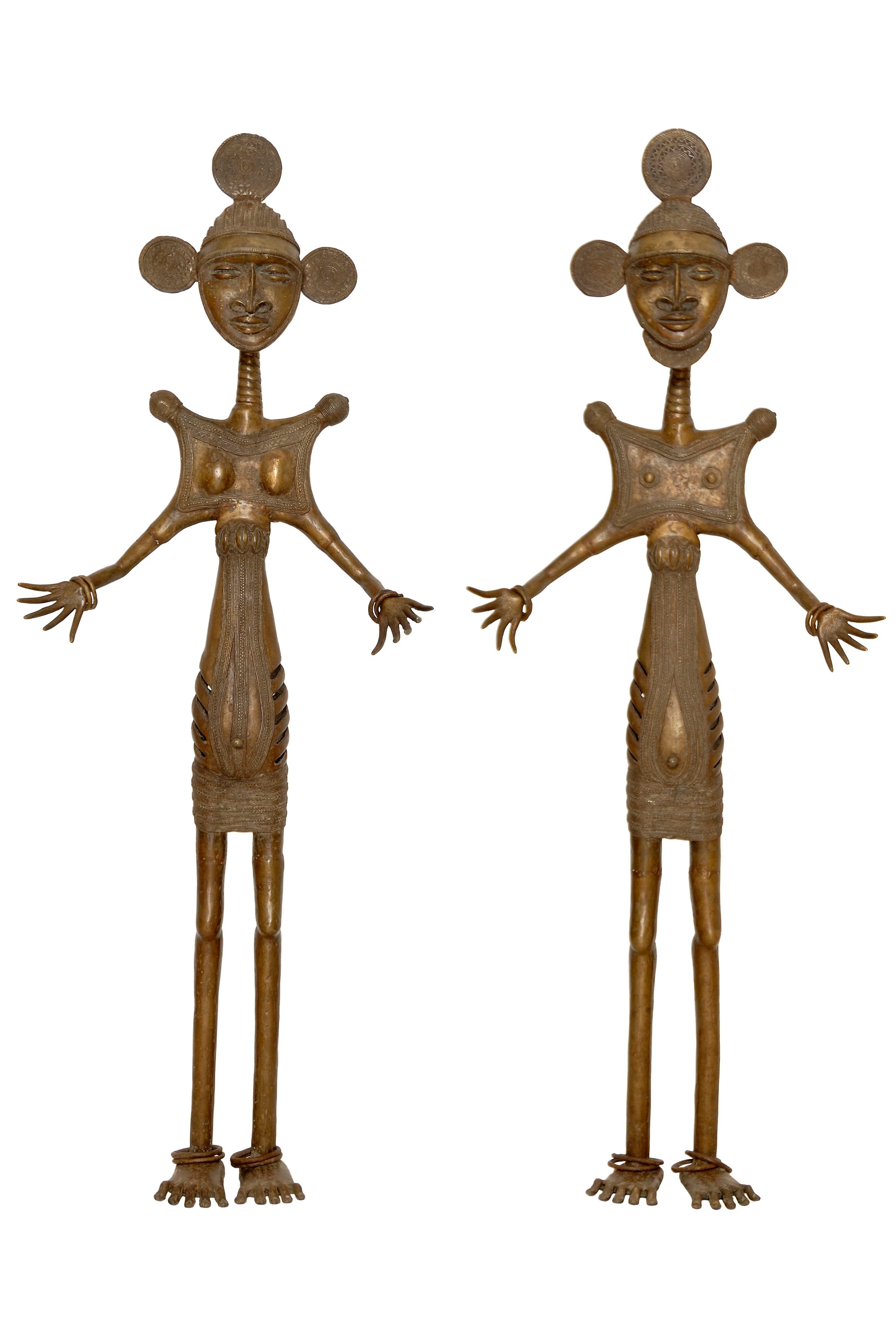
The canonical object collection of the Bamun is one of the most complex and visually opulent traditions on the African continent. As art production was under royal patronage, it primarily served to glorify monarchical power. The typology is dominated by architectural carvings (monumental door frames and palace pillars), representative ceremonial objects and textile masterpieces. Among the most iconic objects are the large-format thrones with anthropomorphic and zoomorphic caryatids (canonically the Mandu Yenu throne with double-headed serpent and earth spider), beaded royal statues (especially the statue of the king's mother Shah-Pou / Ngwuo), Bamun-specific wooden helmet masks (Tu Nkum Mpelet, Tu-Ngünga, Ngoin) as well as the elaborate helmet crowns of the Nja masquerade (Geary research focus), drinking horns and ceremonial tobacco pipes with elaborate terracotta or bronze heads. Important distinction: the famous elephant mask (tu pa nya) of the Kuosi society, which often circulates in Western collections as a pars-pro-toto for "Cameroon Grassfields art" (cf. Brooklyn Museum, Smarthistory, MET-Khan-Academy-Curriculum), is, according to current research, strictly attributable to the Bamileke tradition, not to the Bamun - even if neighbouring Bamileke chiefdoms and the Bamun court in the Grassfields complex interacted stylistically and politically. Dossiers that blur this classification perpetuate the older collection subsumption under "Bamileke/Bamun complex" (Northern 1975), against which Geary explicitly argued in 1983.
The choice of materials and the canon of proportions are subject to strict court etiquette. Wood (often African mahogany or cedar wood), brass, iron, imported European glass beads (from Venice or Bohemia) and Kauri snails from the Indian Ocean function as primary media. The canon of proportions follows indigenous priorities: The head, as the metaphysical seat of vitality and intellect, often takes up a disproportionate amount of space in sculptures. The male pipe heads are dominated by strongly inflated cheeks that articulate virile strength, endurance and a dominant nature. Scar tattoos (scarifications) on the cheeks and chin are meticulously worked out and serve as status indicators.
The iconographic semantics are highly specific and strongly hierarchised. Animals are never mere decoration, but bearers of ritual and political meaning:
- The spider (ground cloak): Symbolises divinatory wisdom, industriousness and omnipresence. As it moves between the surface of the earth (world of humans) and the underground (world of ancestors), it is the perfect mediator.
- The double bell: A symbol of patriotism, unity and military mobilisation.
- Leopard and Elephant: The ultimate royal referents. Only the monarch and secret societies authorised by him were allowed to depict these animals or wear their skins.
- Double-headed snake: The military emblem of victory on two fronts.
Documented master hands set Bamun art apart from anonymous African traditions. The workshops in Foumban (especially the famous Rue des Artisans) produced artists known by name. The most prominent was Ibrahim Njoya (a cousin of King Njoya, ca. 1890-1962), a master draughtsman and carver whose epigonal style dictated the Foumban canon of the early 20th century and created a new visual vocabulary at the intersection of tradition and colonial modernity. This workshop tradition ensured that craftsmanship knowledge was passed on in an extremely concentrated manner, with woodcarvers and blacksmiths often working in closely interlinked guilds.
The ontological difference between a profane object and an activated ritual object in grassland art is fluid and highly dependent on the performative context. As Eelco Bruinsma illustrates, following Geary's research on the Foumban workshops, authenticity is not necessarily defined by age, but by the physical interaction of the monarch. Throne diplomacy provides a striking example: Sultan Njoya had a replica of his famous mandu-yenu throne made for Kaiser Wilhelm II in 1908. However, as this was not completed in time for the diplomatic handover, he quickly gave away the original (which is now in the Ethnological Museum in Berlin) and kept the newly carved copy in Foumban. From a Western museum perspective, the Berlin throne was considered "authentic" because it was older. From the indigenous Bamun perspective, the new replica became an authentic, ritually charged symbol of power at precisely the moment when King Njoya sat on it and ritually "switched on" the object, while the throne that had been shipped to Europe was stripped of its spiritual charge ("switched off").
Forgery criteria are of immense relevance on the international art market, as the workshops in Foumban continue to produce masterful replicas for the export and tourist market to this day. Forensic indicators of artificial ageing can be seen in the development of patina. An authentic sacrificial patina forms over decades through repeated applications of palm oil, tukula paste (made from redwood) and libation-induced grease, creating a deep, layered crust. Modern forgeries, on the other hand, often have a homogeneous, purely superficial soot patina that was artificially created over a fire of green wood and has a strong olfactory odour of fresh chimney smoke. The lack of historical traces of repair on elaborate beadwork or the absence of heartwood cracks can also be a warning sign for collectors.
Ritual practice
The ritual practice of the Bamun and the ceremonial use of the artworks created are characterised by a high degree of performance and choreographed publicity. Sculptures and masks are not isolated aesthetic phenomena, but integral, active agents of state-supporting diplomacy and ancestor worship. An outstanding example of the fusion of iconography, iconology and performance is the Nja festival, which is documented in Christraud Geary's research (Smithsonian / Smarthistory curriculum "Pageantry in the Palace") as a central Bamun-specific masquerade event. Here the Bamun helmet masks (Tu Nkum Mpelet as "Royal Prestige Dance Helmet", Tu-Ngünga, Ngoin) appear in elaborate court dances, worn by high-ranking dignitaries and members of courtly secret societies such as Mutngu, Giri and Kuosi - the latter acting as an aristocratic male society in the Bamun context (in the stylistically related Bamileke context, a society of the same name performs the iconographically different tu pa nya elephant masquerade).
The construction of the Bamun court masquerade requires a full, extremely expensive costume that visually displays the wearer's social status. Characteristic are helmet masks carved from hardwood (often polychromed with red cheeks, a black beard made from sewn-in cowries or dyed plant fibres), which are applied with copper sheet overlays, imported European glass beads and cowries from the Indian Ocean. The highest-ranking representational masks are dominated by symbolically dense reliefs on the cheeks - spider, double-headed snake, leopard spot pattern - which function as a visual declaration of loyalty to the Mfon. This headpiece is combined with indigo fabrics (Ndop), a massive red feathered hat and leopard skins draped over the back.
| Colour of the glass beads | Ritual-cosmological symbolism among the Bamun/Bamileke |
|---|
| The colour black is associated with the night, the liminal sphere and the dead. | |
| White | Represents ancestors, bones and ritual purity. |
| Red | Symbolises the Fon (king), life energy, blood, women and renewal. |
The activation of these objects takes place in the context of highly dynamic dances on the palace forecourts, accompanied by the complex rhythms of courtly double drums and iron gongs. Through the rhythm, the sweat of the wearer and the swirling dust of the earth, the mask merges with the environment and channels the power of the monarch. Static objects such as altars or ancestor figures are activated through direct offerings. The process begins with a blank carved from "green", i.e. fresh wood. To transform this into a powerful object, it is sprinkled with palm wine and ritually rubbed with red camwood powder (Pterocarpus soyauxii) and sometimes animal blood to transfer the vitality of the ancestors into the wood. The application of beads (which historically represented a direct currency) was another act of "activation" through the pure display of wealth.
The lifecycle of a cult object varies greatly. The deactivation and disposal of profaned or irreparably damaged ritual objects is a deeply pragmatic process. The sources are sometimes ambiguous as to the extent to which wooden masks were systematically ritually burnt or left to decay naturally in the forest before 1900. However, there is evidence that the valuable materials were not destroyed when textile masks were discarded. The European glass beads and Kauri snails were rigorously separated and recycled for new masks, whereby the carrier material completely lost its sacred and economic charge. High-ranking objects, such as the thrones of deceased kings, were never destroyed. They were transferred to the Royal Treasury at Foumban, where they remained as inactive but venerable relics of the dynasty. This safekeeping practice accounts for the outstanding state of preservation of many Bamun artefacts, which can be found today in institutions such as the Brooklyn Museum or the Virginia Museum of Fine Arts. Regional variations and contemporary developments show the fluidity of this system: the Cameroonian artist Hervé Youmbi, for example, today integrates modern silicone masks into the dances of local secret societies, proving that ritual performance defies rigid categorisation into "traditional" versus "modern".
Historical context
The historical trajectory of the Bamun and their art production is inextricably interwoven with a profound history of migration and the later upheavals of the European colonial encounter. Most oral histories and early court chronicles date the ethnogenesis of the Bamun to the late 14th century (ca. 1394). At this time, Nchare Yen, a prince of the Tikar dynasty, led a splinter group into today's Noun Plateau, where he militarily subjugated and assimilated local groups (the Mbum) and founded Foumban as the capital. Dating controversies exist in research with regard to the exact chronology of the subsequent dynasties, due to the lack of pre-colonial written records. However, it is undisputed that the political consolidation and maximum territorial expansion of the empire took place under King Mbuembue in the late 18th century, who successfully fended off invasions by the Fulani cavalry and Chamba warriors - a victory that led to the institutionalisation of the double-headed serpent motif.
The most radical paradigm shift occurred at the turn of the 20th century through the German colonial encounter. Unlike many African empires, which resisted European expansion militarily and were subjugated by force, the young, diplomatically highly accomplished Sultan Ibrahim Njoya chose a strategy of active co-operation around 1902. In the face of German superiority (represented by Governor Jesko von Puttkamer and agents such as Eugen Zintgraff and Gustav Conrau), Njoya deliberately used art as an instrument of diplomacy and to maintain power. He instrumentalised the German interest in the "exotic" and centralised hundreds of craftsmen in the palace workshops of Foumban. There he had thrones, pipes and textile handicrafts made explicitly as diplomatic gifts for German military officers, missionaries and museums.
One of the most prominent debates in African art history manifests itself here. In her work, Christraud Geary (1983) deconstructs the "German myth" of the unspoilt, paradisiacal Bamun empire. She postulates that Njoya actively served the Western art market and massively modernised the workshop tradition between 1900 and 1933. The result was a kind of courtly sanctioned "tourist art" in which pre-colonial traditions were mixed with hybrid, Western-inspired elements. Tamara Northern, on the other hand, argues that despite the intended commercialisation, the basic semantic and stylistic integrity of grassland art (especially in beadwork) was fully preserved. So what is "authentic"? An object from the 19th century that underwent bloody rites, or a throne masterfully carved in 1910 under Njoya's directive for a German collector? This fluidity of authenticity is forcing collectors and museums to recalibrate their standards of judgement.
The history of the market in the West took off rapidly in the 1920s. Pioneers such as the Swiss collector Eduard von der Heydt (whose foundations now form the core of the Museum Rietberg in Zurich) acquired African sculptures en masse, often through influential Parisian dealers such as Charles Ratton. The extreme demand for "authentic" Bamun art fuelled the price level, culminating in spectacular auctions by dealers such as Jacques Kerchache at houses such as Christie's and Sotheby's in later decades. The forgery problem grew in proportion to the demand.
Today, forensics is increasingly being used to authenticate market acquisitions, but it has glaring weaknesses in the African context. Radiocarbon analyses (C14 dating) are often deceptive due to the so-called "old wood effect": as wood carvers in the Cameroon grasslands often used the hard, innermost core of huge jungle trees for prestigious masks, the wood often dates centuries before the actual act of carving. In addition, modern counterfeiting networks in Cameroon have perfected their techniques. They simulate termite damage, provoke artificial heartwood cracks in drying chambers and bury objects in order to inject minerals into the wood structure. Against the backdrop of the current restitution debates initiated by President Emmanuel Macron in 2017, German institutions (including the Linden-Museum Stuttgart, the Ethnological Museum Berlin and the MARKK in Hamburg) are devoting themselves intensively to provenance research in a project funded by the German Centre for Lost Cultural Assets. They are examining hundreds of royal Bamun objects in order to separate looted colonial art from regular market trade and to institutionalise dialogue with the descendants in Foumban.