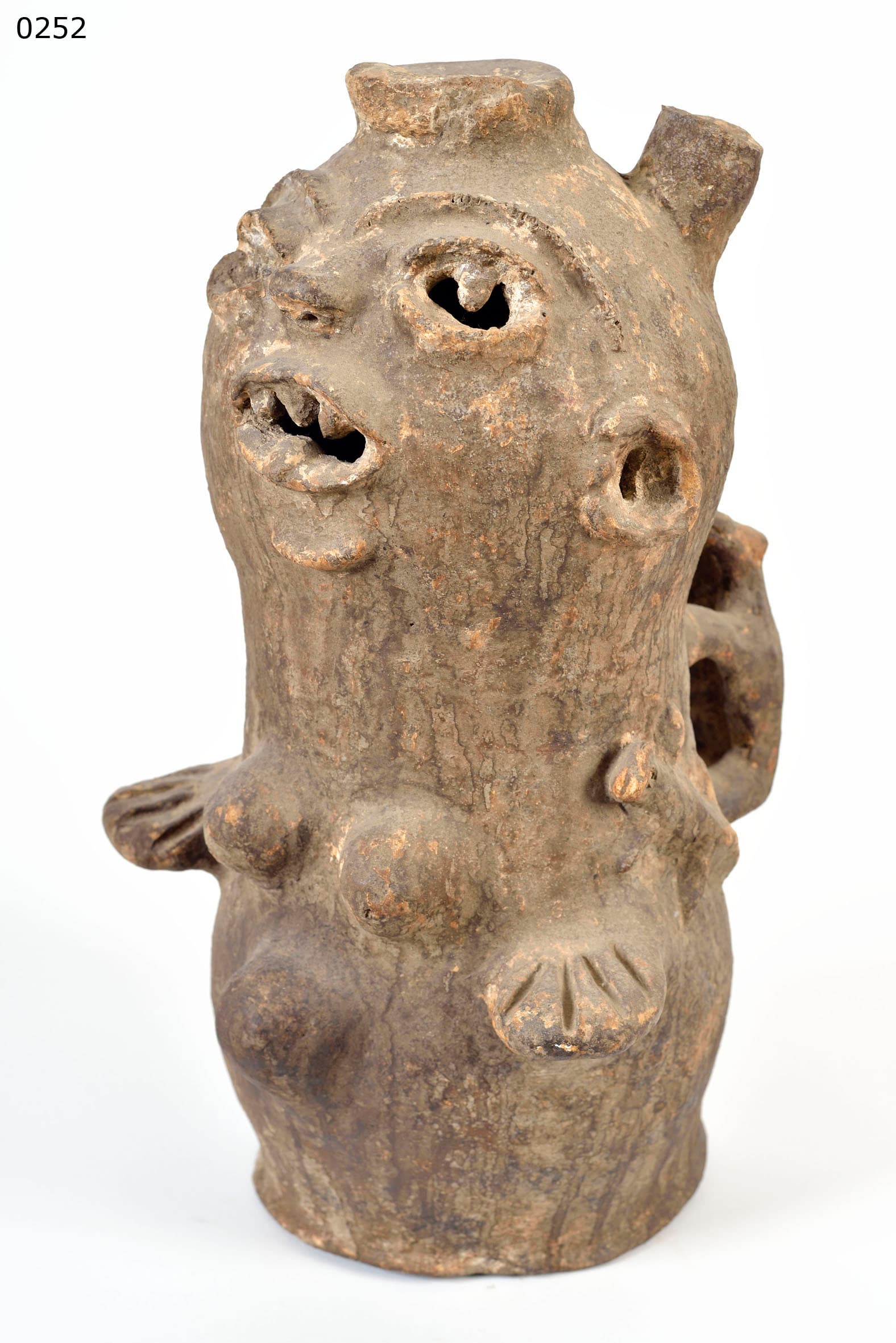
This provocative, crudely carved wooden figure squats heavily, featuring an enormously exaggerated phallus and a prominent iron implement driven directly into the top of its head. It is tightly bound with native cordage, suspending a small gourd from its back, and possesses a thick, encrusted, grey-brown patina.
1. Aesthetic style — phallic hyperbole and the anti-aesthetic
This object is a classic Bocio (empowered body) from the Fon or Ewe cultures of the Republic of Benin, representing the raw, utilitarian aesthetics of traditional Vodun (Voodoo). The carving is deliberately crude, prioritizing psychological shock over refined beauty. The massively exaggerated phallus is a common motif in Bocio figures, functioning not merely as a fertility symbol, but as a representation of unbridled, aggressive, and penetrating spiritual energy. It is a visual hyperbole designed to project the immense, unstoppable power of the deity or spirit contained within the wood.
2. Ritual function — the Vodun deity legba and surrogate defense
In the complex pantheon of Vodun, figures with prominent phalluses are often associated with Legba, the divine trickster and the god of the crossroads, who mediates between humans and the spirit world. This Bocio served as an active, magical decoy. Placed at the entrance of a compound, it absorbs curses and malevolent spells intended for its owner. The iron spike driven into the skull is the mechanism of activation; it "pins" the volatile spirit into the statue. The attached gourd likely contains ase (magical medicines), further empowering the object to protect the household.
3. Physical patina — organic binding and earth taphonomy
The authenticity of this Bocio is guaranteed by its messy, accumulative taphonomy. The object is covered in a dense, friable crust of dried earth, palm oil, and sacrificial blood, demonstrating its history of being "fed" by a Vodun priest. The native cordage binding the figure is incredibly stiff, brittle, and stained with decades of use. The iron spike is heavily oxidized, displaying flaky, deep red rust. The base and lower legs show significant erosion from being repeatedly planted in the wet soil of the Benin coast, confirming its original shrine context.
Summary
A raw and visually shocking artifact of traditional West African Vodun, this Fon Bocio utilizes exaggerated phallic geometry and iron activation to project terrifying spiritual defense. Its thick sacrificial encrustation and profound earth taphonomy make it an extraordinary, authentic power object.
Written with AI assistance from the collection appraisal, object photography and our own research; editorially reviewed. Mistakes are possible — corrections are welcome. How we work →