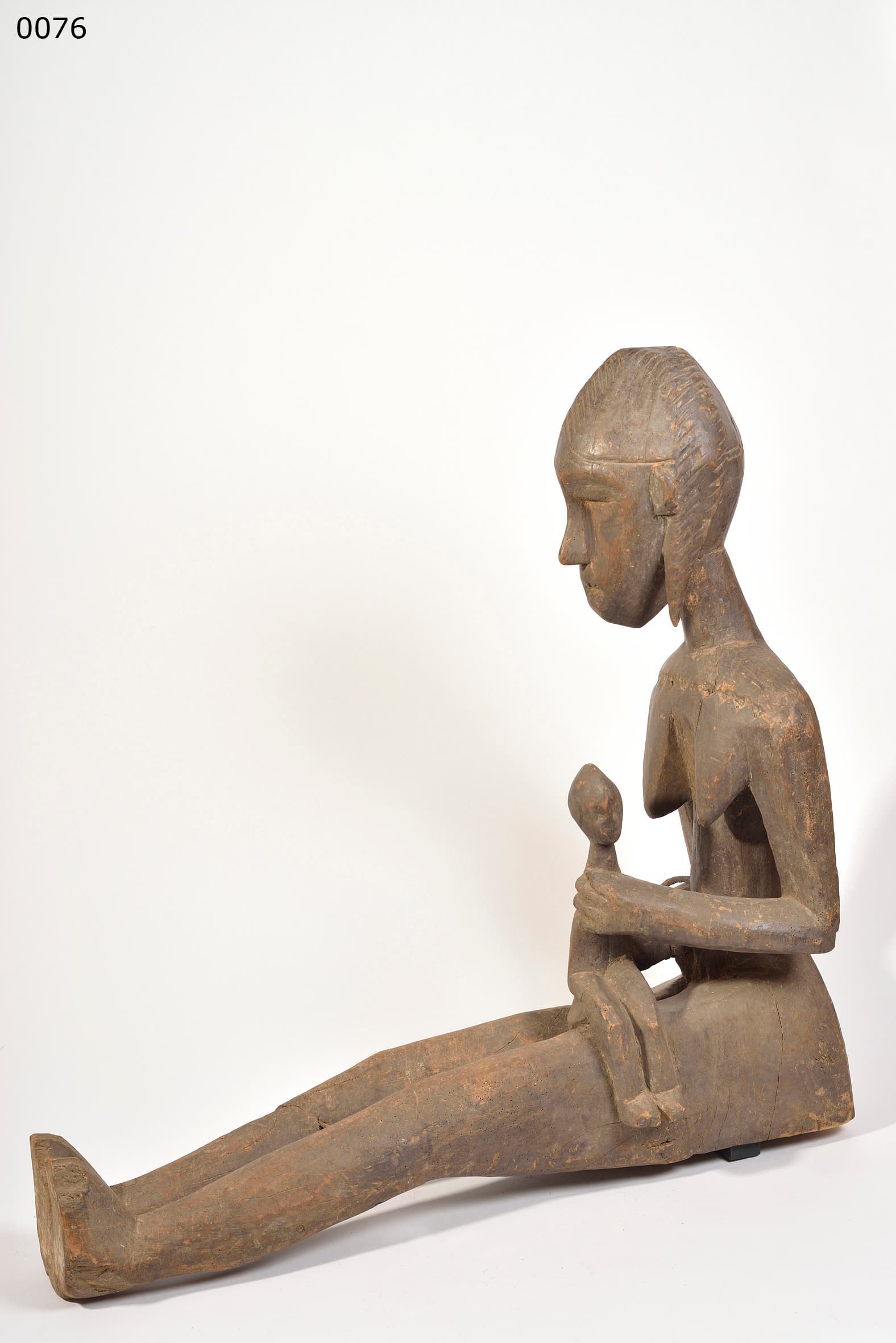
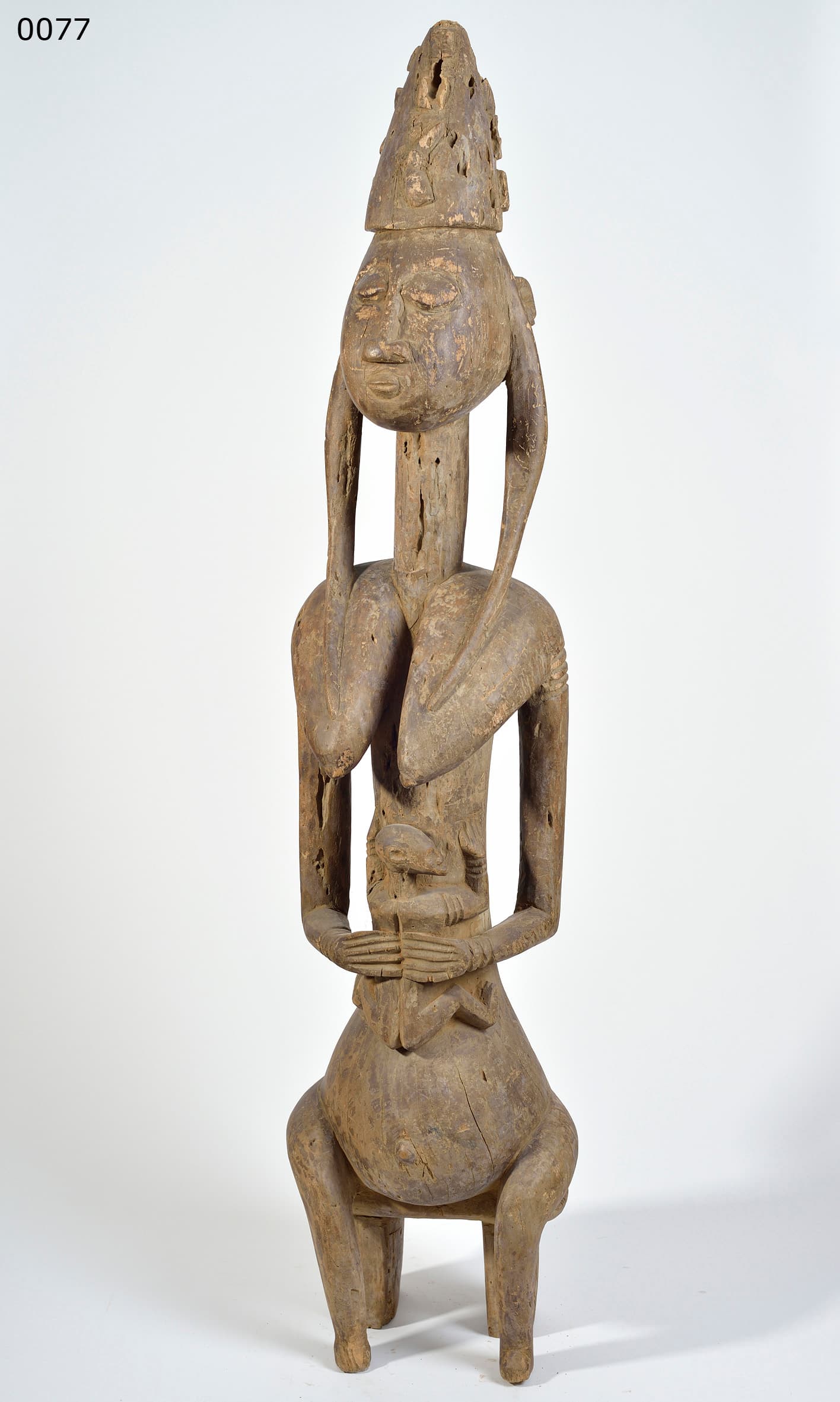
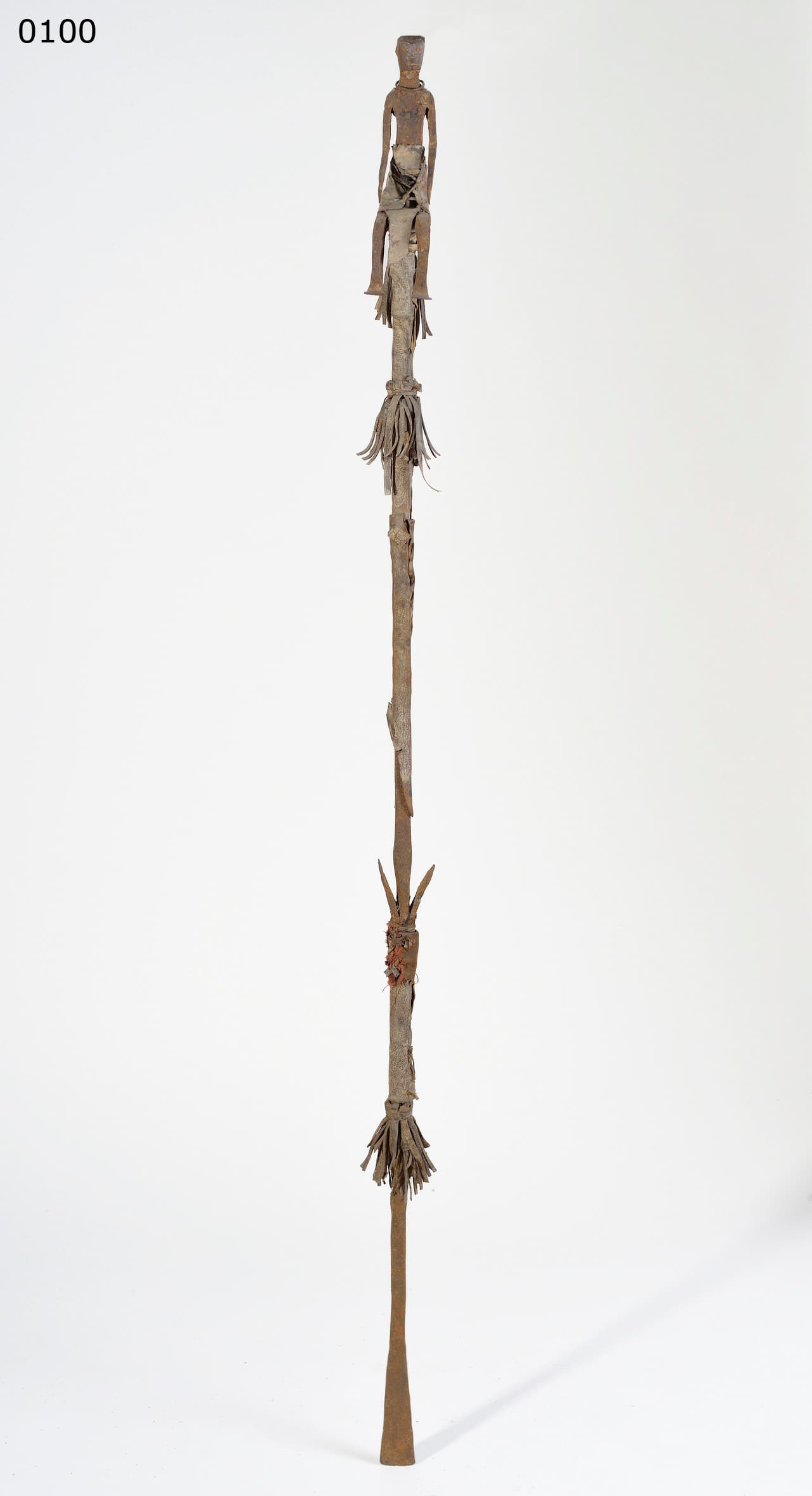
A seated wooden female figure (attributed to the 19th to early 20th century, 91 cm) from the Bamana of Mali, attributable to the Jo or Gwan initiation societies — adorned with braided fiber tresses and metal rings in its prominent sagittal crest coiffure, deep diamond-shaped geometric bodily scarifications, hands meeting at the lower abdomen, and a dry aged surface retaining organic attachments.
1. Abstract expressionism of the Bamana
The figure exhibits the geometric reduction characteristic of southern Bamana sub-styles and is consistent with the classical canon of Gwandusu ancestor figures, traditionally venerated as embodiments of female power and maternal authority (cf. Kate Ezra).
- Intersecting Cylinders: The carver breaks the human form down into cylinders and sharp angles, especially in the face and the elongated torso with its conical breasts.
- Presence Over Realism: The approach prioritizes spiritual presence over anatomical realism. The fine scarifications are traditionally associated with the high ritual status of the entity.
2. Nyama and organic attachments
The braided fiber and the tight wrapping of the arms and legs with cloth are traditionally associated with spiritual efficacy.
- Loaded with Vital Force: In Bamana belief, such textile applications are understood to be functional rather than decorative — priests are said to use them to bind the object's nyama (vital energy), to ritually "clothe" it, or to stabilize structural weaknesses after long use, thereby charging the wooden armature.
- Active Interface: With the attachments in place, the figure is believed to interact with the spirit realm to protect the community rather than merely representing an ancestor.
3. Untouched shrine surface
The desiccated unpolished surface with its thick patina suggests long stationary residence and repeated ritual washings.
- Dry Crusty Remnants: Deep carvings and the wrappings retain crusty residues consistent with libations (such as shea butter or millet porridge), as detailed by Sarah C. Brett-Smith in her studies on the care of Bamana sculptures.
- Fragile Organics Preserved: The oxidized fiber attachments and pronounced sacrificial patina support an attribution to 19th to early 20th-century Malian ritual practice, showing no apparent signs of modern commercial polishing.
Summary
Combining geometric abstraction and organic materials, this Bamana shrine figure is associated with the ritual practices of the Jo or Gwan societies. Its dry unpolished surface, deep patina, and fiber elements are consistent with a 19th to early 20th-century origin.
Written with AI assistance from the collection appraisal, object photography and our own research; editorially reviewed. Mistakes are possible — corrections are welcome. How we work →