The Bamana are a Malian people of the Niger Arc, known for chiwara antelope crests, encrusted boli altars and the masks of the komo and ntomo societies.
Overview
The ethnographic, demographic and art-historical study of the Bamana requires an extremely differentiated and methodologically stringent examination of their geographical, linguistic and social realities. The Bamana, usually referred to as "Bambara" in older colonial literature and the early inventory catalogues of European museums, represent the dominant ethnolinguistic group in today's Republic of Mali. They also have significant diaspora communities and historical settlement areas in the neighbouring states of Senegal, Burkina Faso, Guinea and Côte d'Ivoire. Current demographic estimates and census data put the total number of native speakers (L1) at around 4.2 to 4.4 million individuals. As the Republic of Mali had a total population of around 24.4 million people in 2024 (World Bank 2024: URL), the Bamana make up an estimated 33 to 38 per cent of the national population. However, the fact that their language is used as a supra-regional lingua franca by up to 15 million people throughout West Africa is far more significant for the cultural and economic weight of the ethnic group (Gordon 2005: 1611). Linguistic categorisation places Bamanankan within the Mande language family, which in turn belongs to the gigantic Niger-Congo macrofamily (Bird & Kendall 1980: 13).
The nomenclature and classification of this ethnic group is subject to an ongoing and sometimes polemical debate in research. The foreign term "Bambara" was largely coined by early Arab traders, who used it to refer to the non-Islamised peoples of the Niger Arc, and was later cemented as an ethnographic container term by the French colonial administration in the Soudan Français (Monteil 1924: 101). In recent ethnographic and art historical scholarship, however, this term is increasingly deconstructed and rejected. The preferred self-designation is "Bamana" (plural: Bamananw), which etymologically is usually translated as "the rejection of a master" or "those who refuse to submit". This autonymy refers to the historical refusal of Islamisation and the successful military resistance against the expanding Malinke empire in the 13th century (Dieterlen 1951: 12). Nevertheless, contemporary researchers such as Jean-Paul Colleyn highlight a fundamental controversy in the classification: Colleyn argues that the Bamana are less a hermetically sealed ethnic or genetic unit, but rather a fluid, linguistic-cultural network that has been constituted through centuries of assimilation and interaction with neighbouring peoples such as the Fulani, Bozo, Dogon and Senufo (Colleyn 2001: 15). The source situation is ambiguous with regard to the historical homogeneity of the Bamana identity, which is why modern provenance research increasingly speaks of "Bamana-style objects" instead of "Bamana objects".
Table 1: Demographic and linguistic distribution of the Bamana
| State | Estimated Bamana population | Percentage of total population | Bamana language status |
|---|
| Mali | approx. 6.7 million (incl. L2) | approx. 33 - 38 % | National lingua franca (80% speakers) |
| Burkina Faso | approx. 1.1 million (as Dioula) | approx. 4.8 % | Recognised minority language / trade |
| Côte d'Ivoire | approx. 2.6 million (as Dioula) | approx. 8.4 % | Trade language in the north |
| Senegal | approx. 91,000 | approx. 1.3 % | Local minority language |
The social structure of the Bamana in the rural core regions is primarily based on an acephalous, patrilineal and patrilocal village structure. However, this apparent decentralisation is permeated by an extremely rigid, hierarchical caste system that characterises the entire Mande world. Society is traditionally divided into three primary classes: the freemen or nobles (horon), who were historically responsible for agriculture, political leadership and warfare; the slaves or descendants of prisoners of war (jon), who functioned as agricultural labourers and servants; and the endogamous occupational castes (nyamakala) (Conrad & Frank 1995: 1-27). Within the nyamakala there is a highly specialised division of labour: the garanke work as leather processors, the jeli (griots) function as indispensable oral historians, musicians and prize singers of the horon, and the numu form the caste of blacksmiths.
The blacksmiths of the numu caste occupy an absolutely special position, which is essential for the understanding of Bamana art. The men of the numu are not only responsible for profane metalworking and the carving of all ritual wooden objects, but also act as central ritual specialists, healers, diviners and executive leaders of the influential secret societies. The women of the numu are traditionally active as potters and carry out the ritually highly significant excision rituals (circumcisions) of the girls (McNaughton 1988: 130). This interweaving of artisanal production and ritual authority is the fundamental key to interpreting African object biographies.
The subsistence economy of the Bamana is based on an agropastoral strategy. The rain-fed cultivation of sorghum (Sorghum bicolor) and pearl millet (Pennisetum glaucum) forms the economic backbone of rural society (Wooten 2009: 45). This absolute existential dependence on agricultural yields in the fragile ecology of the Sahel zone manifests itself directly in the agrarian rites and the production of art-historical masterpieces such as the Chiwara essays. The social organisation is complemented by strictly generation-based age-group associations (tón). All boys who are circumcised in the same year form a lifelong community of solidarity. These tón serve as agricultural labour cooperatives, finance village-wide festivities through wage labour and act as social control bodies of the gerontocracy (Toulmin 1992: 34). The relationship with neighbouring peoples is traditionally characterised by a mixture of symbiotic trade (such as the exchange of millet for fish with the Bozo) and historical warlike rivalry (especially with the Fulani and the early Malinke empires). Museum collections, such as the African holdings of the Musée du quai Branly - Jacques Chirac, reflect this agrarian and acephalous social order by always placing the profane and sacred objects in the context of these village age and caste structures.
Cultural context
The religious and philosophical system of the Bamana is structurally very different from the strongly mythical and genealogical cosmologies of neighbouring peoples such as the Dogon. While the religion of the Dogon is centred on an elaborate ancestor worship and a complex creation myth (Amma, Nommo), the religious system of the Bamana is much more pragmatic, action-oriented and institutionally focused. The absolute core of Bamana cosmology is the manipulation, containment and control of an invisible, formless and amoral cosmic energy known as nyama. The ethnologist Patrick McNaughton, one of the most prominent experts on this ethnic group, defines nyama as the fundamental "energy of action". This power is inherent in all living beings, animals, physical objects, spoken words and natural phenomena. It is neither good nor evil in itself, but has a highly toxic and destructive effect when released uncontrollably - for example, by killing a wild animal, cutting down a tree or breaking a human taboo (McNaughton 1988: 15; Bird & Kendall 1980: 15).
The accumulation, neutralisation and purposeful control of nyama is the primary goal of the entire Bamana cult. This requires an extraordinary degree of esoteric secret knowledge (dalilu), which is almost exclusively controlled by the ritual specialists of the numu caste. In order to channel the nyama in a socially acceptable way, the Bamana have organised their ritual authority into six central initiation societies known as jow (singular jo). These secret societies permeate the acephalous village structure and represent the actual legislative, judicial and spiritual executive of Bamana society.
Table 2: The six canonical initiation societies (Jow)
| Jo (initiation society) | Demographic target group | Primary ritual and social function | Associated canonical art objects |
|---|
| Ntomo | Uncircumcised boys | Education for discipline, preparation for excision | Face masks with vertical prongs |
| Komo | Circumcised men (leadership: Numu) | Highest judicial authority, defence against harmful spells, social control | Horizontal helmet masks (hyena), heavily encrusted |
| Nama | Initiated men | Protection against witchcraft and poisoning, economic regulation | Masks and power objects with bird skulls |
| Kono | High-ranking men | Promotion of moral behaviour, psychology and judgement | Large helmet masks (elephant/bird hybrid) |
| Chiwara | Young men and women | Agricultural cult, promotion of fertility and harvest | Wooden antelope helmet tops |
| Kore | Elders, finally initiated men | Attainment of higher philosophical knowledge and cosmic immortality | Koreduga objects, animal face masks (lion, monkey) |
The Komo Covenant is the undisputed centre of power within this hierarchy. Its ritual authority far exceeds that of the profane village chiefs. The Komo leader, always a high-ranking numu smith, acts as supreme judge, healer and protector of the community from hostile nyama and malevolent spirits (McNaughton 1979: 32). The knowledge of the Komo is absolutely secret and taboo; women, children and the uninitiated are strictly forbidden to see the activated Komo masks under threat of illness or death.
It was precisely this point of secrecy that sparked one of the most heated research controversies in modern African studies (author vs. author). In her monograph The Making of Bamana Sculpture (1995) and a subsequent article in RES (1997), the art historian Sarah C. Brett-Smith published in-depth insider knowledge about the Komo masks that she had obtained from her informants, in particular the blacksmith Nyamaton Diarra. Brett-Smith applied an explicitly gendered and psychoanalytic reading: she argued that on an esoteric level of meaning, the fearsome, fissured jaws of the Komo hyena masks are a metaphorical representation of the female vagina and womb. The initiation process of the boys into the Komo can thus be deciphered as a ritual, male-controlled act of birth into a spiritual existence (Brett-Smith 1995: 34-43; Brett-Smith 1997). This publication of extremely taboo knowledge provoked massive opposition from the ranks of anthropology. The linguist and ethnologist Barbara G. Hoffman accused Brett-Smith in a highly publicised discourse of having committed a blatant ethical breach of trust. Hoffman argued that the publication of absolute Komo secret knowledge not only violated the indigenous taboo of invisibility, but also arrogantly overstepped the epistemological boundaries of Western research expertise by putting local informants at risk and destroying the concept of "secrecy as power" (Hoffman 1997; Brett-Smith 1997: 198-204). This controversy exemplifies the friction between the Western thirst for knowledge and respect for indigenous knowledge monopolies.
Despite the formal visual exclusion of women from alliances such as the Komo, the role of women in the cult is highly relevant. Women manipulate nyama through their own complementary processes. The pottery of numu women is understood as an alchemical process that correlates metaphorically with human reproduction and pregnancy. The bògòlanfini (mud cloths), which are woven by women and painted with specific geometric patterns, also play a central role. These textiles are worn during female rites of passage, primarily excision, in order to absorb and neutralise the highly dangerous nyama of blood released during the operation (Brett-Smith 1982: 15-31). The cosmological balance of the Bamana always requires the interaction of male and female energy, which is increasingly thematised in exhibitions on the materiality of gender roles in Western museums such as the Fowler Museum at UCLA.
Aesthetic features
The material culture of the Bamana is characterised by an unmistakable formal canon, which is characterised by a highly complex balance of radical abstraction, geometric rigour, rhythmic repetition and a deliberate opacity of materials. Bamana's canon of proportions generally favours reduction to essential lines; volumes are often fragmented cubistically. The canonical object typology correlates directly with the respective initiation societies (jow).
Chiwara attachments (Tyiwara): These wooden helmet attachments, which are mounted on wickerwork on the dancer's head, are among the most iconic works of art in Africa. They amalgamate the morphology of various animals - mostly the horns of the roan antelope (grace, strength, growth), the body of the aardvark (the ability to dig deep into the earth) and the scales of the pangolin. They visualise the mythical half-animal Chiwara, which taught humans how to farm (Wooten 2009: 45). Within art history, there is a prominent iconographic controversy (author vs. author) regarding the classification of Chiwara styles. The French ethnologist Dominique Zahan (1981) categorised the masks strictly geographically and cosmologically into three main types: Vertical masks (common in the Segu region) represent for him the sun and the celestial vault; horizontal masks (Bamako region) stand for the earth; and abstract masks (Bougouni region) represent the root system of plants (Zahan 1981: 22-24). However, the American researcher Pascal James Imperato sharply attacked this static and highly theoretical explanatory model. Based on decades of field research, Imperato (1970) argued that Zahan's rigid metaphysical classification did not stand up to morphological variability in the field. The styles have mixed far more dynamically through migration and performative exchange, and the local dancers do not share Zahan's rigid cosmological classification of subtypes (Imperato 1970: 8-13, 71-80). The source situation is therefore ambiguous with regard to the absolute origins of the subtypes. A dates and localises the styles according to Zahan, while B (Imperato) deconstructs this typology as a Western construct.
Komo helmet masks (Komo Kun): These masks consist of a wooden core, which is often designed as an elongated, massively abstracted animal head (usually a hyena, more rarely a crocodile). Aesthetically, the sculptural form is radically subordinate to the ritual function. The object is a pure accumulator of nyama. The continuous, ritual application of sacrificial blood, chewed kola nuts, mud, porcupine bristles, bird skulls and feathers creates a thick, amorphous and encrusted patina. The wooden core often becomes completely invisible.
Boliw power objects (plural: boliw): Boliw are amorphous, highly abstracted, often zoomorphic (four-legged) or bulbous sculptures. They consist of a rudimentary wooden core wrapped in white cotton cloth and successively encapsulated in a centimetre-thick layer of sacred sacrificial materials (blood, millet, honey, earth). These objects are not regarded as representations, but as literal physical models of the Bamana cosmos, which bind all the elements of the universe within them (Colleyn 2009: 28).
Ntomo masks: These oval face masks are characterised by a vertical crest of prongs on the forehead, often combined with a long, fine nose and a small mouth (symbolising the need for secrecy among novices). The number of prongs is strictly determined iconographically: Three or six prongs encode masculinity, four or eight prongs refer to femininity, while two, five or seven prongs symbolise androgyny. This numerology refers to the primary primordial seeds from which creation emerged. Exemplary masterpieces of this type are documented in the British Museum (Inv. E_Af1956-27-5).
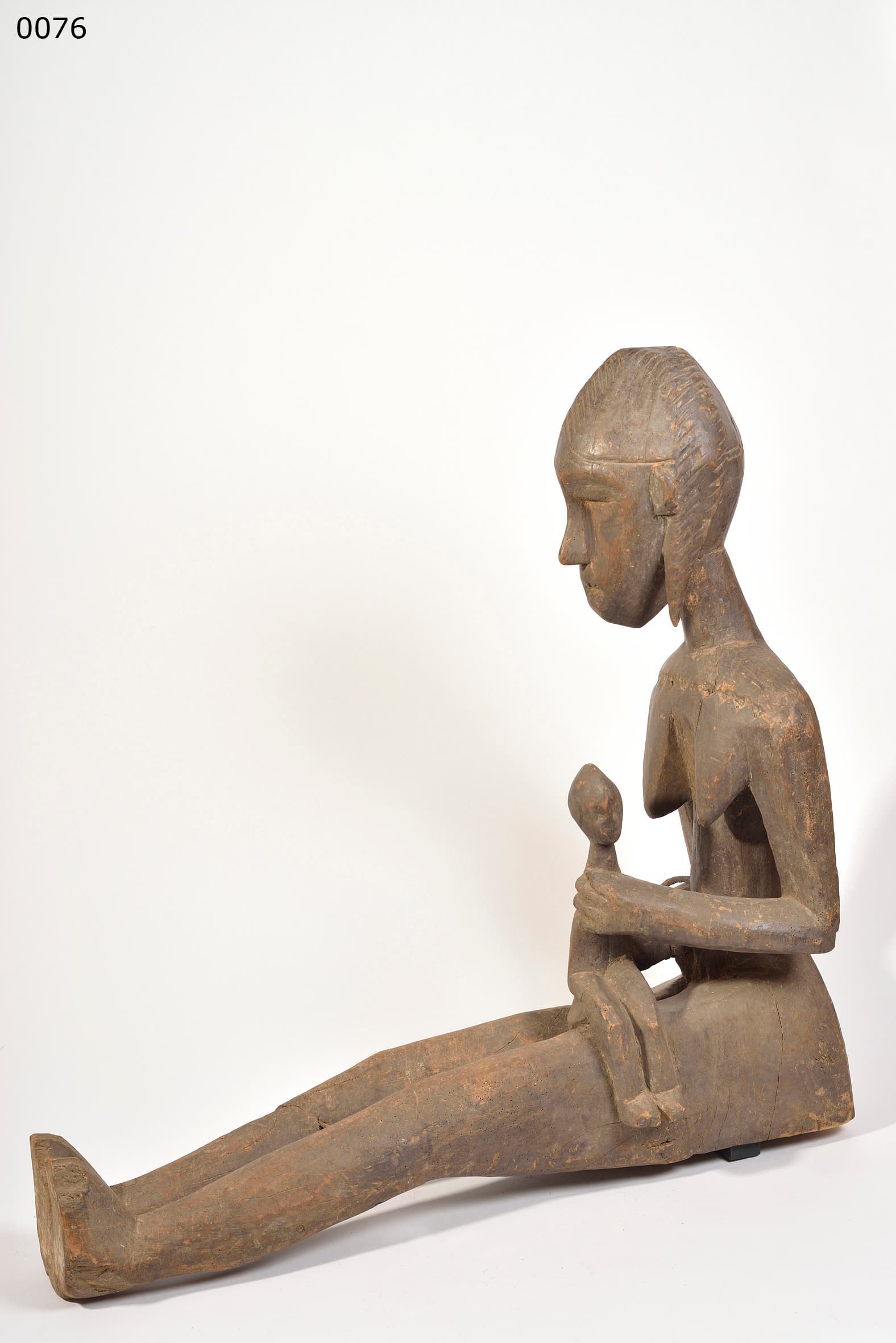
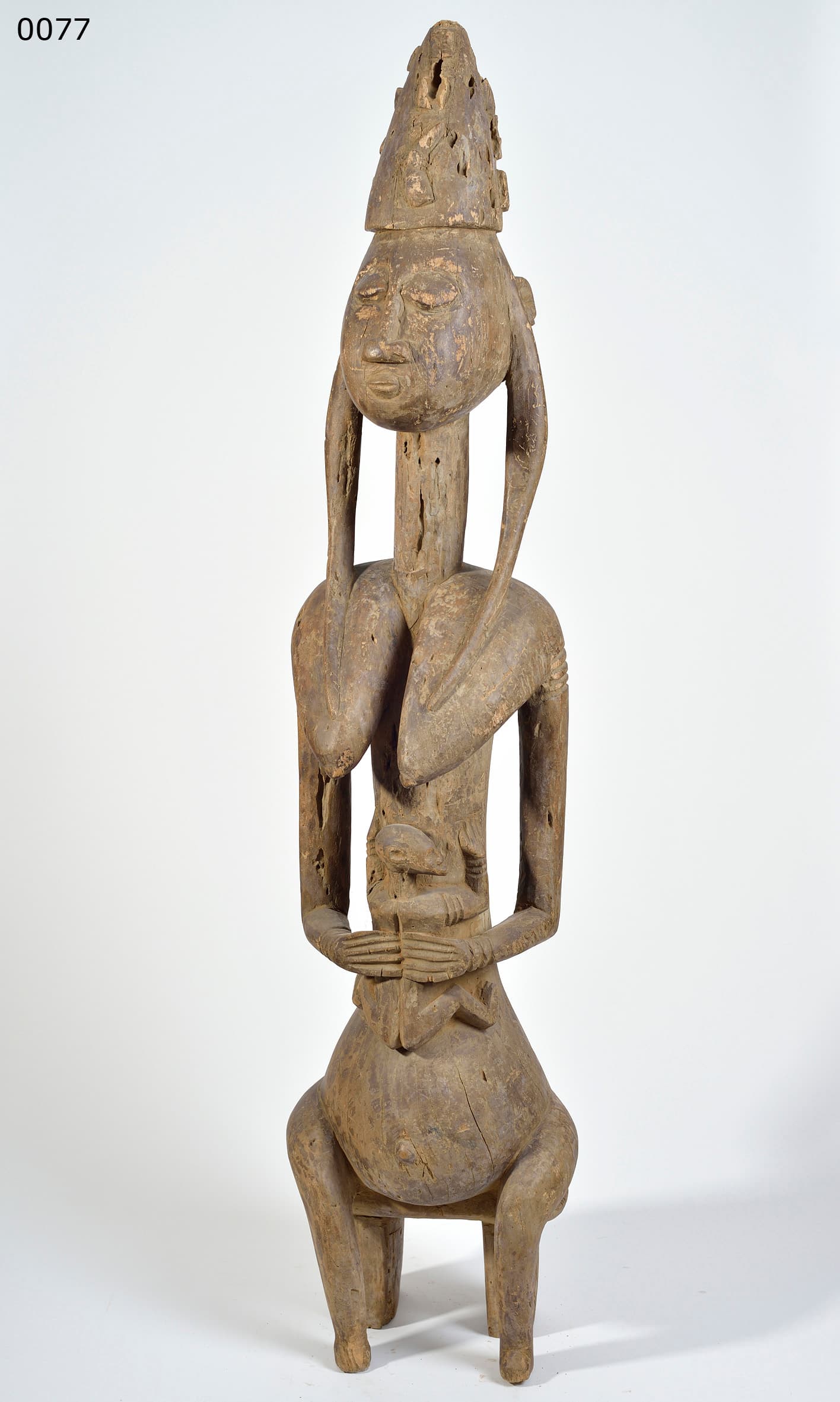
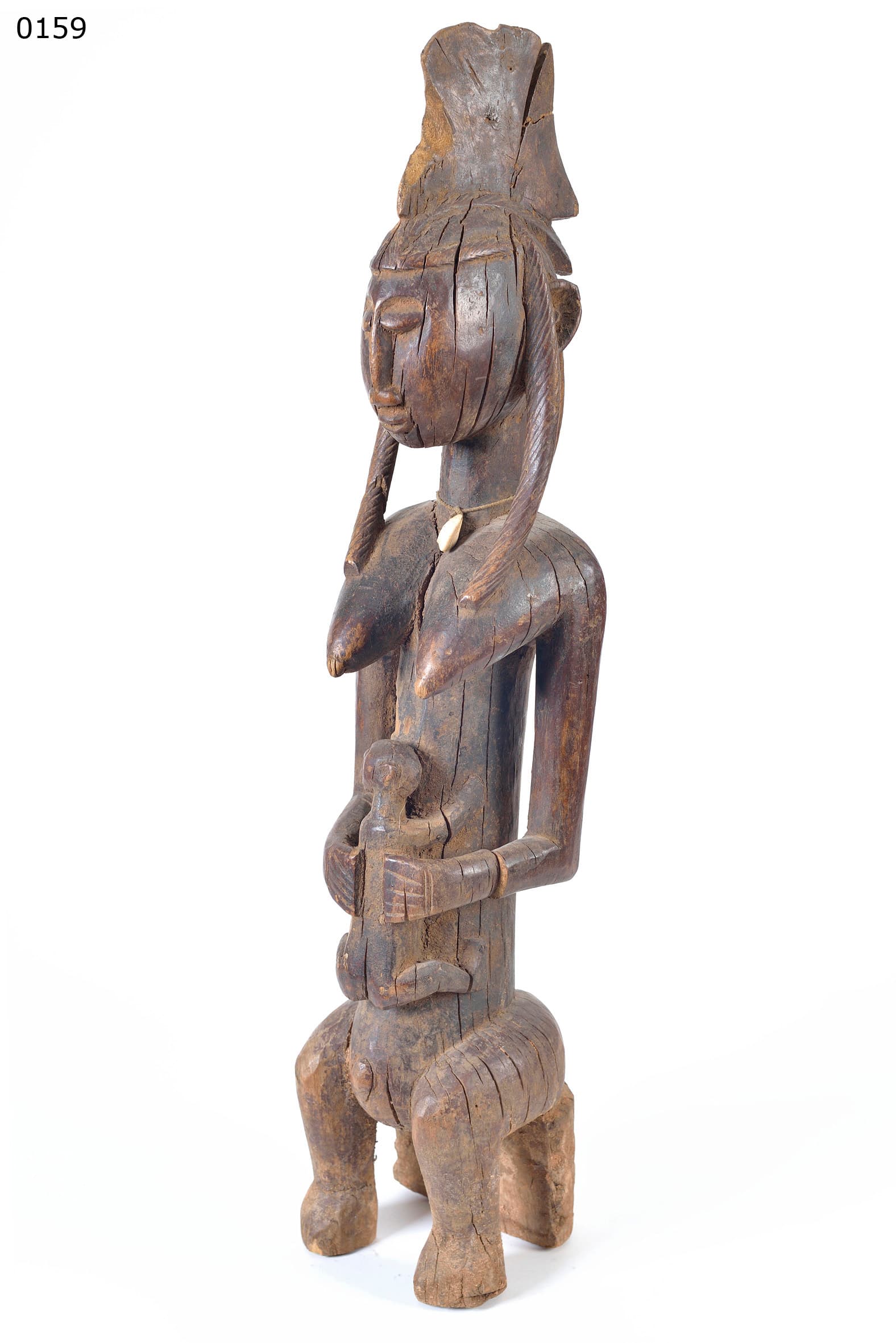
Jo and Gwan figures: These large-format, often life-size figurative wooden sculptures stand in stark aesthetic contrast to the encrusted Komo objects. They mostly depict mother and child (gwandusu) or male hunters and priests (gwantigi). They have a smooth patina, often treated with vegetable oils, and have idealised, self-contained proportions. The closed lips and heavy eyelids radiate badenya ("mother-child-like" / social harmony and authority) (Ezra 1986: 37). Master hands are rarely documented by name here, but specific workshops can be identified through style analyses (such as that of the "Master of Koulikoro").
Table 3: Aesthetic dichotomy of profane and activated objects
| Feature | Profane / newly carved object | Activated ritual object (e.g. komo/boli) |
|---|
| Materiality | Pure, often light-coloured wood, visible traces of carving | Wooden core completely concealed, organic accumulation |
| Ontological status | Carrier of low, natural nyama | Highly charged, toxic nyama, independent agent |
| Visual texture | Smooth, geometrically legible, clear volumes | Amorphous, encrusted, repellent, "terrifying" |
| Odour / sensory | Wood smell | Strong animal odour (blood, oil, decay) |
There is a striking difference between the profane (or freshly carved) object and the activated ritual object. The freshly carved piece of wood has no inherent magical power. Only the ritual coating and invocation by the numu generates the sacred, active field. Due to the enormous market demand in the West, forgeries of Boliw and Komo masks are a significant problem. Sarah C. Brett-Smith formulated groundbreaking criteria for authenticity testing in the journal African Arts in 1996. Since the 1960s, traders in Bamako have been producing masses of "market boliw". Counterfeiters simulate the sacred sacrificial layer by accelerating chemical processes, adding tar or burying it in mud for weeks. According to Brett-Smith, forgery criteria include the absence of a microscopic, organically grown layer structure (which indicates decades of periodic libations), the absence of heartwood cracks (which inevitably occur during decades of storage in the dry Sahel climate) and the absence of specific, inactive termite feeding traces beneath the crust (Brett-Smith 1996).
Ritual practice
The performance, handling and staging of Bamana objects varies greatly between the inclusive, public festivities of the agrarian confederations and the hermetically sealed, exclusive rites of the protective and judicial confederations. The ritual practice defines the ontological status of the object; for the Bamana priest, the mask is never a static work of art, but a living, powerful agent within a performative network of music, dance, prayer and sacrificial blood.
The life cycle of an object begins in secret. The numu blacksmith searches the bush for specific woods that are selected for their natural nyama content. During the carving process, the blacksmith often has to maintain sexual abstinence and wear apotropaic amulets to protect himself from the nyama released by the wood. After physical completion, the object is transferred to the shrine (basi) of the respective covenant and ritually "opened" and activated by the first major blood offering.
In the public agrarian rites of the Chiwara covenant, the performance is designed for collective participation and aesthetic brilliance. Without exception, the masks act in pairs (male and female). Two young men, excellently trained as "champion farmers", who have proven themselves through particular endurance in the field, are chosen to dance the helmet tops. The wooden sculptures are mounted on wicker caps, while the dancers' bodies and faces are completely concealed under thick, blackened bast fibre robes symbolising falling rain. They dance in a crouched position and imitate scratching the earth with sticks in their hands, which represent the antelope's front legs. They are accompanied by virtuoso drummers and a choir of women. Young women often dance behind the masks and fan the dancers with scarves to cool the energetic "heat" resulting from the physical exertion. The performance visualises the necessary cooperation between the sun (male principle), earth (female principle) and water (bast fibres) in order to secure the agricultural yield in the harsh savannah (Wooten 2009: 45; Imperato 1970: 8-13). Similarly inclusive are the secular puppet dances (sogo bo) staged by the youth organisations (ton) in the village squares to satirically convey social values.
The practice of the Komo Federation stands in stark contrast to this. Komo masks (Komo Kun) and Boliw are kept in closed, windowless shrine huts. These objects are activated in the deepest secrecy. The numu priest "feeds" the boli or mask with fresh chicken, dog or goat blood, chewed kola nuts, millet porridge and alcohol. Each offering to this altar binds additional nyama to the object and "recharges" its spiritual battery. During the nightly komo ceremonies, which serve to cleanse the village of harmful spells, the komo dancer - usually a younger, athletic blacksmith who can bear the immense physical burden of the encrusted mask - often breathes fire and moves in erratic, aggressive patterns. The performance is accompanied by acoustic terror from buzzing sticks and iron gongs to acoustically ward off witches and evil spirits and keep trespassers at a distance (McNaughton 1979: 32).
The lifespan of such a highly charged ritual object harbours immense dangers and requires specific deactivation. The source situation is sometimes ambiguous with regard to regional variations in the extensive Bamana region, but the ethnologist Kassim Kone provides decisive and documented insights into the disposal practice of Komo masks for Malian contexts. The sacred crust builds up over decades of offerings. Kone reports that this accumulation of nyama and dried blood can reach a critical, highly dangerous stage that worries the community. If the owner of the mask falls seriously ill or comes to the conclusion that there is no adequate successor in his direct family line of succession with the necessary esoteric knowledge to safely control this highly explosive energy, he makes the decision to deactivate it: "It is time for it [the mask] to die." The ritual deactivation does not consist of destruction, but of safe isolation. The Komo mask is often deposited in an abandoned, hollow beehive far away in the bush. This place is considered taboo, so no one dares to touch the object. There, the energetic charge of the object can decompose organically for years and flow back into the earth without endangering the village (Kone, quoted in Strother / RMCA Tervuren 2024). The Royal Museum for Central Africa (RMCA) in Tervuren and the Musée du quai Branly are evaluating precisely these disposal contexts in current provenance research, as historical colonial collectors often removed precisely these deposited, "ownerless" objects from the bush without realising that they were part of a highly complex deactivation cycle.
Historical context
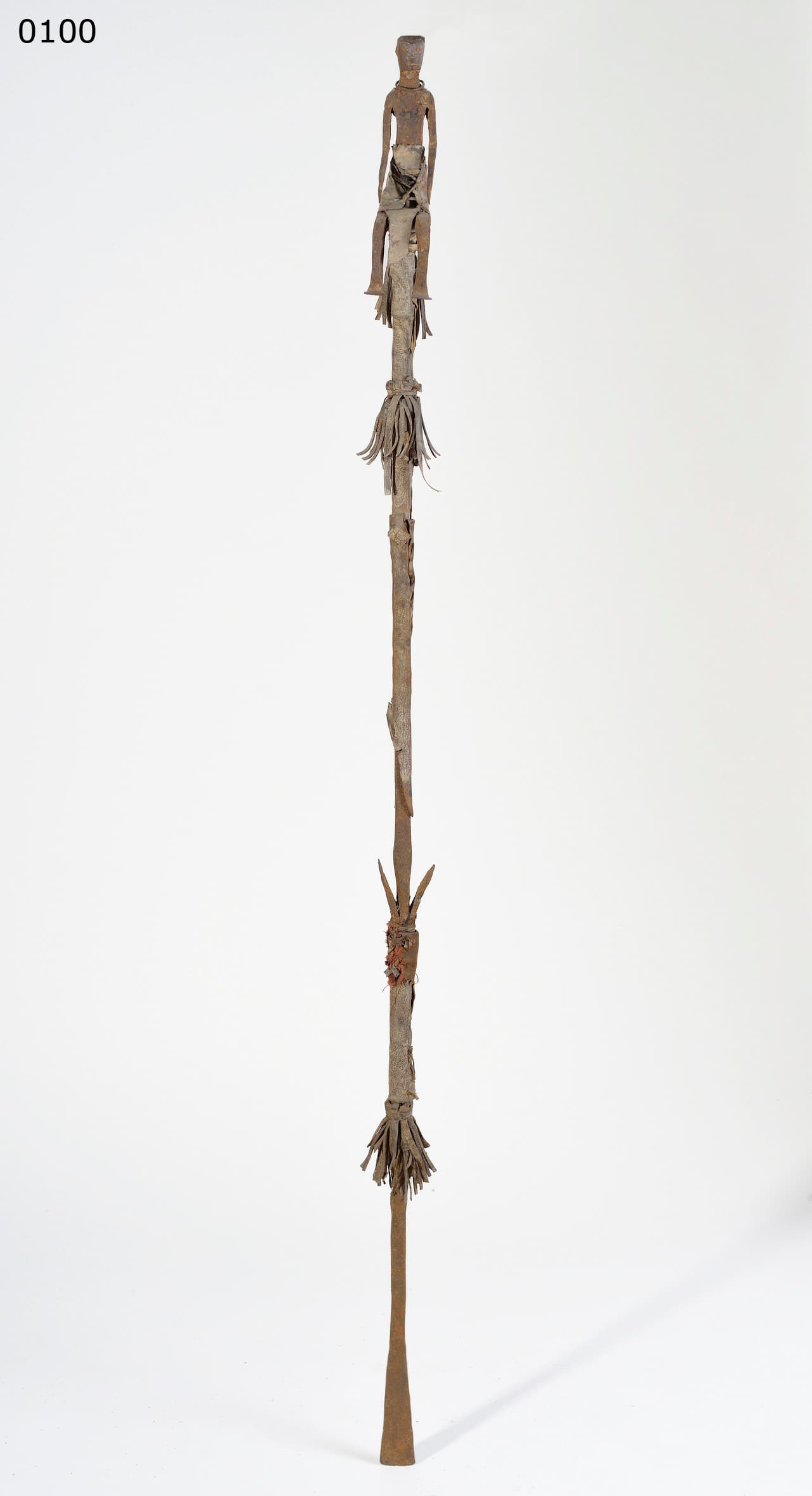
The history of the Bamana and the history of the reception of their material culture in the West are inextricably linked to the dynamics of pre-colonial migrations, African empire-building, colonial exploitation and the genesis of the global art market. Oral traditions, recited by the jeli (griots), locate the original home of the Bamana in the Toron region (in today's northern Ivory Coast). They are said to have migrated from there in the 13th century, primarily to escape forced Islamisation and enslavement by the militarily superior, expanding Malinke empire of Sunjata Keita (Dieterlen 1951: 12). C dates this migration somewhat more fluidly to the 14th century, but the sources for the exact dating of ethnogenesis remain speculative. In the following centuries, despite their acephalous village base, the Bamana established powerful, centralised and highly militarised states, primarily the Empire of Segou (founded around 1712 by Biton Coulibaly) and the Empire of Kaarta - summarised in English-language literature under the collective term Bambara Empire (ca. 1712-1861). Art production flourished during this period, as numu smiths produced not only masks, but also highly decorated weapons and iron rods to legitimise state power (Colleyn 2001: 15). These empires fell victim to the Islamic jihad of El Hadj Umar Tall in the late 19th century and finally to the French colonial army.
The colonial encounter with the French administration (Soudan Français) in the late 19th century marked a drastic break in the production of art. The French administratively subsumed the diverse, locally organised Mande groups under the homogenising colonial term "Bambara". With the violent "pacification" of the region, the mass transfer of ritual objects to Europe began. These first collection phases (for example by the military and missionaries) were rarely characterised by a genuine interest in ethnographic knowledge, but rather served the purpose of trophy hunting or the curious equipping of the ethnological museums that were created. The colonial presence partially undermined the power of the jow societies, which led to numerous blacksmiths beginning to produce secular commissions for the new colonial rulers.
A fundamental semantic and aesthetic transformation took place on the Western art market in the first decades of the 20th century. Influential collectors and art dealers such as Joseph Brummer and protagonists of the Parisian avant-garde (including Picasso, Matisse and Modigliani) acquired Bamana objects, which flowed to Europe in large quantities via the harbour cities. The modernists were particularly fascinated by the radically abstracted Ntomo masks and the elegant lines of the Chiwara centrepieces. For these artists, the Bamana works were primarily formal sources of inspiration ("art nègre"); their deep ritual, nyama-based context was completely ignored and negated in the West at this time (Biro 2018).
Table 4: Significant stages in the exhibition history of Western institutions
| Year | Institution / Museum | Exhibition title (curator) | Paradigmatic focus |
|---|
| 1960 | Museum of Primitive Art, New York | Bambara Sculpture from the Western Sudan (Robert Goldwater) | Formal-aesthetic appreciation, establishment of a uniform "Bambara style", reduction to form. |
| 1986 | National Museum of African Art, Washington / Met | A Human Ideal in African Art: Bamana Figurative Sculpture (Kate Ezra) | Focus on the aesthetics of the Jo and Gwan mother figures, emphasis on human proportions. |
| 2001 | Museum Rietberg, Zurich / Museum for African Art | Bamana: The Art of Existence in Mali (Jean-Paul Colleyn) | Definitive deconstruction of the purely aesthetic gaze; radical shift in focus to the performative and ritual jow practice. |
With the massive price development and canonisation of African artworks from the 1960s onwards, the problem of forgery exploded. Local workshops in Bamako began to produce sculptures explicitly for export to the West. Today, checking the authenticity of classical Bamana art requires the highest level of interdisciplinary expertise, as applied in museums such as the Rietberg or the Fowler Museum at UCLA. In addition to visually analysing the patina, specific physical characteristics are considered proof of age and ritual use in the African field. An object used in the shrine necessarily exhibits heartwood cracks caused by decades of thermal fluctuations in the dry Sahel climate. In addition, specific, inactive termite feeding marks at the base of masks and figures (which occur when the wood stands in the moist mud of the shrine floor) are considered indicators of authenticity, provided they lie below the patina layer (Brett-Smith 1996). Modern museum forensic methods now analyse binders, animal proteins from blood sacrifices and carbon deposits by C14 dating to distinguish genuine pieces ritually activated by the numu from high quality market replicas that merely mimic the external form without ever having acted as carriers of nyama.
Sources & References
This dossier draws on standard scholarship in Bamana studies. For deeper reading and image archives, see:
Inline citations in this dossier refer to canonical scholarly works on Bamana art; full bibliographic resolution is pending a researcher pass.