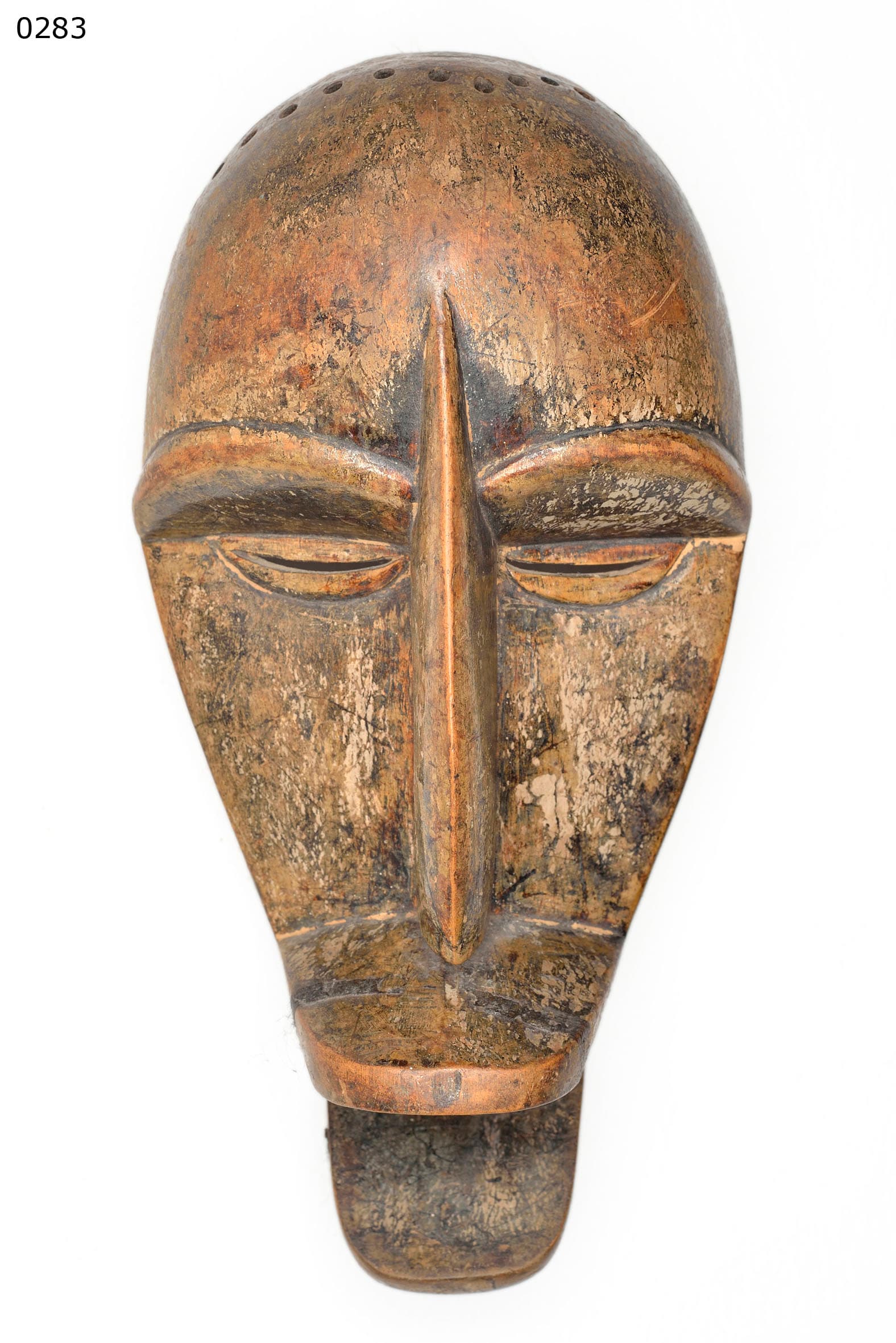
An architectural Guere mask (attributed to the mid-20th century, 44 cm) from the Ivory Coast — dominated by a massive overhanging forehead and a sharp severe nasal ridge that plunges into the face, the dark oxidized wood showing remnants of thick white kaolin clay and complex multi-layered patination.
1. The aesthetics of terror (Guere/Wobe)
While the registry labels this Dan/Guere, its form is highly characteristic of the aggressive expressionistic cubism of the Guere (or Wobe) style.
- Anti-Deangle: In contrast to the smooth idealized beauty of the Dan Deangle, the Guere style traditionally distorts and fragments the human face.
- Shadowed Visor: The massive overhanging brow acts as a heavy protective visor — casting the deeply set eyes into deep shadows. Extreme architectural exaggeration is traditionally intended to intimidate and command respect.
2. Judicial authority and the forest spirit
Masks of this imposing nature are traditionally understood as manifestations of a powerful forest spirit (Gle or Gla).
- Social Control: They traditionally functioned as agents of social control, associated with roles akin to judge, police, and executioner within the village.
- Judicial Role: When disputes cannot be resolved by human elders, the mask is traditionally brought forth from the forest to render final judgments — its imposing visage designed to command obedience from the community.
3. Kaolin encrustation and structural weathering
The patina is complex and consistent with traditional use.
- Ancestral Kaolin Deposits: The deep heavy recesses created by the overhanging brow have protected thick deposits of white kaolin clay — traditionally linking the mask to the realm of the ancestors and the dead.
- Handled Bare: The prominent outer edges of the nose and brow are rubbed bare and dark from handling — a contrast in surface wear consistent with active mid-20th-century ritual use.
Summary
Projecting a powerful sense of authority, this Guere mask is an expressive example of aggressive West African cubism. Its massive overhanging architecture and deep kaolin-stained patina are consistent with its traditional role as an instrument of judicial power.
Written with AI assistance from the collection appraisal, object photography and our own research; editorially reviewed. Mistakes are possible — corrections are welcome. How we work →