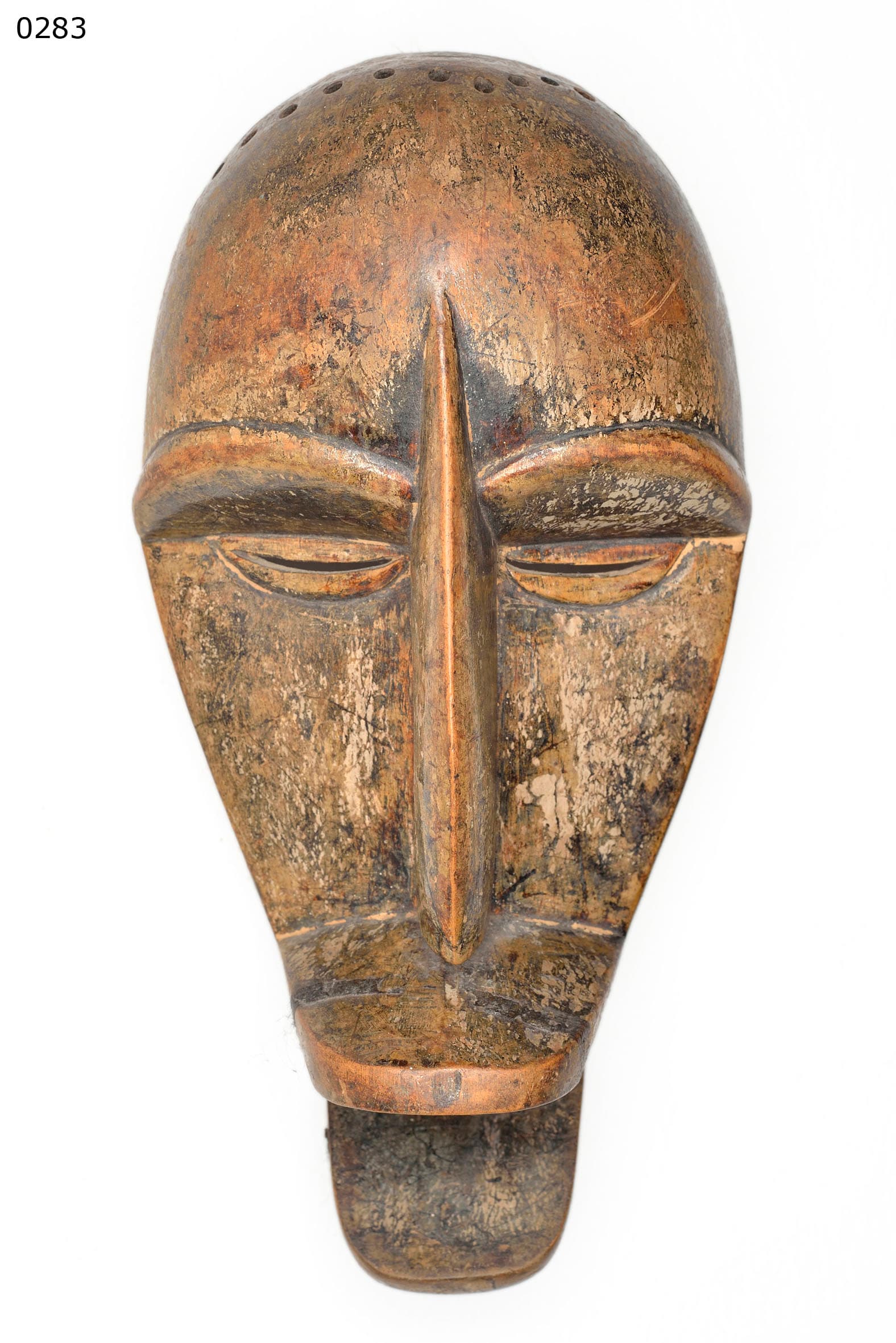
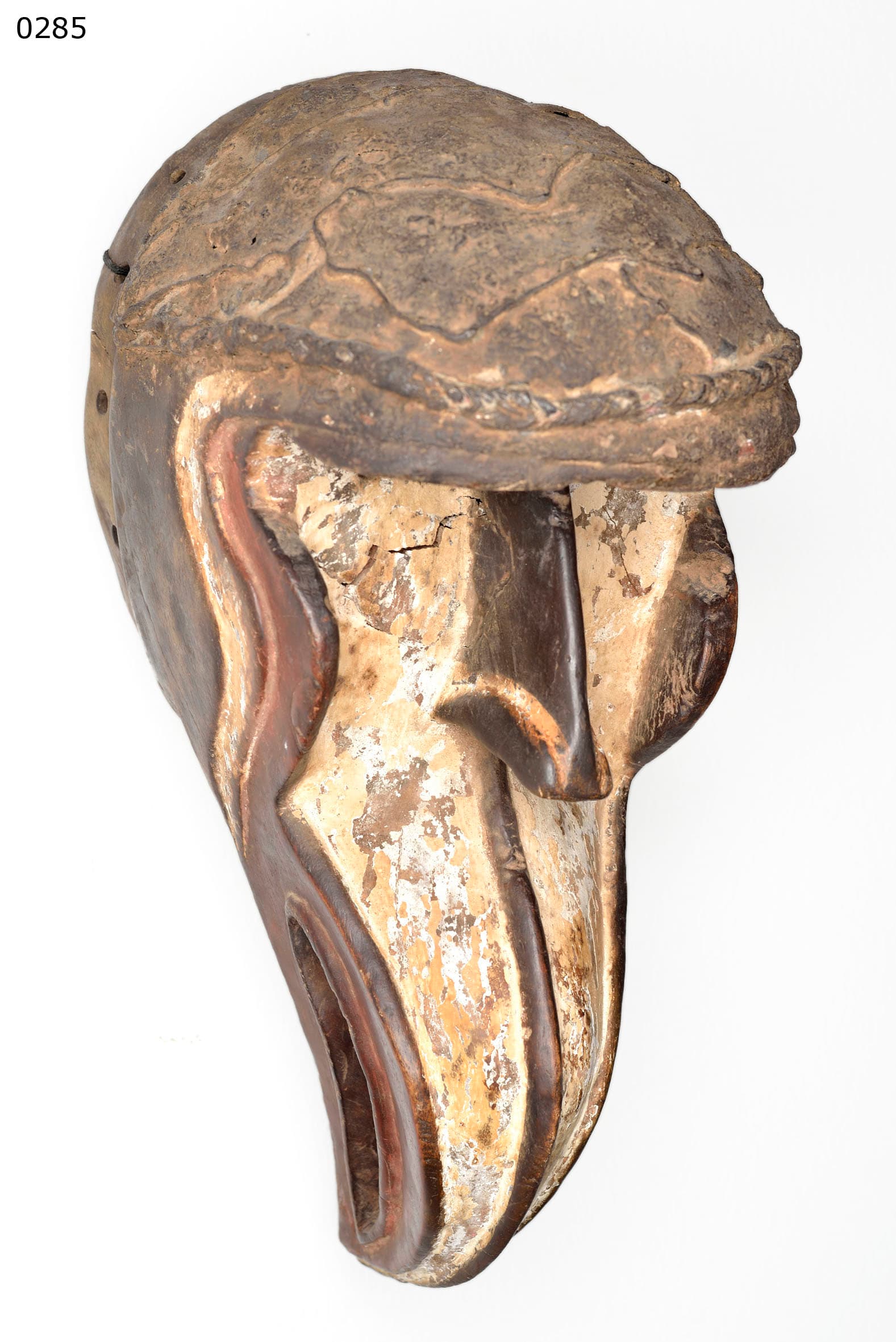
The Dan are a West African people of the Nimba and Toura Mountains in Côte d'Ivoire and Liberia, known for smooth, high-polished deangle masks embodying forest spirits.
Overview
The ethnolinguistic group of the Dan, often subsumed under the administrative exonym Yacouba in Francophone literature in Côte d'Ivoire and under the historically pejorative foreign term Gio in the Republic of Liberia, which goes back to the Bassa word for "slave", is one of the most influential cultural and artistic entities in West Africa. The self-designation of the ethnic group varies greatly from region to region, whereby terms such as Danwopeumin (loosely translated: "the Dan-speaking people") are documented in the indigenous nomenclature. The primary settlement area extends over the mountainous region of the Nimba and Toura Mountains in the western centre of Côte d'Ivoire (particularly around the urban centre of Man and Danané), which is dominated by dense tropical rainforest and wet savannahs, as well as the neighbouring Nimba County in north-eastern Liberia, whereby the topographical isolation at altitudes of 450 to 1,200 metres favoured the historical autonomy of the region.
The linguistic classification clearly places the Dan in the southern branch of the Mande language family, which links the ethnic group historically, culturally and philologically closely with the neighbouring Mano, Kpelle and the historical populations of the Maghan and Mali empires. This linguistic affiliation sharply distinguishes them from their direct southern neighbours, the Guéré (often referred to synonymously in the literature as Wè or Ngere) and Krahn, who belong to the Kru language family. The exact demographics of the Dan population are subject to considerable statistical uncertainty. While older ethnographic surveys assumed around 350,000 to 700,000 individuals, more recent demographic models extrapolate a recent Dan population of an estimated 1.5 to 3 million people based on overall national growth rates - Côte d'Ivoire had a total population of around 31.9 million in 2024, Liberia around 5.6 million.
| Demographic framework conditions of the main settlement states (as at 2024-2026) | Côte d'Ivoire | Liberia |
|---|
| Total population 2024 | 31,934,230 | 5,612,817 |
| Forecast 2026 | 33,494,340 | 5,853,958 |
| Degree of urbanisation | approx. 49.4 % | n.a. |
| Relevant neighbouring ethnic groups in the border region | Guéré (Wè), Guro, Toura, Mano | Krahn, Kpelle, Bassa, Mano |
The pre-colonial social structure of the Dan, which has largely been handed down to the present day, is characterised by a pronounced acephalous, patrilineal and polygamous organisation. The society historically lacks a centralised political authority in the sense of a sacral kingship or a hegemonic chieftainship structure. The basic unit of Dan culture is the extended family. Several family groups (lineages) linked by patrilineal descent inhabit spatially separated, autonomous village neighbourhoods, each headed by a neighbourhood elder whose authority is based less on sacred birthright than on seniority, economic success and charismatic assertiveness. Consolidated political power manifests itself in the council republics of the elders as well as in the rigid structures of merit and secret societies.
The subsistence economy is traditionally based on shifting cultivation (slash-and-burn agriculture) with rice, manioc and yams as the main crops, which are cultivated through a strict gender-specific division of labour: Men do the clearing, hunting and fishing, while women are responsible for sowing, weeding, harvesting and the complex preparation of ceremonial meals. The economy is supplemented by marginal livestock farming (goats, cattle), the consumption of which, however, is almost exclusively reserved for ritual feasts and sacrifices for atonement. In recent economic history, these traditional patterns have been partially replaced by wage labour in rubber plantations and diamond mines, whereby the principle of social advancement through material wealth (tin labour) has remained intact.
The relationship with neighbouring peoples was historically characterised by a highly complex dynamic of ritual assimilation, interethnic marriage sexogamy and latent armed conflicts. The intensive cultural exchange with the Wè (Guéré) in particular led to a massive diffusion of plastic styles, institutions and mask cults, which makes the strict ethnic classification of historical artefacts in Western museums extremely difficult. The source situation regarding the historical bellicosity of the Dan is ambiguous: while older narratives assume a strictly warlike, isolated mountain population, critical historical studies postulate that many of the surviving battles are rather mythical topoi for demarcation from neighbours. The controversies of classification in early ethnology (often erroneously homogenised as the "Dan-Wè complex") are reflected in the old collections of European institutions; for example, historical collections in the British Museum in London succinctly document this cross-border fluidity of material culture, in which objects circulated deep into neighbouring territories through trade or war booty before they were recorded by colonial officials.
Cultural context
The religious, metaphysical and philosophical system of the Dan is based on a strictly dualistic cosmological order, which ontologically separates the civilised, orderly human space of the village (zru) from the untamed, chaotic and spiritual space of the primary forest (bon). At the head of this metaphysical pantheon is the almighty creator god Zlan (also known regionally as Xra), who created the universe and all physical and spiritual entities. However, Zlan acts as a typical deus otiosus; after creation, he withdrew from the direct, profane concerns of humanity, which is why he is neither invoked directly nor is there an active cult, altar or visual representation of him.
Instead, active ritual communication and cosmological balance are orchestrated via invisible, transcendent natural and spiritual beings, the so-called dü or genu (singular: ge or gle). These entities inhabit the deep, inaccessible forest and strive to enter the material, structured sphere of the village in order to manage, maintain or direct social processes there. However, they achieve this exclusively through physical manifestation in the form of masks and by taking possession of the bodies of highly initiated dancers.
Institutional control over these transcendent forces and the orchestration of social initiation is the responsibility of hierarchically structured secret societies. The research controversies regarding the exact delimitation of these alliances are significant. On the one hand, there is the ubiquitous Poro system, an inter-ethnic male society that regulates the rigorous initiation of boys in the bush camp, circumcision, the transmission of esoteric knowledge and the transition to the status of full adult citizens throughout West Africa (including among the Senufo and Mende). In contrast, the Dan have a specific Gor covenant (Dan for "leopard"). The sources on the genesis of the Gor-Bund are ambiguous; while some historians regard it as an ancient institution, A. dates it as a more recent, reactive peacemaking organisation that emerged in the 19th century to provide a legal corrective to the excessive fragmentation of acephalous villages. Structurally, the Gor Federation today acts as the highest judicial authority and should not be confused with the violent Ekpe Leopard Society of Nigeria, which bears the same name. Ritual knowledge is exclusively administered by divinators and the ritual masters known as zo, whose authority is legitimised not by heredity but by their proven direct spiritual interaction with the genu as well as sound knowledge of pharmacology and divination.
| Structural juxtaposition of ritual authorities | Primary function | Cosmological reference | Socio-political reach |
|---|
| Poro covenant | initiation, circumcision, socialisation of male youth | mediation between ancestors, forest spirits and novices | cross-village, foundation of civil rights |
| Gor-Bund | Peacemaking, judiciary, conflict resolution | Highest spiritual sanctioning power, control over gle wa | Inter-village alliances, regional stability |
| Zo (ritual master) | Divination, healing, leadership of mask performances | Direct individual pact with specific genu | Individual prestige, leadership of local cults |
What distinguishes this religion structurally from many neighbouring peoples (such as the Akan or certain groups of the Senufo) is the high degree of individualisation of the spiritual pact. While elsewhere collective ancestor cults or bloodline-based shrines dominate, the Dan religion manifests itself primarily through extremely personal dream callings: A single man receives his specific spirit guide in a dream, who from then on dictates his personal destiny.
Another fundamental peculiarity is the institutionally anchored, exceptionally visible and prestigious role of women in the mask cult. Although the carving and wearing of wooden masks is strictly reserved for initiated men (in contrast to the Sande covenant of the Mende, where women wear masks), the Dan have the title of wunkirle (plural: wunkirlone). This status of "most hospitable woman" is awarded to the woman of a village quarter who excels through outstanding agri-cultural productivity, logistical genius and unrivalled generosity in feeding the community and the masked entourage. She acts as an indispensable ritual counterforce to the male masked power. In its groundbreaking Persona exhibition (2009), the Royal Museum for Central Africa (RMCA) in Tervuren succinctly illustrated how the material culture of the Dan - both the men's masks and the women's ceremonial spoons - do not function as dead props, but as independent, active players in the complex social structure of the villages.
Aesthetic features
The canonical object typology of the Dan is almost absolutely dominated by two main sculptural categories: the highly differentiated mask complex (which primarily modifies the human face) and the large-format, anthropomorphic ceremonial spoons of the women. The Dan sculpture's canon of proportions is characterised by a refined, idealising naturalism, a striking vertical symmetry, a strongly convex forehead, fine, often slit eyes and a pronouncedly protruding mouth. The wood of the African rubber tree (Funtumia elastica or Funtumia africana), known regionally as ofruntum, traditionally serves as the favoured support material for sculpture. This wood is characterised by a light basic colour, a fine, homogeneous texture (density approx. 64 kg/m³) and a low weight, which makes it ideal for carving performative masks worn on the body.
The creation of the famous, deeply dark and tactilely dense patina is an elaborate chemical and ritual process. The freshly carved, still light-coloured wood is first smoothed with hot blades and sanded with the rough leaves of specific fig trees. It is then blackened with a tincture of leaf-extracted plant juices. However, the actual "dance patina", which is highly valued by collectors, only accumulates over decades of ritual activation: the continuous anointing of the object with palm oil, the rubbing with red earth (kaolin or laterite), sacrificial matter and the sweat of the dancer penetrate deep into the cellulose of the wood and create a resistant, deeply shiny crust that seals the object physically and spiritually.
| Subtype (genus) | Iconographic features | Ritual function & performance |
|---|
| deangle (female) | Oval face, narrow slit eyes, idealised features, peaceful expression. | Peaceful mediators, request food for the initiation camp, entertainment. |
| gunyege | Round, partially open eyeholes for peripheral vision, aerodynamic features. | Competition racing mask, appears in running duels during the dry season. |
| kagle | Deep-set eyes, strongly projecting polygonal cheekbones, animalistic features. | "Troublemaker", tests social boundaries, aggressive, uncontrollable behaviour. |
| Red fabric applications, aggressive physiognomy, often round eyes. | Firekeeper mask, controls herds in the dry season to prevent fires. | |
| gä gon | Large, often with movable lower jaw or strongly elongated snout. | Represents the Turako bird (Kalao), entertainer, often with mythological reference. |
| ma / ma go | Miniature format (size range approx. 5 to 10 cm), detailed replica of large masks. | Personal relic, "passport mask", apotropaic altar object in a leather pouch. |
The distinction between a profane piece of carved wood and an activated ritual object is absolutist in the ontology of the Dan. A wooden face fresh from the workshop has no ritual power per se. Only through the blessing of the elders, the application of the elaborate costume (consisting of raffia, colobus monkey fur, bird feathers and cowrie snails) and the trance activation by the dancer does the transubstantiation from artefact to living ge take place.
The female equivalent of the mask is the wakemia or wunkirmian (ceremonial spoon). These insignia of the wunkirle reach lengths of 30 to 80 cm. Iconographically, the handle is usually sculpted as a detailed female head (often in deangle style) or as a muscular, often ring-shaped pair of scarified legs. The spoon's deeply moulded bowl is metonymically read as the community's birthing uterus, from which wealth (in the form of rice or coins) is distributed to the villagers. In contrast to most other African art traditions, in which the carvers remained historically anonymous, field research has been able to identify documented master craftsmen and workshops among the Dan. In addition to the legendary Zlan of Belewale (active until around 1960), whose works are characterised by exquisite metal tooth inlays and fine carvings on the forehead, Eberhard Fischer documented the virtuoso carvers Tame, Si, Tompieme and Sõn precisely in words and film.
Due to the immense market relevance of dan art, there are strict forgery criteria. Since the 1950s, workshops in Man ("tourist Dan") have been producing flawless, perfectly shaped masks for export, which, however, lack any ritual depth. Authenticity tests focus on the evidence of genuine dance patina (sweat erosions on the chin and forehead area on the inside), naturally occurring heartwood cracks, oxidised iron nails and organic, not subsequently manipulated termite damage. The Metropolitan Museum of Art in New York keeps paradigmatic examples (such as Gunyege and Wunkirmian) in the Michael C. Rockefeller Wing, which excellently illustrate these fine differentiations between ritual accumulation and sterile perfection of form.
Ritual practice
The ritual lifecycle of a dan object, from organic raw material to disposal, is a highly regulated process characterised by spiritual interactions. Every authentic mask performance has its origin in immaterial space. In a dream passage, an initiated man of the Poro covenant receives the decisive instruction of a genu forest spirit. This spirit dictates his visual appearance, his character preferences, his specific rhythm and the ritual purpose he intends to fulfil in the village. The dreamer must submit this revelation to the council of elders (zo). Only if the council verifies the authenticity of the vision is a master carver commissioned to make the mask, usually in strict isolation in the bush.
In addition to the large dance masks, there is a highly intimate ritual practice of altar use centred around the ma (or ma go). These miniature masks function not as face coverings, but as portable relics and physical key rings to the spiritual contracts. A man carries his ma in a leather pouch when travelling or places it on a private shrine. The activation and maintenance of this altar requires regular offerings: The ma is libated with the owner's own spit (symbolising life force), chewed kola nuts, palm oil and, on specific occasions, the blood of white sacrificial animals (chickens, goats) to ask for protection, hunting luck or healing.
The performance of a full face mask in the village is a multimedia event. A naked wooden face never acts in isolation. The performance requires the gle-zo (the dancer), a heavy, body-concealing costume made of raffia, textiles and skins, as well as an entourage. As the spirit comes from the uncivilised forest, it often acts unpredictably and articulates itself in guttural, non-human sounds. An obligatory companion (often armed with a whip stick) acts as tamer and translator, decoding the ghost's wisdom or demands into understandable language for the village audience. The scenery is flanked by a specialised ensemble of musicians, whose complex polyrhythms on various barrel drums direct the gle's movements and put him into a trance state in the first place.
It is precisely in the analysis of these performances that the most central and vehement iconographic research controversy in Dan art studies is ignited. The established classification, largely characterised by the pioneers Eberhard Fischer and Hans Himmelheber, postulated a strict typology: 10 to 12 morphologically distinct types of mask were fixed to specific functions (the oval eyes of the deangle for peace, the round eyes of the gunyege necessarily for running, etc.). Ethnomusicologist Daniel B. Reed strongly disagrees with this on the basis of recent field research. Reed argues in favour of a fundamental "mask fluidity". He postulates that the meaning of a mask does not stagnate in its wooden morphology, but grows biometrically with the prestige of its wearer. A dancer can change his mask roles depending on the occasion; a simple gunyege racing mask can rise from a mundane entertainment function to the feared gle wa (highest judicial authority) over the course of decades as its owner gains political power. Reed accuses the classical typology of being a Western-Linnaean projection that does not do justice to the dynamic, demand-driven ontology of Dan.
The deactivation and disposal of the masks marks the end point of this cycle. The sources regarding disposal are regionally heterogeneous: When a mask has been desecrated through ritual misbehaviour or its indwelling spirit decides to leave the village for good, the wooden sculpture is stripped of its applications and deposited deep in the forest, where it is left to decompose naturally through insect infestation. Particularly sacred gle wa masks, on the other hand, are not disposed of when damaged, but are kept in special shrines as relics and passed on to the next generation. The Museum Rietberg in Zurich documents this material life cycle, from the unfinished raw form to the heavily eroded, ancient object, in an unrivalled way using Himmelheber's immense field research collections.
Historical context
The historical localisation of the Dan results primarily from the large migration movements of the West African Mande language area, some of which are disputed in research. Between around the 8th and 18th centuries, the ancestors of today's Dan migrated from the northern, savannah-dominated areas (the peripheries of modern-day Mali and Guinea) successively southwards into the inhospitable, forested mountain regions of the Ivory Coast and Liberia. The dating of these migrations and the historicity of the pre-colonial territorial wars is controversial in ethnology; in the oral tradition of the Dan, memories of real, bloody distribution battles with the Wè or Kpelle often merge with mythical narratives that served to legitimise military masked alliances.
The colonial encounter at the transition from the 19th to the late 20th century - fuelled by French military campaigns in Côte d'Ivoire and the aggressive expansion of Liberia's African-American elite into the hinterland - dramatically changed the Dan's art and ritual production. The enforced state "pacification", the expansion of administrative structures and the ban on interethnic warfare led to a fundamental loss of significance for warrior mask types such as the bugle. In order to maintain their relevance, these masks adapted to the new circumstances; former warrior spirits were increasingly pushed into the roles of civilian entertainers, legal mediators or even as actors in state-orchestrated anti-witchcraft campaigns.
The epochal breakthrough of Dan art on the Western art market took place primarily in the interwar period. Early collectors and dealers such as the Parisian gallery owner Paul Guillaume recognised the formal congruence between the reduced, almost cubist abstraction of some Dan and Guéré masks and the aesthetics of the European avant-garde (such as Picasso or Modigliani). A decisive institutional catalyst for museum canonisation was the groundbreaking exhibition "African Negro Art" at the Museum of Modern Art (MoMA) in New York in 1935, curated by James Johnson Sweeney. For this exhibition, the legendary photographer Walker Evans staged prominent Dan objects in his portfolio, which finally elevated the sculptures from the ethnographic cabinet of curiosities to the Olympus of global modernism. At the same time, between 1930 and 1948, the medical missionary Dr George W. Harley acquired and catalogued 391 wooden masks, mainly of Mano and Dan speakers, in the Liberian hinterland (now in the Peabody Museum, Harvard) and laid the scientific basis for Western classifications with his essays Notes on the Poro in Liberia (1941) and Masks as Agents of Social Control in Northeast Liberia (1950).
| Auction history and price development of significant Dan masks (selection) | Provenance highlight | Auction house / year | Price achieved (estimated/realised) |
|---|
| deangle Mask (19th century) | Paul Guillaume, Hubert Goldet | Christie's Paris, 2014 | € 721,500 / ca. $ 850,500 |
| deangle Mask | Paul Guillaume, Marc Ginzberg | Christie's Paris, 2017 | € 547,500 / ca. $ 648,000 |
| mask | gunyege / zakpai Mask | Hyman Klebanow, Chuck Close | Christie's New York, 2024 |
| Dan Mask (Liberia) | Dr George W. Harley | Christie's New York, 2024 | $ 12,600 |
This significant price development, which has catapulted absolute top pieces of Dan art into the million-dollar segment, has massively exacerbated the problem of forgery. The market is increasingly flooded with objects from West African copy workshops that are specifically tailored to the visual preferences of Western collectors. Today, the establishment of valid authenticity criteria is based on complex interdisciplinary forensics: in addition to the visual examination of the dance patina (oxidation of the metal eyes, deep sweat and grease residues on the inside of the wood) and the detection of naturally occurring heartwood cracks, modern imaging techniques are used. UV luminescence and infrared spectroscopy are used to reliably detect artificially applied signs of ageing, such as acid treatments to simulate weathering or insect larvae subsequently inserted into fresh wood (to imitate organic termite damage). Exquisite historical reference examples, which serve as an unadulterated benchmark for this complex material-aesthetic genesis, can be found today in renowned European institutions such as the Musée du quai Branly (for example in the Marc Ladreit de Lacharrière Collection) in Paris, which comprehensively document the global path of Dan art from sacred forest object to icon of world art.
Sources & References
This dossier draws on standard scholarship in Dan studies. For deeper reading and image archives, see:
Inline citations in this dossier refer to canonical scholarly works on Dan art; full bibliographic resolution is pending a researcher pass.