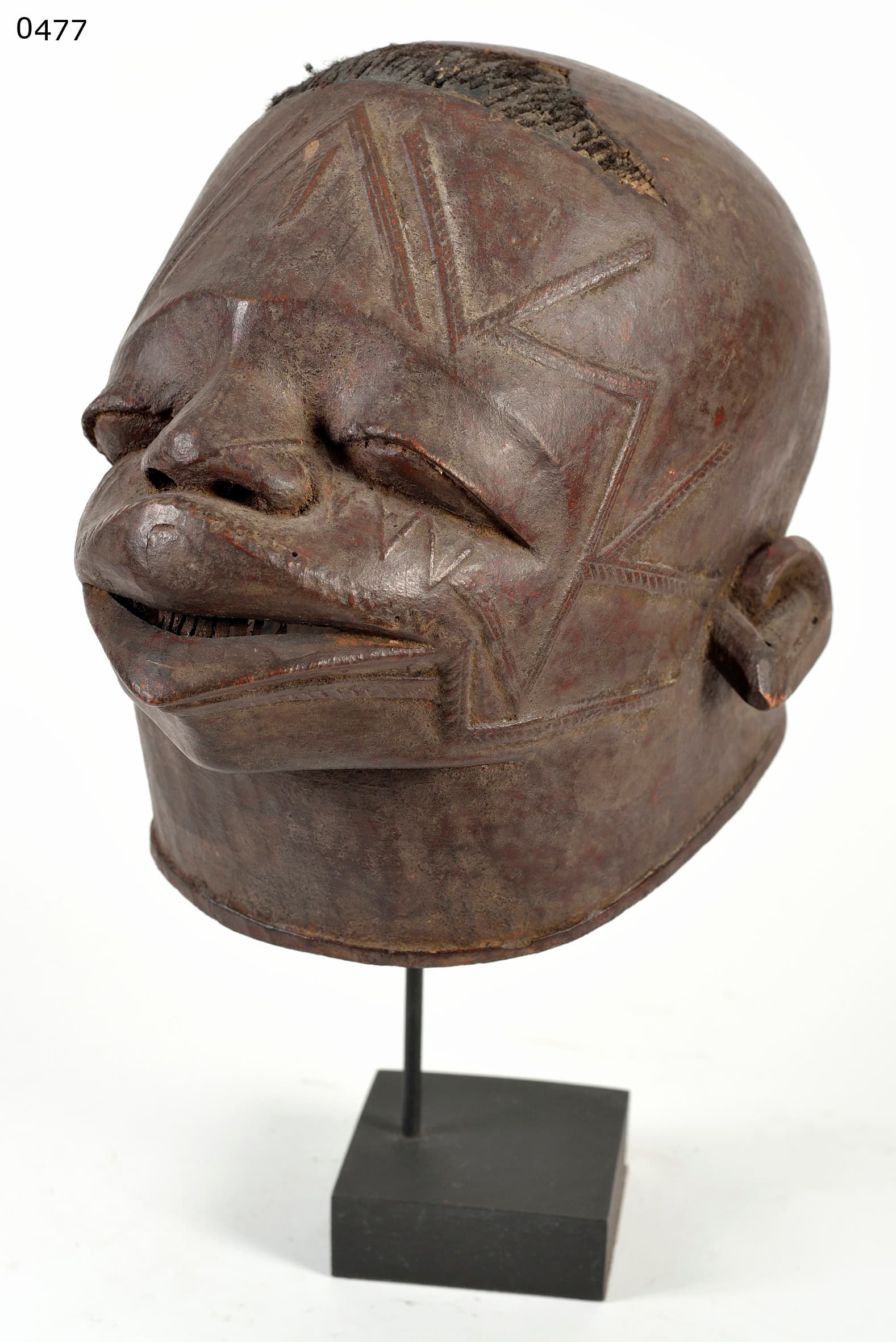
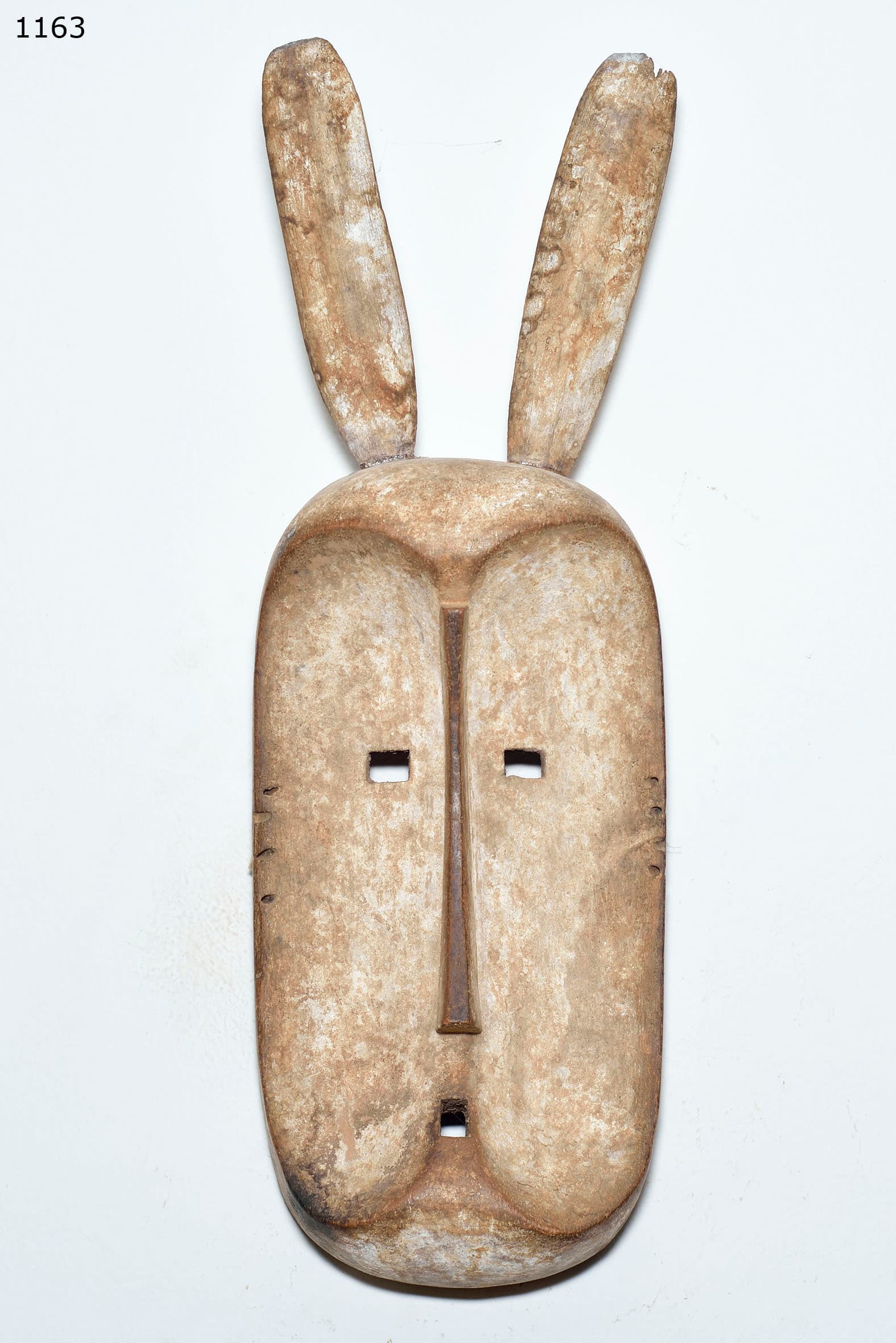
This small face mask belongs to the mask traditions of the Rovuma region on the border of Tanzania and Mozambique, an area shared by the Makonde and their neighbours the Makua, Yao and Mwera. Collectors and museum catalogues group these closely related workshops as the Makonde complex, because individual pieces rarely allow a firm attribution to a single people.
1. Applied wax tattoos
The most telling feature is the decoration of the cheeks. The rows of dots are not carved. They are small beads of blackened beeswax pressed onto the wood, reproducing the raised facial tattoos (dinembo) worn across the region until the middle of the twentieth century. A band of the same dark material runs across the forehead. Applied wax ornament of this kind is a hallmark of Makonde-complex carving and is not part of the Chokwe tradition of Angola, to which the mask was formerly assigned.
2. Form and surface
The face is a compact oval, 18 cm high, with a domed forehead, narrow slit eyes set in shallow concave sockets, a long straight nose and a protruding rectangular mouth. Small block-like ears with pierced lobes stand away from the head; ear piercing and ear plugs were common body ornaments in the region. The surface carries a matte red-brown pigment with darker accents on the mouth and brow. Wear along the rim and inside the eye slits appears consistent with use rather than display.
3. Face masks in the Makonde complex
The Makonde are best known for the lipiko helmet mask, worn on top of the dancer's head during mapiko initiation dances. Face masks that cover the front of the head form a second, less studied group, more common among the Tanzanian Makonde and their Makua and Mwera neighbours; Makonde speakers themselves sometimes regard them as an imported form (Kingdon 2002; Israel 2014). They appeared in the same context of initiation, harvest and funeral dances, worn with a cloth or fibre costume that concealed the dancer.
Summary
The wax-applied tattoo dots, the pierced block ears and the small oval format place this mask in the Makonde complex of the Rovuma region rather than in Angola. The mask was catalogued as Chokwe when it entered the collection; the attribution was revised in September 2026 following a reader's observation.
Written with AI assistance from the collection appraisal, object photography and our own research; editorially reviewed. Mistakes are possible — corrections are welcome. How we work →