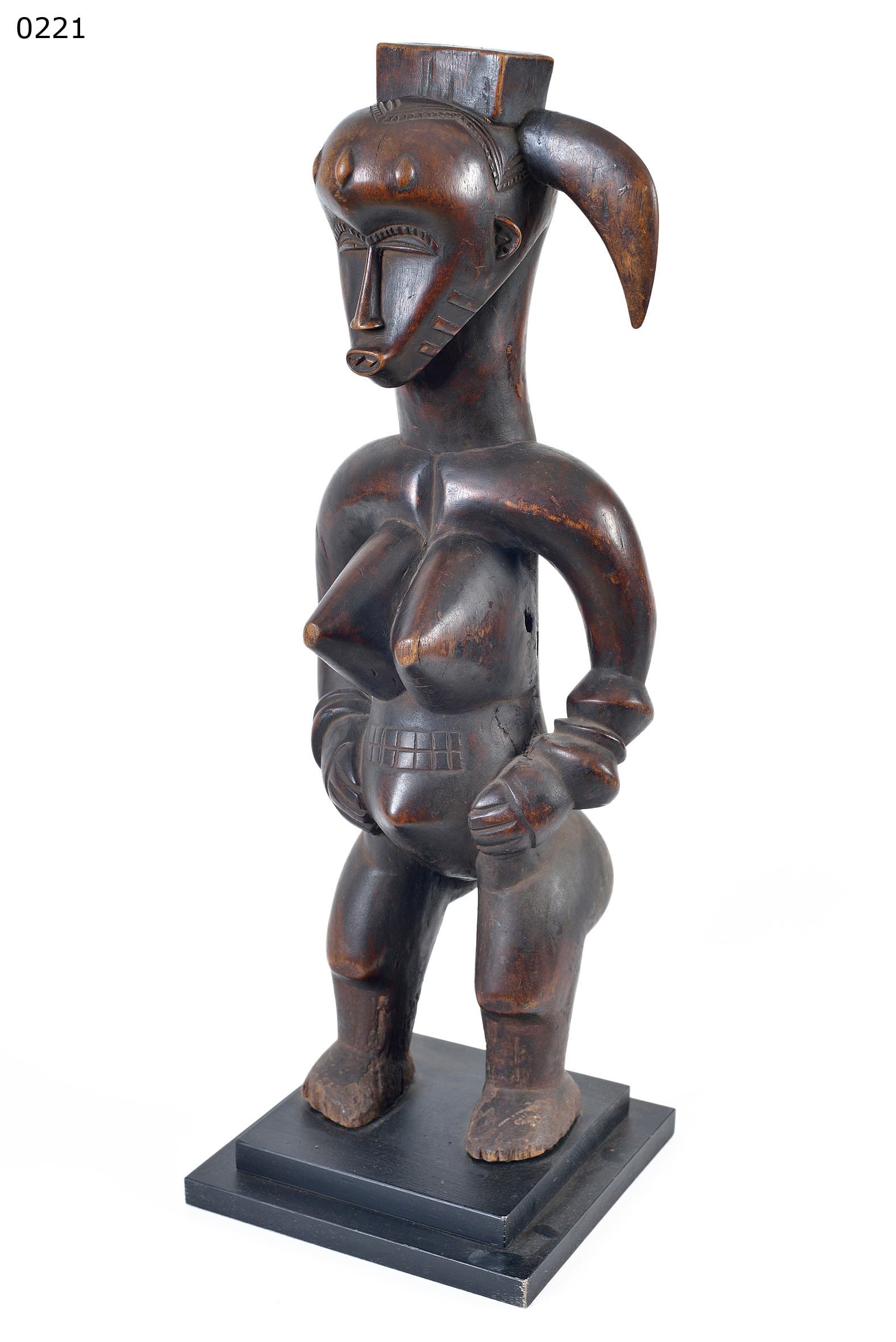
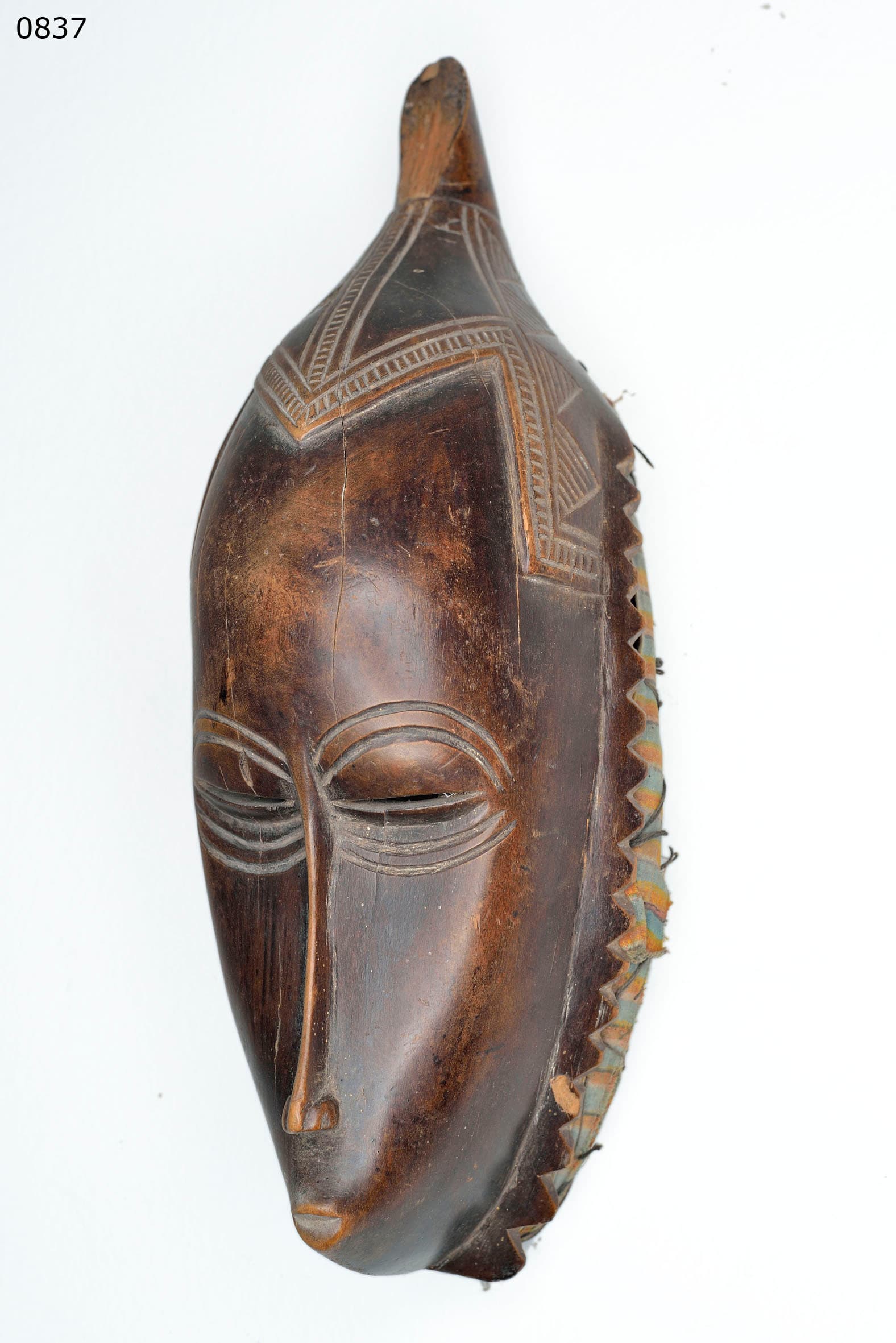
This pair of carved wooden heddle pulleys features sturdy U-shaped bases, with the smaller retaining its friction-worn wooden roller and the larger topped by an elegant, horned zoomorphic finial and incised geometric patterns. Both pieces exhibit a dark, highly oxidized wood grain with smooth, handled highlights.
1. Aesthetic style and regional traits
The Guro people of Ivory Coast, closely related to the Baule, are celebrated for their ability to infuse small, utilitarian objects with extraordinary sculptural grace. This pair demonstrates their stylistic range. The larger pulley features a stylized animal head — likely an antelope or bush cow — characterized by sweeping, elegant horns and a finely carved face, balanced by the rhythmic, incised cross-hatching on the yoke. The smaller pulley strips away literal representation, favoring a taut, architectural geometry that focuses entirely on the balance and weight of the structural form.
2. Ritual function and secret society context
In traditional West African society, narrow-strip cotton weaving is a highly respected, exclusively male profession, spiritually equated with the act of cosmic creation. These heddle pulleys are suspended above the loom to hold the cords that alternate the warp threads. By topping the pulleys with zoomorphic totems or abstract ancestral markers, the weaver ensures his loom is protected from malevolent bush spirits or witchcraft that might cause the delicate threads to snap. The rhythmic, repetitive clacking of the wooden roller is believed to be the physical voice of the guiding spirit aiding the weaver's hands.
3. Physical patina and age indicators
An early-to-mid 20th-century attribution for these tools is supported by their specific, function-driven wear. The smaller pulley retains a wooden spool, which is deeply grooved and worn asymmetrical from friction against cotton cords. Both U-shaped frames display smooth, blunted wear on their interior walls and elongated stretching at the suspension holes. The tropical wood has deeply oxidized over time, shifting from a polished finish to a dry, textured, and earthy brown patina consistent with active labor and environmental exposure.
Summary
These Guro heddle pulleys are fine examples of West African utilitarian artistry, blending zoomorphic elegance with daily domestic labor. Their detailed miniature carving and cord-worn friction patinas are characteristic of classic Ivory Coast textile production.
Written with AI assistance from the collection appraisal, object photography and our own research; editorially reviewed. Mistakes are possible — corrections are welcome. How we work →