Overview
The ethnographic, geographic and sociolinguistic location of the Guro is characterised by a complex mixture of historical migration, colonial categorisation and socio-economic stratification, which forms the basis for understanding their visual culture. The ethnic group's primary settlement area is centred on central Côte d'Ivoire, a topographical transition zone between the dense equatorial forest region in the south and the open tree savannah in the north. Geographically, this presence can be localised in detail on the western shores of Lake Kossou and in the administrative regions of Marahoué, Haut-Sassandra and Goh (Fischer 2008). More specifically, their heartland extends across the sub-prefectures of Zuénoula, Vavoua, Gouitafla, Bouaflé, Sinfra and Oumé, with smaller enclaves in the regions of Vallée du Bandama and Worodougou (Lewis 2012). Current demographic estimates put the population at around 500,000 to 600,000 individuals, making them a medium-sized but culturally highly influential grouping within the Ivorian nation state borders (Lewis 2012).
Linguistically, the Guro are clearly part of the South Mande language family, a subgroup of the Niger-Congo languages spoken by an estimated 25 million people in West Africa (Lewis 2012). This linguistic categorisation is of immense ethno-historical significance. As a schematic geographical and sociolinguistic localisation shows, the settlement area of the Mande-speaking Guro on the shores of Lake Kossou marks a hard linguistic boundary: they border directly on the Kwa-speaking Baule to the east. This geographical interface is the origin of the intensive stylistic exchange between the two cultures, which still dominates the art-historical classification today. In the north, the Dioula areas are adjacent, which illustrates the historical trade and migration routes from the Sahel region. The Mande languages, which include Guro (also Gouro), have a special linguistic feature: They lack the complex noun-class system that characterises most other Niger-Congo languages, which has repeatedly prompted linguists to discuss their classification as an isolated line of development (EBSCO 2023).
The nomenclature of the people reveals the asymmetrical power relations of colonial historiography and is by no means uncontroversial in recent research. The original and indigenous self-designation of the ethnic group is Kweni, in some dialects also Kwéndré or Lo (Goy 2014). The exonym "Guro", which is used globally today, was only imposed on them during the phase of military subjugation by the French colonial troops between 1906 and 1912. Remarkably, the French borrowed this term from the vocabulary of their hostile neighbours, the Baule, which illustrates the colonial practice of systematic cultural overwriting (Goy 2014). Although postcolonial ethnography occasionally argues for a re-establishment of the term Kweni, the term Guro has become firmly established in the institutional cataloguing of museums (for example in the Musée du quai Branly, the Rietberg Zurich or The Met) for pragmatic reasons of international compatibility in lending.
| Parameters | Classification / Description |
|---|
| Demography | approx. 500,000 - 600,000 individuals |
| Geography | Central Côte-d'Ivoire (Marahoué, Haut-Sassandra, Goh, Lake Kossou) |
| Linguistics | Niger-Congo, South-Mande (without noun class system) |
| Nomenclature | Self-designation: Kweni; foreign name: Guro (due to colonialism) |
| Social structure | Acephalous, council of elders, patrilineal, domestic mode of production |
| Neighbours | Baule (east), Dioula (north), Yaure, Wan, Mona |
The social structure of the Guro is strictly acephalous and decentralised. There is no centralised political authority, no kingship and no superordinate administrative hierarchy. Political decision-making and the exercise of legal power are based on local lines of descent. The villages are led by a council of elders, in which the heads of the most influential lineages dominate. A designated, particularly respected elder acts as primus inter pares, presiding over conflict resolution and representing the village vis-à-vis foreign ethnic groups or the state administration (Boyer 2008).
In economic anthropology, the French Marxist Claude Meillassoux brought about a paradigm shift in his ground-breaking monograph Anthropologie économique des Gouro de Côte d'Ivoire (1964), which was based on field research and revolutionised the reception of acephalous West African societies. He defined the concept of the "domestic mode of production" among the Guro (Meillassoux 1964). This structuralist approach explains that older men (elders) systematically exploit the labour of younger men and women by monopolising access to marriage alliances, the payment of bride prices and the genealogy of lineages. In contrast to Western capitalism, which generates power through the ownership of land or means of production, the accumulation of power among the Guro is based on control over people and their reproductive capacity. In this pre-colonial system, objects of art and prestige did not serve as subsistence goods, but as elite exchange capital for the circulation of women between the lineages (Meillassoux 1964).
In terms of subsistence farming, the Guro operate primarily as sedentary, partly seasonal farmers whose survival is ensured by a combination of subsistence farming and the production of cash crops. They cultivate cotton, rice, yams and, in modern times, increasingly coffee and cocoa (Fischer 2008). Agricultural work is subject to a rigid gender-specific division of labour: the physically demanding clearing of the fields is the responsibility of men, while the sowing, tending and harvesting of the plants is the responsibility of women (Bouttiaux 2012). This agrarian rhythm directly shapes the production of art. During the extended dry season, which lasts from December to April, work in the fields is suspended. During this phase, the Guro men devote themselves to hunting and highly specialised craft activities, in particular the weaving of textiles and the carving of ritual sculptures and masks (Fischer 2008).
The relationship between the Guro and their neighbouring peoples is characterised by an asymmetrical but continuous cultural and economic exchange. The centuries-long interaction with the nomadic Dioula in the north secured the Guro access to imported textiles, metals and Trans-Saharan salt (Fischer 2008). As the Dioula also speak a Mande language, they acted as a cultural link to the northern Sahel region. The relationship with the Kwa-speaking Baule, Yaure and Wan in the east is far more complex. Although the Guro are linguistically completely isolated from these groups, their geographical proximity to the water belt led to an intensive syncretic exchange of sculptural concepts and mask forms. This formal and institutional transfer has made the art-historical classification of artefacts from this border region extremely difficult up to the present day and has triggered central scholarly debates on the identity of African workshops (Vogel 1997).
Cultural context
The ontological, religious and cosmological order of the Guro is structurally significantly different from Western religious concepts and, despite regional adaptations, has clear distinguishing features from the belief systems of its Eastern neighbours. The metaphysical foundation is based on a polyvalent system of earth cults, rigid divination practices and highly institutionalised secret societies that mediate between the visible and invisible world. At the top of the spiritual hierarchy is a creator entity that often remains unapproachable and abstract in everyday cult practices. Instead, the active influence on the world of the living is attributed to a multitude of ancestral spirits as well as anthropomorphic and zoomorphic natural beings (Bouttiaux 2009).
An essential and institutionalised ritual actor in every Guro village is the "Earth Master" (Earth Master). While the political council of elders performs legal tasks, the Earth Master acts as an exclusive intermediary to the chthonic sphere. He performs elaborate sacrificial rituals and blood libations to the earth in order to ensure agricultural fertility, adequate rainfall and the general well-being of the community (Fischer 2008). Complementary to this collective protection exists the instance of the divinator (soothsayer). The divinator is consulted as a diagnostic authority before all life-cycle transitions, illnesses, marriages or important socio-political decisions. The divination practice, which often involves animal oracles (such as the mouse oracle technique common among the neighbouring Baule) or the interpretation of thrown objects, serves to identify disturbances in the cosmic order and to decree the necessary atoning offerings to the spirit world (Fischer & Homberger 1986).
The social executive and the ritual exclusivity for maintaining this cosmological balance lie with the gender-segregated secret societies. The primary institutions are the Je covenant (sometimes also transcribed Dye) of men and the complementary Kne covenant of women (Rood 1969). The male Je-Bund is far more present in the production of material culture and regulates de facto all fundamental socio-political, legal and police matters of the village. It decides on war and peace, sanctions deviant behaviour, detects harmful spells (witchcraft) and makes an obligatory appearance at the funerals of its high-ranking members in order to guide the soul of the deceased safely into the ancestral cosmos (Boyer 2008).
| Institution / actor | Cosmological function | Socio-political authority |
|---|
| Creator God | Origin of existence, passive distance | Cosmic architect |
| Earth Master | Chthonic Mediator, Agrarian Sacrifice | Ensuring Fertility |
| Divinator | oracle interpretation, crisis diagnosis | counsellor for life decisions |
| Je-Bund (men) | control of sacral masks, executive | justice, war/peace, funerals |
| Kne-Federation (women) | Specific initiation rites | Female solidarity and teaching |
The role of women within this cult complex is the subject of ongoing anthropological research controversies and has recently undergone a paradigmatic reassessment. The older research literature often postulated a marginalised, passive role for women. This was based on the indisputable fact that women are strictly forbidden from visual and tactile contact with activated sacred Je masks (such as the Zamble) under threat of draconian metaphysical sanctions. During rituals that evoke the bush and its raw natural forces, women must retreat into their homes (Vogel 1997). However, recent field research, largely driven by scholars such as Anne-Marie Bouttiaux at the Royal Museum for Central Africa (RMCA) in Tervuren, emphasises the complementary necessity of female participation to maintain ritual efficacy. In the performance of more profane entertainment masks (such as the Sauli or Zauli) as well as in certain rites of passage, women form an indispensable choral sounding board. They sing specific praise songs, dance at the edge of the ritual area and assist significantly in the design and repair of the voluminous textile mask costumes (Deluz 1993). Without this acoustic and material contribution from the women, the metaphysical activation of the male mask incarnation would be incomplete.
A far more profound theoretical controversy in the development of Guro mythology and ritualism is provided by the discourse within French-speaking anthropology. The renowned ethnologist and psychoanalyst Ariane Deluz interpreted the Guro myths (especially those narratives that thematise the origin of the masks and latent matrilineal tensions) primarily from a psychoanalytical complementarism based on the theories of Georges Devereux and Jacques Lacan (Deluz 1994). In her essays, Deluz argued that the rigid initiation and exclusive performative mask practice of men represent mechanisms for ritually sublimating the unconscious, Oedipal and gender-specific traumas of the community. The mask is interpreted here as a psychological vehicle for coping with aggression within the family.
This contrasts with the structuralist view coined by the American anthropologist Susan Vogel. Vogel sees the masks of the Guro and Baule primarily as a regulatory instrument for the physical and metaphysical regulation of the demarcation line between "village" (civilisation, socialised, primarily female-coded space) and "bush/wilderness" (nature, untamed, dangerous, primarily male-coded space) (Vogel 1997). In this binary structural model, theoretically underpinned by Henrietta Moore and Sherry Ortner, masked dance is not understood as a psychotherapeutic act, but as a controlled import of the dangerous forces of nature into the village in order to domesticate these forces for the good of the community (Vogel 1997). Impressive evidence of the institutional validation of this structural model can be found in the exhibition narratives of the RMCA in Tervuren, where the epochal Persona exhibition (2009) explicitly presented the masks not as isolated artworks, but as socially regulating vectors between bush, spirits and the village topography (Bouttiaux 2009).
Aesthetic features
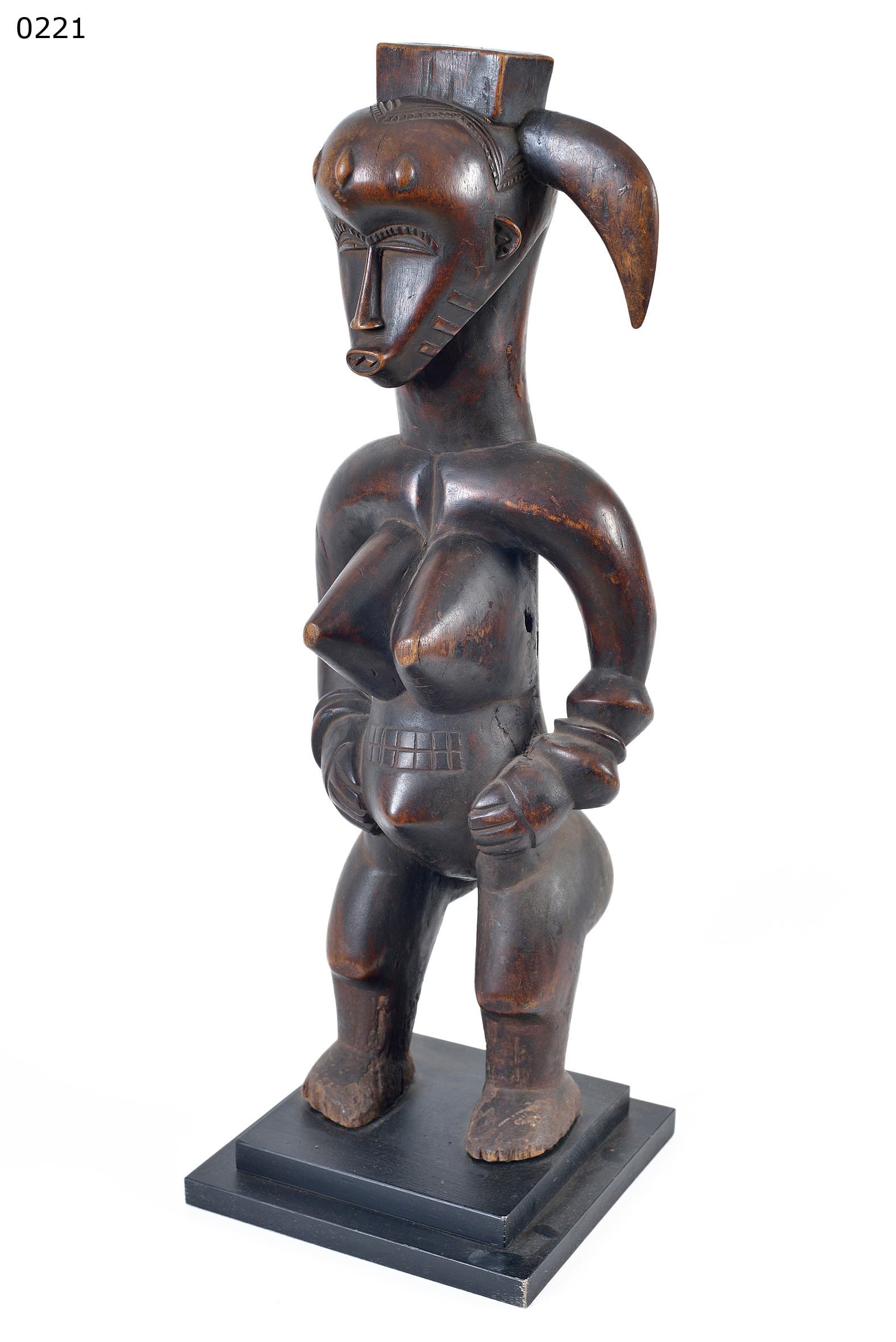
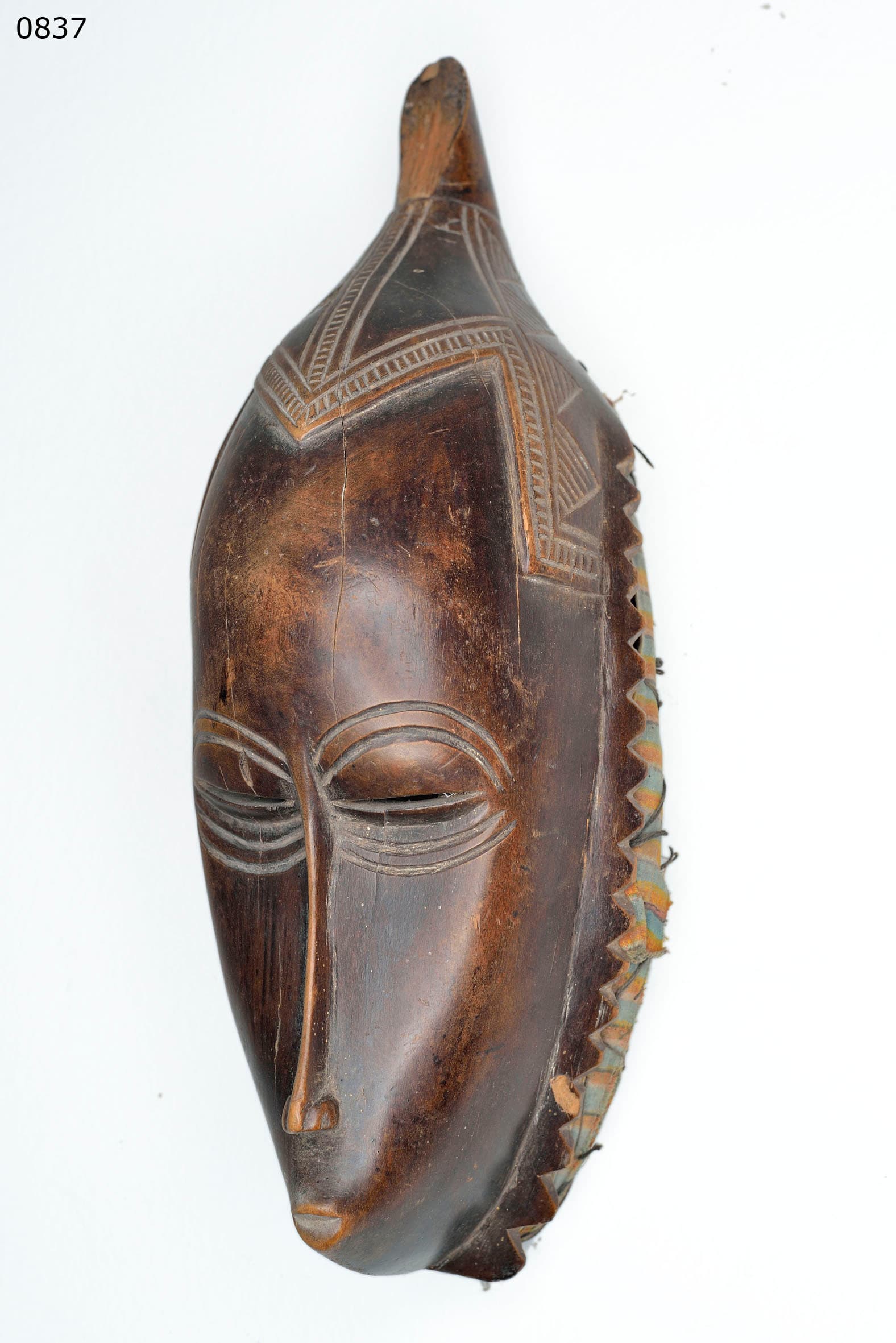
The canonical typology of Guro art is characterised by an elaborate, filigree formal language that is often subsumed in Western art historical discourses as the epitome of formal "elegance". This extreme sophistication in woodworking manifests itself in a strict canon of proportions, which makes Guro objects so highly sought-after on the global collectors' market. The classic proportions of Guro anthropomorphic face masks almost invariably follow a specific morphology: a strikingly elongated, vertically stretched face, in which the curve of the forehead and the fine bridge of the nose in the side profile describe a continuous, elegant and harmonious S-curve. The almond-shaped, almost completely closed eyes (often described as "swelling" or "contemplative"), a tiny, slightly pointed and protruding mouth and a highly detailed relief scarification (tattoo pattern) on the forehead, temples and cheeks are obligatory aesthetic attributes (Fischer & Homberger 1986; de Grunne 2015). A technical feature that distinguishes them from the very similar masks of the eastern Baule is the wide wooden collar often integrated into the solid wooden base, which serves as a robust attachment point for the voluminous, heavy raffia costume (LaGamma 2011). In addition, Guro carvers tend to fuse human facial features with animal elements in a surreal way far more than the Baule - be it protruding elephant ears on a human face or a complex attachment in the shape of a bird or leopard (Boyer 2008).
The mask-like manifestation of the pantheon is dominated by three central entities, the creation of which requires the highest level of craftsmanship. The sacred zamble mask represents a chthonic hybrid creature that fuses the morphological characteristics of an antelope (curved, fluted horns), a crocodile or leopard (elongated, fearsome snout) and a human (head and eye area) in one sculpture (Fischer 2008). These mostly polychrome, red and black masks evoke abstract male energy, speed and potential ritual terror. Their aesthetic, mythological and dance counterpart is the gu mask, which represents the wife of the zamble creature. Gu masks show a sublimated female countenance immersed in deep contemplation, crowned by highly complex hairstyles or animal attachments. They are considered the pedagogical ideal of feminine grace, ethical restraint and moral integrity and are the most sought-after collector's items (Bouttiaux 2009). The third major category comprises zauli (or sauli), a primarily profane entertainment mask. It often features deliberately caricatured exaggerations and is necessarily crowned with spectacular animal carvings, carved birds, snakes or even entire figurative horsemen on the head to amuse the public at village festivities (Homberger 2001). Another masculine category is the Dye grouping (or Je), which includes powerful animal spirits such as hyena, buffalo or rams and appears as the ultimate symbol of male authority at funerals (York's Shona Gallery 2020).
| Mask/Object Type | Iconography & Formal Characteristics | Ritual Function & Gender Coding |
|---|
| Zamble | Hybrid creatures: Antelope horns, crocodile snout | Aggressive masculine energy, sacred |
| Gu | Idealised woman: S-curve, scarification, zigzag hair | Male danced, model of female grace |
| Zauli / Sauli | Caricature-like, elaborate figurative essays | Profane entertainment, festivities |
| Dye / Je | Zoomorph: ram, hyena, buffalo, massive | Executive authority, funerals |
| heddle pulley | Anthropomorphic heads, miniature format | Profane tool with high aesthetic appeal |
In addition to the monumental mask carving, the virtuosity of the Guro artists' craftsmanship manifests itself in profane but ritually charged everyday objects, in particular the loom pulleys (heddle pulleys). These small wooden pulleys (usually 15-25 cm in size) hang directly at the weaver's eye level in the traditional narrow band loom (strip loom). They feature meticulously carved, often idealised female faces. As Yaelle Biro explains in her analysis for the Museum of Modern Art (MoMA), the primary function of these extremely finely crafted bobbins was to present the weaver with an aesthetically perfect image for inspiration and contemplation during the monotonous, hours-long labour (Biro 2026). Examples of these bobbins, which were often carved by the same masters who created masks, are among the absolute highlights in the collections of the Courtauld Institute, the MoMA and the Museum Rietberg (Fénéon Collection) due to their formal abstraction.
Within Guro research, there is a sharp, still unresolved iconographic controversy regarding the authorship and stylistic delimitation of the workshops. The Swiss ethnologists Lorenz Homberger and Eberhard Fischer and the Belgian art historian Bernard de Grunne advocate the methodological approach of strictly isolatable "master hands" (Master Carvers) and closed local workshops. They classify objects according to meticulous morphological signatures and attribute them to historical individuals - the most famous of these is the unknown "Master of Bouaflé" (active ca. 1890-1920). His specific signature includes an extremely precise zigzag hairline pattern, a strongly arched forehead, eyes formed by two oblique incisions and a characteristic thick lichen on the nape of the neck (Pigearias & Hornn 2011). Homberger argues in favour of a clear territorial dividing line between the Guro and Baule workshops along topographical markers (the so-called water belt).
The renowned US researcher Susan Vogel vehemently disagrees with this rigid morphological demarcation. In her groundbreaking studies (Baule: African Art, Western Eyes, 1997) on the Guro-Baule border area, she argues in favour of a phenomenon of interlocking "inter-workshop migrations". According to Vogel, commissioned works, stylistic elements and even the artisan carvers themselves circulated fluidly across ethnic and linguistic boundaries. A Baule client often ordered from a Guro carver because he had special ritual or aesthetic expertise. Therefore, according to Vogel, the definition of isolated Guro or Baule Classicism was artificial; the final style was primarily based on the metaphysical and ritual requirements of the respective client, completely independent of the geographical or ethnic origin of the artist (Vogel 1997).
Ritual practice
The life cycle of a sacred guro ritual object is a highly complex, regulated process of gradual ontological transformation in which a profane piece of wood transubstantiates into a metaphysically active, extremely dangerous actor. This process eludes the binary Western concept of pure object production, which strictly separates form and matter (Vogel 1997). The physical carving is the exclusive responsibility of highly specialised male craftsmen (often family lines in which knowledge is passed on from father to son) and necessarily takes place in ritually secured, shielded areas of the "bush" (the wilderness) away from the village. This spatial segregation is essential in order to prevent visual contact with non-initiated women and children, as the untreated transitional state of the resulting mask is considered highly volatile and taboo (Fischer 2008). Even the choice of material is not a purely pragmatic or aesthetic, but a deeply magical act: the wood must have specific spiritual vectors, as the Guro believe that it is already impregnated with the active, dangerous forces of nature before the first carving. Only the correct wood gives the final work its necessary vital charge (vital charge) and guarantees the intervention power of the spirits (Boyer 2008).
However, once the physical form of the face mask is complete - a process that takes days and is finalised by staining with natural pigments, painting and the ritual setting of the scarification lines - the wooden object is still not fully active. Its actual metaphysical activation (activation) requires a performative symbiosis of material, movement and the human body. Only when the wooden face is sewn together with the comprehensive, often extremely heavy textile and raffia costume (which completely conceals the wearer's human body) and the designated, ritually cleansed dancer puts on the mask does the artefact transform. Significantly, in the linguistic nomenclature of the Guro, there is no isolated term for the physical "wooden mask" per se; the term always describes the inseparable amalgam of invoked spirit, costume, polyrhythmic music and ecstatic dance movement (Bouttiaux 2009).
| phase of the life cycle | location | ritual actors | function / state |
|---|
| 1st wood selection & carving | bush (wilderness), far from the village | initiated master carvers | transfer of vital charge into the wood |
| 2. corporeal activation | transition zone bush-village | carvers, musicians, dancers | symbiosis of wood, raffia and human body |
| 3. performance & sacrifice | village square or sacred grove | mask, Je-covenant, choir (women) | libations, executive power, social regulation |
| 4. deactivation / ageing | hidden shrines | council of elders, mask guardians | incrustation of sacrificial patina, resting of energy |
| Physical decay | bush | termites, weather | diffusion of residual energy back into nature |
The human dancer, always a man, undergoes a profound spiritual and corporeal transformation during this activation; his worldly identity is completely erased (eclipsed), and his body mutates into a corps dressé (a disciplined, physically extremely loaded vessel) that now serves exclusively as a mouthpiece for the spiritual power of the bush entities to defend the continuity and honour of the village community (Bouttiaux 2009; Legendre 1978). During the ritual practice of the powerful Dye or Je groups, libations and sometimes animal sacrifices are continuously offered to the mask to appease its wrath or to favour it at the funerals of prominent dignitaries (Sacks 2018). The liquid food offerings (such as chicken blood, fermented palm wine, millet porridge and cola nut chews) incrust into the surface of the wood over decades and form an opaque, crusty sacral patina that differs fundamentally from the smoothly polished, clean aesthetics of purely profane objects.
The deactivation or final disposal of ritual objects depends on their physical state of preservation and the fluctuation of metaphysical power. An object that is irreparably damaged or badly eaten away by termites loses its ritually binding power. It is stripped of its textile and sacred attachments and remains in the bush, where the residual energy bound in the wood slowly and surely diffuses into nature.
However, contemporary ritual dynamics in Côte d'Ivoire have forced a massive urbanisation and commercialisation of the life cycle. Mask ensembles are now increasingly performing in urban areas, in nightclubs, for tourists or at state peace ceremonies (as documented in Bouaké in 2008) in return for financial remuneration. The economic capital generated in this way flows back to the home villages in the form of consumer goods (smartphones, textiles) as prestige, which redefines the social significance of the masked dancer in the 21st century. However, research (documented in publications by the Fowler Museum at UCLA and exhibitions at the Branly, among others) shows that this commercialisation does not necessarily deconstruct the intrinsic spiritual coherence of the Guro tradition in the village, but rather represents a resilient adaptation of pre-colonial rituals under the conditions of global capitalism (Bouttiaux 2012).
Historical context
The historical genesis of Guro art and its transformation into global collectibles is inextricably intertwined with pre-colonial migratory movements, violent imperial caesuras and the discovery of African aesthetics by the European avant-gardes of the early 20th century. The macro-history of the ethnic group begins between the 13th and 16th centuries, when the Mande-speaking ancestors of today's Guro migrated south from the arid Sahel region of present-day Mali to the forest savannahs of central Côte d'Ivoire (Fischer 2008). There they established themselves at the junctions of West African trade routes. However, the archaeological sources regarding the exact dating of this migration and the gradual assimilation processes of autochthonous previous populations remain incomplete and ambiguous.
The most profound epochal break, which radically changed the production of art, occurred with the colonial penetration. French colonial troops subjugated the people (who called themselves Kweni) in bloody and brutal campaigns between 1906 and 1912 (Goy 2014). This so-called "pacification" destroyed traditional African trade networks, enforced monetary tax systems and undermined the pre-colonial subsistence system based strictly on kinship and age as described by Claude Meillassoux (Meillassoux 1964). The colonial forced cultivation of cash crops changed the time economy of the woodcarvers. At the same time, it was precisely this military and administrative occupation that opened the channels for the mass transfer of ritual artefacts - often as booty or through asymmetrical barter - to the ethnographic collections and galleries of Europe.
The market history of Guro art in the West, whose precise historical processing is impressively reflected today in the digitised provenance files of the Musée du quai Branly or the British Museum, experienced its absolute breakthrough in the 1920s and 1930s in Paris (Goy 2014). The visionary gallerist Paul Guillaume (1891-1934) played a leading role. Guillaume no longer presented Guro masks as obscure ethnological curiosities, but contextualised them as formal masterpieces on a par with the European avant-garde (Modigliani, Picasso). Amongst other things, he passed on masks by the "Master of Bouaflé" to institutional pioneers such as the Barnes Foundation in Philadelphia or the Rietberg Museum (Inv. RAF 466) (Pigearias & Hornn 2011). Another prominent, early example of art historical ennoblement is the art critic Félix Fénéon, who explicitly included Guro weaving spools in his private collection as "art from far away places" and was thus one of the first intellectuals to deny them the pejorative stamp of the "primitive" (Biro 2026).
| Historical phase | Central events & actors | Market effects |
|---|
| 13th - 16th century | Migration of Mande ancestors from Mali | Establishment in the Kossou lake area |
| 1906 - 1912 | Colonial subjugation by the French | Forced export of artefacts to Europe |
| 1920s | Paul Guillaume, Félix Fénéon | Establishment as avant-garde art |
| 1934 | André Breton, publication in Negro anthology | Inclusion in the Surrealist canon |
| 2014 | Tajan auction in Paris (Master of Bouaflé) | Record price of 1.375 million euros |
The appropriation by Surrealism reached its peak when André Breton prominently displayed a now legendary Guro mask in his Parisian flat in Rue Fontaine around 1924. This specific mask, crowned by an embracing couple and attributed to the Master of Bouaflé, appeared in Nancy Cunard's radical anthology Negro (1934), then disappeared into private ownership for decades and finally realised a record price of 1.375 million euros when it was rediscovered on the Paris auction market at Tajan in 2014 (Cunard 1934; Goy 2014).
This extreme financial market price distortion has predictably generated a flood of highly professional forgeries in recent decades, the identification of which requires in-depth material and forensic analyses. Today, macroscopic analyses of heartwood cracks are among the most important authenticity criteria for private collectors. These cracks are evidence of natural, extremely slow drying of the wood over decades in the changeable subtropical climate of the Ivory Coast and can hardly be reproduced identically artificially in an oven (Fischer 2008). Another decisive indicator is the evidence of autochthonous termite feeding. An authentic feeding path of the African species Macrotermes bellicosus always runs with microscopic precision along specific, softer wood fibre layers and can be clearly distinguished forensically from recent forgeries applied with modern dental drilling tools or acids. In addition, the stratigraphy of the sacral patina is forensically examined: genuine incrustations of cola nut chewing oil, soot, animal blood and kaolin are characterised by a historically evolved layer formation (stratigraphy), whereas market-oriented forgeries can often be unmasked by quickly rubbed, chemically homogeneous layers of shoe polish, bitumen or artificial resins (Fischer 2008; LaGamma 2011). For serious private collectors, complete provenance research, ideally with photographic evidence from collections from the pre-1950s (as in the case of the Breton mask), is therefore often a more reliable indicator of historical originality than purely aesthetic morphological conformity.