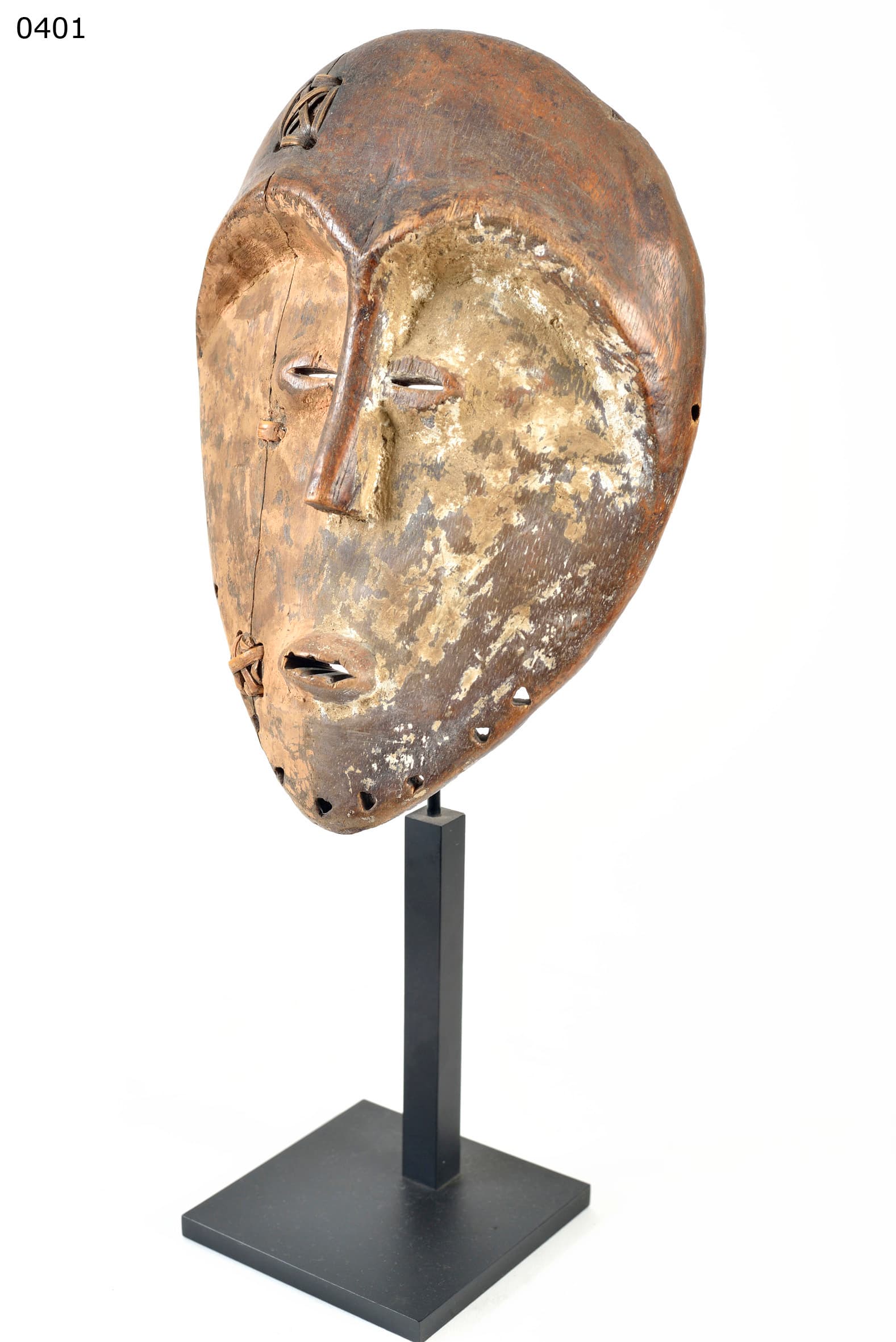
A small, oval wooden mask featuring a concave, heart-shaped facial plane, narrow coffee-bean eyes, and a small mouth. It is heavily coated in white kaolin clay and has a small tuft of natural fiber attached to the chin.
1. Aesthetic style and regional traits
This mask exemplifies the classic Lukwakongo style of the Lega people. It is characterized by its stark, minimalist geometry: the deeply concave, heart-shaped face and the protruding, slit "coffee-bean" eyes. The Lega traditionally avoid naturalism, opting instead for a highly standardized, easily readable visual icon that signifies membership and rank within their complex social structure. The visual standardization is understood to be institutionally meaningful — Bwami masks are designed to be recognizable across the entire society, so individual creative variation is typically suppressed in favor of canonical form.
2. Ritual function and bwami pedagogy
This mask was not worn over the face during public dances. Instead, it is a badge of rank belonging to the Yananio grade of the Bwami secret society. During closed initiation ceremonies, the mask is held in the hand, strapped to the arm, or hung on a fence. It is used as a pedagogical tool to illustrate specific proverbs, teaching initiates vital moral lessons regarding social harmony, restraint, and wisdom. The non-worn use of these masks is itself characteristic — Bwami visual culture is traditionally associated with proverbial display rather than performative dancing.
3. Physical patina and age indicators
The heavy application of white kaolin is traditionally associated with the mask's spiritual efficacy, as white connects the object directly to the realm of the ancestors and moral purity. The thick, crusty, and actively flaking state of this pigment, layered over dark, oxidized wood, suggests repeated ritual use. The brittle, aged state of the fiber beard is consistent with an early 20th-century origin in the Congolese rainforest.
Summary
A classic Lega Bwami mask that utilizes stark, concave geometry and white kaolin to impart profound moral proverbs. Its flaking pigmentation and fiber attachments make it a compelling document of Central African secret societies.
Written with AI assistance from the collection appraisal, object photography and our own research; editorially reviewed. Mistakes are possible — corrections are welcome. How we work →