Overview
The Bidjogo (alternately transcribed in ethnographic literature as Bijagós, Bidyogo or Bijago) represent a relatively small demographic, but historically and culturally highly singular ethnic group inhabiting the Bissagos archipelago off the West African coast of what is now the Republic of Guinea-Bissau. The archipelago comprises over eighty islands, whose geological and ecological isolation has acted as a natural bulwark for centuries, preserving the socio-cultural integrity of the people. Demographic macro data from the World Bank and current census projections put the total population of Guinea-Bissau at around 2.2 million individuals for the year 2024. Within this national structure, the Bidjogo form a marginal minority with an estimated population of 30,000 to 36,000 speakers. Nevertheless, their cultural footprint, particularly in the field of material culture and ritual sculpture, has a presence that radiates far beyond West Africa into the archives of Western institutions. Collections such as that of the Royal Museum for Central Africa (RMCA) in Tervuren impressively illustrate through their West African sub-collections that, due to the long archipelagic isolation, the Bidjogo objects often exhibit completely different formal and patinated characteristics than the artefacts of the mainland ethnic groups collected at the same time.
The linguistic categorisation of Bidjogo (or Bijagó) is the nucleus of an ongoing and sharp scholarly controversy. Traditionally, macro-classifiers assign the language to the Bak subgroup of the Atlantic branch of the Niger-Congo language family, which would make it nominally related to the languages of neighbouring Diola or Balanta. However, this established taxonomy is being massively deconstructed in modern descriptive linguistics. Leading linguists such as Güldemann (2018) and Childs (2003) argue that the Atlantic language family is based on a methodological construct and a scientific inertia ("scholarly inertia"). They postulate that the lexical and morphological divergences are so serious that Bidjogo should be more precisely classified as an independent linguistic isolate within the Niger-Congo phylum. This isolation thesis is supported by an extreme internal differentiation of the language. Four distinct main dialects can be identified: Kagbaaga (spoken on Bubaque), Kajoko (on Orango and Uno), Anhaki (on Canhabaque) and Kamona (on Caravela and Carache). The fragmentation goes so far that the northern Kamona dialect is almost incommensurable for speakers of the other islands. A phonological singularity that supports the linguistic isolate argument is the existence of a rare linguolabial consonant (d̼ or b̼) in the Kajoko dialect, which is completely absent in the neighbouring languages.
| Demographic and Linguistic Classification | Data / Specification |
|---|
| National population (Guinea-Bissau 2024) | approx. 2,201,352 |
| Ethnic population (Bidjogo) | 30,000 - 36,000 |
| Linguistic macro-family | Niger-Congo (controversial) |
| Primary dialect groups | Kagbaaga, Kajoko, Anhaki, Kamona |
| Research controversy (classification) | Atlantic group (traditional) vs. isolate (Güldemann/Childs) |
The socio-political architecture of the Bidjogo is decidedly acephalous; there is no centralised state superstructure, no indigenous kingship in the Western sense and no institutionalised jurisdiction. Instead, society operates as a strict gerontocracy based on a highly complex, strictly sequenced system of age grades (age-grades) and age sets (age-sets). Access to political decision-making power, land use rights and ritual executive power is absolutely linked to initiation status and biological-social age. The kinship system through which these rights are handed down has strong matrilineal structures, which is a notable exception in West African ethnography.
The subsistence economy is dichotomised along gender lines and is based on two pillars. Women dominate the agricultural sphere, especially cyclical wet rice cultivation in the mangrove zones, crustacean gathering, processing and local trade, which gives them considerable economic autonomy. The men concentrate on maritime activities, deep-sea fishing, the extraction of palm wine and - in pre-colonial times - military expeditions. The historical relationship with the continental neighbouring peoples (such as the Biafada, Mandinka or Papel) was characterised by an asymmetrical dynamic of violence. The Bidjogo utilised their nautical superiority in massive war pirogues to regularly attack the mainland for slave hunts and cattle raids. This offensive maritime isolation not only allowed them to successfully evade Islamic conversion waves from the Sahel, but also to fend off European infiltration attempts well into the 20th century, enabling them to preserve their indigenous cultural system in rare purity.
Cultural context
The spiritual paradigm of the Bidjogo is based on a cosmological order that differs structurally from many mainland African models, as it is an extreme synthesis of unapproachable high god theology and granular worship of nature spirits. At the head of the pantheon is an omnipotent but distant creator deity who, depending on the dialect and island, is referred to as Nindo, Nalí Batí or Orrebuco-Ocoto. As this creator does not intervene in the profane concerns of the people, daily ritual practice is completely focussed on a vast number of ancestral, nature and protective spirits, which are subsumed as iran in the Creole lingua franca and as orebok in indigenous terminology (especially on Bubaque). The interaction with these entities takes place in dedicated sacred buildings, the so-called baloba. These shrine houses function as spiritual epicentres of the villages; they house the sacred symbols of the lineage and are subject to strict gender segregation during ritual gatherings - women sit on one side of the room, men on the other.
The structure of the ritual authorities and the role of women in the cult form the core of one of the most prominent iconographic and sociological controversies in the region. Early research, largely influenced by the Austrian ethnologist Hugo Adolf Bernatzik, who travelled to the islands in 1930-1931, postulated the myth of an extreme matriarchy. In his publications (e.g. Äthiopen des Westens), Bernatzik (1933) reported on a radical female leadership in which women chose their husbands, dictated divorces and enjoyed unchallenged supremacy. This essentialist, partly romanticised perspective was methodically deconstructed and relativised by modern ethnographic research - in particular by Luigi Scantamburlo (1978), Danielle Gallois-Duquette (1983) and later Rosanna Henriques.
Rather, the current sources (Henriques, Gallo 1995) provide evidence of a differentiated system of power-political complementarity. Male power (Oronho) is individualised, political-executive and derives directly from the relationship to the royal lineage and the ancestral line. Female power, on the other hand, is deeply spiritual and collectively organised. The group of older, initiated women (okinka) elects a leader (also called okinka) from its ranks, who has a powerful representative and sacred mandate. Women function primarily as diviners and healers; they have absolute cult authority in combating witchcraft and are responsible for ritual measures against disease, social unrest and crop failures. A fundamental spiritual duty of women is the Orebok ritual: they act as mediums in possession trances to appease the restless spirits of boys who have died before their initiation. This "recuperative initiation" grants the dead boys posthumous adult status and protects society from the destructive wrath of these limbo-bound souls. This degree of female control over male ancestral lines makes the Bidjogo structurally very different from strictly patrilineal neighbouring peoples. Collections from Western institutions, such as the Fowler Museum at UCLA, provide essential material evidence for the study of this gender variance in West African ritual objects through their carefully documented artefacts.
| Male Initiation Cycle (Age Classes) | Sociological Characteristics & Ritual Commitments |
|---|
| Nea / Ongbá / Kadene | Informal early phases, childhood. |
| Kanhokam | Warrior ethos. Handling of wooden swords, shields and imitation rifles at dances. |
| Karo* (pl. n'aro) | Focus on dance and finding a partner. Permission for eshoní (temporary relationships), but without right to paternity or land ownership. |
| Manras* (Fanado) | The central initiation and retreat rite in the sacred forest. Strict secrecy; transformation into an adult. |
| Kamabi / Kassuká | Full adult status. Right to koneió (permanent marriage), land ownership and social fatherhood. |
| Okotó | Status of elder (Elders). Membership of the executive council, access to the most profound sacred knowledge. |
The male life cycle is subject to a rigid, sequential dictate that culminates in the top-secret initiation complex of the manras (also called fanado). Before this initiation, the boys go through phases such as the kanhokam (in which they try out a martial ethos with wooden swords) and the karo phase, a period of relative freedom in which temporary romantic relationships (eshoní) are permitted, but rights to land or fatherhood are strictly denied. The transition to the adult class (kamabi/kassuká) requires a retreat into the sacred forest (manras). This process is characterised by absolute secrecy; the local principle is: "If a bidjogo speaks, he will die". Initiation transforms society into two hierarchical groups: those who "know" and rule, and those who are "ignorant" and must obey. The initiation rite is of such existential importance that a separate spirit, the iran di fanadu, was created, to whose will the initiates must submit unconditionally.
Aesthetic features
The sculptural and aesthetic canon of the Bidjogo is highly distinctive and operates primarily in two main material categories: the hermetic, geometrically reduced statuary of the ancestor and power figures (iran) and the expressive, kinetic formal language of the zoomorphic initiation masks. The difference between an activated ritual object and a profane object is striking in the Bidjogo and is primarily recognisable in the patina. Profane objects, such as the masterfully carved spoons, which were presented in a groundbreaking exhibition at the Museum Rietberg in Zurich in 1990, have a shiny, hand-welded, polished patina. Activated iran shrine surfaces, on the other hand, accumulate an amorphous, deeply encrusted and ritually charged sacrificial patina through iterative libations of animal blood, palm oil and millet porridge.
The canonical typology of iran figures (often called orebok) serves as a physical receptacle for spirits. Their canon of proportions ignores anatomical naturalism in favour of a highly geometricised reduction that fascinated early European avant-garde artists. Typical features include a cylindrical torso, a flattened face with a pointed chin, semicircular ears and a distinctive neck ring. The figures - both male and female - are often conceived seated on a traditional stool, with navel, breasts and buttocks hyperbolically emphasised as markers of lineage continuity and fertility. A recurring material aesthetic specific to the most valuable pieces is the incrustation of the eye areas with imported European glass beads or metal pins, suggesting the entity's piercing, all-seeing gaze.
A fascinating iconographic controversy concerns the integration of colonial status symbols into sacred art. Already in sculptures from the 1930s (as photographed by Bernatzik) and late 19th century iran figures wearing European top hats (Chapeau Claque) can be found. While early interpreters dismissed this as a naïve adaptation of colonial clothing, Danielle Gallois-Duquette (1983) proves that the top hat was deliberately reinterpreted semantically by the Bidjogo: It did not function as a symbol of subjugation, but was integrated into the inventory of their own objects of power as the ultimate emblem of royal dignity, wealth and resistance in order to arm the spiritual authority of the ancestors against the colonial threat.
| Typology of the Bidjogo sculpture | Morphological & iconographic characteristics | Function / sponsorship |
|---|
| Iran / Orebok statuettes | Cylindrical torso, flat face, pointed chin. Often seated. Inlaid eyes (glass/metal). Encrusted sacrificial patina. | Ancestor/spirit receptacle in the baloba. Sacrificed for fertility and protection. |
| Orrebuco ocoto (bottle figurine) Cylindrical vessel shape, often covered with red fabric, sometimes with anthropomorphic head. | Highest divination and power figure. Extremely rare. | |
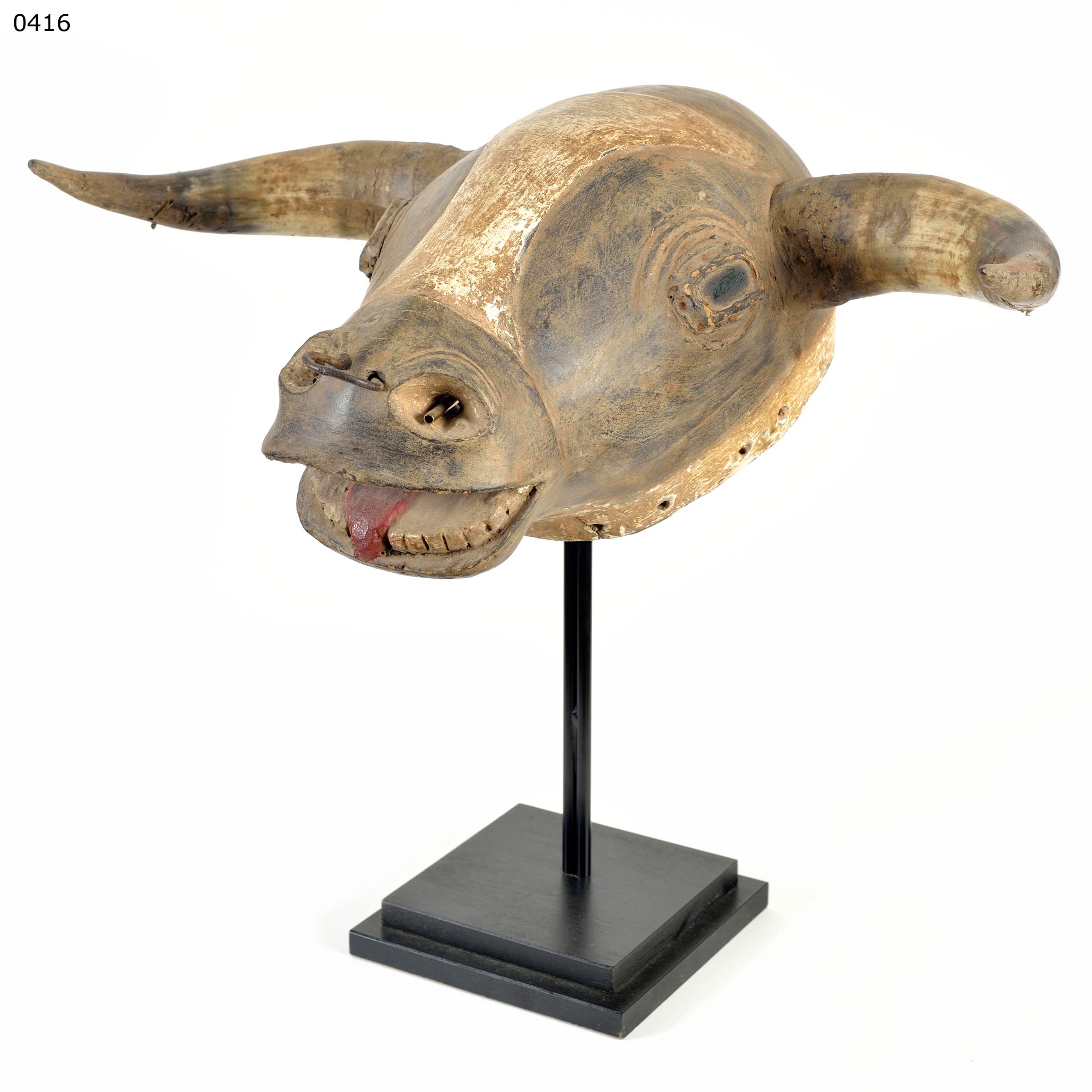
| Vaca Bruta / Dugn'be mask | Realistic bovine head, incorporation of real animal horns, glass eyes, guiding rope through the nostrils. | Male post-adolescence (cabaro). Symbolises uncultivated youthful power. |
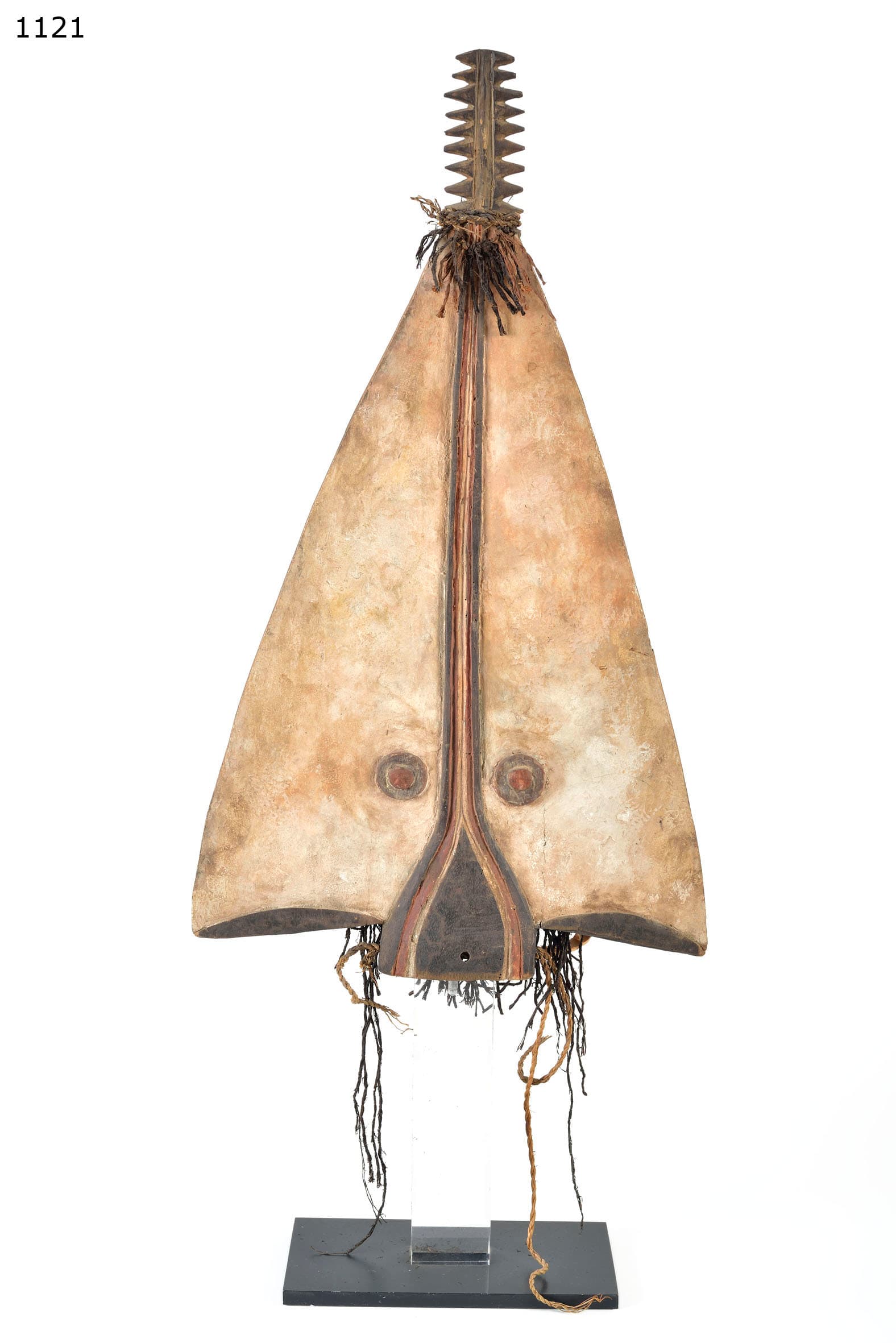
| Maritime crests (shark / sawfish) Horizontal forehead attachments, geometrically reduced. Use of genuine sawfish crests. Complemented by wooden dorsal fins on the back. | Initiation and memorial dances. Mimics the unpredictable agility of ocean predators. | |
The bottle-shaped Orrebuco ocoto power figures form an extremely rare subtype. Only around ten examples of this type are documented worldwide, including pieces in the Brooklyn Museum and the Museu Nacional de Etnologia in Lisbon. The stylistic-critical analysis of this limited group enables the identification of "master hands" that are unknown by name but evident in their craftsmanship. Thus, three of these figures (Brooklyn, Wall Collection, former Allan Stone) can undoubtedly be attributed to the same master carver due to exact stylistic similarities.
The mask-like production is dominated by the iran mask complex of zoomorphic helmet and forehead masks, which primarily depict marine predators (sharks, sawfish, rays) and terrestrial bovids (bulls, calves). Strict forgery criteria are relevant for the art market in the case of bidjogo pieces. As the objects achieve high auction prices, experts (for example at Christie's or through companies such as Art Certification Experts) resort to forensic analyses. X-ray scans and infrared reflectography are used to identify hidden cracks in the heartwood, artificially induced termite damage or modern metal pigments in the paint, which expose recent falsified "antiquisation". Today, outstanding, authenticated holdings of this aesthetic form core exhibits in institutions such as the Musée du quai Branly in Paris, which has documented the geometric radicalism of the iran figures in various catalogues.
Ritual practice
The ritual practice of the Bidjogo is deeply embedded in the age group structure and manifests itself most strongly in the life cycle of the initiation masks. From the moment it is carved, a mask goes through a phase of ritual activation; it is not merely a costume, but is "charged" by offerings - primarily the blood of chickens or cattle as well as palm wine - whereby the spirit (iran) incarnates into the wood.
The most spectacular performance is the dance of the vaca bruta (wild bull) or dugn'be ("the ox reared in the village"). These heavy helmet masks, which are often fitted with real cattle horns, are worn exclusively by the cabaro age group - young men in a ten-year post-adolescent phase before their final full initiation. The performance is physically extremely demanding and dangerous. The dancers, dressed in heavy raffia skirts and wearing bells, do not dance upright but crawl on their hands and knees. The choreography imitates the unpredictable, aggressive thrusts of an untamed bull, metaphorising the raw, uncultivated nature of youth. An essential iconographic and performative detail is the pull rope that is threaded through the mask's nostrils: Older attendants hold this rope during the dance and try to tame the "bull" - a direct ritual staging of the social domestication and subjugation of youth to the authority of the gerontocracy.
The performance structure of the maritime masks (shark, sawfish, hammerhead shark) varies considerably. These objects are usually not full helmets, but forehead crests that are tied in such a way that the dancer's face remains uncovered. The dancer tilts their upper body horizontally parallel to the floor and performs whipping, oscillating movements. The illusion of the maritime predator is completed by a wooden dorsal fin strapped to the dancer's back. While calf and fish masks are worn by younger boys, the dangerous predatory fish and large bovids are reserved for the older uninitiated groups.
Apart from the mask rituals, the domestic and village altar use of the iran statues requires constant care. In the baloba shrines or private homes, these figures function as divinatory foci and protective instances against curses. The practice of sacrifice is strictly conditional: animal sacrifices must be made before any agricultural activity, in the event of illness or to confirm a village head, and after the harvest the iran is entitled to a share of the yield (usually millet or rice). Another highly feared form of ritual materiality is the use of plant artefacts, namely the koratokó (or n'oratokó). These are elaborately knotted, fresh palm leaves made by specialists. They are used to attract aggressive forest spirits, to consecrate sacred places, to keep thieves away from fields or to be used as an offensive magical weapon against witchcraft.
The life cycle of a ritual object is finite. An iran only retains its power as long as it is cared for and sacrificed. If the wood loses its structural integrity through natural decay, weathering or massive termite infestation, it is believed that the spirit has left the receptacle. Such deactivated objects are not sacredly preserved but left to rot in the forest without further ceremony - a circumstance that explains the rarity of pre-colonial pieces in Western collections such as those of the Musée du quai Branly or the British Museum.
Historical context
Reconstructing the historical genesis of the bidjogo is a complex endeavour that was long overshadowed by Eurocentric diffusion models. In the middle of the 20th century, the Portuguese researcher Fernando R. Rogado Quintino (1962) advocated the widely received, but now considered obsolete, migration theory according to which the Bidjogo were direct descendants of ancient Ethiopian populations that migrated from the Sahara region to the west coast due to climatic changes. He cited morphological similarities in sculpture and wall paintings as supposed evidence. Modern Africanist historiography and ethnology (cf. Scantamburlo, Bordonaro) radically rejects this model. Instead, it postulates that the colonisation of the archipelago was the result of a successive, autochthonous fragmentation and separation of mainland ethnic groups, which consolidated an independent cultural identity on the islands - protected by nautical isolation.
The colonial encounter of the Bidjogo differs strikingly from the regional standard. While large parts of the African mainland were subjugated relatively quickly, the Bidjogo vehemently defended their autonomy on the islands such as Canhabaque against the Portuguese colonial power until the 1930s. Their fleets of warships of up to 70 men not only secured their independence, but also made them feared players in the Atlantic slave trade. In cooperation with Afro-Portuguese middlemen from the Rios de Guiné, they systematically raided neighbouring peoples such as the Beafada and Mandinka and sold their captives. This warlike dominance and the constant influx of European barter goods was deeply reflected in their art production, where - as mentioned - the top hat was quickly adapted as a new insignia of power on the iran statues. Only brutal Portuguese pacification campaigns (1935-1936) on Canhabaque forced the final subjugation.
The market breakthrough of Bidjogo art in the West dates primarily to the pioneering work of Hugo Adolf Bernatzik, who acquired the first extensive collections for European museums (and his private collection) in 1930-1931. Objects with a provenance that can be traced back to Bernatzik - such as those shown in the 1990 exhibition at the Museum Rietberg - are now regarded as absolute blue chip works on the art market. Since the late 20th century, auction houses such as Christie's and Sotheby's have recorded extreme price increases for African art, driven by strategies that specifically present these objects to collectors of Western Modernism and Post-War Art as formal precursors. A prominent example of Bidjogo's market strength is the auction of the Fredric Mueller and Allan Stone collections. In 2014, an extremely rare bottle-shaped power figure was sold at Sotheby's with an estimated price of USD 40,000 to 60,000.
The rapid price development has massively exacerbated the problem of forgeries. Today's collectors' market no longer relies solely on style analysis (connoisseurship) for authentication, but demands tough criteria. These criteria include the analysis of genuine heartwood cracks (which prove natural drying over decades), the verification of historical insect and termite damage, as well as the chemical forensics of the patina (libation layers vs. artificial stain).
Parallel to market developments, the museum handling of bidjogo objects today is strongly characterised by restitution and provenance debates. With the PROCHE project (Provenance Research on the Ethnographic Collection), the Royal Museum for Central Africa (RMCA) in Tervuren has launched a large-scale initiative to clarify the exact circumstances of acquisition (loot, purchase, gift) of over 83,000 objects, whereby the holdings from West Africa and the Bissagos archipelago are also being systematically analysed. Institutional transparency initiatives of this kind (similar to the Museum Rietberg's Benin Initiative) recontextualise Bidjogo art today from an isolated aesthetic form to a historical testimony to colonial friction.