Overview
The ethnogenetic and demographic recording of the Dyula (usually referred to as Dioula in the Francophone literature, historically also as Wangara or Jakhanke in specific contexts) poses considerable methodological challenges for West African ethnography. The geographical distribution of this population group is not characterised by a closed territory, but by a transregional, diasporic network that spans large parts of West Africa. Current demographic estimates put the population at around 4.9 million individuals. The absolute majority of this group is concentrated in the Republic of Côte d'Ivoire (approx. 2.2 million) and Burkina Faso (approx. 2.4 million), while significant, historically deeply rooted minorities reside in Mali (approx. 143,000) and Ghana (approx. 93,000) as well as a growing diaspora in the United States (approx. 16,000). Linguistically, Dioula (Julakan) is categorised in the western branch of the Mande languages within the Niger-Congo language family. The language has such a profound lexical and syntactic proximity to Bambara (Bamana) and Malinke that linguistic differentiations are often fluid; Dioula has historically and currently functioned as the dominant lingua franca of the entire West African trade network.
The definition of Dyula as a coherent "ethnic group" is the subject of a long-lasting and profound research controversy in socio-cultural anthropology, as the term dyula literally means "trader" in the Mande languages. The French anthropologist Jean-Loup Amselle argues in his seminal monograph Les Négociants de la savane (1977) that the Dyula (and specifically the Kooroko subgroup) did not constitute an ethnic group in the conventional, Western European sense in the pre-colonial era. Amselle deconstructs the ethnic mapping of West Africa as a primarily colonial construct of the French administration. He postulates that fluid socio-professional networks based on "logiques métisses" (hybrid, situational logics) were only forced into rigid administrative registers and thus ethnicised through colonial census practices. In contrast, the American ethnologist Robert Launay emphasises in Traders Without Trade (1982), based on field research in the Korhogo region (Côte d'Ivoire), that in practice the Dyula did indeed act as exclusive, ethnically closed communities. Launay points to the rigid kinship systems, the strong endogamy within specific clan neighbourhoods (Kabla) and the clear spatial and cultural demarcation from neighbouring groups (such as the Senufo) as empirical evidence of a consolidated ethnocultural identity. The source situation is ambiguous; while Amselle interprets the self-designation as situational and network-based, Launay documents an essentialist attribution of self and others in urban contexts.
| Demographic and linguistic classification | Specification and data situation |
|---|
| Total population (estimate) | Approx. 4,937,000 individuals worldwide |
| Demographic focus | Burkina Faso (2.45 million), Côte d'Ivoire (2.22 million) |
| Linguistic macro-family | Niger-Congo language family |
| Linguistic micro-family | West-Mande (Manding subgroup) |
| Etymology of self-designation | Jula / Dioula (Mande: "itinerant trader") |
| Historical foreign names | Wangara, Jakhanke, Wakoré (in the context of the Ghana Empire) |
The traditional social structure of the Dyula is strictly hierarchical, patrilineally organised and historically stratified into castes. The basic socio-economic and residential unit is the lu, a complex family and labour association traditionally consisting of the head of the family (patriarch), his sons and other affiliated male relatives. Beyond this kinship organisation, society was divided into nobles and clerics (moriw), free long-distance traders, endogamous craftsmen (nyamakalaw, including blacksmiths, potters and leather workers) and historically also an influential class of warriors (tuntigi), who were responsible for the physical protection of trade caravans and fortified towns. Slaves, mostly prisoners of war from neighbouring regions, formed the lowest stratum and primarily performed agricultural subsistence work, but were often integrated into the lowest ranks of society if they behaved well. Authority lay almost exclusively with the older male clan members, who controlled the accumulation and redistribution of capital, marriage policy and the passing on of esoteric and commercial knowledge.
In economic and agricultural terms, the Dyula were characterised by a remarkable regional symbiosis that dictated their relationship with neighbouring peoples. Traditionally, they did not engage in subsistence farming of their own, but established themselves in enclaves within agriculturally dominated, often acephalous or semi-centralised societies, primarily among the Senufo or Kulango. While the indigenous population took over food production, the Dyula controlled the extremely lucrative long-distance trade in gold dust, kola nuts, salt, cotton textiles and slaves between the arid desert fringes in the north and the dense forest areas in the south. This interdependence is also profoundly reflected in material culture, as documented in the extensive West African holdings of the Metropolitan Museum of Art (The Met) in New York, for example, where Dyula objects are often classified as hubs and catalysts of intercultural exchange. The relationship with neighbouring peoples was strategically characterised by peacefulness and pragmatic cooperation in order to guarantee the undisturbed exchange of goods; this coexistence was only temporarily transformed into military conflict by external shocks or internal jihadist movements in the late 19th century.
Cultural context
The religious system of the Dyula is ontologically inseparable from their identity as long-distance traders and scholars; the maxim "to be Dyula is to be Muslim" is the absolute, constitutive paradigm for the group's self-image. In strict contrast to the cosmologies of their neighbours (such as the powerful Poro initiatory societies of the Senufo or the Komo societies of the Bamana), which are often characterised by rural cults and secret societies, the Dyula historically practise a Sunni Islam of the Malikite school of law. The fundamental structural peculiarity of this religion in West Africa lies in the development of the so-called "Suwarian tradition", named after the influential Soninke scholar Sheikh Al-Hajj Salim Suwari, whose work is controversially dated in the research literature to the 13th or 15th century.
The Suwari tradition provided the theological and socio-political legitimisation for the life of a Muslim, commercially oriented minority in a non-Muslim (animist) majority society. At the centre of this doctrine are principles that prescribe a strict separation of religion and politics as well as radical pacifism. The duties of the believing Dyula comprised seven core postulates: Firstly, non-Muslims are considered ignorant, but explicitly not evil. Secondly, it is Allah's unfathomable plan that some people remain in this ignorance longer than others. Thirdly, Muslims must not actively proselytise (do missionary work), as conversion is subject to Allah's dictates alone. Fourthly, Muslims must set a shining example through absolute piety, rigid learning and moral integrity. Fifthly, the political authority and jurisdiction of non-Muslim rulers is fully accepted as long as the undisturbed practice of religion according to the Sunnah of the Prophet remains guaranteed. Sixthly, military jihad is only legitimised as a defensive measure of last resort if the physical existence of the faithful is threatened. Seventhly, continuous education and the study of the holy scriptures is considered the highest virtue. This theological basis fundamentally distinguishes the religious system of the Dyula from the aggressive, expansionist and state-building jihad movements of the Fulbe (Usman dan Fodio) or the Tukul (Al-Hajj Umar Tall) of the 18th and late 19th centuries.
Despite this orthodox anchoring in global, Arab-influenced Islam (the Umma), the cosmological order of the Dyula shows profound, structural adaptations to the West African context. In addition to Allah as the absolute creator and the angels, the belief manifests itself strongly in the presence of spiritual beings (djinns) and the power of esoteric practices to manipulate the physical world. The ritual authorities are formed by the moriw (often referred to as marabouts, clerics or imams). These function not only as Koranic scholars and prayer leaders in the mosque, but also primarily as diviners, healers and makers of amulets. The epistemological boundaries between orthodox Islamic practice and local African protective magic are completely blurred in the production of gris-gris (amulets), in which the moriw capture Koranic verses, astrological calculations and esoteric diagrams on paper and encapsulate them in leather.
In ethnographic and Islamic studies research, there is a striking controversy regarding the analytical evaluation of this syncretism. Older colonial discourses, French administrators and 20th century orthodox reformers coined the pejorative term "Islam noir", which devalued the practices of the Dyula as contaminated, superstitious and impure in comparison to Middle Eastern Islam. However, contemporary ethnologists such as Robert Launay emphasise that these adaptations do not represent a theological weakness or dilution, but a highly complex, intellectually sound localisation of a universal world religion. Launay deconstructs the binary opposition of "global Islam" and "local superstition" and shows that the incorporation of djinns and amulets is firmly anchored in Sufi traditions imported by scholars from North Africa.
Another central aspect of cultic practice concerns the role of women, which is also subject to recent change. In his field research in Korhogo, Robert Launay documented that although women were traditionally excluded from the formal, public ritual spaces (the mosque), a specific female canon of piety developed in modern times. The religious ideal of women does not differ dogmatically from the male paradigm - piety, prayer and fasting are universal - but is performed in strictly segregated, domestic spaces. Central rites of passage such as naming (precisely on the eighth day after birth), the circumcision of boys and marriage are strictly coded in Islamic terms, but incorporate the local patrilineal kinship systems and reciprocal gift exchange networks. The materialisation of this cosmological interface between strict scriptural scholarship and West African fetishism can be exemplified in the historical amulet collections of the British Museum, where Mande/Dyula leatherwork documents the ritual, indissoluble symbiosis of text, calligraphy and protective magic.
Aesthetic features
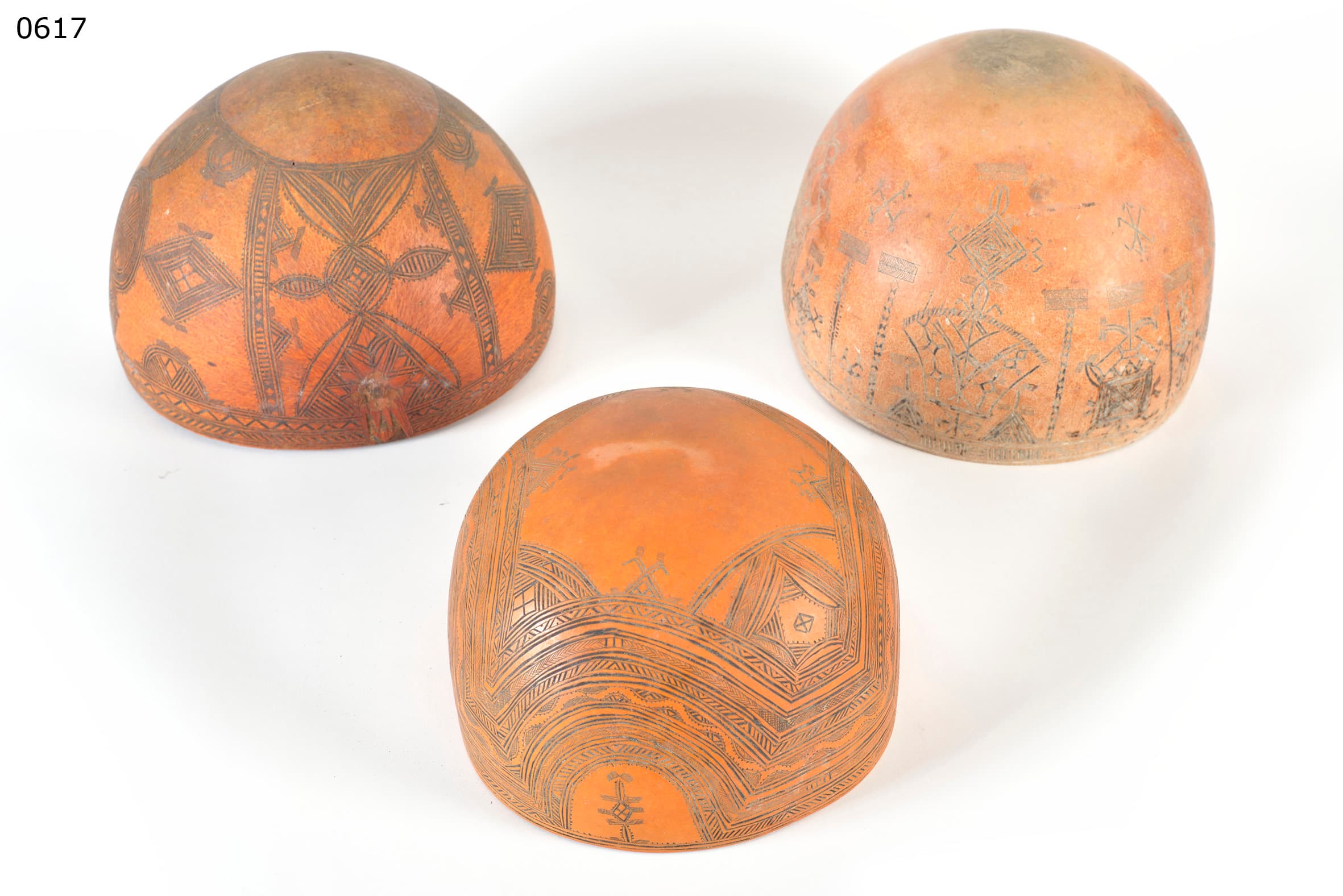
The material culture of the Dyula eludes the classic Western categorisation of African art, which in historical discourses is primarily focused on figurative, sculptural wooden ancestor figures. Due to the Islamic paradigm of the prohibition of images (aniconism), the Dyula historically produced hardly any ancestor figures or classical anthropomorphic steles. Rather, their formal canon manifests itself in highly specialised artisanal hybrids produced by the nyamakalaw (artisan caste): complex textile art, highly developed metallurgy (goldsmithing and yellow casting) and elaborate leatherwork, as well as - as a significant, highly debated exception - a specific mask tradition.
The object typology of textiles is dominated by heavy, hand-woven cotton, which was produced on narrow drawlooms. The Dyula were not only traders, but also the primary distributors of weaving technology in the region. One iconographically central subtype is the so-called suruku kawa (translated: "spotted hyena"). This is a complex warp ikat weave in which solid, indigo blue blocks are woven in alternating patterns with undyed white cotton, creating a strict, chequerboard-like layout. These textiles were not mundane everyday wear, but highly prestigious objects worn at religious festivals, weddings and funerals. Prestigious Dyula textiles, such as those preserved in the Museum Rietberg in Zurich, often feature interwoven symbolic patterns that visually encode wealth, social distinction and the wearer's status as a tuntigi (warrior) or moriw (scholar). Documented master workshops exist primarily in established weaving villages such as Waraniene (near Korhogo), whose textiles continue to meet the highest quality standards to this day.
In the field of metallurgy, the Dyula craftsmen excelled in the processing of gold, silver, tin and copper alloys. The canon of proportions in jewellery - extensively documented in the holdings of the Musée du quai Branly - Jacques Chirac - is characterised by geometric austerity, which combines Islamic ornamentation (arabesques, complex knot patterns) with abstract local symbols. Tin-alloy boxes, which served as containers for miniature Korans or protective writings, represent an outstanding typology. These objects occasionally show stylised, mask-like faces on the lids, which represents a rare, formalised break with the aniconic principle. Technologically, the workshops used a combination of lost wax casting (cire perdue) and fine cold hammering to generate wafer-thin gold foils and solid brass amulets. The separation between profane and sacred objects is often manifested in metallurgy through the blessing (activation) by a scholar, which transforms a regular bangle into a defensive artefact against djinns.
The most prominent and intensely debated iconographic controversy, however, concerns woodcarving, specifically the so-called Do or Bedu masks. René Bravmann (1974) postulated in his dissertation and later monograph Islam and Tribal Art in West Africa that the Islamised Mande-Dyula and the closely related Ligbi not only tolerated these masks, but actively integrated them as an integral part of their religious festivals and rituals. The anthropomorphic Do masks, which often depict an idealised young woman (Gbanyamuso), are characterised by extremely smooth, highly polished surfaces and fine, elongated proportions, in contrast to the roughly hewn, martial anti-witchcraft masks (Gbain) of the region. The scholarly controversy runs between Bravmann, who argues that these masks are authentically "Muslim" (an internal Dyula innovation), and more orthodox art historians who claim that the Dyula merely subsidised and co-opted the art of the autochthonous, animist Senufo or Nafana people without integrating it spiritually into Islamic theology in any profound way.
| Object Typology | Material & Technique | Iconographic Meaning & Utilisation |
|---|
| Gris-Gris (amulets) | Hallmarked leather, paper, ink | Houses esoteric Koranic texts; physical protection against harmful spells. |
| Suruku kawa Textiles | Hand-spun cotton, ikat | Prestige garments for clerics and merchants, worn on holidays. |
| Do masks (Gbanyamuso) | Highly polished wood, plant pigments | Embodies idealised aesthetics; appears on Islamic holidays. |
| Amulet boxes | Pewter or copper alloys | Representation of wealth; safe storage of sacred scriptures. |
Strict forgery criteria apply to these objects on the Western art market. A profane object carved explicitly for the tourist market or for export differs radically from an activated ritual object in the nature of its patina. Genuine, ritually used do masks must show authentic signs of use: Hand sweat on the handle areas, wear abrasion on the back edges and, elementarily, a smoke odour that has penetrated deep into the pores from decades of storage in the beams of wood-heated huts. Forgers from workshops in Bamako or Abidjan use modern mechanical drills for the holes in the bast fastening, apply artificial ageing substances (such as shoe polish or chemicals) in even, unnatural layers and mechanically imitate termite damage. The latter can be quickly forensically exposed under the microscope due to the lack of genuine oxidation layers, the absence of heartwood cracks with authentic dust inclusions and the disregard of natural wood grain directions.
Ritual practice
The ritual performance of the Dyula unfolds primarily in two phenomenologically completely different spheres: the highly intimate, individualised magic of the esoteric amulets and the public, cathartic performance of the masked alliances, which regulates collective social tensions.
The life cycle of a gris-gris (amulet) is a meticulously orchestrated process of esoteric activation that requires deep theological and craft knowledge. A profane piece of leather and blank paper only becomes a sacred object through the physical and spiritual intervention of the moriw (marabout). The scholar writes specific Koranic suras tailored to the client, astrologically calculated numerological grids (so-called magic squares) or the names of specific djinns on paper with ritual ink. The amulet is then activated by the precise, ritual folding of the paper - a highly sacred act that conceals the written text from profane, human eyes and physically compresses and seals the divine baraka (blessing power). The text package is then sewn into a leather pouch by specialised leather workers of the artisan caste. The offerings made during the creation process are usually bloodless and are limited to kola nuts, textiles or direct monetary payments to the scholar. The activated object is worn close to the body (on the neck, arm or concealed under clothing around the waist). The deactivation and disposal of such an object is usually mundane and organic: when the specific purpose (e.g. curing an illness, protecting against damaging spells on a long trade journey) is fulfilled or the strap breaks, the object gradually loses its power and can be disposed of. There are no elaborate deconsecration rites for amulets; their power is limited teleologically and chronologically.
| Phases of ritual practice | Gris-Gris (amulets) | Do masks (wooden sculpture) |
|---|
| material acquisition | paper, ink, tanned animal leather | wood from sacred groves, plant pigments |
| activation | calligraphy, folding by moriw, sewing | washing, painting, attaching raffia |
| Performative context | Individual, permanently worn on the body | Collective, synchronised dances on Islamic holidays |
| Deactivation | Decay of the material, end of the specific crisis | Decay due to termites; transfer of the spirit into new wood |
The public, loud performance of the Do masks is diametrically opposed to this hidden textual magic. Although the Dyula are orthodox Muslims, the mask performance is strictly synchronised with the Islamic calendar in the regions where it has been adapted. The masks mainly appear on Yawm-al-ashura (the tenth day of the month of Muharram) or at the festive breaking of the fast (Eid al-Fitr) after Ramadan. The performance is highly regimented and requires extreme physical endurance: the dancer is completely wrapped in raffia, dense fabric drapery and occasionally animal skins to conceal any trace of human skin and signal the complete surrender of human identity to the spirit. The mask itself does not act in isolation in the village square, but is the visual centre of a multi-sensory event conducted by djeliw (griots/musicians). These musicians, who historically are often equipped with the bamba-da (an elaborate crocodile headdress), play complex polyrhythms that are supposed to inevitably put the dancer into a trance-like state. According to local cosmology, the energy (ritually understood as "warmth") rises from the knees to the dancer's head in the course of the dance, whereupon the mask performs extreme, jerky spinning movements (amyo, translated: "dancing with the head") that appear to be completely independent of the body.
The regional variance of these practices is enormous: while in the north the masks appear as representatives of enormous animal spirits (bush-cow/buffalo) as anti-witchcraft tools with glowing coals in their mouths (gbain cult), the focus of the do masks further south (for example in the Banda region) is on the representation of beauty, grace and the strengthening of social cohesion between the Muslim Dyula and their non-Muslim neighbours. A new cut of such a mask is ritually activated by special washings and the application of earth pigments and plant extracts. If a wooden mask is destroyed by severe termite damage, accidents during dancing or structural breakage, it loses its ritual charge; the spiritual entity (the djinn) must be transferred from the marabout to a new, young wooden body. The old body is then often carelessly left to decay, burnt or, in more recent history, sold to Western collectors and traders. Objects that can be proven to originate from this specific, active context of use can be studied in detail in the archives of the Musée du quai Branly in Paris, where the striking difference between sterile commissioned works for export and ritually saturated, sweat and smoke-patinated performance objects is documented.
Historical context
The migration history of the Dyula is inextricably linked to the rise and unprecedented prosperity of the medieval Mali Empire (ca. 1230-1600 AD). Starting from the Manding region, these traders (documented in historiographical Arabic texts primarily as Wangara) expanded massively southwards along the Niger routes, mainly in the 14th and 15th centuries, deep into the forest regions of present-day Ghana and Côte d'Ivoire. The primary motive for this non-violent, network-based territorial expansion was to control the productive gold mines (for example in the Akan regions) and to monopolise the lucrative trade in salt, slaves and kola nuts, which were destined for the trans-Saharan trade towards the Maghreb and Europe. The dating controversies within academic historiography centre on the question of whether the Wangara and today's Dyula have an unbroken genetic and cultural continuity, or whether they were successively newly formed, fluid alliances of completely different ethnic groups. A. Massing dates the arrival of the Wangara as a cohesive group to the late 14th century, while other sources, based on the Kano Chronicle, place a massive emigration from Mali only in 1433 under the rule of Mohamad Rumfa in Kano.
The brutal colonial encounter in the late 19th century radically changed the socio-political structure and the economic foundation of the Dyula. The central historical figure of this era is Samori Touré (ca. 1830-1900), a Dyula cleric, former trader and brilliant military strategist who founded the mighty Wassoulou empire. Turning completely away from the historically established pacifist Suwari tradition, Touré used armed force, forced conversions and Islam as a unifying military ideology to put up fierce resistance to the aggressively advancing French colonial troops for almost two decades. The eventual dismantling of his empire by the French in 1898 and the subsequent colonial demarcation of borders finally thwarted the centuries-old trans-regional trade routes of the Dyula. As Robert Launay succinctly points out, they historically became "Traders Without Trade", who lost their old monopoly position and had to turn to new urban professions, western education or wage labour in order to survive economically.
This profound colonial caesura had a direct, structural impact on art production. The loss of the old caravan monopolies and the impoverishment of the nobility forced many artisan castes (the nyamakalaw) to switch from the production of ritual and prestigious objects for internal elites to production for the emerging Western market. The market history of West African art in the West began with unsystematic ethnographic collections of curiosities, which were often brought to Europe as looted art by military expeditions (such as the Benin bronzes, the return of which is now being negotiated by institutions such as the Rietberg Museum). Breakthrough exhibitions in the 1920s, significantly influenced by the Surrealists around collectors such as André Breton and Helena Rubinstein, elevated the objects from the status of ethnographic fetish to the universal rank of "primitive art". Leading institutions such as the Royal Museum for Central Africa (RMCA) in Tervuren or the Fowler Museum at UCLA in Los Angeles systematised these African holdings academically and curatorially over the course of the 20th century.
With the exponential price development on the art market from the middle of the 20th century, a massive, highly professional forgery problem arose. Authenticity criteria became essential and vital for private collectors and auction houses. In addition to the aforementioned organic signs of wear (wear sweat, smoke patina), the modern market is increasingly making use of forensic analyses. Genuine ageing on dyula objects (whether Koran weights, yellow cast amulets or wooden masks) is characterised by natural micro-oxidation of the pigments, irregular termite damage that strictly respects the natural direction of the wood grain, as well as deep cracks in the heartwood into which microscopic mineral dust has been deposited over generations. Such in-depth material analyses are now the absolute standard in expert dossiers of institutions such as the Rietberg Museum in Zurich or major auction houses in order to guarantee the art-historical and financial integrity of collections of African masterpieces and to weed out forgeries.