The Bura are a West African people in the Middle Niger Valley and Biu Plateau, known for prehistoric terracottas, funerary urns, and decentralised workshop traditions.
Overview
The Bura culture represents one of the most fascinating, yet methodologically most challenging, aspects of West African art history. A precise scholarly analysis necessitates the analytical distinction between two distinct entities that are frequently conflated in older literature: on the one hand, the prehistoric archaeological Bura-Asinda-Sikka culture in the Middle Niger Valley, and, on the other hand, the recent ethnolinguistic group of the Bura-Pabir (also Babur/Bura) on the Biu Plateau in north-eastern Nigeria. The evidence regarding historical and cultural continuity between the two remains ambiguous and forms the core of an ongoing interdisciplinary controversy, which has been marked as an explicitly open research question since Michelle Gilbert’s influential essay “Bura Funerary Urns: Niger Terracottas: An Interpretive Limbo?” (African Arts, 2020).
Geographically, the archaeological Bura culture is situated in the lower and middle Niger Valley, particularly in the Téra Department in the Tillabéri region of present-day south-western Niger, as well as in neighbouring south-eastern Burkina Faso. The area of discovery extends over a length of approximately 450 kilometres and exhibits local stylistic variations that point to decentralised workshop traditions within a shared formal canon. The chronology of the classical heyday is narrowed down by stratigraphic data and radiocarbon measurements to the 3rd to 11th/13th centuries AD, with the main necropolises reaching their maximum density in the late first millennium. The prehistoric Bura culture thus operates within a time frame prior to the establishment of the great Islamic-influenced Sahel empires (Mali, Songhai) and the Kanem-Bornu Empire — a context that is essential for understanding its distinctiveness. Structural comparisons point to contemporary West African centres such as Djenné-Jeno in the inner Niger Delta or the megalithic complexes of Tondidarou in Mali, with which the Bura-Asinda-Sikka shared a far-reaching Sahelian network of interaction.
The modern Bura-Pabir population, however, inhabits an ecologically and topographically entirely different region: the Biu Plateau and the Gongola Valley in Borno State (north-eastern Nigeria), with peripheral extensions into Adamawa and Yobe. Current demographic estimates put the number of Bura speakers at between 250,000 and over 500,000 individuals. Linguistically, they belong to the Chadic language family (Biu-Mandara subgroup) within the Afro-Asiatic phylum, with close kinship ties to Margi, Kilba, Kibaku and Chibok — a classification that indicates a strong settlement and exchange corridor in the Lake Chad basin and the adjacent savannah regions. The linguistic classification of the prehistoric Asinda-Sikka creators, however, remains purely speculative; whether their speakers used early forms of Chadic, Nilo-Saharan or Niger-Congo languages is not supported by evidence.
The internal social structure of the modern Bura-Pabir is characterised by a historically layered dichotomy. The indigenous Bura population traditionally lived in a leaderless and decentralised manner in kinship hamlets, led by an elder (Bulama). In the 16th century, the legendary invader Yamta-ra-Wala, who probably originated from the Kanuri or Mandara sphere of influence, established a centralised monarchy and the Biu Emirate; the descendants of the Woviri clan, who intermarried with the indigenous Bura, have since formed the ruling Pabir class under the Kuthli (Emir). The Bura villages remained subject to tribute, a structural tension that manifests itself to this day in a latent rejection of Pabir hegemony by the rural Bura populace. The gender-specific division of labour diverges significantly between the subgroups: Pabir women traditionally work three days a week in their husbands’ fields, whilst Bura women assist with fieldwork on only a single day each year — an indicator of serious differences in female economic autonomy. Institutionalised joking relationships with neighbours such as the Jen, Chamba and Awak — often marked by the ritual planting of baobab trees as boundary markers — function as traditional mechanisms for pacifying inter-ethnic conflicts.
The debate regarding continuity between the archaeological Asinda-Sikka culture and the recent Bura-Pabir population remains open among scholars. Abubakar Sule Sani argues, using a social theory of frontier, that ceramic typologies and settlement patterns in the Bauchi and Borno regions point to long-term transfer processes over the past 1,500 years that may link the Niger Valley with north-eastern Nigeria; Detlef Gronenborn and Nicole Rupp date related archaeological complexes in the Gongola Valley to the 10th to 15th centuries. The opposing view (prominent in the curatorial practice of the Fowler Museum UCLA under Marla Berns) warns against inadmissible ethnographic projections: naming the archaeological culture after the present-day Niger village of Bura does not establish an ethnolinguistic identity with the Nigerian Bura-Pabir. The grey area between the two entities remains an interpretive limbo, and the present collection of 40 Bura objects is primarily to be situated within the framework of the archaeological Asinda-Sikka tradition — with all the ethical and methodological reservations that this classification requires today.
Cultural Context
The systematic reconstruction of the religious and cosmological system requires the analytical separation of archaeological findings from the ethnographic present, as the material evidence from prehistory does not align seamlessly with the oral traditions of today’s Bura-Pabir population.
The prehistoric Asinda-Sikka culture manifests itself religiously primarily through a highly complex cult of the dead. The massive necropolises — often covering several hundred square metres, flanked by sacred altars of stacked stone blocks and adjacent settlement structures — suggest a cosmology in which ancestor worship and the ritual anchoring of territorial claims were inseparable. The density and elaborate decoration of the cephalomorphic and anthropomorphic urns attest to a stratified society in which elite status groups — particularly a horsemen’s elite — were posthumously venerated in cultic rites and acted as mediators between the living and the dead. The earliest known terracotta depictions of horsemen in the Niger Basin originate from this context and mark the emergence of a militarised elite that shaped the Sahel landscape of the first millennium.
A structural parallel that serves as a hermeneutic bridge in research (without implying a direct genealogical relationship) is the cosmology of the Dogon: whose creation myth, centred on the primordial ancestors Nommo and the cosmic placenta, has inspired ethnographers and specialists in ceramic history to interpret the Bura urns as spiritual vessels of rebirth. The strongly genital formal language of Asinda-Sikka pottery — tubular phallic urns and spherical uterine vessels — alludes to a cyclical life-death-rebirth complex that is ethnographically attested across large parts of the West African savannah, even if the specific Bura theology itself remains silent.
In contrast, the recent ritual reality of the Bura-Pabir offers an ethnographically accessible, albeit related animistic, order. The supreme creator deity bears the name Hyel (or Hyel-taku) — a being associated with the sky and the moon, regarded as the origin of all life, yet scarcely intervening directly in everyday human life. Active communication takes place via personal spirit and ancestral beings, the Haptu (also known regionally as Naptu), who manifest themselves in specific physical objects and natural phenomena: water, certain rock formations, sacred groves, or — in a domestic context — in covered clay pots kept by the head of the family. Ritual authority rests with the Mthakur haptu, a priest who conducts consultations, coordinates offerings (mostly chicken sacrifices at the beginning and end of the dry season) and leads harvest and rites of passage.
Structurally, the Bura differ from their hierarchical Pabir neighbours in the absence of central public ancestral festivals: whilst the Pabir celebrate the Mambila festival, during which the souls of the deceased collectively return to the town, intimate family rituals dominate among the acephalic Bura. A central ritual of remembrance involves individuals who have lost their parents ritually dressing three maize cobs for the maize harvest, burning their leaves and placing them on a tray beside the head of the bed at night — an individualised, agrarian-coded form of ancestor worship that testifies to a highly decentralised cosmology.
A profound iconographic controversy dominates research into the prehistoric Asinda-Sikka culture. Boubé Gado (1993), the discoverer and excavator of the necropolis, interprets the anthropomorphic urns as classic representations of ancestors and coined the term village des morts (village of the dead): For Gado, the individual heads and horsemen figures symbolise the physical and social continued existence of the elite ancestors in the afterlife, with scarifications representing real insignia of rank. Michelle Gilbert (2020) radically challenges this consensus in African Arts: for her, the tubular and spherical forms are not primarily portraits, but abstracted genitals — phalli and uteri — within a cosmological grammar of fertility, death and rebirth. Gilbert bases her thesis linguistically on the modern Hausa word bura (literally ‘penis’) and argues that the urns symbolised continuous life force, not the individual portrait. Gado and his followers reject such reductions and point to the military-memorial function of the horsemen statuettes, which is difficult to reconcile with pure phallic iconography. The debate remains unresolved — rather, it highlights the need to interpret objects such as this collection not in isolation, but within a cosmological framework, as modern curatorial concepts at the Musée du quai Branly – Jacques Chirac explicitly demand.
A parallel, increasingly central research perspective concerns the gender dimension of production. In her extensive fieldwork in the Gongola Valley, Marla C. Berns has demonstrated that in this region it was primarily women who produced the ritually-destined figurative ceramics. Women acted not only as craftswomen, but as key agents in the construction of social and cosmological meanings. This finding — supported by theoretical work by Michelle Gilbert and Babatunde Lawal on female pottery in the West African savannah — shifts the interpretation of the Asinda-Sikka urns: they may be the work of a female priestly or artisan caste whose ritual authority lay in guiding the transition from life to the realm of the ancestors.
Aesthetic Characteristics
The material culture of the Bura-Asinda-Sikka civilisation is characterised by a highly specific, strongly abstracted set of proportional standards that remains virtually unique in West African prehistory. The formal rigour and the almost modernist reduction of forms have made these objects highly sought-after on the Western art market since the 1990s — whilst simultaneously bringing them into the focus of critical provenance research.
The canonical typology of Bura art can be divided into four primary subtypes:
| Subtype | Morphology | Function / Iconography |
|---|
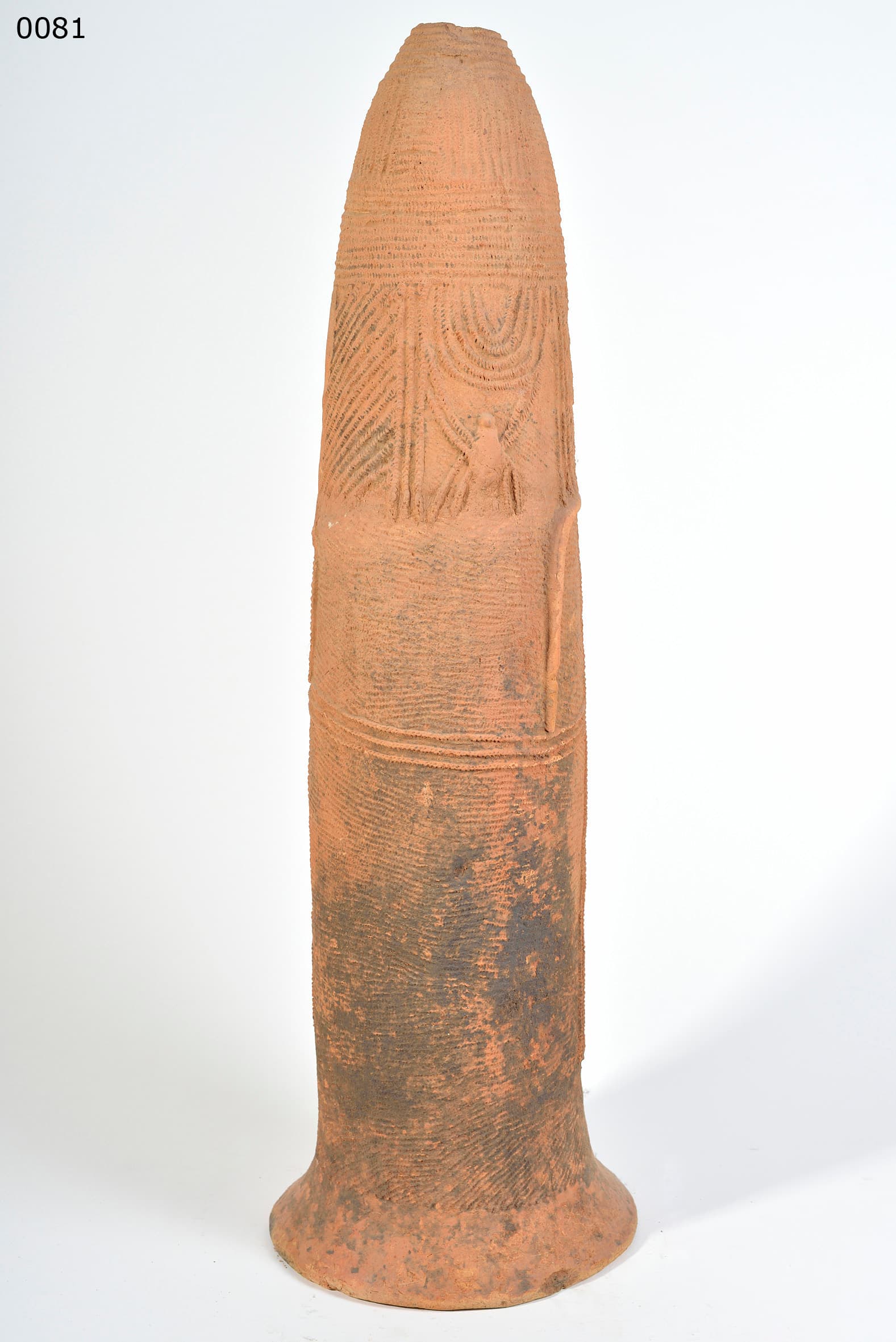
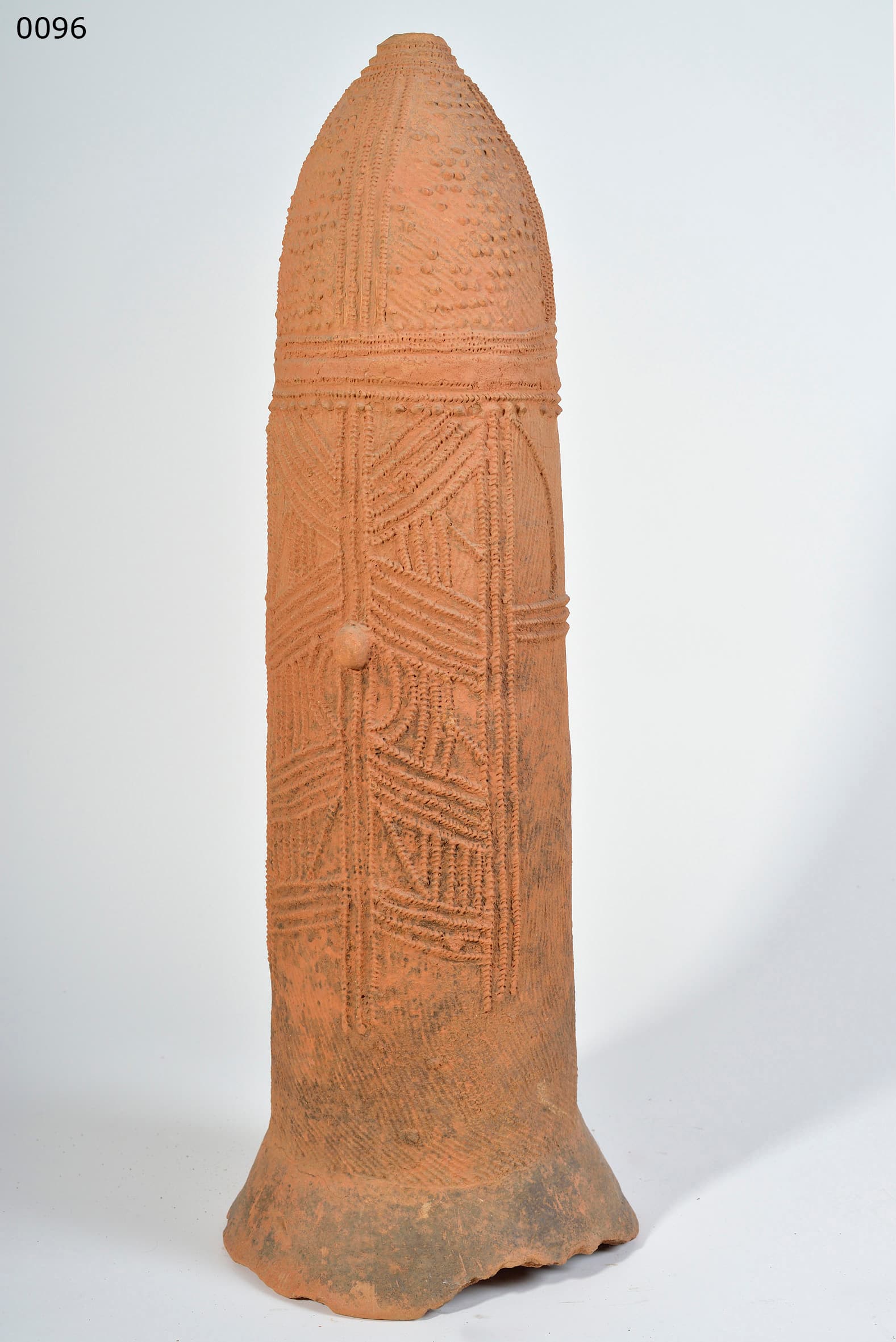
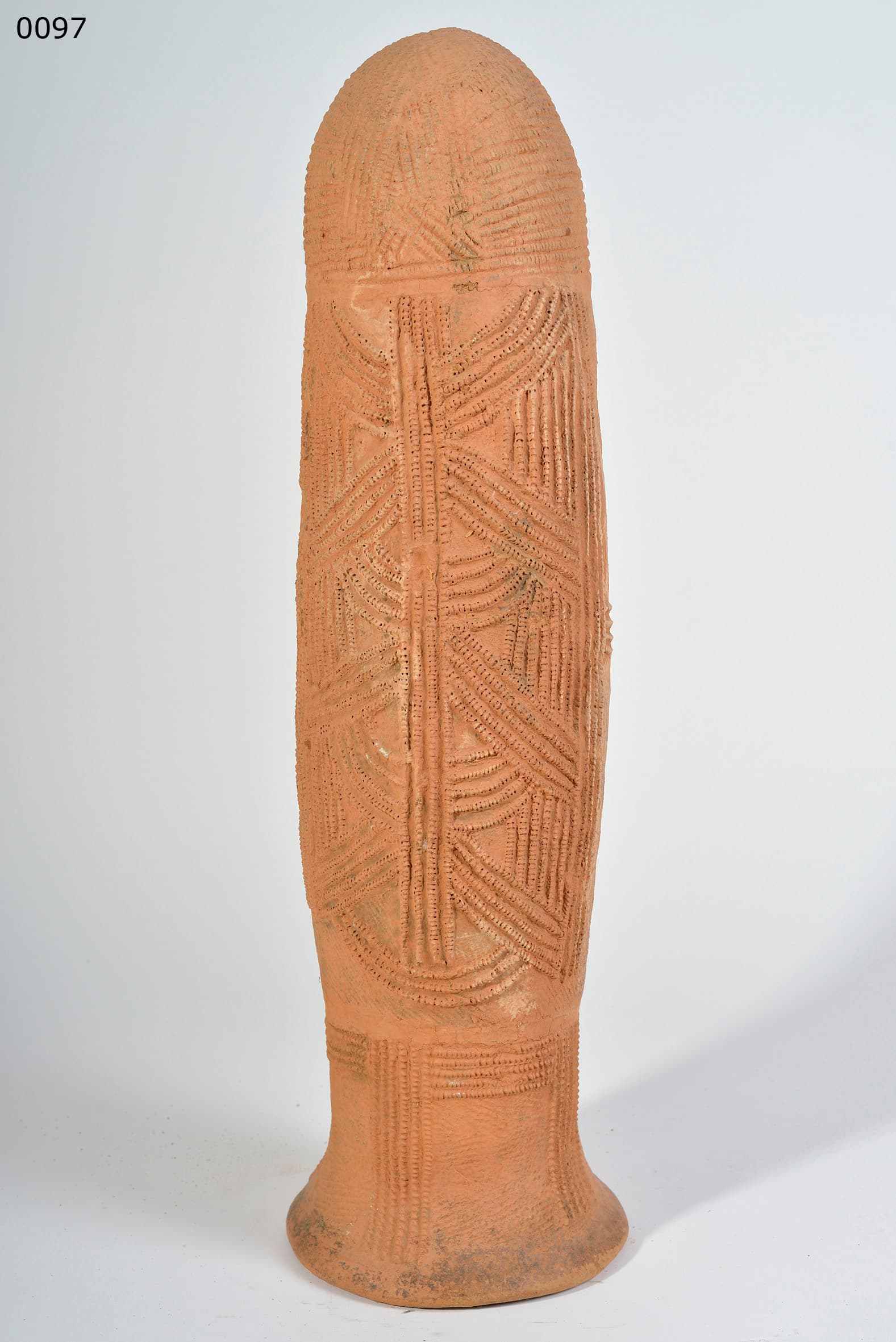
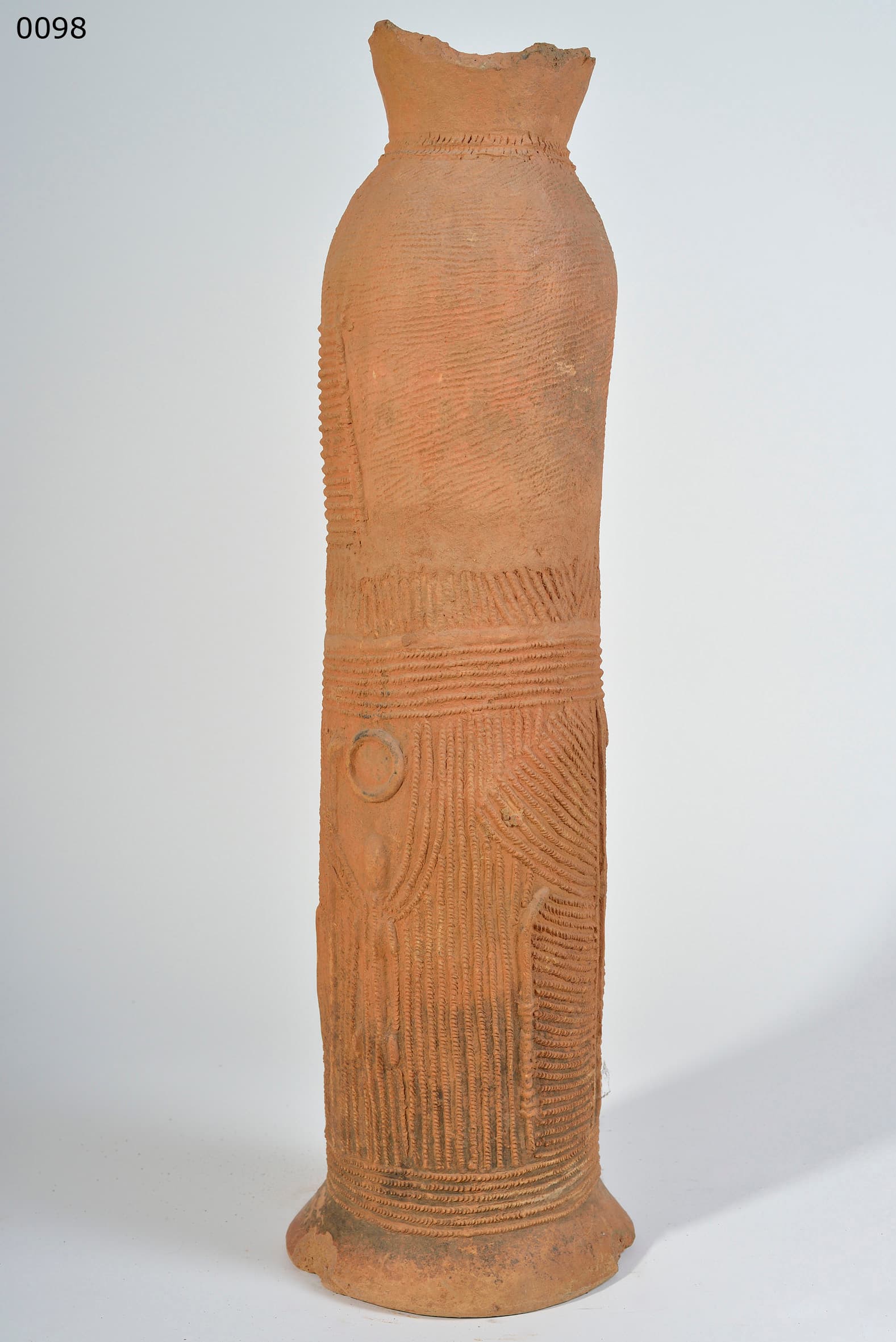
| Tubular phallic urns | Cylindrical, 50–98 cm, scarification patterns, protuberances | Erected upside down, vessel for the soul / Gilbert: masculine fertility |
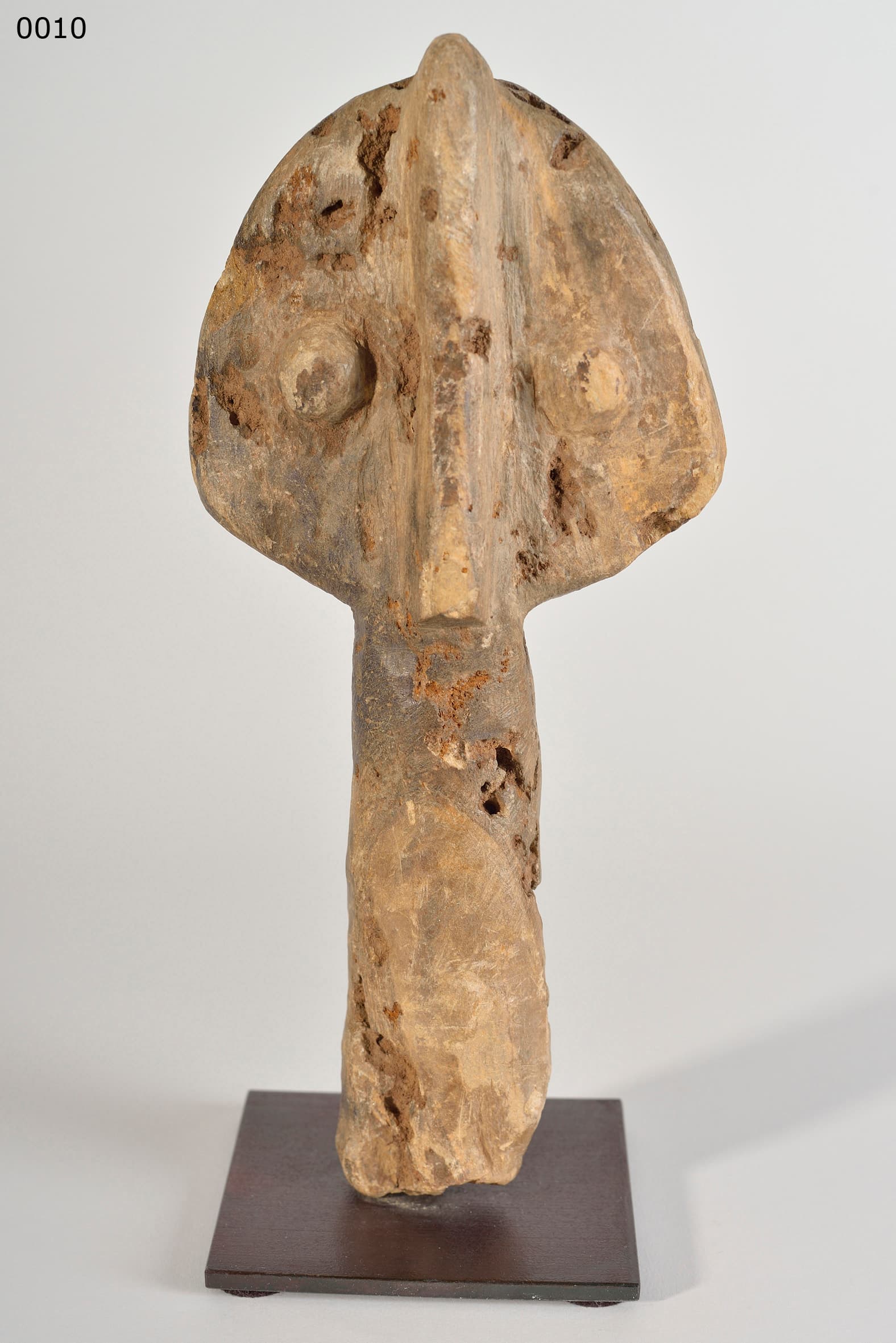
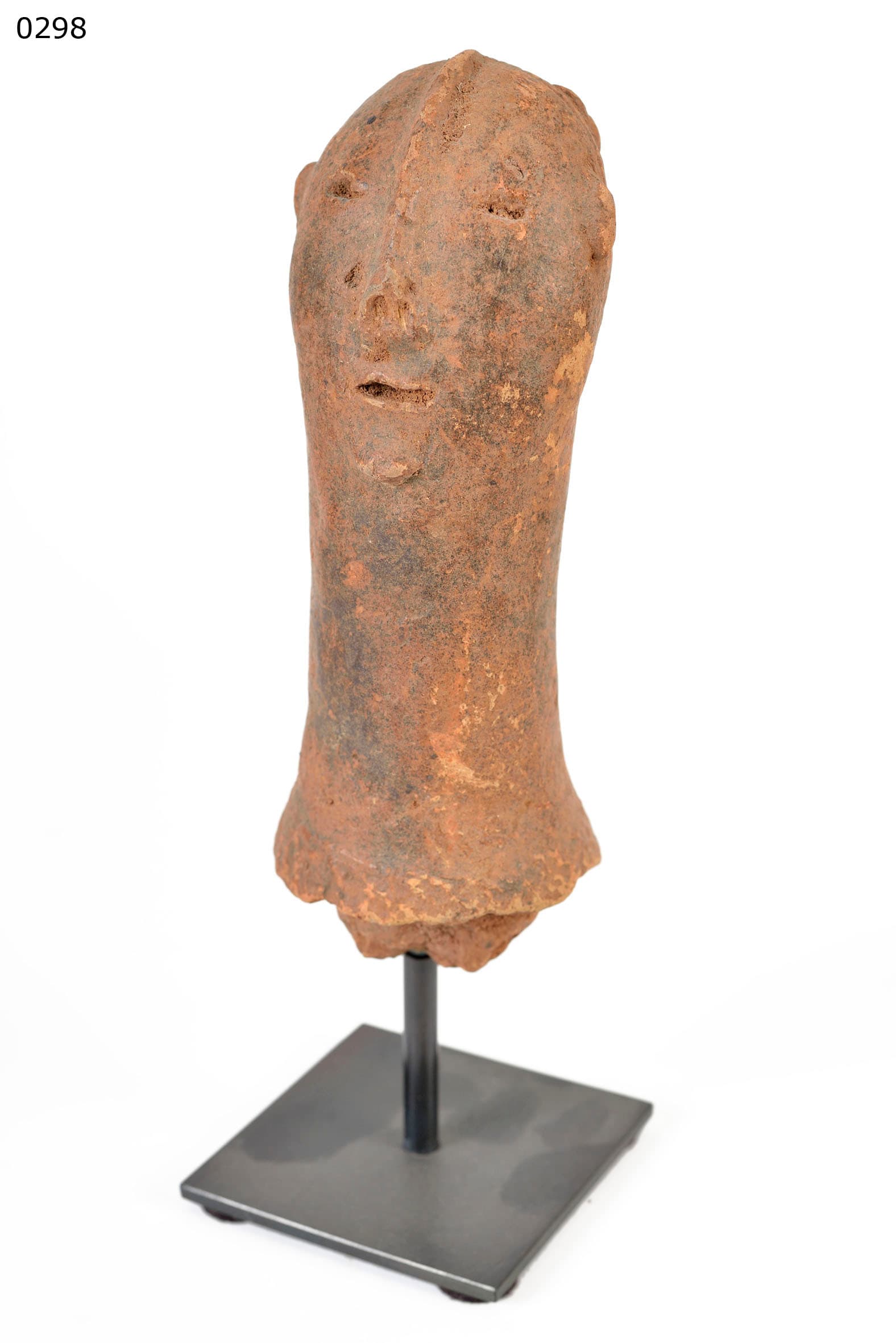
| Cephalomorphic head stelae | Flat-oval, coffee-bean eyes, braided hair, grooved neck | Above-ground grave markers, ancestral portraits |
| Spherical / ovoid urns | Round-bellied, 50–70 cm, with lid figure | Erect, receptacle for skeletons and skulls |
| Equestrian statuettes | Warrior on horseback, bandolier, weapons | Oldest depictions of horsemen in the Niger Basin, military elite |
The largest specimen in this collection, the phallic urn No. 81, standing 98 cm tall, corresponds to the upper end of the documented Bura spectrum and thus ranks among the finest of the surviving monumental urns. The cephalomorphic head stelae in the collection (Nos. 292, 298, 313, 646; between 19 and 30 cm) exemplify the smaller-scale parallel typology. The spherical and ovoid urns (Nos. 117, 119, 249) represent the counterpart to the tubular pieces. Three objects of exceptional significance in the history of the collection are of particular importance: the “rare phallic urns with complete faces” Nos. 130 and 131 (45 and 58 cm respectively) form iconographic intersections between the predominantly abstract urn tradition and the cephalomorphic portrait line. Figure No. 242 (“rare female tomb figure”, stone, 34 cm) exemplifies a distinctly gendered variant, and No. 256 — a “rare pair of tomb figures with a maternity figure” (stone, 39 cm) — is typologically unique. Alongside the majority of terracotta pieces, the collection features around sixteen stone tomb figures, constituting a substantial stone component that represents a parallel monolithic sculptural tradition and is often underrepresented in the Western exhibition history of Bura art.
The figures’ proportional canon features flat, slightly oval to disc-shaped faces with a mask-like quality. The key iconographic feature — the “coffee bean eyes” — is created by two clay pastilles placed one on top of the other with a horizontal incision. The noses are rendered as long, narrow ridges, the mouth small, often open and slightly protruding. The hairstyles are particularly detailed, with their relief bands at the back of the head imitating complex plait patterns and providing insight into social rank and ethnic affiliation. The scarifications — geometric patterns cut deep into the damp clay or stone, often radiating outwards from a navel-like protrusion — are not purely decorative: they reflect real bodily modifications among the population and function as ontological markers of the deceased’s identity.
The material is almost exclusively limited to locally sourced, iron-oxide-rich clay, which was hardened in open field kilns — with a colour range from light sandy beige to deep brick red — as well as monolithic stone sculptures made from locally available Sahelian hard rocks. Traces of red ochre on some surfaces attest to an original polychromy, which has largely weathered away after over a millennium of burial. The patina of archaeological pieces is strictly taphonomically determined: earth encrustations, sinter formations, mineral deposits, root marks and the after-effects of termite activity in the surrounding soil form a matt, crusty texture that stands in stark contrast to the smooth or artificially waxed surfaces of modern forgeries. The difference between active ritual objects and secular utilitarian pottery is primarily evident in the ornamentation: everyday vessels are smooth and undecorated, whilst burial urns are covered over their entire surface with incised and stamped patterns.
Naturally, there are no named master craftsmen associated with the prehistoric Bura culture; yet the strict adherence to the canon of proportions points to centralised potteries. In relation to related North Nigerian contexts (the Nok culture), Nicole Rupp posits ‘centralised rules, enforced by authorities or shared belief systems’; Peter Breunig supplements this workshop hypothesis with comparative archaeological arguments. This systematic approach is reflected in the rigorous formal logic of the Asinda-Sikka urns, without individual hands being definitively identifiable. The controversy between anonymous collective production and an implicit workshop hierarchy — in which some master craftsmen can be grouped stylistically but not personalised — remains unresolved.
Authenticity testing faces a market-relevant forensic challenge. Thermoluminescence (TL) dating determines the time of the last firing and should indicate an age of approximately 800 to 1,500 years for authentic Bura terracottas. However, as forgers pulverise ancient but undecorated shards and press them with modern synthetic resins into iconographically sought-after forms (head stelae, equestrian figures), a conventional TL test merely dates the ground-up ancient crystals and falsely certifies the hybrid object as antique. The current gold standard for testing therefore combines three methods: high-resolution 3D computed tomography (detection of internal fracture lines, inconsistent density distributions and hidden adhesive edges), wet chemical binding agent tests (detection of modern organic resins in the matrix) and comprehensive provenance documentation, ideally dating back to before 1993 — the start of the major market boom and, consequently, the widespread looting.
Ritual Practice
The detailed reconstruction of the ritual practices of the Asinda-Sikka culture is based almost exclusively on the stratigraphy and spatial analyses of the 1983 excavations led by Boubé Gado at the Institut de Recherches en Sciences Humaines (IRSH) at the University of Niamey. The main necropolis, covering an excavated area of merely 25 × 20 metres, displayed an immense, oppressive density of 630 closely spaced urns — a veritable landscape of urns that was highly regulated both spatially and ritually.
The arrangement of the objects followed strict rules with clear vertical and typological differentiation. The tubular, cylindrical urns were invariably placed upside down — with the opening facing downwards — into the ground. This inversion is highly significant ritually: it presumably symbolises the connection to the underworld, the flow of spiritual energy into the earth, or a form of ritual sealing of the grave’s contents. The spherical urns, by contrast, were placed with the opening facing upwards, towards the sky, but were not left open: a secondary statuette — usually a cephalomorphic ancestral head or an animal effigy — was inserted into the opening like a guardian or ritual stopper to protect the contents from physical and spiritual interference. This typologically contrasting treatment points to a dual gender or functional system, which finds a coherent cosmological justification in Gilbert’s phallus-uterus interpretation.
The excavation of the graves revealed a striking vertical spatial separation: the urns themselves often contained only scattered human bones — primarily isolated skulls — as well as personal items such as iron weapons, copper arm rings, brass nose rings and quartzite beads. The postcranial skeleton of the deceased, by contrast, often lay deep beneath the urns, buried up to one and a half metres below the original surface. This spatial dissociation has led to the second major research controversy in Bura archaeology: In his Guardian Theory, Boubé Gado postulated that the skull found in the urn did not belong to the elite deceased, but to a spouse, servant or slave who was sacrificed to act as a spiritual guardian over the deep-lying elite grave in the afterlife. Michelle Gilbert criticises this violent interpretation and proposes, as an alternative, a secondary burial in which the head, as the seat of vital energy, was treated separately to ensure the continuity of the clan. Forensic clarification is hampered by the poor state of preservation of the skeletons in the Sahelian soil; the controversy remains unresolved.
Offerings played an essential role in the ritual constitution of the graves. Iron arrowheads with distinctive hooked ends (hooked arrowheads, rat-tail spear-points) were found alongside virtually every intact urn. Gilbert and others interpret these not primarily as functional hunting weapons, but as remnants of ritual blood sacrifices or as signs of ritual disablement — a killing the object that energetically initiates the deceased’s journey to the afterlife. Chemical residue analyses also suggest offerings of cooked food, and the prestige jewellery (beads, brass rings) cemented the deceased’s social status beyond death. In his ethnoarchaeological work on metallurgy in the Mandara Mountains, Nicholas David has pointed out that iron in this region is structurally linked to notions of procreation and transformation: The smelting furnace is regarded as a womb, the forging process as an act of creation — a cosmological matrix that allows the iron grave goods of the Asinda-Sikka to be interpreted as more than mere weapon offerings.
The life cycle of a Bura object began with its ceremonial manufacture and the scarification in damp clay, which inscribed the social identity of the deceased into the material. The reductive firing process sealed the object for eternity; this was followed by its static, earth-bound role as an active grave marker, at which the bereaved regularly offered libations and food sacrifices. There was no formal ritual deactivation in the modern sense; once their function was fulfilled, the necropolises were left to natural taphonomic erosion until, from the 13th century onwards, sand dunes and increasing aridity buried and preserved the sites beneath them. Paradoxically, it was the Western art market that first broke this closed cycle — through looting expeditions that tore objects from their context and bestowed upon them a new, ethically highly problematic ‘aesthetic life course’ within the European exhibition context.
Regarding the ethnographic presence of the Bura-Pabir, Charles Meek (1931) and later Nicholas David documented a central cult object that illustrates the region’s ritual grammar: the habtu pwapu, a stylised snake forged from iron, which is worn as a personal protective amulet or, as a male-female pair in a gourd bowl on the household altar, is activated through libations. Upon the owner’s death, the object is subject to strict disposal rules: it is ritually deactivated by being thrown into a deep latrine or placed inside an active termite mound — any uncontrolled misuse of its residual spiritual power by unauthorised persons must be strictly prevented. This clear choreography of complete ritual life cycles, which is also reflected in the curatorial practices of the Museum Rietberg (for example, regarding the Yoruba Opon Ifa, Inv. 2005.1), illustrates that West African cult objects are not passive works of art, but energetically defined agents with a beginning, an activation and a formal disposal.
Historical Context
The historical origins and decline of the Bura-Asinda-Sikka culture are closely intertwined with climatic fluctuations and the socio-political upheavals of the Sahel region. Radiocarbon dating places the use of the large necropolises precisely within a timeframe between the 3rd and 11th/13th centuries AD — thus, the heyday of this civilisation falls within an era preceding the military and economic dominance of the great Islamic-influenced Sahel empires (Mali, Songhai) and the Kanem-Bornu Empire. The reasons for the culture’s relatively sudden disappearance in the 13th century remain a matter of debate: prolonged periods of drought, the aggressive expansion of warlike neighbours and the massive shift in trans-Saharan trade routes are discussed in research as overlapping factors, without any single-cause explanation being established.
By contrast, the migration history of the modern, Chadian-speaking Bura-Pabir people is significantly later and geographically distinct. Oral traditions point to movements from the Lake Chad region into the hilly terrain of north-eastern Nigeria. The legendary military conflict in the mid-16th century, in which the invader Yamta-ra-Wala established the Biu Kingdom, marks the historical genesis of today’s sharp dichotomy between the rural Bura and the aristocratic Pabir elite — and thus a historical rupture that was unknown to the prehistoric Asinda-Sikka culture.
The European colonial encounter under British administration (Lord Lugard, early 20th century) cemented and institutionalised the pre-colonial differences in a lasting manner. The British applied their principle of Indirect Rule and systematically supported the monarchical, centralised and partially Islamised Pabir elites, who were appointed as District Heads; the acephalic, decentralised and predominantly animist Bura were thereby politically marginalised. Although missionary activities led to the linguistic codification of the Bura language and the translation of the Bible, they met with massive political resistance from the Pabir emirs, who saw their supremacy—guaranteed by the British—threatened by Christian efforts at egalitarianism. The influence of the colonial order on the traditional material culture of the Bura — particularly on Haptu shrines and animist iron amulets — was considerable: these objects largely disappeared from public spaces and today circulate only within family circles.
The modern Western perception of Bura archaeological art began in 1975 with a chance discovery: the local hunter Abdurahman Sindy found two terracotta head stelae north-west of Niamey. This discovery led to the first systematic excavations in 1983 by the Nigerien archaeologist Boubé Gado under the auspices of the IRSH. Gado’s work was groundbreaking — not only as the revelation of a previously unknown civilisation, but also as an expression of post-1960s practice, in which African historiography was increasingly shaped by African scholars themselves.
The international breakthrough on the Western art market came in 1993/1994 with the landmark travelling exhibition Vallées du Niger at the Musée National des Arts d'Afrique et d'Océanie in Paris. The exhibition presented the artefacts to a global audience and generated an enormous demand overnight among Western private collectors, fascinated by the geometric, almost modernist stylistic purity of the figures. The immediate consequence was a devastating wave of looting: according to UNESCO reports and research by Le Monde, between 1994 and 1996 alone, around 90 per cent of the approximately 800 identified Bura sites in the Niger Valley were systematically destroyed by professional, often heavily armed looters. The archaeological context of thousands of objects was irretrievably lost. Bura artefacts were placed on the ICOM Red List of endangered West African cultural assets; nevertheless, they continue to circulate in large numbers on the secondary market. In the 1990s, a number of US collectors — including Jerome Vogel — established a transatlantic market route in parallel with the French reception, firmly anchoring Bura art within the international canon.
The current curatorial debate has shifted significantly towards forensic documentation and restitution ethics. Leading institutions — the Royal Museum for Central Africa (RMCA) in Tervuren, the British Museum, the Metropolitan Museum of Art (Michael C. Rockefeller Wing; Bura horseman figurine IRSH BRK 85 AC 5e5 in the 2020 Sahel exhibition) and the Fowler Museum at UCLA — find themselves confronted by postcolonial discourse with demands for complete provenance records. To tackle the problem of forgeries (the artificial terracottas made from pulverised old shards, which cannot be detected by TL tests) and illegal smuggling through technological means, organisations such as the Factum Foundation in London are launching pilot projects in collaboration with the Lam Museum of Anthropology: Endangered African objects are scanned in high-resolution 3D, and their provenance is permanently secured via cryptographic blockchain technology. These digital authenticity criteria establish a forensic gold standard which, in future repatriation processes to Niger or Nigeria, inextricably links the physical return of the objects to their digital record, thereby pre-emptively countering further theft and the circulation of forgeries.
For the present collection of 40 Bura objects, this complex situation entails an immense curatorial and ethical responsibility. Preservation today requires not only conservatorial care, but absolute transparency regarding the history of acquisition — ideally with provenance dating back to before 1993, forensic dating (TL, 3D-CT, binding agent analyses) and an explicit dialogue with the countries of origin, Niger and Burkina Faso. The collection documents a culture that erected monuments of earth, stone and iron for its dead, which have endured for a millennium; their preservation in the 21st century is, at the same time, the preservation of a historical responsibility.