Overview
The Kahe ethnic group (historically referred to as "Wakahe" in colonial sources or pejoratively subsumed under the Swahili term "Wanyika" for coastal or bushland dwellers) is a demographically small group in northern Tanzania that has been massively marginalised in ethnological research. Current demographic estimates put the population at only around 6,000 to 8,000 individuals, who primarily settle in the flat, formerly heavily forested foothills of the southern Kilimanjaro massif, which are criss-crossed by watercourses. Their traditional settlement area is concentrated in the valley of the Pangani River and the neighbouring wetlands south of the city of Moshi, an area that is ecologically and socio-economically extremely heterogeneous and forms a transition zone between the fertile volcanic mountain slopes and the dry Maasai steppe. The self-designation of the Kahe is historically highly fragmented and was defined pre-colonially less by an overarching ethnic cohesion than by micro-regional lineage affiliations and the shared use of specific irrigation systems. There is an extreme lack of sources in the region; the Kahe are considered one of the least researched East African micro-peoples. This dossier therefore explicitly highlights the material and immaterial culture of the Kahe as a significant research gap that must be contextualised by comparative data from the dominant Chaga complex.
Linguistically, Kikahe is categorised as E64 within the Chaga-Taita group of Bantu languages according to the Guthrie classification. Despite its obvious proximity to Kichaga, Kikahe retains a distinct grammatical and lexical structure. Recent lexicographical analyses document a division into at least three primary subdialects: Kimwangaria, Msengoni and Kichangareni. A linguistically sound study of loanwords by Nurse and Spear proves a deep historical penetration of Kikahe through early contacts with Cushitic and Nilotic-speaking groups and later Swahili, which linguistically underpins the geographical position of the Kahe as a historical trading centre.
| Linguistic classification according to Guthrie (Bantu Zone E) | Associated dialects / languages | Geographical focus |
|---|
| E61 / E62 | Rwo, Hai, Wunjo | Western and central Kilimanjaro slopes |
| E63 | Rombo | Eastern Kilimanjaro slopes |
| E64 | Kikahe (Kimwangaria, Msengoni, Kichangareni) | Southern plains / Pangani basin |
| E65 | Gweno | Pare Mountains |
There is a fundamental research controversy in African studies with regard to ethnic and political classification. The key question is: Do the Kahe have a genuinely distinct, indigenous identity or are they merely a peripheral subgroup of the Wachaga? Early missionaries and anthropologists such as Bruno Gutmann postulated a homogeneous, organically grown "Dschagga" tribal identity, which regarded the Kahe merely as a sub-grouping of the landscape in a unified cultural area. Gutmann's essentialist model was later sharply deconstructed by the legal anthropologist Sally Falk Moore. Moore (1986) argues convincingly that the supposedly homogeneous "Chaga identity" represents a deliberate colonial construction (fabrication). Pre-colonially, the Kahe acted as independent, albeit small, political units that were only artificially integrated into the administrative Chaga complex through the administrative constraints of indirect rule (Indirect Rule) by the British Mandate. The sources on the pre-colonial identity of the Kahe are therefore extremely ambiguous and overlaid by hegemonic Chaga narratives.
The social structure of the Kahe was historically organised asymmetrically and hierarchically, albeit on a micropolitical scale. The primary social unit was the patrilineal kinship system, organised in exogamous lineages (ukoo or kishari). At the head of the political entity was a chief (mangi), whose power was based less on military strength than on the allocative control of land and water. Historical oral traditions refer to ruler figures such as Meneri I, who was elected for life by the consensus of the lineage elders and had absolute judicial powers in matters of land law. District chiefs (mchili) were subordinate to the mangi.
The economic subsistence of the Kahe was traditionally based on an elaborate system of irrigated agriculture. In contrast to the pure rain-fed farmers of the higher altitudes, the Kahe were masters of the mfongo system - a complex network of irrigation channels carved out of the rock and bridged by wooden gutters, which channelled the melt and rain water from Kilimanjaro into the dry plains. The cultivation of bananas, finger millet (eleusine) and maize was supplemented by livestock farming. The relationship with the neighbouring peoples was characterised by symbiotic exchange and occasional conflicts. Oral history records evidence of intensive bartering at regional markets: The Kahe exchanged iron tools, agricultural surpluses and sisal ropes for cattle from the pastoral Maasai and traded with the Wagweno and Pare.
The material and cultural independence of the Kahe is systematically ignored in Western museology. In large institutions such as the British Museum in London, artefacts from the Pangani Basin, which could be attributed to the Kahe according to provenance-historical parameters, are almost exclusively inventoried under generic ethnic collective terms such as "Chaga" or "Nyika". This makes the reconstruction of an isolated Kahe corpus considerably more difficult for private collectors and researchers.
Cultural context
The religious system of the Kahe is deeply rooted in the East African Bantu cosmology, but has specific structural adaptations due to the topographical liminality of their habitat in the river plains. The cosmological order is based on a two-part metaphysical theory of the world. The zenith is formed by the solar creator god Ruwa, an omnipotent but distant entity. Ruwa is conceptualised in mythology as the liberator of humanity (mopara wandu), who freed the first humans from a closed vessel or rock. In contrast to many Central African societies, however, the Kahe and their neighbours do not have an elaborate myth of a common, heroic descent; the society has always seen itself as an amalgam of the most diverse migration groups. As a rule, Ruwa does not intervene in the profane events of the day.
Instead, the active and directly effective metaphysical sphere is dominated by the ancestral spirits as well as specific natural and spiritual beings, which are localised in the waters, swamps and dominant trees of the Kahe plain. Religious practice is primarily focussed on maintaining the precarious balance between the living and these ancestral spirits through strict adherence to customary law and continuous acts of sacrifice. Structurally, this religion differs from that of the highland Chaga through a less pronounced ritual fixation on the Kibo peak. While the Chaga altars were often physically orientated towards the mountain peak and the snow of Kilimanjaro was considered a magical substance in rituals (for example in Mangi Rindi), the Kahe increasingly integrated the watercourses of the Pangani system into their cleansing and sanctifying rituals.
The ritual authorities of the Kahe were organised into a strict functional hierarchy. The mangi was not only the secular leader, but also the supreme ritual specialist whose power derived from his control over vital apotropaic objects and rainmaking techniques. He was assisted by divinators and specialised curse priests, known regionally as waanga or mringaringa. These specialists often operated outside the regular social order and derived their authority from inherited secret knowledge. There is a fundamental controversy within ethnological research (Bruno Gutmann vs. Sally Falk Moore) about the nature of this ritual authority. Gutmann (1926) paints a picture of an archaic, static ritual order that is deeply rooted in the "tribal soul". Moore (1986) deconstructs this and shows that many religious sanction mechanisms and prerogatives of the Mangi were by no means ancient, but were established in the late 19th century as strategic innovations (fabrications) in order to centralise economic and political power in the face of colonial pressure. The supposedly static religion was thus highly dynamic and politicised.
| Ritual authority | Function in the religious system | Status and legitimisation |
|---|
| Mangi | Highest priest, rainmaker, guardian of the most sacred ancestral objects | Hereditary (patrilineal), legitimised by lineage consensus |
| Mringaringa / Waanga | Curse priest, specialist in ordinals (ipara nungu) | Secret specialised knowledge, often described as socially isolated |
| Divinator | Diagnosis of ancestral anger, identification of witchcraft | Spiritual calling, use of oracle techniques |
The role of women in the cult of the Kahe was characterised by ritual segregation, but at the same time by essential symbolic significance for agrarian fertility. Women were strictly excluded from the direct handling or even the sight of the most powerful apotropaic objects (such as the nungu figures) under threat of death or absolute barrenness. Nevertheless, they occupied a central position in the rites of passage. The initiation rites for girls historically included drastic forms of circumcision (female genital mutilation), which were carried out within the framework of institutions such as the nyago or the so-called lawalawa ceremonies. These initiation phases were accompanied by specific, restrictive chants that rehearsed the subordination of women, their role as producers of offspring and the avoidance of male ritual spheres. For boys, circumcision represented the central transition into the warrior generation, a ritual complex that borrowed structurally from the age-group systems of the neighbouring Maasai.
The museum representation of this complex cosmology is heavily distorted in the West. Although there are extensive East African collections in the holdings of the Musée du quai Branly - Jacques Chirac (Paris), anthropomorphic Kahe cult figures are almost completely absent. This is due to the structural nature of the Kahe religion, which was primarily aniconic. The spiritual presence was not localised in elaborate ancestor statues, but in fleeting material arrangements (plants, stones at crossroads) or in reduced iron objects. This radical aniconia fundamentally distinguishes the ritual systems of the Kilimanjaro foothills from the image-rich ritual worlds of West or Central Africa.
Aesthetic features
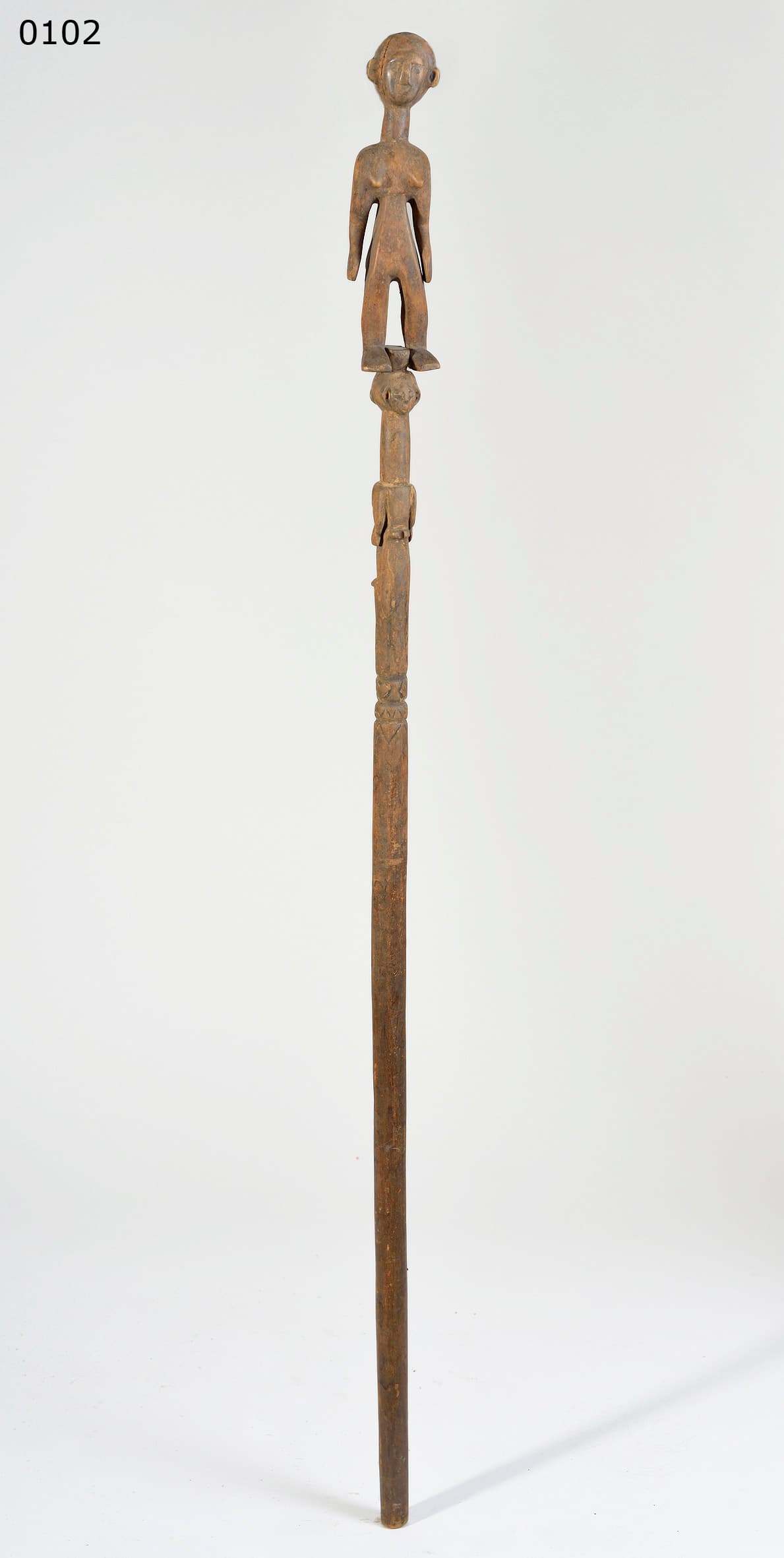
The material culture and object typology of the Kahe largely eludes classical Western expectations of "African art", which have historically been characterised by the voluminous and expressive mask and sculpture traditions of West and Central Africa. The Kahe aesthetic is characterised by extreme formal rigour, iconographic reduction and absolute functional pragmatism. The canonical object typology primarily comprises ritual forged objects (lances, ceremonial staffs), iron ritual bells (maanga) and small apotropaic figures made of hardwood or clay. A distinct, secular figurative carving tradition does not exist.
By far the most complex object of this rudimentary tradition and the most relevant to the market for specialised collectors is the nungu. Iconographically and functionally, the nungu (a term that in the everyday language of the region profanely stands for "cooking pot") served as the ultimate instrument for ordinances, truth-finding and destructive curses. A significant iconographic controversy exists within the history of ethnological science (Raum vs. Thomé/Baroin). Early missionaries such as Thomé translated the term nungu literally and assumed that the ritual object was simply an ordinary ceramic vessel that was symbolically smashed. Johannes Raum (1904) strongly opposed this misinterpretation and was the first to postulate the existence of specific curse figures. Raum's thesis was only verified by later, detailed field studies by Baroin (2013, 2018) and comparative analyses by Vajda (1953) and Kumbi-Kumbi (1988): The activated ritual nungu is physically not a container, but an anthropomorphic figure about 10 to 15 centimetres tall.
The canon of proportions of the nungu is stylised to the extreme. The figure deliberately lacks arms and legs; it essentially consists of an oversized, rudimentarily indicated head and a torso on which the primary sexual characteristics are greatly exaggerated. Female nungu figures, which are characterised by clearly modelled breasts and vulvas, are considered far more powerful and dangerous in the ritual hierarchy than male specimens. Unusual protuberances, asymmetrical lumps or deformations on the figure's torso visually encode their supernatural, non-human essence and destructive capacity.
The choice of material for the nungu and other ritual artefacts was strictly dictated by local availability and spiritual regulations. Dense hardwoods from the savannah or coarsely leaned, unfired local clay were used. The patina formation differs greatly from the objects of West Africa, which are polished to a shine by palm oil and handling. A Kahe object usually has a rough, matt encrusted patina. This results from the specific storage in holes in the ground (to shield against toxic spiritual radiation) and the repeated ritual application of sacrificial blood, soot and specific herbal extracts.
The difference between a profane object and a highly activated ritual object was often marginal on a visual level. There was no formal aesthetic differentiation through finer carving. The transmutation from a piece of wood to a fetish took place exclusively through the invisible charging (activation) by the ritual specialist. There are no documented master craftsmen or workshops known by name; production was the responsibility of anonymous craftsmen or the curse priests themselves, whose social status was based solely on their metaphysical ability, not their artistic talent.
Alongside the anthropomorphic figures, iron objects formed the second pillar of the ritual aesthetic. Long, rudimentarily forged iron bells (maanga), which were originally used to locate the animals in the cattle herding of the plains, were acoustically and symbolically recoded for the curse context. Staffs (staffs) and iron lances served as insignia of the mangi and symbolised the connection to the ancestors and control over the land.
Due to the low international market demand for greatly reduced East African ritual art, the problem of counterfeiting genuine Kahe artefacts is comparatively low. Modern tourist replicas from Kilimanjaro are mostly highly polished, naturalistic animal or human figures that do not serve any ritual canon. Nevertheless, there are strict authenticity criteria for historical objects: A deep, dry crust patina, traces of endemic termite damage and deep heartwood cracks caused by decades of drying out in the semi-arid climate are considered valid indicators. In the Museum Rietberg in Zurich and in various private collections (such as the Passaré Collection), such extremely reduced wooden apotropaics are often wrongly classified under neighbouring, better-researched ethnic groups such as the Pare, Kamba or Zaramo. Precise provenance research must use the iconographic absence of extremities as a diagnostic marker for the Kahe/Chaga-Nungu complex.
Ritual practice
The ritual practice of the Kahe was extremely contextualised, performative and unfolded its full socio-political and metaphysical power primarily in times of social crisis. In contrast to the cyclical, agriculturally motivated mask dances of West Africa (mask performances in the classical sense did not exist among the Kahe), ritual objects were used reactively here, especially in cases of serious theft, unsolvable land conflicts, inexplicable outbreaks of disease or the disruption of the water supply in the mfongo system. The most outstanding and feared ritual, which illustrates the complex interaction between humans, animate matter and cosmology, is the ipara nungu (literally: "breaking the pot").
The lifecycle of a nungu ritual object did not begin with a ceremonial, public consecration, but in strict isolation. A freshly carved or moulded clay object initially possessed no inherent magical power. The ritual activation was the responsibility of a specialised curse priest (mringaringa or waanga), who is usually described as an older man. Due to the immense destructive power attributed to the activated figure, the priest was never allowed to keep the nungu in or near his own home; the spiritual "radiation" would inevitably have destroyed the fertility of his own lineage. The object was therefore kept hidden in secret holes in the ground at the edge of fields, in tree hollows or near the banks of the Pangani.
The actual performance of the ipara nungu was a restrictive, esoteric ordal that functioned primarily as a psychological weapon. The aim of the ritual was to force an unknown perpetrator (such as a cattle thief or land robber) to confess and make restitution through pure metaphysical terror. The procedure followed a strictly regulated legal-ritual protocol: First, the aggrieved party instructed the priest and paid a fee. The unknown perpetrator was then publicly granted a grace period. During this period, he had the opportunity to return the stolen goods anonymously or ask for forgiveness. If these days passed without result, the priest escalated the conflict and initiated the physical activation of the curse.
| Phases of the ipara nungu ritual | Actors | Performative action | Socio-spiritual purpose |
|---|
| 1. commissioning & warning | injured party, priest, village public | public announcement of the impending curse, setting a deadline | psychological pressure on the unknown perpetrator to make voluntary restitution |
| 2nd extraction & preparation | curse priest (mringaringa) | recovery of the figure from the earth hiding place, preparation of the offerings | physical isolation of the toxic object entity |
| 3rd activation (ikaba nungu) | curse priest (mringaringa) | physical violence against the object (striking with iron/bells), recitation of the curse (isesa) | unleashing the metaphysical destructive force against the lineage of the perpetrator |
| 4th deactivation / disposal | curse priest (mringaringa) | destruction ("breaking") of the figure, ritual ablution, deep burial of the remains | cessation of uncontrolled spiritual contamination after the effect has occurred |
The activation often involved physical violence against the object. The priest would bring out the figure and beat it rhythmically with a massive piece of iron or an iron cattle bell (maanga). Local linguistic studies show that the act of "striking the pot" (ikaba nungu) was semantically deeply intertwined with the concept of cursing (isesa or the more general iabisa). This sonic and physical charge of violence was meant to awaken the ancestors' foreboding energy.
This activation was accompanied by offerings. These were usually animal sacrifices (goat's blood, chicken), the blood of which was poured over the object. In extreme historical times of crisis (such as massive droughts that threatened the entire society), human sacrifices - such as the drowning of virgins - are also documented in the wider Chaga area (Old Moshi), although this was probably less common among the Kahe in the lowlands. The ipara nungu ritual culminated in the metaphorical or actual physical destruction (the "breaking") of the figure. This act unleashed the curse and haunted the entire lineage of the guilty party. Ethnographic accounts emphasise that the curse was timeless: it could strike generations later and manifested itself in disease, drought in the fields and the total infertility of the clan's women.
Once the curse had achieved its goal, the perpetrator had confessed or the ancestors had calmed down, the object and the contaminated sphere had to be elaborately deactivated. This cleansing process involves ritual ablutions of the priest and the surfaces involved, historically often performed with water from the mfongo channels or on the banks of the Pangani. The physical remains of the activated nungu were never used for profane purposes, but were burnt, thrown into the river or buried deep in the ground. In the museum landscape, there are structural parallels to such restrictively used and physically destroyed objects in the Hamba cult figures of the Bushongo or Tshokwe in Central Africa, whose life cycle has been intensively researched by the Royal Museum for Central Africa (Tervuren / RMCA). This practice of extreme secrecy and systematic physical destruction at the end of the life cycle explains conclusively why verifiable original Kahe ritual objects are absolute rarities of the highest ethnographic value on today's African art market.
Historical context
The migration and settlement history of the Kahe is a complex amalgam of oral-historical traditions and archaeological findings that is still the subject of intense debate among researchers today. Migration narratives, which are supported by modern lexicostatistics and pottery finds, indicate that the ancestors of the Kahe were part of large-scale Bantu movements. Two primary hypotheses of origin dominate the discourse: the first locates the origin in a direct migration from the Taita region (in present-day Kenya), while the second postulates a much more far-reaching migration from the mythical "Shungwaya" region (between the Tana and Juba rivers on the Somali coast). The dating of this land grab is the subject of a fierce research controversy. While historians and linguists such as Derek Nurse (1985) argue in favour of a very early establishment of the first proto-Chaga-Taita communities in the Pangani Basin as early as the first millennium AD, researchers such as Kathleen Stahl (1964) and Charles Dundas (1924) date the consolidation of the Kahe as a distinct ethnopolitical entity as late as the 17th or even early 19th century. According to this interpretation, the Kahe ancestors were largely pushed out of the open steppe into the densely forested river valleys and the slopes of Kilimanjaro by the expansive pressure of nomadic Maasai groups.
Regardless of the exact dating, the Kahe established themselves as an integral part of a dense regional trade network in the 19th century. The Pangani Valley served as a critical corridor for caravans travelling from the East African coast (Pangani, Mombasa, Zanzibar) to the deep interior. This pre-colonial globalisation not only brought new goods such as firearms, glass beads and imported textiles, but also led to a gradual infusion of Swahili elements into the material culture.
The formal colonial encounter in the late 19th century drastically and often violently changed the socio-political and artistic landscape of Kilimanjaro. In the run-up to formal colonisation, centralised, militarily aggressive Chaga principalities had formed on the mountain slopes under rulers such as Mangi Rindi (Old Moshi) and Mangi Sina (Kibosho). The Kahe, settling in the less protected lowlands, increasingly came under the tribute and influence of these mountain princes. When the German Empire officially took over the administration of German East Africa in 1891, actors such as Reichskommissar Carl Peters and the Schutztruppenkommandeur Hermann von Wissmann deliberately exploited these local rivalries in order to pacify the region. German troops moved through the Kahe region, requisitioned food and conscripted porters, which massively weakened the economic basis of the subsistence economy. The later construction of the Voi-Kahe railway line also cut deep into the territorial and spiritual landscape.
The influence of colonial and especially missionary history on the art and ritual production of the Kahe was devastating. The region fell primarily under the jurisdiction of the Lutheran Leipzig Mission. Its most prominent representative, the ethnographer and missionary Bruno Gutmann (active on Kilimanjaro from 1907), represented a supposedly "conservative" approach in contrast to many of his contemporaries, who wanted to integrate the local social structures (tribal soul) into an African Christianity; de facto, however, this meant the merciless persecution and eradication of all those ritual practices that contradicted Lutheran monotheism. Ancestral altars were destroyed, the system of ipara nungu was criminalised, and the ritual iron and wooden objects were either destroyed or shipped to Europe by missionaries as evidence of "paganism". As a result, the production of authentic ritual art among the Kahe came to a virtual standstill before the Second World War.
The market history of Kahe art in the West therefore hardly exists as an independent phenomenon. The first collectors were invariably German colonial officials (such as Wilhelm Methner), Schutztruppe officers and missionaries, who did not regard these objects as "art" with intrinsic aesthetic value, but as ethnographic curiosities, trophies or "idols". There were no breakthrough exhibitions for these objects, such as those held for the masks of Dan or Baule in Paris, which makes historical price trends on the art market impossible. In the 20th century, East African art was systematically devalued by Western collectors and curators as "unaesthetic" or "too rudimentary".
It is only in recent years that East African material culture has increasingly become the focus of decolonial provenance research. Current, ground-breaking research at the Linden-Museum Stuttgart (2024/2025) under the direction of Tanzanian archaeologist Dr Valence Silayo illustrates the immense extent of this museum deficit. Of around 450 ethnographic objects from the Kilimanjaro region examined in the Stuttgart depot, numerous artefacts that had previously been misclassified or generically classified as Chaga for decades could be specifically assigned to the Kahe and southern Moshi regions through precise archival forensics and formal analyses. Such research is forcing institutions worldwide to re-evaluate their inventories.
For private collectors of African art, the problem of forgery in Kahe artefacts is thus shifting from concerns about modern, Western-initiated replicas to the recognition of deliberate misattributions by dealers who often attribute East African objects to more lucrative ethnic groups. Authenticity criteria are therefore primarily based on strict material forensics: genuine historical Kahe objects must have deep cracks in the heartwood (the result of decades of drying out), traces of feeding by endemic Tanzanian termite species and, above all, an irregular, thick and matt encrusted patina (earth, blood, soot). Any object with a shiny wax or oil patina resulting from use should be viewed with the utmost scepticism and is almost certainly either not from the Kilimanjaro foothills or has been subsequently prepared for the Western art market.