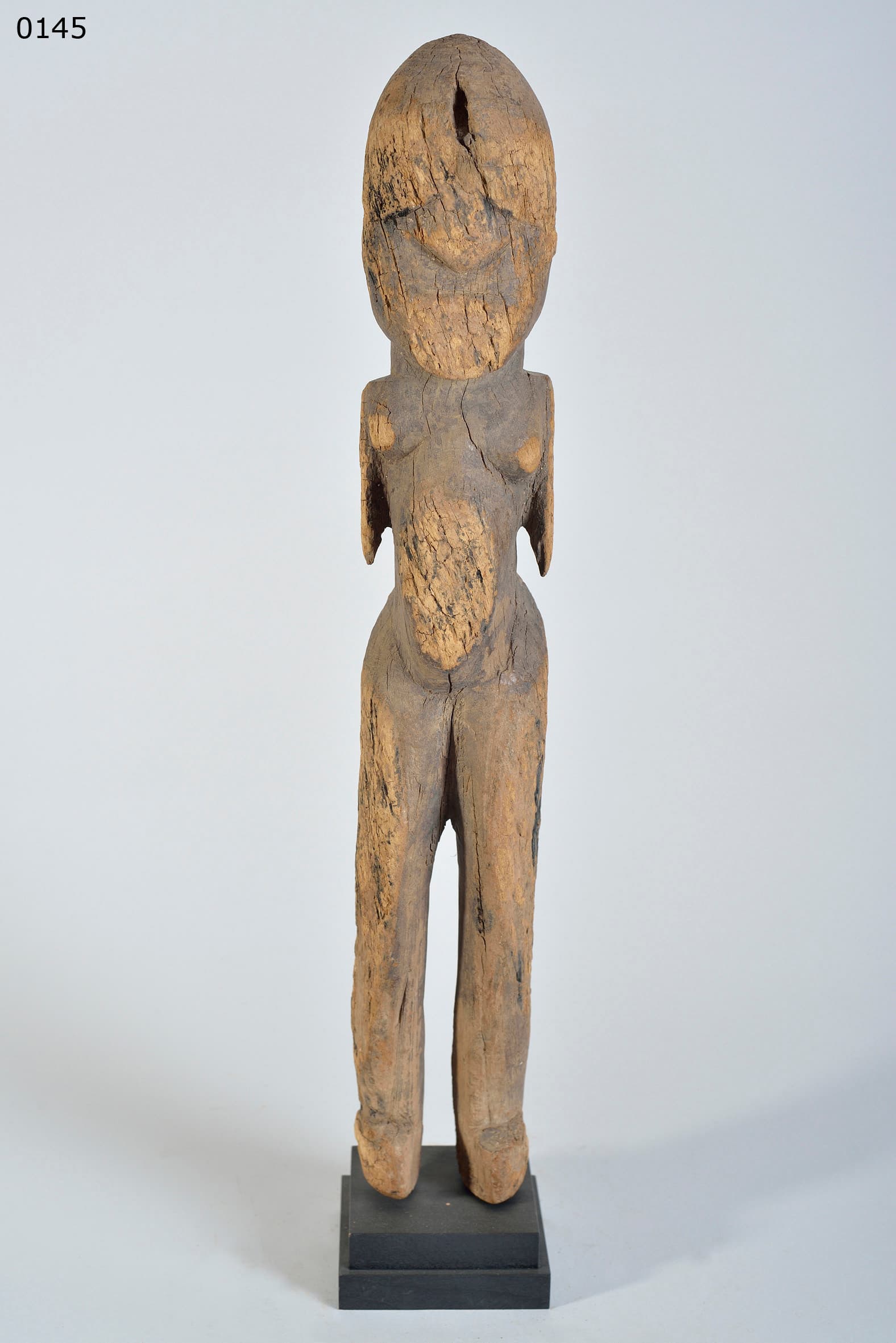
The Nyonyosi are a Burkina Faso people of the Central Plateau, known for masked performances, archaic forms similar to those of the Dogon, and intensive mask exchange with the southern Gurunsi.
Overview
The Nyonyosi (also transcribed in academic literature as Nyonyonse, Ninisi, Nioniosse or Nyonose; singular Nyonyoaga) constitute one of the most historically deeply rooted and, in terms of art history, most distinctive ethnic groups in present-day Burkina Faso. Their traditional settlement area extends across the Central Plateau and the northern and north-western arid savannah regions of the country — primarily defined by the catchment areas of the White, Red and Black Volta river systems. The historical and ritual centre is the Yatenga region with the adjacent areas of the upper Nakambé Valley, supplemented by the provinces of Sanmatenga, Oubritenga and the region around Boulsa. This barren, Sahelian terrain forms not only the physical but above all the spiritual habitat of the Nyonyosi, whose collective identity is inextricably linked to the land.
Demographically, it is no longer methodologically possible to record them as an isolated ethnic unit in modern surveys. According to current projections, Burkina Faso has a total population of 23.5 to 24.6 million people (2024/2025), of whom the Mossi group as a whole accounts for approximately 52 per cent — around 11.1 to 12 million individuals. The Nyonyosi do not appear as a separate entity in official census data, but are subsumed as an autochthonous subgroup, specific lineage or ritual class within this Mossi majority. Rough estimates based on the density of earth shrines in rural regions put the number of individuals defined primarily by Nyonyosi identity at several hundred thousand to a maximum of one million, although centuries of intermarriage have blurred the boundaries.
Linguistically, the historical language of the Nyonyosi belongs to the Oti-Volta subgroup of the Gur languages (Niger-Congo macrofamily), with documented close ties to the Kurumfe of the Kurumba. In the wake of Mossi hegemony, the original language has been almost entirely supplanted by Mooré in everyday secular life. Nevertheless, it is noteworthy that in strictly limited ritual contexts — particularly within the initiation societies and during masked performances — remnants of an esoteric secret language called suku have been preserved, which is cultivated by the ritual authorities as a sacred distinguishing feature. The self-designation Nyonyosi is etymologically derived from Mooré concepts for ‘those who are from here’ or ‘the First Ones’ and underpins their status as pre-dynastic first settlers of the Central Plateau. The exonym Tengabisi (“Children of the Earth”), used for them by the Nakomse (Mossi conquerors), implies political subordination, yet simultaneously acknowledges the inviolable sacred status of the Nyonyosi as the original lords of the land.
The pre-Mossi social structure was strictly acephalic and decentralised: patrilineal kinship groups and segmentary lineages, organised around local places of worship, without any overarching state authority. In the present-day constellation, the Nyonyosi assume the exclusive role of the Tengsoba (plural: Tengsobadamba or Tengsobendo) — the ‘earth priests’ or ‘lords of the earth’, whose inviolable spiritual authority over the land derives from their genealogical connection to the first settlers. They form the spiritual counterweight to the political Nakomse rulers: Without the ritual services of the Nyonyosi, no Mossi Naaba can effectively exercise his God-given power (naam).
The basis of subsistence rests on rain-fed agriculture in a fragile savannah ecosystem — sorghum and millet (Pennisetum) form the backbone, supplemented by maize, groundnuts and small livestock. Relations with neighbouring peoples are characterised by close interaction: ritual and stylistic affinity with the Kurumba in the north; archaic forms similar to those of the Dogon in the north-west; intensive mask exchange with the southern Gurunsi (Nuna, Winiama, Bwa); and parallels in the acephalic model with the Lobi. At the heart of the identity debate lies a controversy between Christopher D. Roy (1987) and earlier ethnographers such as Leo Frobenius and Henri Labouret: Whilst the latter regarded the Nyonyosi as mere ‘remnants’ of a vanished culture, Roy argues that through their art they maintained an active counter-identity to the Mossi elite — the aesthetic canon that today appears in museums worldwide as the ‘Mossi style’ is in truth largely attributable to their indigenous production. The present collection of 16 stone funerary figures (16th century) constitutes a rare and, in terms of its density, remarkable body of work from this archaic stone tradition, which flourished long before the consolidation of the Mossi Empire.
Cultural Context
The Nyonyosi religious system is a complex form of animism that differs structurally in significant ways from the centralised court cults of hierarchical West African kingdoms. At the apex of the cosmological order stands Wende, the creator god and ultimate source of all existence — who, however, after the act of creation, withdrew into an unreachable transcendence as Deus otiosus. Wende is neither invoked directly nor represented materially through sculptures. Instead, active religious practice focuses on Tenga — the earth as a feminine, maternal entity, personified as the wife of the sky —, on the ancestors (baamba) and on an immense pantheon of nature and spirit beings: Kinkirsi (bush and water spirits), Boghoba (divining spirits) and Saba. Within this dense spiritual framework, the soul of the deceased (siga) acts after death as a wandering force that can be transformed into an active ancestor through ritual fixation in an object — such as the stone stelae in this collection.
The central ritual authority is the Tengsoba (“Master of the Earth”), recruited strictly patrilineally from the bloodline of the first settler of a specific territory. His office is for life and subject to draconian taboos: he is often forbidden to touch the ground with bare feet, must wear hand-woven cotton and avoid certain foods. He alone is authorised to allocate land to new settlers, to sanction the start of sowing and harvesting, to tend the tengan kuur (physical earth shrines — stones beneath prominent trees or in groves) and to restore the disturbed balance through expiatory sacrifices in the event of serious taboo violations such as unnatural deaths. In related Gur languages, a similar authority is known as utindaan (“guardian of the shrines”). Alongside the Tengsoba, diviners operate who frequently discern the will of the spirits with the aid of sand drawings or — as documented among the neighbouring Moosé-Mossi — with the aid of mice.
A highly distinctive feature that sets the Nyonyosi system apart from neighbouring patriarchal ethnic groups is the institutionalised ritual role of postmenopausal women — the karan wemba. Whilst women of childbearing age are excluded from many cult practices for reasons of ritual purity, women accumulate considerable spiritual and social power once they have completed their reproductive phase. They are regarded as freed from earthly duties and attain the status of male elders; they act as diviners, as mediums for the ancestors, and are often venerated after their death through sculptures made especially for them. This institutionalised elevation of female wisdom is the iconographic key to the numerous female figures in this collection: the rare maternity figure #43 (36 cm, stone), the explicit female funerary figures #44 (49 cm), #133 (61 cm), #135 (50 cm) and the 72 cm tall #271 — the largest single figure in the collection. These objects demonstrate that spiritual representation was by no means reserved for male ancestors, but that matrilineal ancestral lines and the figure of the karan wemba occupied a central place in the sacred canon.
The Suku (also Soukou) Festival provides the central ritual rhythm; it is the most important axis of social reproduction, during which young novices are initiated into the secrets of the mask societies whilst in strict isolation. Here, the individual is transformed from a boy into a full member of the spiritual community. A significant historical aspect is the Nyonyosi’s resistance to Islam: whilst the Mossi elite increasingly converted from the 18th century onwards for strategic reasons, the Nyonyosi communities, as guardians of earth cults, remained faithful to traditional forms of belief — the main reason for the continuous production of anthropomorphic sculpture, which was often lost in Islamised regions of West Africa.
Within anthropology, this is where one of the most prominent controversies in West African studies manifests itself: the interpretation of the dualism between the Nyonyosi and the Nakomse. Michel Izard, who dominated the French school of thought with Introduction à l'histoire des royaumes mossi (1970) and Gens du pouvoir, gens de la terre (1985), posits a rigid, static structural model: The Nyonyosi ceded political and military rule to the invaders, whilst retaining a hermetic monopoly on spiritual dominion over the earth — a functional integration into the Moogo state apparatus. The Dutch anthropologist Anne Luning (2007, Africa 77(1)) advocates a completely different paradigm. She strongly opposes Izard’s romanticised image of the immutable earth priests and argues that the ritual territories and narratives of the Tengsoba are highly dynamic, locally contested constructs. The earth priests constantly responded to political disruptions and ecological changes by using the discourse on the ‘erosion of nature and morality’ as a legitimate means of extending their local authority. This debate is no academic trifle — it determines how the stone stelae in this collection are to be interpreted: as witnesses to a static pre-Mossian substrate, or as artefacts of an ongoing negotiation between indigenous and invasive orders.
Aesthetic Characteristics
The aesthetic output of the Nyonyosi comprises two fundamentally distinct material traditions, which are often confusingly conflated in art-historical literature: a highly specialised tradition of stone carving (funerary steles, ancestral figures, altar stones — the primary holdings of this collection) and a more widespread woodworking tradition (Karan-wemba masks, Wango plank masks, Tete figures), which is far better known in the region but is not represented in this collection. The 16 stone funerary figures in the collection — all dated to the 16th century, made of sandstone, laterite or softer volcanic rock — belong to a ritually potent, iconographically distinct family of objects that rarely appears in such numbers in Western collections.
The dominant identifying feature of these stone sculptures is their conception as grave stelae or half-figures. The objects are mostly flat in form, with a rounded or slightly arched lower body explicitly designed to be anchored in the ground — a physical manifestation of the connection to the earth. The stylistic conventions are characterised by a deliberate departure from naturalism in favour of conceptual reduction. The heads are disproportionately large, feature expressive, often triangular facial forms, and frequently occupy a third of the total height — a proportion that emphasises the significance of spiritual power over physicality. The iconic feature is large, round eyes, often deeply recessed or sculpted in relief, which radiate intense spiritual alertness. The mouth area is greatly simplified or absent entirely, which underscores the otherworldly nature of the depicted entities. Physical details such as arms resting in front of the torso or a strongly emphasised navel (Wubri) are rendered as flat reliefs — the Wubri functions as the centre of life force and as an unbroken link to the ancestral line.
The collection spans several distinct typological registers: the monumental #271 (72 cm, female tomb figure), as the largest piece, represents the pinnacle of sacred monumentality. The five female tomb figures (#44/49cm, #133/61cm, #135/50cm, #271/72cm), together with the rare motherhood figure #43 (36cm), form a significant female corpus that stands in direct relation to the Karan-wemba institution and to female ancestral lines. The remaining eleven tomb figures (#8, #9, #132, #134, #250, #304, #305, #375, #518, #1060, #1110) cover a size range from 12 cm (#1060, explicitly classified as rare) to 58 cm (#132) — a range extending from dainty domestic or hand-held altar figures to standing cemetery or grove stelae. Over the centuries, these stone objects have developed a characteristic matt, often earthy or dark brown patina due to weathering, burial in the ground and ritual libations.
The stylistic genesis of this sculpture is the subject of a heated iconographic controversy in the specialist literature. The Austrian ethnologist Annemarie Schweeger-Hefel, who published her canonical monograph Masks and Myths. Social Structures of the Nyonyosi and Sikomse in Upper Volta (1980), interprets the formal similarity of Nyonyosi objects to works of the neighbouring Kurumba (such as their famous antelope masks) and to the archaic finds of the Tellem/Dogon in present-day Mali as evidence of a direct descent of the Nyonyosi from the Kurumba. For Schweeger-Hefel, the art of the Nyonyosi is a secondary, derivative phenomenon of North Voltaic migrations — with concrete archaeological anchor points in the Lurum region. Christopher D. Roy deconstructs this descent theory in his equally canonical monograph Art of the Upper Volta Rivers (1987): Roy argues that the stylistic similarities between the Dogon, Lobi, Kurumba and Nyonyosi do not represent ‘kinship through borrowing’, but are evidence of a very ancient, shared, autochthonous Voltaic base style of the peasant population — a style that flourished before the Mossi cavalry redrew the political map of West Africa. As wood decays rapidly in the savannah climate, the evidence base for precise archaeological dating remains ambiguous and the debate unresolved.
Roy’s criterion for distinguishing the Nyonyosi style from the Dogon style is of particular relevance to the market and to research: many Nyonyosi sculptures were classified as “Dogon” or “Tellem” in the first half of the 20th century, as they share a similar archaic austerity. Roy was able to demonstrate that Nyonyosi figures display specific scarification patterns on the temples and around the navel that do not occur among the Dogon — a forensic criterion that is essential today for the attribution of historical pieces. Thanks to the documentation work of Hans Himmelheber (Negerkunst und Negerkünstler, 1960) and the subsequent systematisation by Eberhard Fischer, specific master craftsmen have also become identifiable by name — such as the “Master of Boulsa”, whose works are characterised by particularly delicate facial features and distinctive notches around the eyes. Himmelheber was a pioneer in recognising African artists not as anonymous craftsmen, but as creative individuals with a recognisable personal style — a paradigm that has permanently transformed the way the region is perceived.
Ritual Practice
The ritual practice of the Nyonyosi is deeply rooted in ancestor worship and absolute respect for the forces of the earth. The stone sculptures in this collection are not representations or memorials in the Western sense, but highly charged sacred instruments. They functioned primarily as funerary figures (stelae) and ancestral shrines, closely linked to the cult of the dead and the ritual succession of the Tengsoba, and mark the transition from physical life to active ancestral status. When a reigning Tengsoba or a high-ranking member of the indigenous lineage passed away, a complex, multi-stage funeral cycle was initiated. The stone figures were erected either directly on the graves — often in the immediate vicinity of the homesteads or in specially designated sacred groves — or in the surrounding bush landscape.
The theoretical premise is that the sculpture is never a visual representation of a spirit, but rather a metaphysical anchor — a vehicle or an antenna that focuses the attention of invisible powers on the supplicant at the moment of prayer. In the Nyonyosi belief system, the spirit of a deceased person (siga) initially wanders after death until it is ‘settled’ within an object through specific rites. It is only through this ritual fixation that the deceased transforms into a venerable ancestor capable of positively influencing the fate of the living. Stone is the ideal material for this purpose because — unlike the wood of the Karan-Wemba masks — it embodies a claim to eternity: the bond between ancestor and place is set in stone.
The spiritual centre of every Nyonyosi community is the earth sanctuary — tengan kuur or, regionally, teng-ku. The structure is often unassuming and organically integrated into the landscape: uncut stones at the base of sacred trees (baobabs or kapok trees) or in enclosed groves, supplemented by small mud-brick structures in which ancestral figures and ritual pottery are kept. The activation of a new stone sculpture is performed by the Tengsoba in a secret rite: The blood of a chicken, a goat or a sheep is mixed with millet porridge and locally fermented millet beer (dolo) and poured onto the object or ritually spat upon it to invoke the life force of the ancestors into the stone. Without this activation, the object remains a mere stone without sacred power.
Sacrifices are made on specific occasions: at sowing and harvest time, to implore the earth’s blessing for agriculture; in times of crisis such as drought, epidemics or social conflicts; during initiations, when new members are admitted into the mask societies; and mandatorily following serious transgressions (murder or suicide on the territory) that have metaphysically contaminated the ground. The dull, often encrusted patina that many of these stone grave figures display today is the direct material result of centuries of ritual offerings. Libations of millet water, dolo, shea butter or sacrificial blood, combined with the dry heat of the savannah and seasonal humidity, produce the characteristic earth-brown to dark surface that identifies the object as an active ritual instrument.
Parallel to the static stone altars, and complementary to them, lies the performative dimension of the cult in the mask performances (waongo). These take place primarily during funeral ceremonies for high-ranking figures (suuru) and annual commemorative ceremonies. In contrast to the stones, the wooden masks represent a transient form of mediumship: the dancer, completely enveloped in a costume made of plant fibres (mostly Hibiscus cannabinus), loses his human personality upon donning the mask and becomes a medium for the spirit; the masks escort the soul of the deceased into the realm of the ancestors. At the Soukou festival, hundreds of masks from different villages come together; regionally, red masks (more aggressive, dynamic, using whips or swords to punish social transgressions) differ from black masks (more measured, meditative, representing transcendent aspects). A distinctive feature is the institutionalised playful alliance with nomadic Peul (Fulani): This playful kinship of jest serves to preventively defuse tensions between sedentary Nyonyosi farmers and Peul herders, who compete for scarce ecological resources. For the collection, this wooden dimension is context, not content — the 16 stone objects belong to the static, site- and grave-bound pole of the practice, not the kinetic-performative side.
The use of these stone objects was subject to strict restrictions: touching or ritual manipulation was reserved for initiated men of the relevant lineage. For the uninitiated, particularly members of the Nakomse ruling caste, the sites were often taboo and associated with great spiritual fear. The life cycle of an activated stone does not end abruptly: since stone — unlike wood, which is rapidly destroyed by termites in the Sahel — defies the passage of time, many of these objects remained in ritual service for generations. It was only with the extinction of a lineage, the conversion of the community to Islam or Christianity, or with colonial disruptions that the stones lost their active sacred status and entered collections — a process that contextualises the present 16 objects as witnesses to an interrupted ritual biography.
Historical Context
Reconstructing the migration and settlement history of the peoples of the Volta Basin is a highly complex task, as the pre-Mossian era of the Nyonyosi is documented solely through oral traditions and scant archaeological evidence. The Nyonyosi are regarded as the original inhabitants of the area between the White and Red Volta rivers. At the heart of the historiographical discourse lies the dating of the defining turning point: the invasion of the Nakomse from the regions of Mamprusi and Dagomba (in present-day northern Ghana) and the establishment of the dualism between political and ritual authority. There is striking disagreement amongst researchers on this matter, which directly affects the dating framework of the stone sculptures in this collection: Annemarie Schweeger-Hefel (1961/62), based on archaeological excavations of early Nyonyosi settlement remains in the Mengao region, places the turning point at around 1315; Michel Izard (1970) dates the establishment of the Kingdom of Ouagadougou under Naba Oubri to around 1495; J. D. Fage (1964, Reflections on the Early History of the Mossi-Dagomba Group of States) dates the consolidation of Mossi rule over the Central Plateau to around 1515; Historical Songhai chronicles, through the Battle of Kobi (1483), in which Sonni Ali defeated the Mossi troops, attest to their presence in the north as early as the late 15th century. For the 16th-century dating of the collection objects, this means: They were created at a time when the compromise between Nakomse rule and Nyonyosi sacred authority was already consolidated but by no means stable — artefacts of an actively negotiated cultural coexistence.
Instead of annihilating the indigenous population, the Nakomse horsemen established a symbiotic system of rule. The Mossi kings recognised that whilst they could rule over people’s bodies, they could not rule over the soul of the earth: a ‘historic compromise’ was reached — the Mossi provided political administration and military protection, whilst the Nyonyosi retained spiritual sovereignty over the land. This dualism shaped artistic production for centuries: Mossi courts promoted equestrian statues and symbols of authority, whilst earth cults and their material artefacts — stone stelae, altars, masks — remained the exclusive prerogative of the Nyonyosi. This balance of power, maintained over centuries, withstood even Islamic expansionist efforts from the north (such as those of the Songhai Empire).
French colonisation brought about a turning point. With the conquest of Ouagadougou in 1896 and the formal constitution of Upper Volta in 1919, the social structure underwent massive disruption. The colonial administration, characterised by a Eurocentric understanding of power, recognised almost exclusively the Mossi chiefdom as its point of contact; the spiritual authority of the Tengsoba, operating behind the scenes, was ignored, defamed as ‘superstition’ or deliberately marginalised. Early collectors such as Leo Frobenius (research 1904–1906) and Louis Tauxier documented the Nyonyosi in a generalised manner under the blanket term ‘Mossi’, leading to a long period of art-historical invisibility. At the same time, missionaries and colonial officials confiscated previously hidden esoteric objects — stone stelae, mask headdresses, ancestral figures — as alleged evidence of “pagan idolatry” or systematically bought them up, thereby abruptly interrupting the ritual life cycle from activation to transmission within the lineage.
The academic rehabilitation began with Hans Himmelheber, who travelled to the region several times between 1933 and 1976; his field notes and collections form the core of the Africa Department at the Museum Rietberg in Zurich, the foundation of which was established through the acquisitions of Eduard von der Heydt. In the 1970s, Christopher D. Roy’s field research, culminating in Art of the Upper Volta Rivers (1987), provided the decisive work for the rehabilitation of the Nyonyosi as an independent artistic force. For these specific stone sculptures, the pioneering work of the Viennese ethnologist Annemarie Schweeger-Hefel — particularly her excavations in Mengao and the Lurum region — was fundamental: she established the first systematic attribution of the stone grave figures to the Nyonyosi, who had previously been misclassified as either ‘Dogon’ or ‘Kurumba’.
The history of the market unfolded in parallel with the revaluation of African sculpture from ethnographic curiosities to masterpieces of world art. A key figure in this re-evaluation was the French sculptor, ethnographer and collector Pierre Meauzé, who published from the 1950s to the 1970s and, within André Malraux’s intellectual circle, vehemently advocated defining African sculpture as Premier Art (“First Art”). His monograph African Art: Sculpture (1968) drew the attention of European aesthetes more strongly to the abstract, hermetic forms of the Volta region. Groundbreaking exhibitions such as Art and Life in Africa (Stanley Collection, University of Iowa, 1984) consolidated the perception of Nyonyosi art as “High Art”. Significant provenance lines today lead through the collections of Eduard von der Heydt (Rietberg), Han Coray and Pierre Meauzé; Nyonyosi stone funerary figures are explicitly documented on auction platforms such as Invaluable under the category “Nyonyosi Stone Sculpture, Burkina Faso”, confirming their status as a distinct market category — separate from the tradition of wooden masks.
Following Burkina Faso’s independence in 1960, and particularly during Thomas Sankara’s revolutionary phase in the 1980s, traditional authorities were systematically curtailed, a development that also affected the institution of the earth priests. Modern land reform, rapid population growth and the spread of Islam and Christianity have placed the traditional way of life under severe pressure, yet in rural regions the Tengsoba continues to be invoked as a moral authority in land disputes and ecological crises. Market price trends show a clear upward trajectory: Karan-wemba masks regularly exceed the €100,000 threshold at Christie’s and Sotheby’s, whilst stone funerary figures with verifiable provenance (von der Heydt, Coray, Meauzé) consistently fetch mid-five- to six-figure euro sums. In parallel, a professional forgery industry has established itself in centres such as Ouagadougou or Bobo-Dioulasso; authenticity testing relies on forensic criteria: C14 dating of organic patina residues, UV fluorescence analysis to distinguish authentic sacrificial residues (blood proteins, plant starch from millet porridge, dolo residues) from synthetic stains or glue-earth mixtures, as well as Roy’s scar ornament criterion to distinguish against Dogon/Tellem misattributions. As the 16th-century stone sculptures are archaeological artefacts, they directly touch upon current discourses on provenance and restitution; initiatives such as the Nexus 1492 research project or the Tervuren restitution debates underscore the need to view the 16 objects in this collection not merely as aesthetic artefacts, but as actors in a resilient, ongoing history — and to document their provenance in full.