Overview
The Moose (self-designation in the plural Moose, in the singular Moaaga; in historical, Francophone and Anglo-French literature and most museum databases usually subsumed as Mossi or occasionally Moshi) represent the demographic, linguistic and cultural-historical hegemonic power in present-day Burkina Faso. The geographical distribution of the ethnic group is primarily concentrated on the so-called Mossi Plateau in the central Volta Basin, a semi-arid savannah area characterised by limited rainfall and poor soils. According to current demographic projections by the United Nations Population Fund (UNFPA) for the year 2025, the total population of Burkina Faso is around 24.1 million people. The proportion of Mosses in this total national population is consistently estimated at 52 to 53.7 per cent, resulting in a current absolute population estimate of around 12.7 to 12.9 million indigenous Mosses within the national borders. In addition, significant transnational diaspora communities exist for historical and economic reasons, particularly in Côte d'Ivoire (estimated at over 1.2 to 2 million members) and to a lesser extent in Ghana and Mali.
Linguistically, Mooré (or Mòoré) belongs to the Oti-Volta subgroup of the extensive Gur language family (traditionally also referred to as Voltaic languages) within the Niger-Congo phylum. This linguistic relationship indicates a deep historical and cultural connection to the Mamprusi and Dagomba in present-day northern Ghana, from whose territories the founding fathers of the Moose kingdoms migrated according to oral tradition. The subsistence economy of the Moose is fundamentally agrarian and is based on traditional, sedentary dryland farming of sorghum and millet, supplemented by marginal livestock farming.
The social structure of the Moose is defined by a rigid, patrilineal and strictly hierarchical organisation, which differs radically from the acephalous (rule-free) social models of neighbouring western tribes such as the Bwa or Lobi. At the centre of this social order is a historical federation of centralised kingdoms (such as Ouagadougou, Yatenga, Tenkodogo and Boussouma), headed by the Mogho Naaba (emperor) of Ouagadougou as the primary political authority. The sociogenesis of the Moose is based on a fundamental dichotomy resulting from the historical overlapping of two distinct population groups: the Nakomse and the Nyonyosi (or Tengabisi). The Nakomse form the political aristocracy; they are regarded as the direct descendants of those warriors on horseback who invaded from the south in the 15th century and monopolised secular power (naam). The Nyonyosi, on the other hand, are the autochthonous descendants of the original, arable population (often associated with the Kurumba or Dogon), who were subjugated militarily but, as "masters of the earth", retained the ritual and spiritual monopoly (tenga) over the chthonic nature and earth cults. This structure is complemented by strictly endogamous, caste-like artisan groups such as the blacksmiths (saaba), who produce sacred wooden sculptures, and the Yarse, an originally Mandespeaking group of Islamic long-distance traders.
Within modern political anthropology and anthropology, the exact structural relationship between Nakomse and Nyonyosi forms the core of an ongoing scholarly debate. The source situation is ambiguous, and controversies of classification must be explicitly marked: The classical, strongly structuralist model of conquest, formulated largely by Michel Izard (1985) in his canonical work Gens du pouvoir, gens de la terre, postulates a clear, static stratification. Izard sees the Mossi nobility in a rigid position of hegemony over the autochthonous Nyonyosi earth cultists, whereby naam is interpreted as a purely political-territorial mechanism of subjugation. More recent research, particularly the work of Doris Bonnet (1988), on the other hand, argues emphatically in favour of a coexistence and syncretism model (author vs. author). Bonnet demonstrates that even in the early consolidation phase in the 16th century, a profound symbiotic interweaving of the two spheres developed, rendering a clear sociological stratification obsolete. The earth priests were not merely subjects, but indispensable ritual-biological antipoles, without whose spiritual sanction the Nakomse could not rule. This syncretic reality is also reflected in provenance research: the inventory records of the Musée du quai Branly - Jacques Chirac in Paris contain numerous objects whose documented contexts of use demonstrate fluid transitions between aristocratic representation and autochthonous earth cult.
| Demographic and linguistic parameters | Specification/source reference |
|---|
| Total population of Burkina Faso (2025) | ~24.1 million (UNFPA projection) |
| Proportion of Moose in total population | 52.0 % - 53.7 % (census data) |
| Estimated population of Mosses (national) | ~12.5 - 12.9 million (derived) |
| Diaspora (primarily Côte d'Ivoire) | 1.2 - 2.0 million |
| Language family | Niger-Congo > Gur (Voltaic) |
| Specific language | Mooré (Mòoré) |
| Social dichotomy | Nakomse (nobility) vs. Nyonyosi (earth priests) |
Cultural context
The religious system and the cosmological order of the Moose are characterised by a fundamental bipolarity that precisely materialises the dual socio-political structure of society. The creator god Wennam (or Wende) is enthroned at the top of the cosmology. In ritual practice, this solar high god entity is exclusively associated with the political power of the Nakomse and the metaphor of the sun and the horse. The Nakomse aristocracy derives its legitimisation primarily from the veneration of royal ancestors. Their cult focusses on ancestral altars and the ritual use of figurative wooden sculptures (such as equestrian figures or chieftaincy posts), which are presented at annual ceremonies such as the na possum to validate secular loyalties.
In contrast, there is the spiritual domain of the indigenous Nyonyosi, which is centred on the chthonic - the earth, the wilderness (brousse) and the unpredictable natural and spiritual beings (kinkirse) that reside there. The Nyonyosi control the magico-religious interaction with those powers that are responsible for elementary survival factors such as rain, agricultural fertility and defence against epidemics. The highest ritual authority in this context is the Tengsoba (earth priest), who acts as custodian of the land and performs blood sacrifices at earth altars. The Tengsoba is supported by a network of divinators and healing specialists as well as by the blacksmiths (Saaba), who not only mould the iron but also create the sacred masks as receptacula for the nature spirits as wood sculptors.
What distinguishes the religion of the Moose most structurally from its Voltaic neighbours - such as the Bwa, Bobo, Nuna or the Senufo in the Ivory Coast - is the complete absence of initiated, closed secret societies (such as the Poro or Do cult). As Christopher D. Roy (1987) explicitly demonstrates, there are no secret mask societies among the Moose. Rather, masks are the collective property of specific patrilineal families and clans. Consequently, mask performances are not exclusive, esoteric events, but public spectacles that men, women and children are all allowed to attend.
The role of women in the sacred cult of the Moose is unique and of enormous ethnographic relevance. While women are strictly excluded from interaction with masks in many neighbouring societies, the Moose institutionalise the figure of the wemba. A wemba is a woman of advanced age who returns to the homestead of her patrilineal origin after the death of her husband and the successful rearing of her children. There she is elevated to the status of a living ancestor's wife. In this position, she acts as a direct, highly honoured channel to the ancestral spirits of the clan. After her death, the canonical karan-wemba mask is carved in her honour and appears at commemorative ceremonies to celebrate her integration into the transcendent pantheon. Central initiation and transition rituals for young girls are also inextricably linked to the biiga wooden dolls. These are not used as profane toys, but accumulate magical potential as part of ritual practices: they ensure the transfer of the soul of a newborn (yisa biiga) into the material world and act as votive offerings for childless women, which are adorned with kauri snails to induce fertility.
Deep research controversies also manifest themselves in the field of cosmology (author vs. author). Michel Cartry and Doris Bonnet (1988) analyse the cosmological system of mosses primarily via a binary, spatial-biological dichotomy (village vs. bush, visible world vs. invisible world of the kinkirse). They argue that the "biological body" and the "social body" are inextricably linked to ritual space. Izard (1985), on the other hand, marginalises this nature-religious metaphor and interprets the cosmological structure in a strictly deterministic way as a purely political instrument of the exercise of nakomse power. Historical artefacts and their documentation in the Royal Museum for Central Africa (RMCA) in Tervuren - which has excellent holdings of historical Moose insignia of power - paradoxically support elements of both theories, as many ceremonial objects syncretically merge legitimation of power (Izard) with animistic iconography (Bonnet).
| Cosmological and socio-political dichotomy | Nakomse (secular power) | Nyonyosi (ritual power) |
|---|
| Supreme Entity | Wennam (Creator God, Solar) | Nature Spirits (kinkirse), Earth |
| Legitimisation | Descent from riders (south) | Autochthonous roots |
| Cult focus | Royal Ancestors | Earth cults, agriculture, weather |
| Material Culture | Figurative Sculpture, Riders, Posts | Totemic Masks (Wango) |
| Ritual Authority | Mogho Naaba, Chiefs | Tengsoba (Earth Priests), Divinators |
Aesthetic features
The sculptural corpus of the Moose is characterised by a fascinating morphological and stylistic diversity, which aesthetically materialises the multi-ethnic assimilation history of the people. The canonical object typology strictly differentiates between the profane-political art of the Nakomse and the sacred-animistic art of the Nyonyosi.
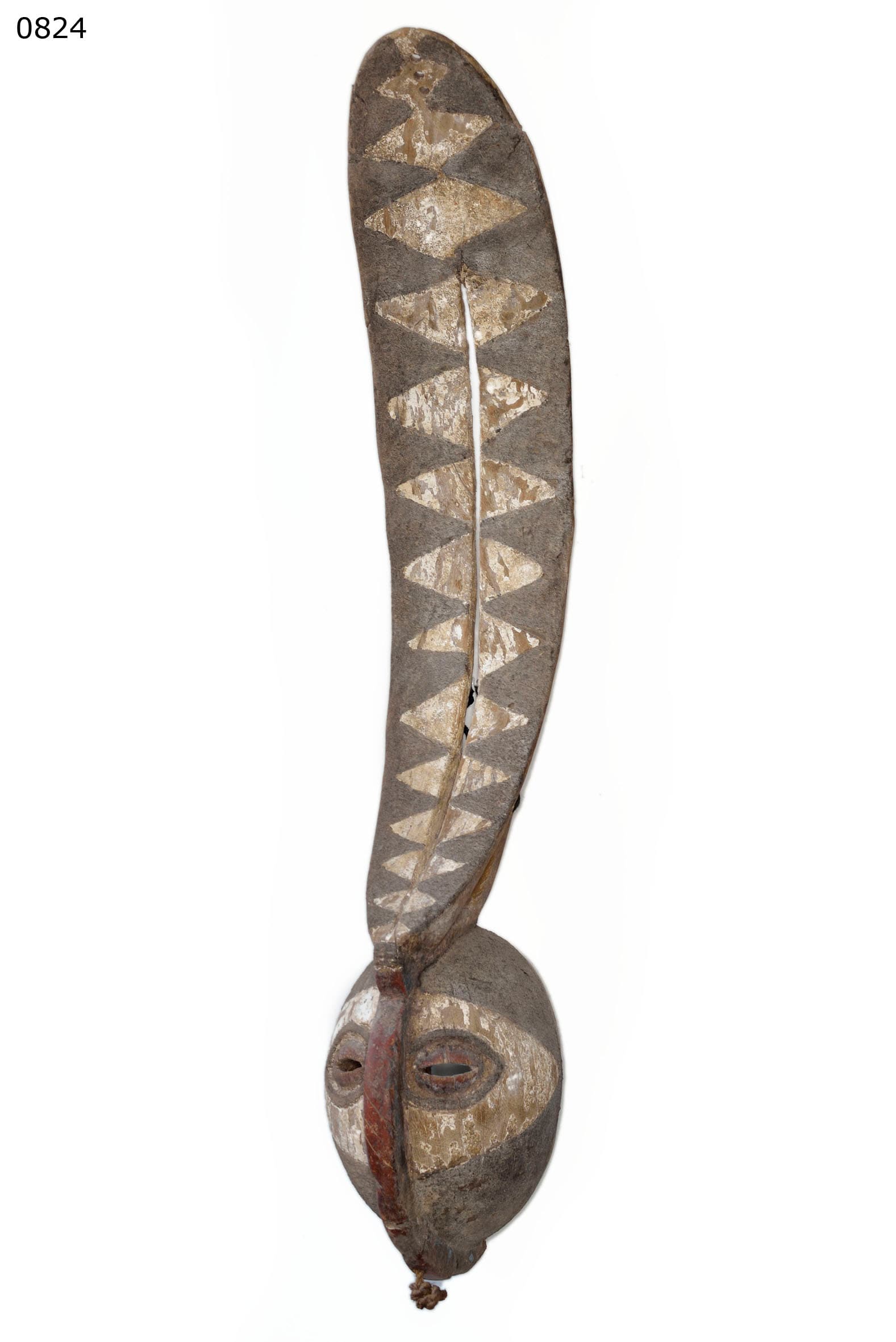
The most iconographically dominant form is the karanga mask, a vertically oriented plank mask of often monumental size (up to 1.80 metres and higher). These masks represent the totemic animal spirit of the respective clan. The karanga typically combines a concave carved, oval face with an extremely elongated, flat wooden plank, which is dominated by filigree geometric openwork (triangles, diamonds, zigzag lines). At the point of contact between the face and the plank, the long, straight and pointed horns of the horse antelope (Hippotragus koba) almost always protrude. One iconographically highly complex subtype is the aforementioned karan-wemba mask (face mask with female ancestor figure). Here, the vertical plank is replaced by a fully sculpted female figure enthroned on the head of the mask. A significant detail of the proportional canon of these figures are the meticulously pyro-engraved (burnt-in) scarification patterns (keloids), which radiate from the navel and traditionally document the status of a woman after the birth of her first child. The biiga wooden dolls stand in stark formal contrast to this. These miniaturised objects (usually 15 to 30 cm) reduce the female anatomy to the absolute minimum: they have a purely cylindrical basic body without arms and legs, but massively accentuate the pendulous breasts (as a symbol of lactation, stimulated by peebo massages) and the elaborate, asymmetrical gyonfo crested hairstyle.
Comparison of the canonical formal languages: The Yatenga-Karan-wemba mask is characterised by the concave facial field and the vertical canon of proportions, while the Ouagadougou style prioritises compact, animalistic volumes. This difference marks the fundamental basis of the subtypology according to kingdom affiliation established by Christopher D. Roy (1987), which is still valid today. Roy differentiates between four primary style provinces:
- Yatenga style (Northwest): High plank masks, oval and highly concave face, antelope horns, white foundation. Historically characterised by the assimilation of local Dogon populations.
- Auagadougou style (south-west): Small, horizontally orientated, zoomorphic helmet masks (often birds, monkeys or cats of prey), red-white-black painting. These are often referred to as wan-nyaka or sukomse.
- Boulsa style (East): Masks with semi-cylindrical vertical structure, often appearing in triadic sets (wan-zega [red], wan-sablaga [black] and wan-peelga [white]).
- Tenkodogo style (south-east): More abstracted, compact forms that show influences of the neighbouring Bissa and Gurma.
A sharp iconographic controversy in research concerns the historical authorship of the plank masks (author vs. author). The Austrian ethnologist Anne-Marie Schweeger-Hefel (1980) attributes large parts of the vertical mask forms (stele and sword masks) primarily to the independent culture of the Kurumba and the Nyonyosi descended from them, and sees the Moose merely as a recipient culture. Christopher D. Roy (1987) vehemently disagrees with this; he argues in favour of a self-sufficient, syncretic Moose conquest model, in which today's masks are the result of 500 years of exclusive Moagic synthesis and have fundamentally emancipated themselves from Kurumba objects. The source situation is ambiguous as to the extent to which master craftsmen (Master of...) documented by name existed in the pre-colonial period, as the blacksmith-carvers (Saaba) acted primarily as functional ritual service providers and not as individual artist-catalysers.
In terms of material technology, the sacred objects are carved from resistant local hardwoods, whereby analyses of important pieces (such as in the Museum Rietberg Zurich or the Met) often show evidence of khaya senegalensis (African mahogany). The formation of the patina marks the absolute difference between an activated ritual object and a profane carving. A genuine ritual patina is a stratigraphic accumulation of palm oil, animal blood and stearic acid that migrates into the cellular wood structure over decades. The characteristic tricolour painting is created organically: white is obtained from powdered lizard excrement or kaolin, red from crushed hematite, and the deep black pigment results from the laboratory boiling of the seed capsules of Acacia nilotica. Forgery criteria for the market-relevant art trade focus precisely on this materiality: forged patinas usually consist of industrial stains, shoe polish or bitumen, which only adhere superficially without penetrating the wood pores, and the artificial "black" does not stand up to mass spectrometric analyses for Acacia nilotica derivatives.
| Morphological mask subtypology (after Roy, 1987) | Geographic region | Iconographic characteristics | Historical influence |
|---|
| Yatenga style | Northwest (Ouahigouya) | Concave oval face, vertical high plank, antelope horns, karan-wemba | Dogon assimilation |
| Ouagadougou style | south-west / central plateau | compact, zoomorphic helmet/crest masks, no planks | Gurunsi groups |
| Boulsa style | east | half cylinders, triadic colour sets (wan-zega, sablaga) | local synthesis |
| Tenkodogo style | Southeast | Abstract, stylised short forms | Bissa / Gurma |
Ritual practice
The lifecycle of a Moose sacred object from newly carved artefact to final deactivation is a highly complex, performative and material process. The cycle begins with the commissioning of the village blacksmith (Saaba) by the male patriarch of a Nyonyosi clan. After the purely physical completion, the object is profane and has no transcendent quality. The initial activation only takes place through the consecration at the family's earth altars.
When they are not in performative use, the masks and figures are kept in special ancestral shrine houses that are not open to the public and are known as kimse roogo. This altar use is not passive storage, but an active act of spiritual maintenance. The masks represent the clan totem of animal or human origin with which the family shares a common life force (nyama). Continuous offerings are required to keep these entities well-disposed and to guarantee their protection against drought, epidemics and infertility. The main occasions for these offerings are the annual year-end or pre-rainy season festivals (known as suku or sigim-dam in regional variations), which usually culminate in May. During activation, chickens, goats or sheep are sacrificed to the objects; the fresh blood and ritual libations of fermented millet beer are poured directly over the wooden surfaces, creating the thick, encrusted layers of patina.
The actual mask performance is a choreographed spectacle that primarily takes place in the context of funeral and memorial rites (memorials). The performative lifecycle of a death is divided into two strictly separate phases:
- The funeral (burial): Immediately after the death of a male or female clan elder, the masks escort the corpse to the grave. At this stage, they act as silent guardians, ensuring that all esoteric protocols are followed. They do not dance.
- The memorial service (Memorial): Weeks or months after the physical burial, the actual festival takes place, celebrating the soul's entry into the ancestral world. This is where the kinetic activation takes place. The wearer (always male) is completely sewn into a thick costume made of black-coloured fibres of kenaf (Hibiscus cannabinus) or hemp, which completely conceals his human anatomy and identity.
The dances are accompanied by specific music produced by long wooden drums (gangaado) and flutes (wiré). In order to stabilise the often extremely high Yatenga plank masks during the acrobatic movements, the dancer bites down on an internal wooden stick, which is fixed through openings in the mask cheeks. The choreography is mimetic: the dancer precisely imitates the movements of the animal depicted - such as the rapid head tossing of the antelope or the pecking of the rooster.
The deactivation and disposal of a sacred object obeys laws that fundamentally contradict Western claims to conservation. If a mask fails structurally due to ritual wear and tear, climatic extremes or massive termite infestation, it is not profanely disposed of or burnt. Instead, it is left to its fate in a state of deactivation: it is discarded in the dark corners of the kimse roogo or in the sacred bushland "left to rot" (left to decay naturally), as the wood must return to the earth (tenga) as matter. A highly specific variant of disposal concerns the ninana wooden posts that flank the entrance to chiefdoms. At the end of their one-year ritual cycle, these guardian figures are ceremonially buried in the ground after the harvest ceremony - a direct imitation of a human burial. Renowned institutions such as The Metropolitan Museum of Art (Met) today possess exhibits (e.g. large karanga masks) that were often acquired by Western collectors precisely during this liminal phase - between ritual discarding and final decay.
Historical context
The historical genesis of Moose art production is inextricably linked to the complex history of migration and the geopolitical upheavals in the Volta Basin. The formal establishment of the Moose kingdoms dates back to a massive military expansion of equestrian warriors from the north of present-day Ghana (from the Mamprusi and Dagomba kingdoms). The exact dating of this event is a classic historiographical controversy: While older authorities such as J.D. Fage (1964) located the formation phase as early as the early 14th century (c. 1350), A.A. Illiasu (1971) revised this chronology by critically re-evaluating oral traditions and convincingly dated the consolidation of the Yatenga and Fada N'gourma states to the late 15th century (c. 1480-1500). This invasion forced the migration of local groups (such as the Dogon, who fled to the Bandiagara cliffs), but at the same time led to the assimilation and aesthetic syncretism with the remaining indigenous farmers described above.
The colonial encounter marked the next dramatic caesura. With the violent conquest of the capital Ouagadougou by French troops in 1896 and the subsequent establishment of the protectorate of Upper Volta (Haute-Volta), the Mogho Naaba lost its absolute political sovereignty. However, the influence of colonial history on the art production of the Moose is ambivalent. While the elitist, courtly representational art of the Nakomse stagnated due to the loss of political power, the ritual mask carving of the peasant Nyonyosi on the periphery remained largely intact, as it operated on a local, village level and often eluded direct colonial-administrative control. In addition, unlike many neighbouring ethnic groups, the Moose resisted widespread Islamisation and Christianisation for a long time, which ensured the survival of animist woodcarving well into the 20th century.
The market history in the West began in the early decades of the 20th century, when African artefacts were freed from their purely ethnographic context ("Curios") and received by the European avant-garde as art ("Art Nègre"). Parisian dealers and collectors such as Paul Guillaume, Charles Ratton and the critic Félix Fénéon were among the first to commercialise the highly abstract, cubist-looking masks of the region (especially the plank masks) in the 1920s and 1930s. The legendary exhibition "African Negro Art" at the Museum of Modern Art (MoMA) in New York in 1935, curated by James Johnson Sweeney, which included numerous pieces from the Fénéon collection, was a massive breakthrough that had a lasting impact on price development and museum canonisation. At the same time, the Swiss collector Eduard von der Heydt acquired excellent objects via Parisian gallery owners, which today form the historical core of the Africa collection at the Museum Rietberg in Zurich. From the middle of the 20th century, the increasing demand led to an exponential price development for documented field specimens.
With the escalating market prices, a massive counterfeiting problem manifested itself. Today, modern forgery workshops produce highly deceptive replicas for the Western market, which is why authenticity criteria are increasingly shifting to microchemical forensics. While superficial signs of ageing such as artificially induced termite damage, heartwood cracks caused by kiln drying or burial in damp soil (to simulate decay) can hardly be visually verified by experts, laboratory analysis of the patina provides absolute certainty. As already mentioned, mass spectrometry analysis detects deeply migrated molecular chains of stearic acid (palm oil/shea butter) and animal proteins in genuine, ritually "fed" objects, while forgeries only show superficial layers of bitumen or modern stains. In addition, provenance research - the complete proof of ownership history through comparison with inventory books of established museums such as the Rietberg, the Quai Branly or the British Museum (e.g. inv. no. Af1947,31.15) - can serve as the ultimate protection against recent forgeries.
| Provenance and market history of Moose art | Historical milestone | Actors / institutions |
|---|
| ~1480 - 1500 | Consolidation of the kingdoms & stylistic synthesis | Nakomse (conquerors), Nyonyosi (autochthones), Dogon |
| 1896 - 1896 | French conquest, end of absolute sovereignty | Mogho Naaba, French colonial army |
| 1920s - 1930s | Commercialisation in Europe ("Art Nègre") | Paul Guillaume, Charles Ratton, Félix Fénéon |
| 1935 | Exhibition "African Negro Art" (international breakthrough) | MoMA (James Johnson Sweeney) |
| 1950s | Canonisation in European museum collections | Eduard von der Heydt (Museum Rietberg) |
| Today | Forensic authentication (stearic acid analysis) | International auction houses, Met Museum |