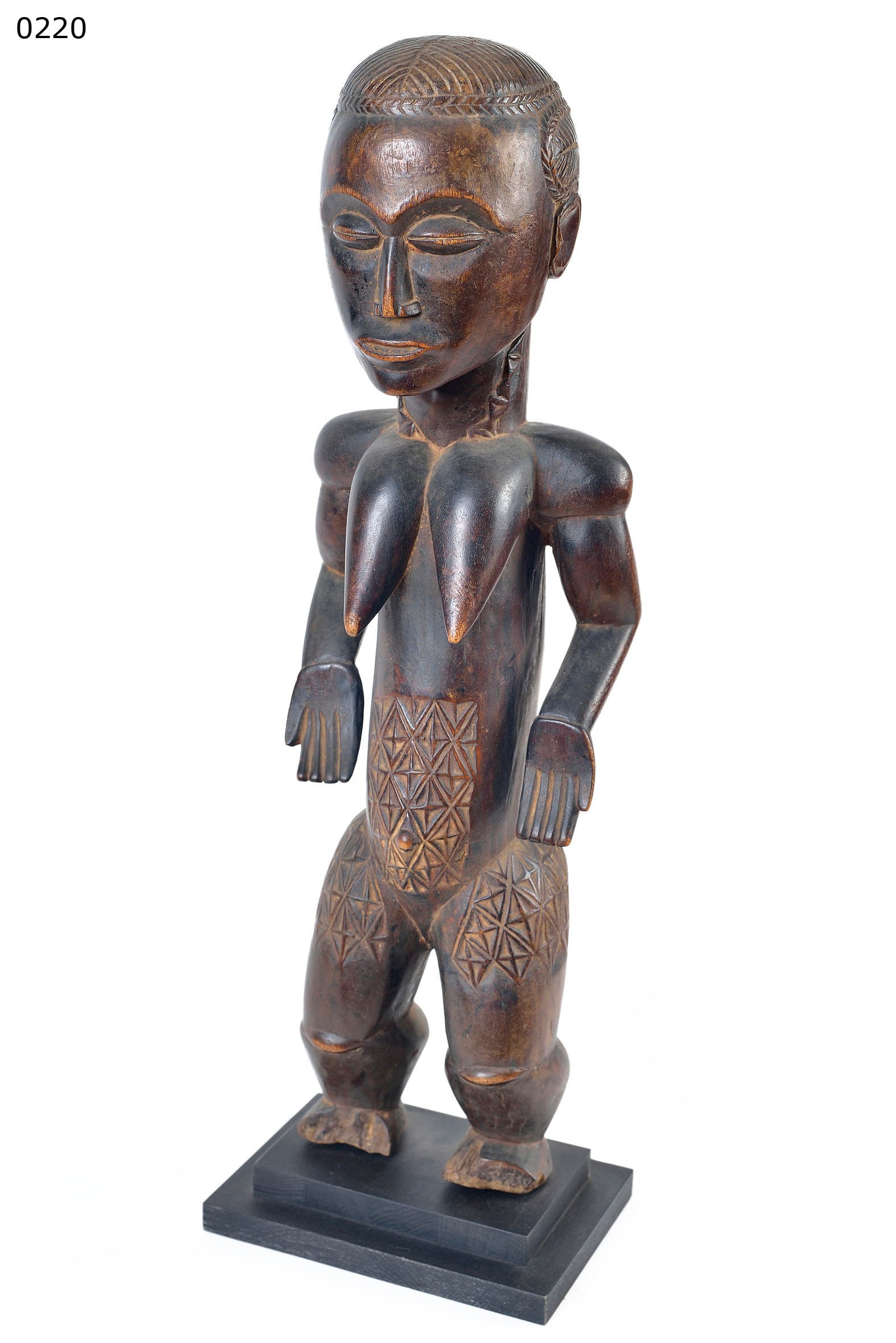
Eine dunkle, stark patinierte weibliche Holzfigur (1. Hälfte 20. Jh., 73 cm) der Bete von der Elfenbeinküste - aggressiv stilisierte Gesichtszüge, aufwendige geometrische Skarifikationen am Oberkörper und markante muskulöse Waden.
1. Die aggressive Bete-Ästhetik
Die Bete leben in den dichten Wäldern der Elfenbeinküste, in der Nähe der Dan und der We.
- Kraft statt Gelassenheit: Während die Dan geschliffene, meditative Gesichter bevorzugen, ist die Kunst der Bete kraftvoll und expressionistisch.
- Der Körper als Kraft: Scharfe Gesichtszüge, gebeugte Knie und pralle Waden unterstreichen eine Ästhetik, die körperliche Stärke und Ausdauer gegenüber zarter Schönheit bevorzugt.
2. Die Karte des Matriarchats
Das auffälligste Merkmal der Figur ist die tiefe rautenförmige Skarifikation, die Bauch und Oberkörper bedeckt.
- Bildsprache: In der Bete-Kultur kennzeichnen Skarifikationsmuster den Rang, den Clan und den Initiationsstatus.
- Gebärmutter als Zentrum: Die Platzierung der dichtesten Motive über der Gebärmutter betont ausdrücklich die Rolle der Figur als fruchtbarer, lebensspendender Anker der Abstammungslinie - eine hochrangige, vollständig initiierte Matriarchin.
3. Heiligtumsverehrung
Diese Figur gehört zur intimen Welt des familiären Schreins.
- Verehrung einer Gründungsmutter: Es wurden Opfergaben dargebracht, um Fruchtbarkeit für die lebenden Frauen des Clans zu erbitten.
- Kontinuität der Blutlinie: Die Figur wurde konsultiert, um die anhaltende Stärke und das Überleben der Linie zu sichern, was die Gründermutter zu einer aktiven spirituellen Präsenz über Generationen hinweg machte.
Zusammenfassung
Diese weibliche Vorfahrin der Bete ist ein Porträt von kompromissloser Stärke. Durch die Kombination von muskulärer Anspannung und aufwendigen rituellen Skarifikationen erhebt sie die Gründermutter in eine Position grimmiger, unnachgiebiger spiritueller Autorität.
KI-unterstützt erstellt aus Sammlungsgutachten, Objektfotografie und eigener Recherche, redaktionell geprüft. Fehler sind möglich — Hinweise darauf sind uns willkommen. Zum Verfahren →