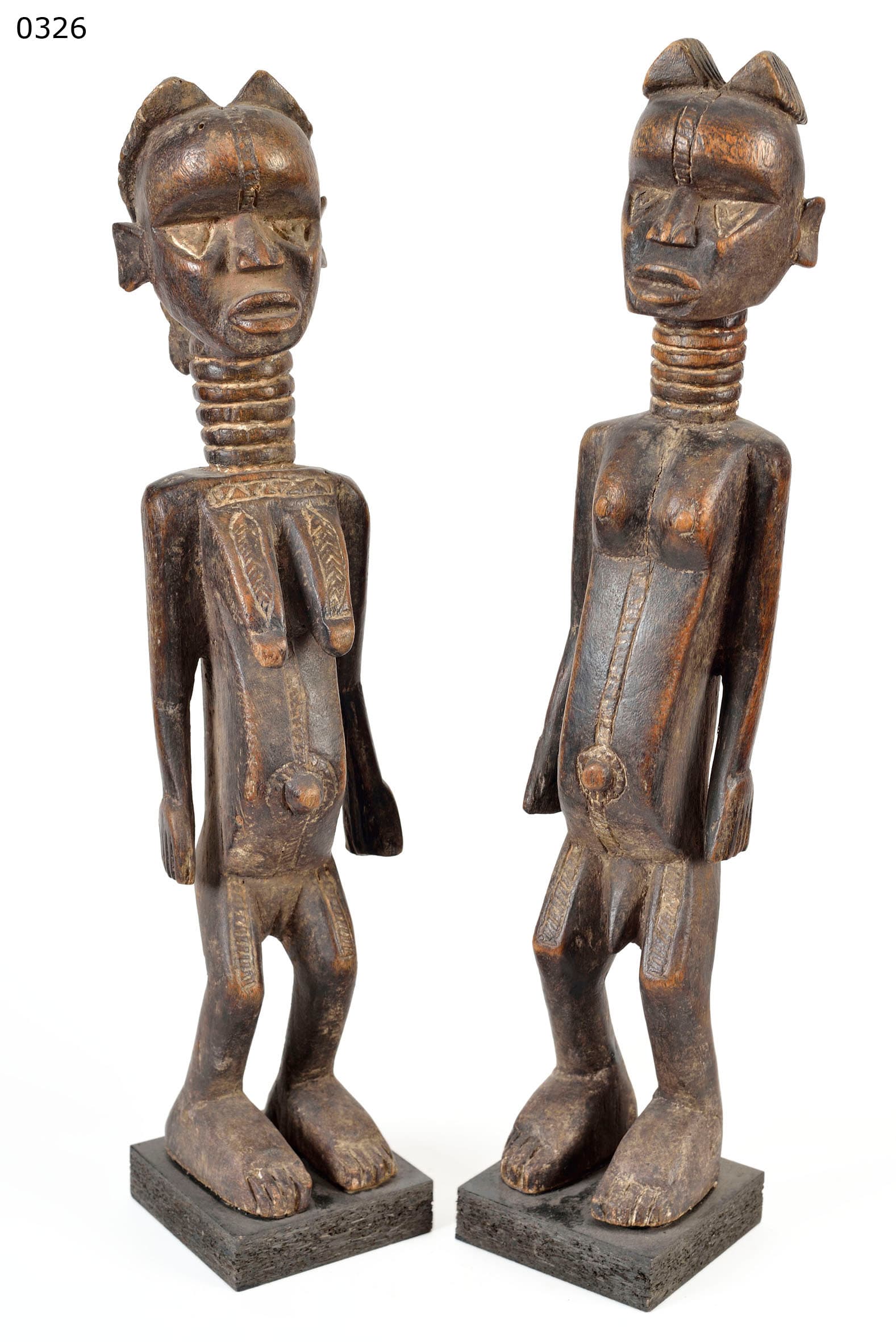
Ein massiver Dan/We Wunkirmian Zeremonienlöffel (1. Hälfte 20. Jh., 74 cm), der Mali zugeschrieben wird, aber mit den Dan/We Grenzgebieten von Liberia und der Elfenbeinküste übereinstimmt - der anthropomorphe Griff teilt identische Merkmale mit dem Ahnenpaar 0326 (hohe gewölbte Stirn, beringter Hals, geschlitzte Augen), das tief oxidierte dunkle Holz zeigt starke geglättete Abnutzungserscheinungen im Inneren der Schale, die auf ein Servieren hindeuten. Kompagnon von 0326.
1. Das Dan-We-Ästhetische Kontinuum
Der Griff des Löffels ist als Porträtfigur geschnitzt, die das Ahnenpaar 0326 widerspiegelt – was dafür spricht, dass das Set als ein einziges skulpturales Programm produziert wurde.
- Gemeinsames Porträtvokabular: Identische Schönheitsmerkmale - hohe gewölbte Stirn, geschlitzte Augen, gestapelte Halsringe - finden sich auf dem Griff und den Begleitfiguren wieder.
- Elegante Schöpfkelle: Die geschwungene, elegante Schöpfkelle des Löffels bildet einen funktionalen Kontrast zu den statischen, volumetrischen Figuren und behält gleichzeitig das gleiche ästhetische Register bei.
2. Das Wakra und das Fest des Verdienstes
Der Wunkirmian ist ein Ehrenzeichen, das an die Wakra verliehen wird - die gastfreundlichste und erfolgreichste Frau in einem Dan-Dorf.
- Verteiler des Festmahls: Die Wakra benutzte diesen Löffel, um Reis und Fleisch bei großen Verdienstfesten zu verteilen - die Skala der Schale (insgesamt 74 cm) lässt darauf schließen, wie viele Gäste gespeist wurden.
- Vollständiger Prestige-Zyklus: Zusammen mit dem Ahnenpaar 0326 repräsentiert er den vollständigen Prestige-Zyklus von Dan/We - den Segen der Ahnen, der landwirtschaftlichen Reichtum hervorbringt und von der Matriarchin großzügig verteilt wird.
3. Rituelle Handhabung und Oxidation
Die Patinierung spricht für eine aktive integrierte Nutzung in der ersten Hälfte des 20. Jahrhunderts.
- Abnutzung der Schüsselinnenseite beim Servieren: Der Löffel weist starke, geglättete Abnutzungserscheinungen im Inneren der Schüssel auf, die vom Servieren von Reis und Fleisch stammen können.
- Einheitliche Ensemble-Patina: Die Oxidation auf dem Griff vereinigt sich visuell mit der krustigeren Opferpatina auf 0326 - was eine gemeinsame Aufbewahrung und Verwendung als ein einziges Haushaltsheiligtum nahelegt.
Zusammenfassung
Zusammen mit dem Ahnenpaar 0326 veranschaulicht dieser Wunkirmian-Löffel die Überschneidung von utilitaristischer Gastfreundschaft und Ahnenverehrung in der Dan/We-Kultur. Die ästhetische Symmetrie des gesamten Sets und die rituelle Patina machen dieses Set zu einer seltenen und vollständigen ethnografischen Gruppierung.
KI-unterstützt erstellt aus Sammlungsgutachten, Objektfotografie und eigener Recherche, redaktionell geprüft. Fehler sind möglich — Hinweise darauf sind uns willkommen. Zum Verfahren →