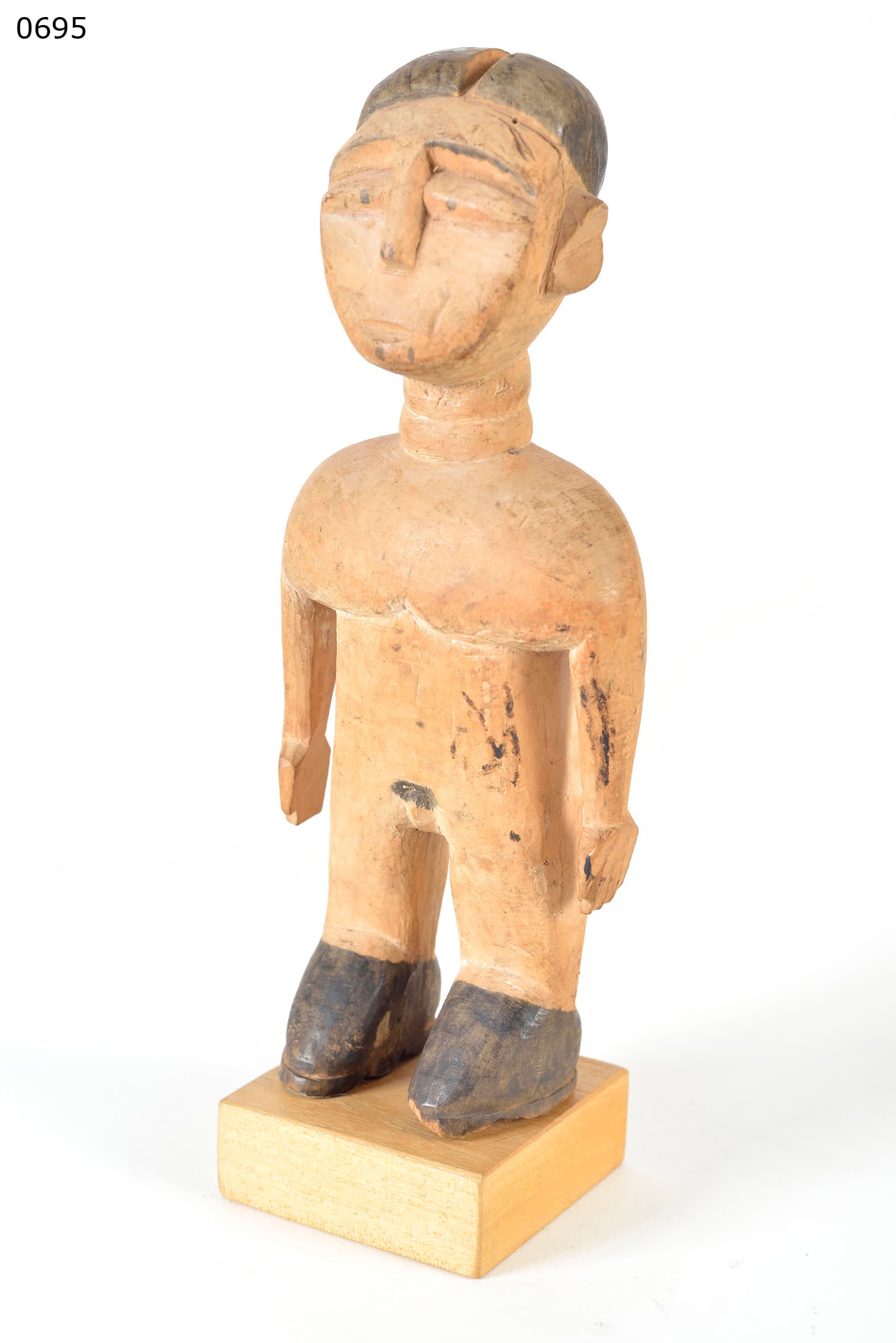
Diese stehende Holzfigur zeigt eine sehr starre, aufrechte Haltung mit abgetrennten, parallel zum Rumpf hängenden Armen, einfachen, blockigen, schwarz bemalten Füßen und einem flachen, stilisierten Gesicht mit einer horizontalen Stirn. Das helle Holz ist trocken und weist leichte Oxidation und Gebrauchsspuren auf.
1. Ästhetischer Stil und regionale Eigenheiten
Diese als Venavi bezeichnete Figur repräsentiert die ausgeprägte Schnitztradition des Ewe-Volkes in Togo und Ghana. Im Gegensatz zu der extremen, flachköpfigen Abstraktion der benachbarten Akan Akua'ba bevorzugt der Ewe Venavi einen steifen, stumpfen und stark verkürzten Naturalismus. Die strenge Frontalität, die starr abgetrennten Arme, die gerade nach unten hängen, und die blockigen, unnachgiebigen Beine vermitteln eine Aura von Unbeweglichkeit und Beständigkeit. Der Schnitzer hat ein helles Holz verwendet, das oft mit lokalen Pigmenten akzentuiert ist (z. B. die schwarzen Füße oder Haare), wodurch eine starke, grafische Präsenz entsteht.
2. Rituelle Funktion und Geheimbund-Kontext
Wie die Yoruba haben auch die Ewe eine hohe Rate an Zwillingsgeburten und verehren Zwillinge als mächtige Geister. Wenn ein Zwilling stirbt, wird der Venavi geschnitzt, um als Ersatzkörper für die Seele des verstorbenen Kindes zu dienen. Die Mutter oder der überlebende Zwilling müssen sich um die Holzpuppe genauso kümmern wie um ein lebendes Kind - sie müssen sie füttern, baden und kleiden. Wenn die Venavi vernachlässigt wird, verursacht der ruhelose Geist des verstorbenen Zwillings Krankheit, Unfruchtbarkeit oder Tod in der Familie.
3. Physische Patina und Altershinweise
Die Oberfläche dieses Venavi spricht für die traditionelle mütterliche Pflege. Das Holz ist nicht handelsüblich poliert; es hat eine trockene, charakteristische, leicht oxidierte Oberfläche. Die hohen Punkte des Gesichts, die Brust und die starren Arme weisen eine weiche, örtlich begrenzte Reibungspatina auf, die auf jahrzehntelanges Halten, Waschen und Einstecken in den Umhang der Mutter hindeuten kann. Das aufgetragene schwarze Pigment an den Füßen und am Kopf ist verblasst und stark abgenutzt, was eine Herkunft aus dem frühen 20. Jahrhundert und ein aktives, taktiles rituelles Leben nahelegt.
Zusammenfassung
Dieser Ewe-Venavi ist eine eindringliche Darstellung der westafrikanischen Zwillingsverehrung. Seine strenge, starre Geometrie und seine durch Handhabung geprägte Patina machen das Objekt zu einem anschaulichen Zeugnis togolesischer mütterlicher Hingabe.
KI-unterstützt erstellt aus Sammlungsgutachten, Objektfotografie und eigener Recherche, redaktionell geprüft. Fehler sind möglich — Hinweise darauf sind uns willkommen. Zum Verfahren →