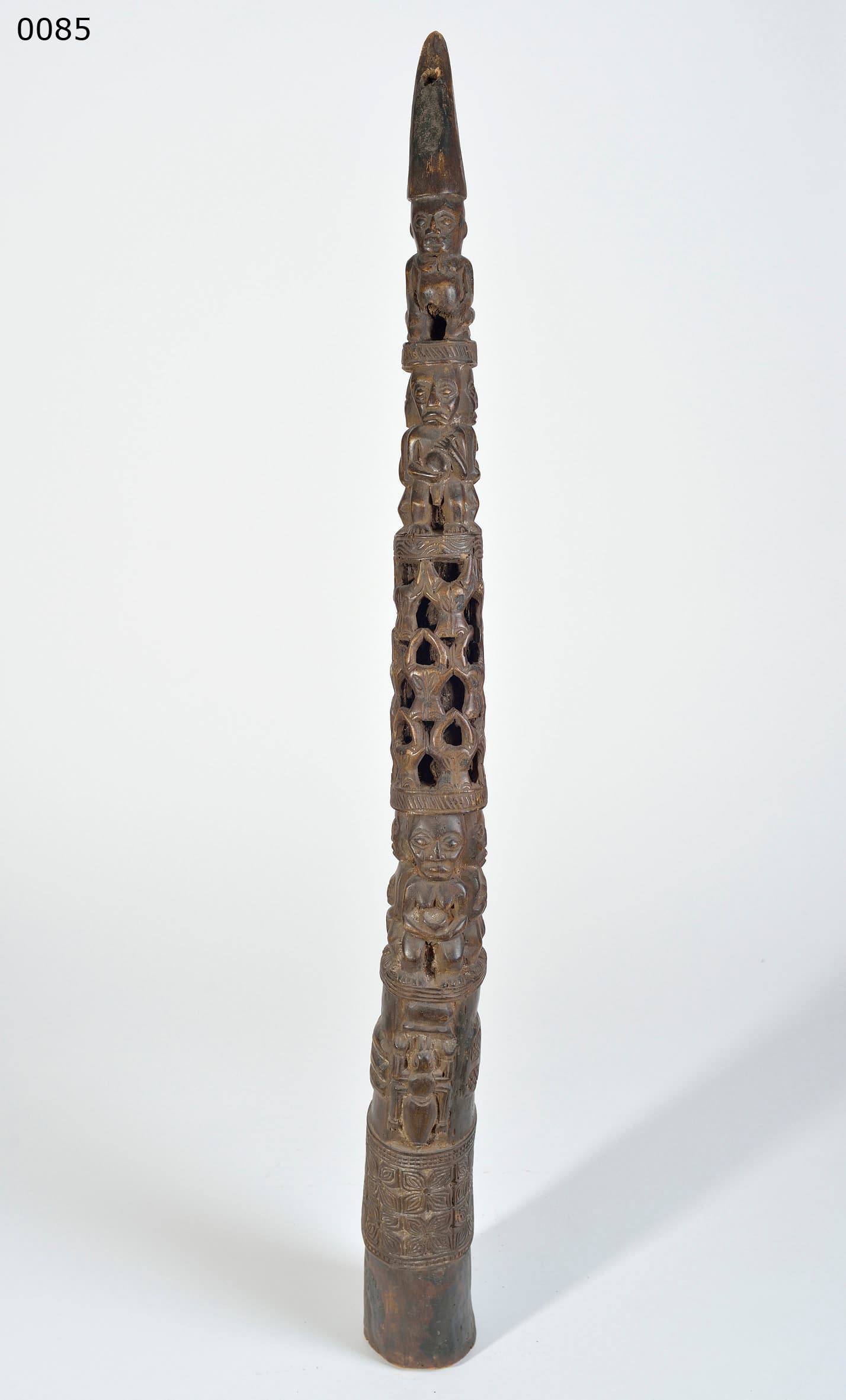
A slender staff of about 200 cm from the Mayap chiefdom in the Sultanate of Foumban, Cameroon. A dark wooden shaft carries a leaf-shaped metal blade, with an open loop beneath it.
1. Form and Carving
The staff is defined by its length and its restraint. At the top, a broad, leaf-shaped blade tapers to a point. Below it the metal narrows to a short neck and opens into a lozenge-shaped loop before running into the shaft. The shaft itself is a long, slim, slightly irregular length of dark wood. It is bound at several points with fine wire or thread, and its lower end is lighter and rougher, where the wood is left less finished.
2. Use and Context
The collection catalogue describes the piece as a chieftain's dignitary staff from the Mayap chiefdom, one of the most important in the Sultanate of Foumban. Such objects, it notes, were commissioned by chieftains so that their wealth and power could be shown to the world. They were usually placed near the chieftain's throne in his audience chamber and were never used for smoking. The warrior's lance on the stem is itself a symbol of power.
3. Surface
The shaft has a deep brown, slightly polished surface, with the bindings showing as finer, lighter bands. The metal blade is dark and matte with some surface mottling.
Summary
A tall, plain-lined Bamum staff whose lance blade, according to the collection catalogue, marks the standing of the chieftain whose audience chamber it furnished.
Written with AI assistance from the collection appraisal, object photography and our own research; editorially reviewed. Mistakes are possible — corrections are welcome. How we work →
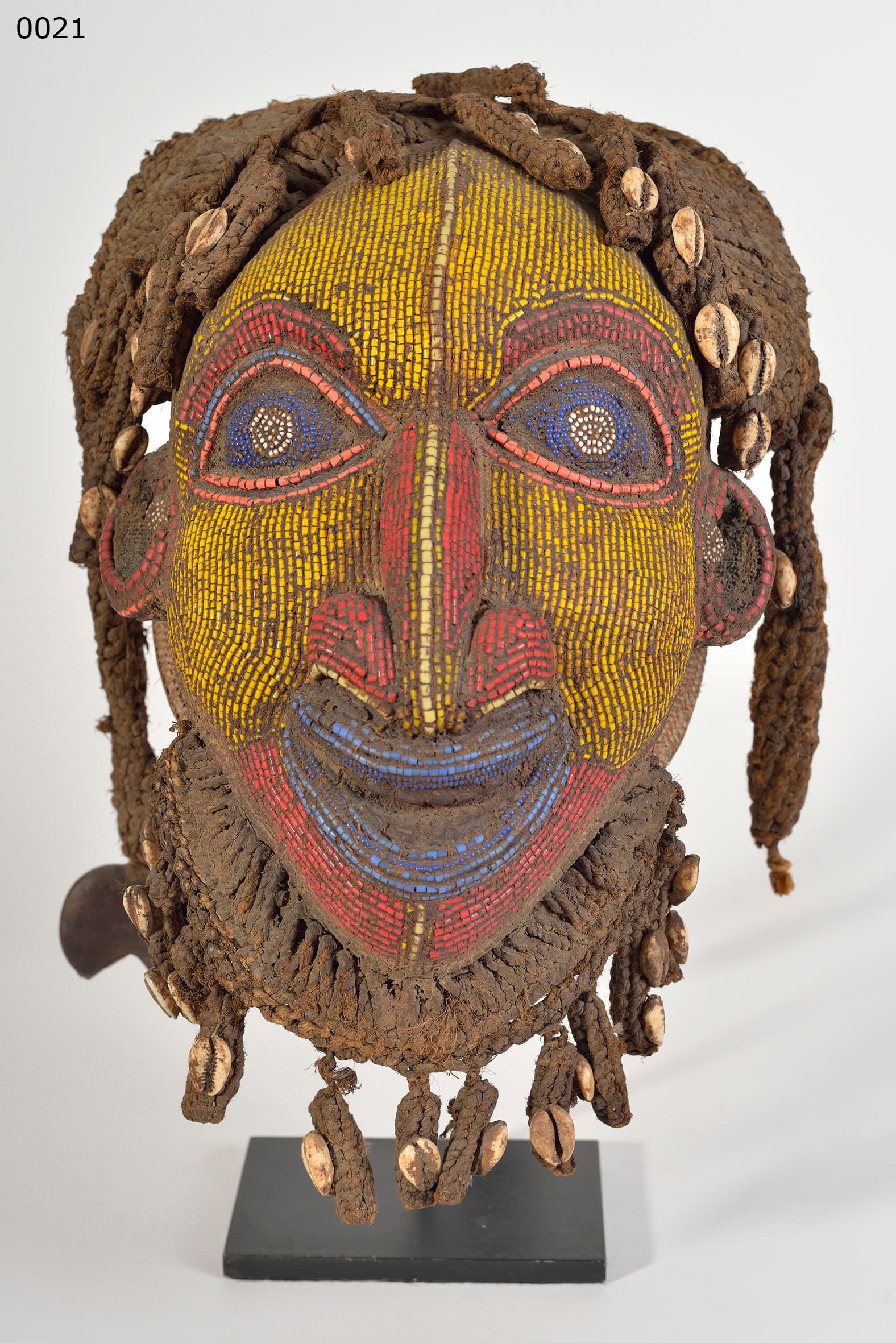
mask (covered with beads - shells on cloth)
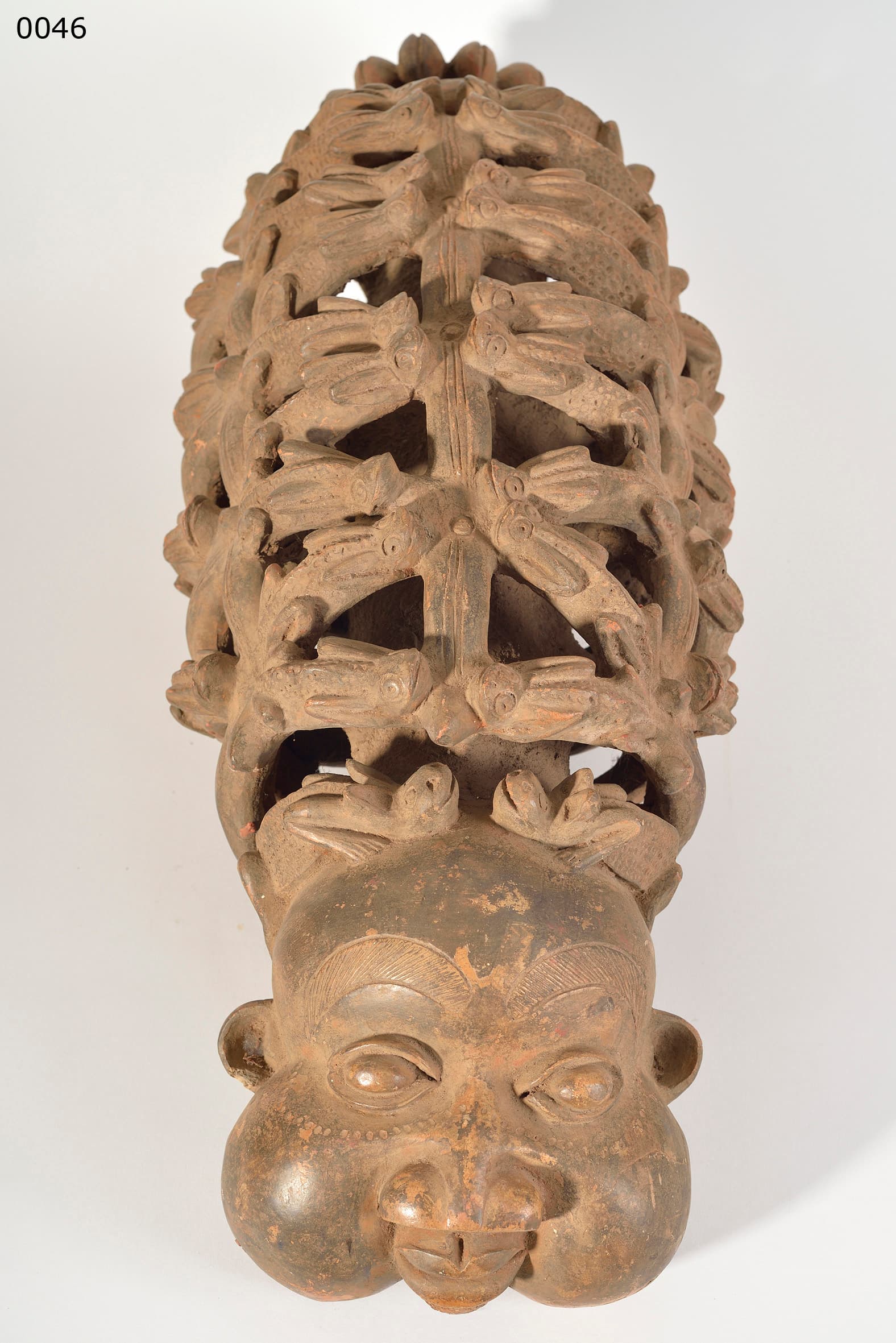
prestige pipe head
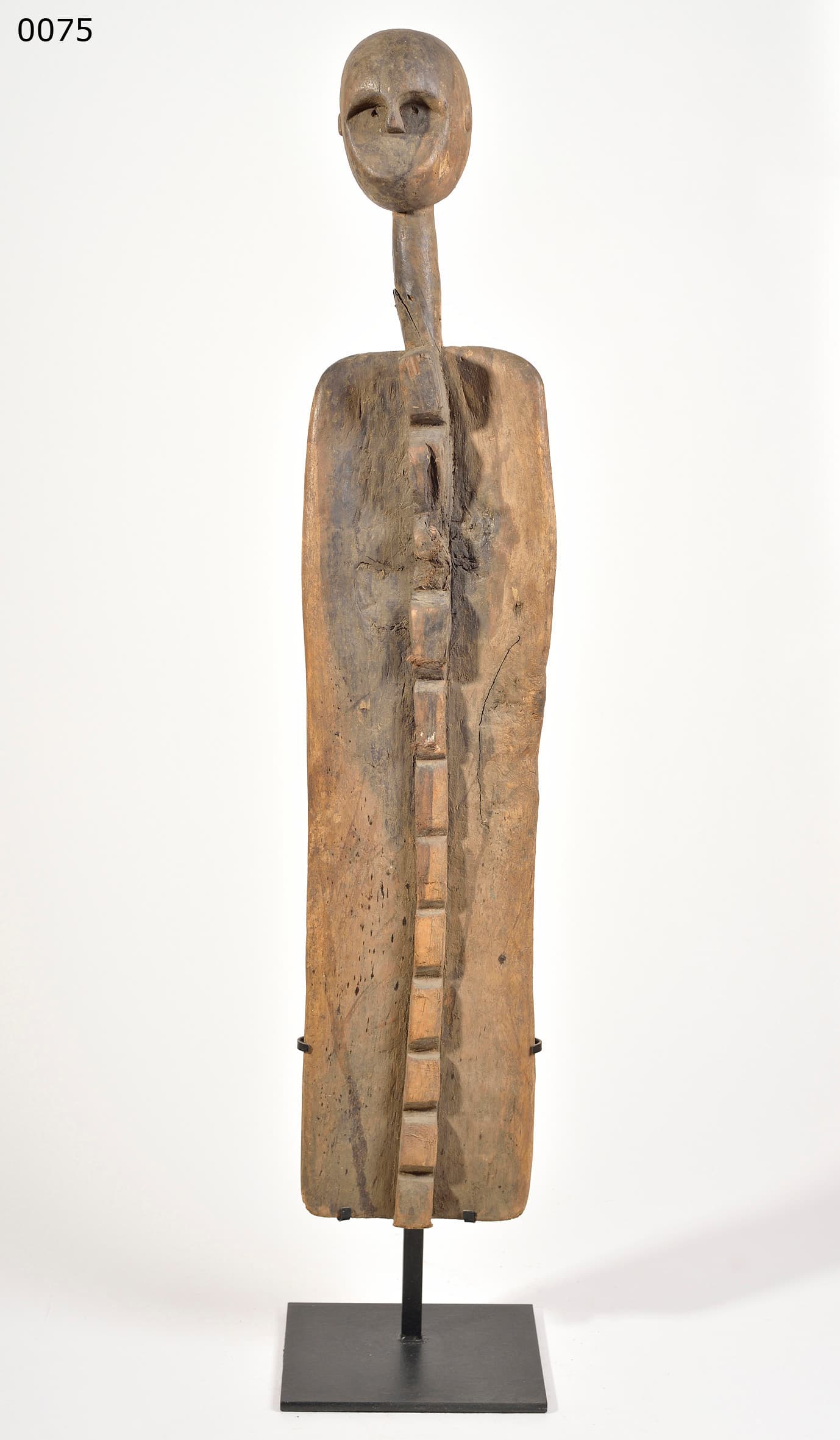
rare friction instrument