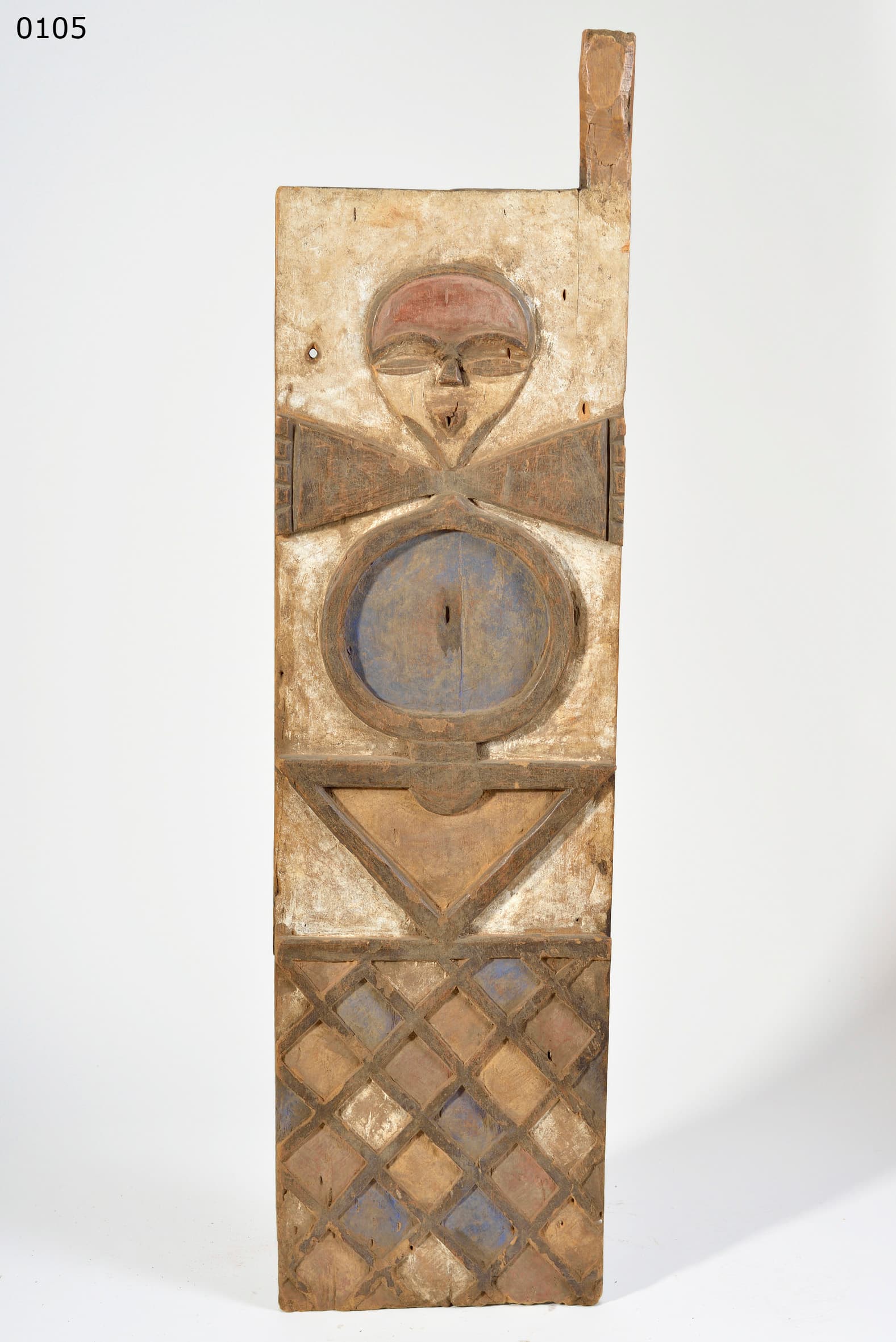
A flat rectangular wooden shrine board (1st half 20th C., 101 cm) from the Tsogho of Gabon — bas-relief carved with a stylized heart-shaped face over concentric circles, triangles, and painted polychrome motifs.
1. Interior pillar of the ebanza
This smaller panel belongs to the same architectural programme as its larger sibling.
- Inside the Temple: The board is mounted inside the Bwiti ebanza rather than at its entrance.
- Dividing Sacred Space: It compartments the structure, marking the boundaries where only initiates of the Bwiti society may pass.
2. The ancestor as witness
The heart-shaped face carries a specific initiatory role.
- Silent Observer: The ancestor carved into the panel is a silent observer of the rites performed within the temple.
- Iboga Vision: Under iboga, the initiate does not hallucinate alone — the carved ancestor "leads" him through the spirit world, validating the visions that follow.
3. Cosmic diagram
The geometry surrounding the face is a miniature diagram of the universe.
- Concentric Cosmology: Circles within circles map the nested layers of the living world, the ancestors, and the creator.
- Polychrome Activation: The red/white/black palette is not ornamental — the colors align with Bwiti's three-part cosmology of blood, spirit, and void.
Summary
This smaller Tsogho panel is the quieter half of a shrine pairing. Its role is contemplative rather than declarative, guiding initiates deeper into Bwiti space with an ancestral face framed by a dense cosmological diagram.
Written with AI assistance from the collection appraisal, object photography and our own research; editorially reviewed. Mistakes are possible — corrections are welcome. How we work →