Overview
The Mitsogho - often transcribed as Tsogo, Tsogho or Shogo in older ethnographic literature and early colonial records - represent an essential and historically highly influential ethno-cultural group in central and southern Gabon. Their geographical core settlement area extends primarily across the highlands of the province of Ngounié, which are criss-crossed by dense equatorial rainforests, particularly in the regions north and east of the provincial capital Mouila. The topographical and cultural connection to this landscape is so intense that the catchment area of the Ngounié River - a major tributary of the Ogooué - is often simply referred to as "Mitsogho Land" in historical and geographical literature. This waterway historically functioned not only as a subsistence base, but also as a primary migration and trade axis that catalysed material and spiritual exchange with neighbouring ethnic groups.
The demographic recording of the Mitsogho is complex due to rural exodus, inter-ethnic mixing and the general difficulty of obtaining precise census data in rural regions of Gabon. Current estimates put the population of the original Mitsogho at around 13,000 to 19,000 individuals. If these figures are set in relation to the current overall demographic development of the Gabonese Republic, it becomes clear that although the Mitsogho represent a numerical minority, their cultural and religious influence is disproportionately large. The sources regarding the exact total Gabonese population vary slightly depending on the projection, but the data from the World Bank and the United Nations converge at around 2.5 to 2.6 million inhabitants for the years 2024 and 2025.
| Demographic indicators Gabon | Data status 2024 | Projection 2025 |
|---|
| Total population | 2,538,952 | 2,593,130 |
| Male population | 1,288,745 | 1,315,214 |
| Female population | 1,250,207 | 1,277,916 |
| Population growth | 2.13 % | 2.09 % |
| Degree of urbanisation | 46.4 % | n/a |
Data basis aggregated according to current demographic estimates and preliminary census data
Linguistically, Tsogo (or Getsogho) is categorised in the broad family of Niger-Congo languages and specifically forms the core of the Bantu language group B30. The language code according to ISO is TSV. However, the classification and nomenclature of this ethnic group harbours historical controversies in which the boundaries between endogenous self-designation and colonial foreign designation (exonym) are often blurred. While Getsogho primarily marks the language and the endogenous identity of the group, the prefix Mi- (Mitsogho) or Ba- (e.g. Bapindji) for neighbouring groups was adapted and formalised by neighbouring Bantu speakers and later by the French colonial administration to form the plural of the ethnic group. Such extrinsic assignments led to considerable taxonomic blurring in the older literature.
The social structure of the Mitsogho is primarily organised acephalously and is based on a highly complex kinship system that follows matrilineal rules of descent. There is no centralised, absolutist state power or hierarchy as understood in the West. Instead, the political and social organisation is based on segments of clan structures and autonomous village communities. According to the surveys in the Ethnographic Atlas (Murdock et al. 1999), each clan operates largely autonomously, with residence after marriage often being avunkulolocal (with the mother's brother) or in separate neighbourhoods within a polygynous system. Authority within a village is exercised by the village elder, whose legitimisation is not based on physical coercion, but on his genealogical proximity to the founding ancestors of the village and his ritual competence as a specialist. This dual function as political arbitrator and spiritual mediator is fundamental to social cohesion.
The traditional subsistence strategy of the Mitsogho is characterised by a strict gender-specific division of labour. It is based on extensive shifting cultivation, which is carried out by the women and is primarily based on the cultivation of tree fruits, bananas and manioc. This agricultural production is supplemented by the men's collective hunting parties in the dense forests, an endeavour that serves not only to procure protein but also to strengthen male alliances. The keeping of domestic animals is limited to small livestock such as sheep and goats; cattle breeding and dairy farming are historically absent.
The relationship between the Mitsogho and their neighbouring peoples - including the Masango, Bavuvi, Sango, Apindji, Fang and the indigenous Babongo (often referred to as Pygmies) - is historically characterised by an oscillating continuum of trade, armed conflict and deep ritual assimilation. The Mitsogho cultivated intensive pre-colonial exchange relations and claim in their own oral traditions to have culturally "domesticated" groups such as the Masango. The interethnic dynamic with the Babongo is particularly controversial and relevant to research. The Mitsogho adopted elementary botanical and spiritual knowledge from these forest nomadic groups, in particular the use of the psychoactive plant Tabernanthe iboga, which they transferred into structured, initiatic cult forms. Holdings in the Weltmuseum Wien (WMW), which preserves important ethnographic collections from Central Africa (including objects acquired by naval officers such as Wunderlich), bear witness to the material culture of these interethnic contact zones. In these border areas, utilitarian and ritual artefacts often merge stylistic characteristics of different groups, making isolated ethno-aesthetic attribution in museum contexts a persistent challenge.
Cultural context
The religious system of the Mitsogho forms the absolute structural and spiritual epicentre of their society. Through its immense radiance, it has permanently transformed the sacred architecture and ritual practices of the whole of Western Equatorial Africa. At the centre of this cosmological and social order is the initiatory religion of the Bwete (known worldwide as Bwiti in the Pan-African and especially the Fang adaptation). The origin of this cult is attributed historically and ethnographically to the Mitsogho, who adapted it from indigenous forest peoples, systematised it and equipped it with an elaborate liturgy.
The cosmological order of the Mitsogho is highly complex and characterised by a complementary dualism. At the head of the pantheon is the creator Kombe (the sun), who acts as ruler over the transcendent village of the incarnated, i.e. the ancestors and spirits. He is assisted by an essential female entity: Dinzona, his mythical first wife, who plays a central mediating role in the ritual system of the Bwete. The name Dinzona is etymologically derived from nzina (blood), which earned her the nickname "the red woman" and emphasises her importance for vitality and sacrificial rites. In addition to these solar and lunar entities, there are powerful natural beings, above all Ya Mwei, a potent water spirit to whom a separate initiation society is dedicated. The Mitsogho universe is strictly divided into the physical sphere of the reincarnates (the living) and the metaphysical dimension of the disincarnates. Every significant ritual act, especially the practice of sacrifice, serves the purpose of building a controlled bridge between these two planes of existence and maintaining the cosmic balance.
What structurally distinguishes this religion from the animistic or purely linear ancestor cults of many neighbouring peoples is its deep institutional anchoring in strictly hierarchical and regulated secret societies. These societies dictate not only the spiritual, but also the legal and social life of the ethnic group. Ritual authority is vested in highly differentiated specialists. The nganga acts as healer, divinator and ritual master. A precise distinction is made within this complex: The simple nganga primarily treats somatic ailments without the use of heavy psychoactive substances. The Nganga-a-myobe operates exclusively within the temple (Ebandza) in the context of the great collective rituals. The Nganga-a-misoko, on the other hand, specialises in detecting witchcraft and the hidden causes of individual ailments; he works magically and divinatory in the homes of patients and uses iboga to induce visionary states for diagnosis. Other central authorities are the Mudunga, a specialist who acts as a medium for the often non-human voices of the spirits (such as Ya Mwei), and the Nima (or Ñima), the chief officiant and keeper of the esoteric knowledge of a Bwete chapel.
The role of women within this cult complex must be viewed in a differentiated way and represents a significant difference to later syncretic adaptations. In the original, orthodox Mitsogho tradition of the Bwete Disumba (the main lineage of the cult), initiation and active participation in the inner sanctuary is strictly reserved for men. Women have their own parallel cults of initiation and possession, such as the Ombudi or Ndjembe, in which psychoactive bark decoctions are also used. Nevertheless, female principles occupy the spiritual centre of the male rites: The invocation of Dinzona or Murhumi (the mythological womb of the matrilineage) is essential for fertility and the continuity of the clan. It was only when it was adapted by the Fang in northern Gabon that the Bwiti developed into a more inclusive system that also allows women as initiates.
In ethnology, there is a massive, decades-long research controversy regarding the origins, iconography and syncretism of the Bwiti cult. This academic debate was primarily fuelled by the diametrically opposed theoretical positions of the American anthropologist James W. Fernandez on the one hand and the French researchers Otto Gollnhofer and Roger Sillans on the other. The sources are strongly coloured by methodological preferences. Gollnhofer and Sillans (1997), who carried out decades of field research among the Mitsogho, advocated a strongly esoteric and partly structuralist interpretation. Under the influence of older missionary theories (such as those of Bishop Le Roy), they postulated that Bwiti had already assimilated "non-African", specifically Masonic or Western esoteric elements in its early manifestations. Sillans explicitly claimed that certain postures of the initiates and iconographic representations could be traced back to the influence of European tarot cards (in particular the card of the "hanged man") or Freemasonry.
James Fernandez (1982) vehemently rejected this hypothetical foreign attribution in his standard publication Bwiti: An Ethnography of the Religious Imagination in Africa. Fernandez argues that the interpretation of Bwiti must have its "centre of gravity strictly in the indigenous culture of the Fang and Mitsogho themselves". He denies a profound Masonic penetration and deconstructs the Gollnhofer/Sillans theses as methodologically flawed, as they ignore indigenous exegesis in favour of external explanatory models. Fernandez interprets the Bwiti rather as an "imaginative coalescence" and a process of permanent "syncretic tension". For him, religion is an endogenous attempt by the equatorial peoples to counter the traumatic colonial degradation by creatively misunderstanding Christian and colonial metaphors and integrating them into an African microcosm model in order to restore "saving circularities" of their old world order. Such profound theological and iconographic discrepancies can be impressively studied in the collections of the Museum Rietberg in Zurich, where comparative juxtapositions of Mitsogho and Fang initiation props make it possible to experience the gradual transformations and the purely African morphology of these ritual objects without Masonic recourse.
Aesthetic features
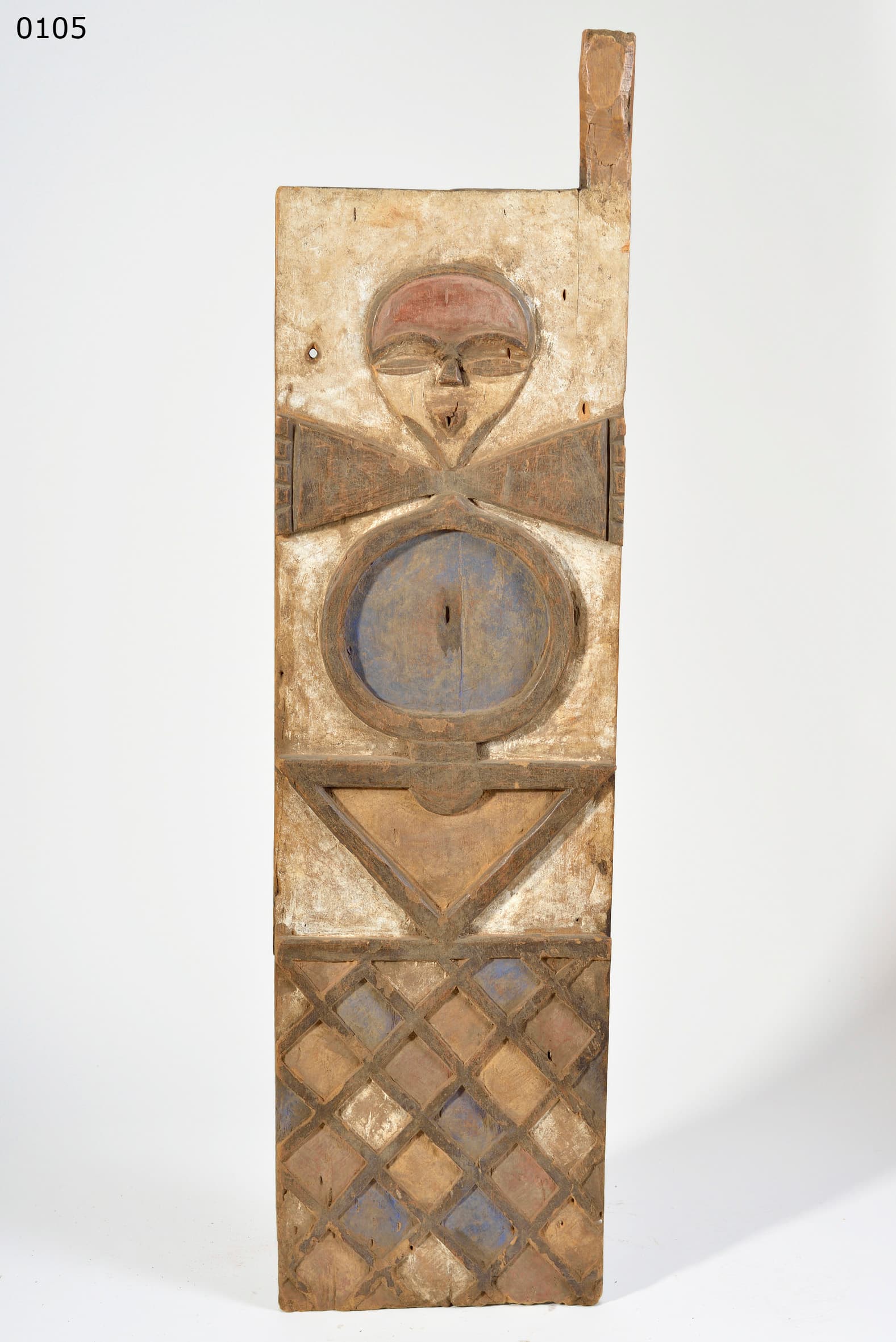
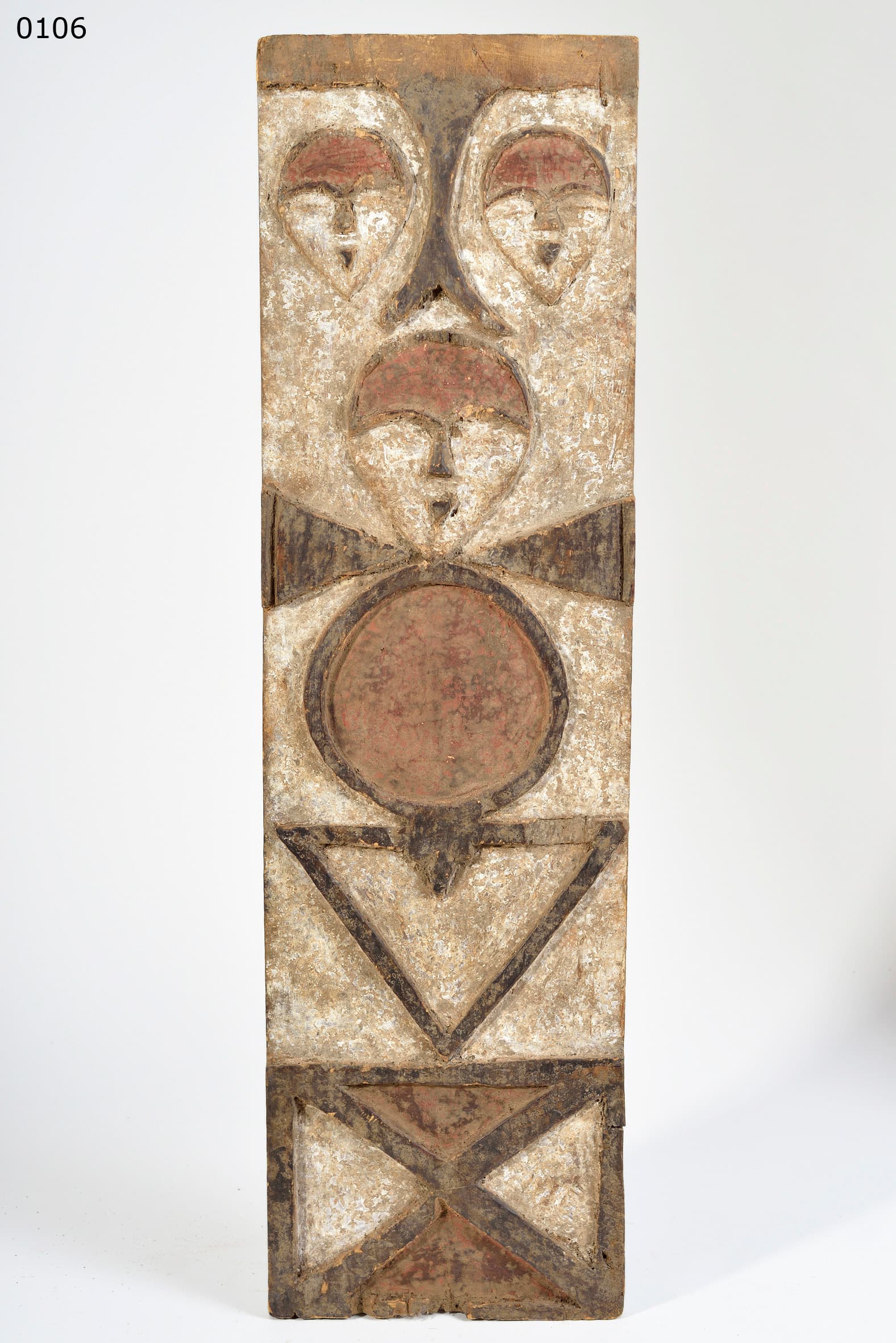
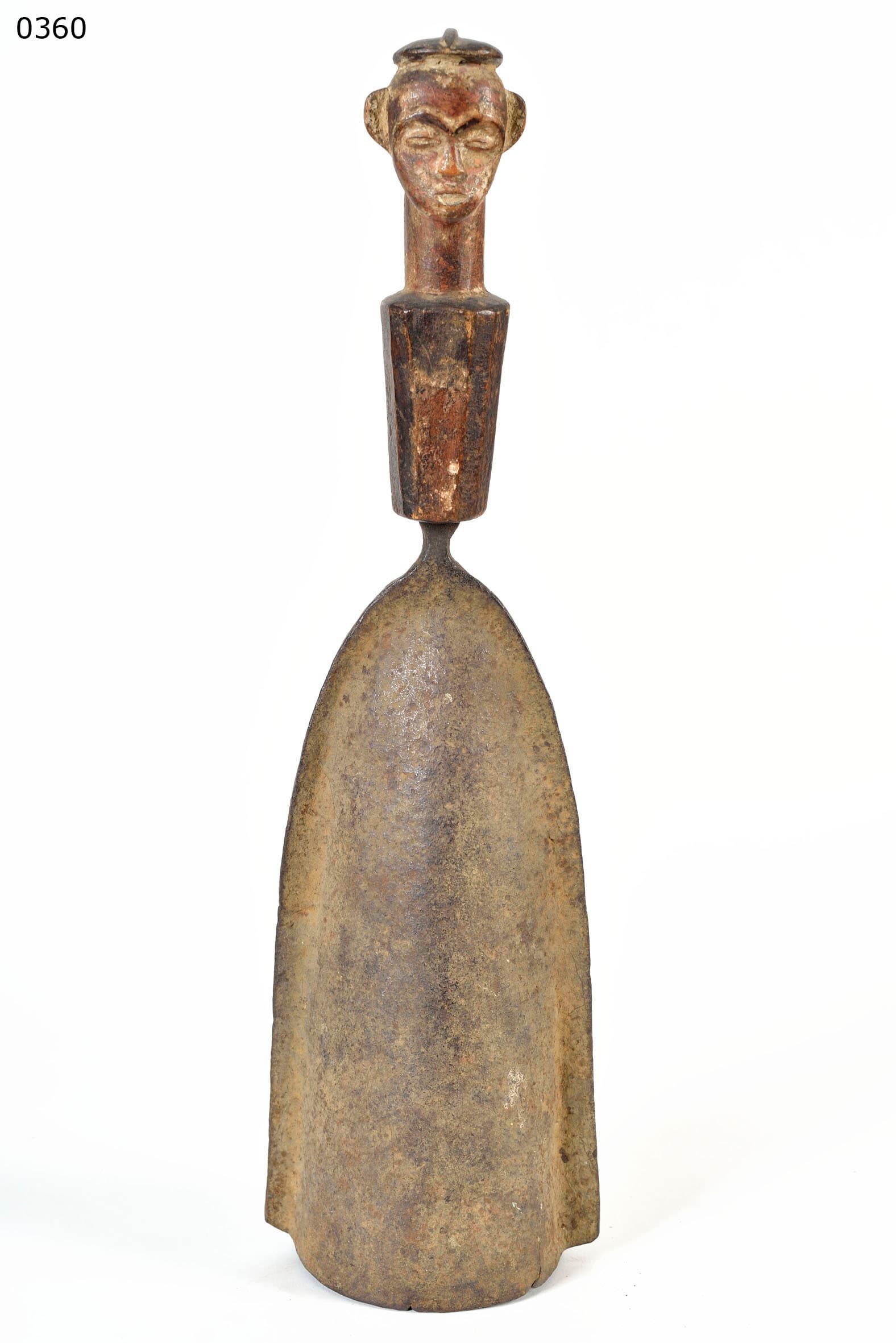
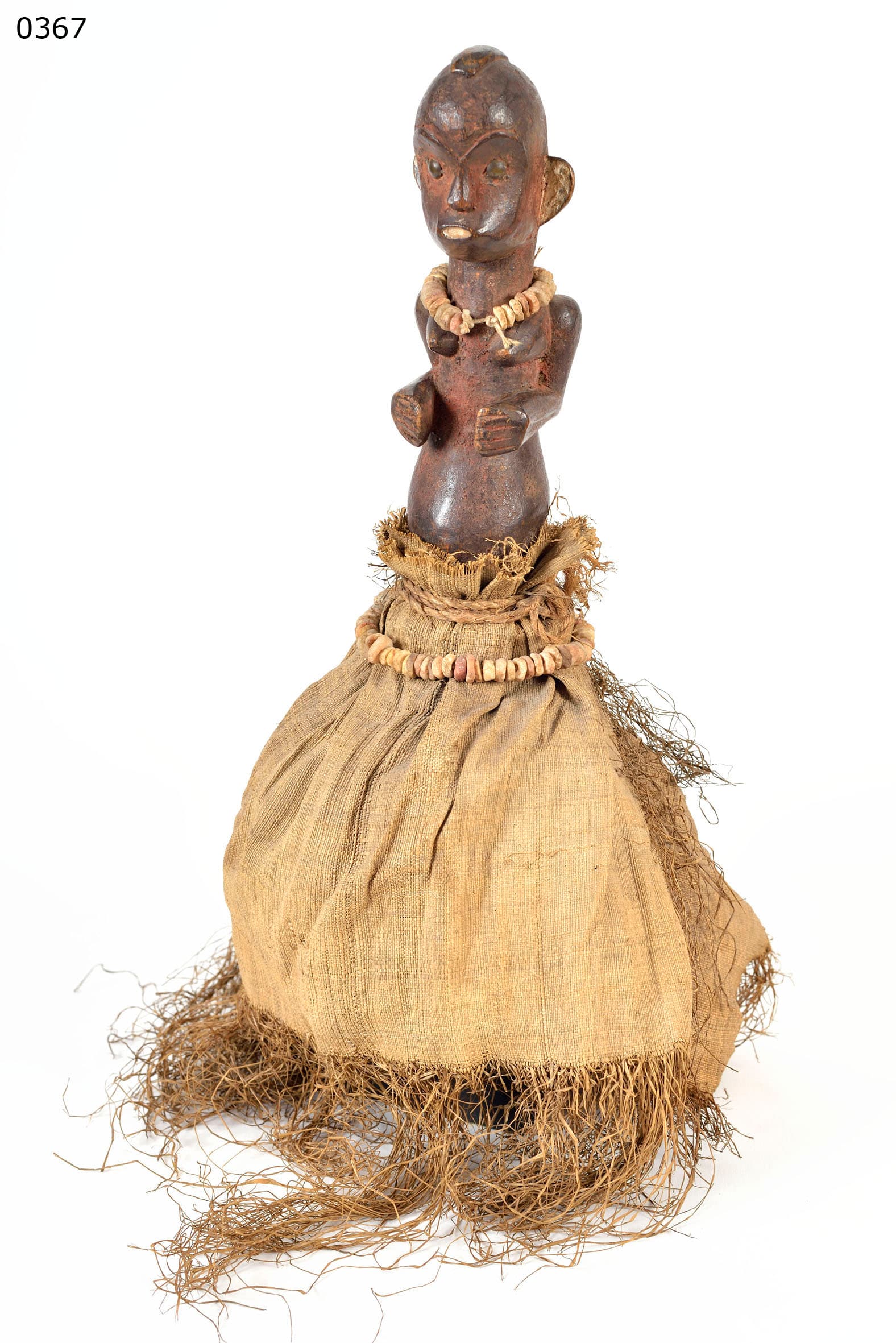
The sculptural work of the Mitsogho is one of the most coherent, expressive and at the same time most abstract formal languages in Central Africa. Three categories primarily stand out in the canonical object typology: the Mbumba Bwiti relic guardian figures, the Gheonga ancestor statues and the magically charged figures of the healing Misoko cult. This inventory is supplemented by architectural elements such as carved doors and the supporting posts of the temple complexes. The systematic stylistic classification of this corpus is largely based on the pioneering ethno-morphological work of Louis Perrois, who classifies the style of the Mitsogho and the closely related Masango in the categories B31 and B32, whereby the so-called "Fougamou style" has established itself as a prominent subtype.
The canon of proportions of the Mitsogho sculptures is striking and deliberately breaks with naturalistic standards. The relic figures usually range in size from 30 to 50 centimetres. The head is extremely oversized and often takes up a third of the total height of the sculpture, which localises the primary seat of spiritual presence and ancestral power in the head. The torso is usually cylindrical, stocky and either ends in semi-flexed legs or is conceived as a pure half-bust with an elongated neck stump, which is inserted into the reliquary baskets.
The iconography of the Mbumba Bwiti faces follows strict aesthetic conventions. The face is characteristically concave and is framed by an implied heart or oval shape. The brow arches are strongly sculpted and merge above the short nose, which is often only rudimentarily indicated as a vertical line, to form a striking shape, which is defined as an "inverted omega" in the Perrois nomenclature. The eyes emerge tubularly or in the form of oversized coffee beans from the concavity of the face; they are often designed as narrow slits, suggesting the introspective, seeing gaze of trance or death. The mouth area is particularly striking: the mouth is lipped, turned forwards and often opens slightly to reveal pointedly filed teeth. This half-open mouth is deeply charged iconographically and symbolises the exhalation of the breath of life or the guttural, eerie voice of the ancestral spirits during the oracle consultation. The top of the head (coiffure) is characterised by flat, bivalve (shell-like) shapes that extend from a sagittal crest to the ears like a cap and voluminously close off the back of the head.
The choice of material is crucial for the identification and ontological understanding of the objects. The carvers use extremely light, porous wood, which is necessarily treated with strongly contrasting pigments. The concave face is almost invariably coloured with white kaolin (pemba). In Bwiti, white is the colour of death, spirits and spiritual clarity. The torso, hairstyle and often the lips, on the other hand, are rubbed with red padouk wood powder (tukula), which is bound with palm oil, and black pigments made from plant ash. In addition, the artists often apply thin copper or brass strips to the centre of the forehead or the neck. These applications are stylistically and materially reminiscent of the Kota or Mindumu living further east and are evidence of the early trade networks.
In Western reception, there is an iconographic and attributive research controversy. While academic ethnographers such as Perrois categorised the objects strictly according to linguistic-geographical ethnicities (B31/B32), the early art trade tended to attribute outstanding pieces to individual, albeit anonymous, artistic geniuses - a phenomenon that was reflected in terms such as "Master of Fougamou". Recent field research, however, deconstructs this concept: the stylistic coherence results less from isolated master hands than from the dictates of strict workshop traditions, in which initiated carvers had to rigorously reproduce the esoteric canon of the Bwete.
An absolute distinguishing feature in the indigenous reception is the ontological separation between the merely carved, profane wood and the activated ritual object. A freshly carved bust has no intrinsic value in the Bwiti. It acquires its agency and sacredness exclusively through the ritual charging process: the pouring of blood, the application of magical substances (maghanga) and the physical connection with the basket containing the relics. Only in this symbiosis does the figure become an active entity. Masterpieces of this activated style, which later found its way to the West, can be studied in the Musée du quai Branly - Jacques Chirac in Paris, which, among other things, preserves the historical collections.
Ritual practice
The performative use of objects and the multi-sensory staging of the altar in Mitsogho-Bwiti represent one of the most elaborate ritual complexes in Central Africa. The nucleus of this religious practice is the Ebandza (or Ébanza), the rectangular, mostly open-fronted meeting house of the men. The architecture of the temple is deeply symbolic: The building itself represents the mythical primal man in the cosmos. Each supporting pillar, especially the central pillar, which functions as the axis mundi, corresponds to a specific body part or organ and is carved with ancestor or spirit motifs. The nocturnal ritual culminates around this central pillar.
The life cycle of a sculpture, be it a mask or a Mbumba Bwiti guardian figure, is inextricably linked to the nocturnal rituals (Ngozé). As explained, a newly carved object must first be activated. The transformation from passive wood to active spiritual entity takes place through the ritual application of substances. It is whitened with kaolin, reddened with tukula and - of crucial importance - fed with sacrificial blood. The ritual authorities, for example within the Bwete or Ya Mwei society, immolate goats or roosters. The blood is poured over leaf partitions in the Ebandza or directly onto the shrines and figures, while specific organs of the sacrificial animal are cooked and ritually offered to the spirits to cement the connection between the sphere of the living and the ancestors.
The actual ritual performance is synaesthetically overwhelming and follows a strict dramaturgy. The ceremonies usually begin at midnight, signalled by chants from the surrounding forest. The room is illuminated by torches and exactly three ritual fires - two inside and one in front of the temple. The initiates (banzi), whose bodies are ritually painted red and white, enter the temple in a choreographed march. Accompanied by polyrhythmic drumming, bells (mokengue) and the dominant sound of the eight-stringed bowed harp (ngombi), a trance dance unfolds for hours. Dancers wear animal skins and bands of palm leaves on their legs and arms to create percussive accents with every step.
The central sacrament of these activation processes is the ingestion of the bark of the root of Tabernanthe iboga. The strong psychoactive alkaloids of this plant induce a visionary state in the banzi, in which, according to reports, the neophyte encounters the bwiti in the form of a "small, fire-coloured, dancing entity" or directly meets his ancestors. By consuming iboga, the initiate is ritually killed and reborn as a full member of the spiritual community. A specific test involves the neophyte looking through a hole in the centre post to identify hidden props - such as antelope horns or genet skins - at the back of the temple.
In the late hours of the night, when the wild drumming gives way to the softer harp, the oracle and healing aspect comes to the fore, especially in the Misoko version of the Bwiti. A wooden statue is presented from the darkness or dense smoke of the rear temple area (the tabernacle). An officiant, often the mudunga, who irritates his throat by eating specific plants (such as leaves of Ancistrocarpus densispinosus) and adopts an unnatural, hissing or hoarse voice, speaks as a medium for the spirit. He answers questions from the congregation on defence against witchcraft, identifies the causes of illness and prophesies.
As soon as the ritual ends at sunrise, the active objects are strictly removed from the profane gaze. The Mbumba Bwiti busts are put back into their baskets, which contain the physical relics (mostly skullcaps and phalanges), and stored in the secrecy of the men's house. The life cycle of an object ends with its deactivation. When a matrilineage dies out, the village is relocated due to epidemics or wood-destroying insects (termites) dissolve the physical integrity of the sculpture, the spiritual charge is extinguished. The wood loses its magical protection and is left to decompose in the forest. In its exhibitions on the materiality of Central African art, the Royal Museum for Central Africa (RMCA) in Tervuren provides excellent examples of how this field of tension between temporary "medicine" application and permanent wood determines the ritual existence of the objects.
Historical context
The historical genesis of the Mitsogho, the evolution of their art and the international reception of their ritual inventory form a dense web of pre-colonial migration, colonial repression and an unprecedented career on the Western art market. Oral-historical traditions, linguistic findings and ethno-historical analyses locate the origins and consolidation of the Mitsogho in complex migration movements along the Ngounié valley. In the pre-colonial era, they established themselves through strategic alliances, extensive trading systems and warlike expansions against neighbouring groups such as the Masango or Eshira, whereby they both absorbed and exported cultural elements. The dating controversies regarding the exact establishment of the Bwiti cult are considerable in research. While some historians and anthropologists locate the formal institutionalisation of the cult as a direct consequence of the first contacts with the forest nomadic Babongo in the 19th century, others postulate deeper historical roots that were overlaid by the upheavals of the transatlantic slave trade. There is a consensus that the cult spread massively towards the coast and North Gabon (to the Fang) after the emancipation of slaves in the large logging camps (chantiers), where various ethnic groups were herded together for forced labour.
The encounter with the French colonial power from the late 19th century onwards marked a traumatic break in the social structure of the Mitsogho. The colonial administration drew artificial, often completely ignorant administrative boundaries (cantons), arbitrarily appointed chiefs and forced the population into a new economic corset based on the CFA franc currency and the cultivation of cash crops. However, the most massive interventions took place on a spiritual level. Between 1930 and 1950, Christian missionaries and the colonial administration carried out targeted persecution campaigns against Bwiti followers. The cult was branded as anti-state, barbaric and subversive. The use of human bones in the relic baskets of the Mbumba Bwiti was reflexively misinterpreted as evidence of grave robbery or ritual human sacrifice. Shrines were razed, objects confiscated or burnt. This repression forced the Mitsogho to move their rites deeper into the forests and paradoxically accelerated the syncretic evolution of art. In order to escape persecution, Christian motifs were adapted - a process that James Fernandez analyses as a conscious, creative survival strategy of the indigenous religious imagination.
Parallel to this existential threat in Gabon, an unprecedented appropriation and market history of Mitsogho art began in the West. In the 1920s and 1930s, Parisian gallery owners and influential impresarios such as Paul Guillaume and Charles Ratton discovered the sculptural power of Gabonese artefacts. These dealers carried out a radical act of de-contextualisation: they removed the carved Mbumba Bwiti busts from their unsightly, bone-filled reliquary baskets, stripped them of the remains of the ritual offerings and presented them as isolated masterpieces of "Art Nègre" on polished pedestals. This aestheticised presentation profoundly fascinated the Western avant-garde. Breakthrough exhibitions, such as the one in 1930 at the Galerie Pigalle or the legendary exhibition African Negro Art in 1935 at the Museum of Modern Art (MoMA) in New York, irrevocably established the formal language of Gabonese sculptures in the elite canon of world art. This museum-like ennoblement continuously drove up the price of Mitsogho objects, which is still reflected today in international auctions at Christie's or Sotheby's, where authentic relic figures from old, documented colonial or Parisian provenances are traded in the six-figure euro range.
This enormous monetary appreciation has created a highly complex problem of forgery on the art market, which poses considerable challenges for private collectors. Forgers are no longer content with merely imitating the canon of proportion (such as the omega brews); they deliberately simulate physical and chemical ageing processes. Today, authenticity testing utilises scientific forensics. A central criterion is the examination of the patina: an authentic patina created during ritual use is the result of decades of successive accumulation of palm oil, kaolin, sweat and padouk powder, which penetrate organically and irregularly deep into the cell structure of the extremely light wood. Modern forgeries, on the other hand, often only have superficial, artificial layers of colour that reveal modern binders or synthetic varnishes under UV light. Termite damage and heartwood cracks are also critically evaluated. Forgers often deliberately expose objects to insect damage; restorers, however, analyse microscopically whether the feeding galleries respect the natural, slow ageing profile of the wood or have been driven into freshly cut wood by machine. Cracks that are simulated by kiln drying also differ in their stress lines from those that have developed over decades under equatorial climatic conditions. World-leading institutions such as the Metropolitan Museum of Art (Met) in New York, which manages outstanding Mitsogho objects in its Michael C. Rockefeller Wing, use this advanced provenance and material research to protect the historical heritage from contamination by the market and to ensure the dignified representation of this deeply spiritual art.