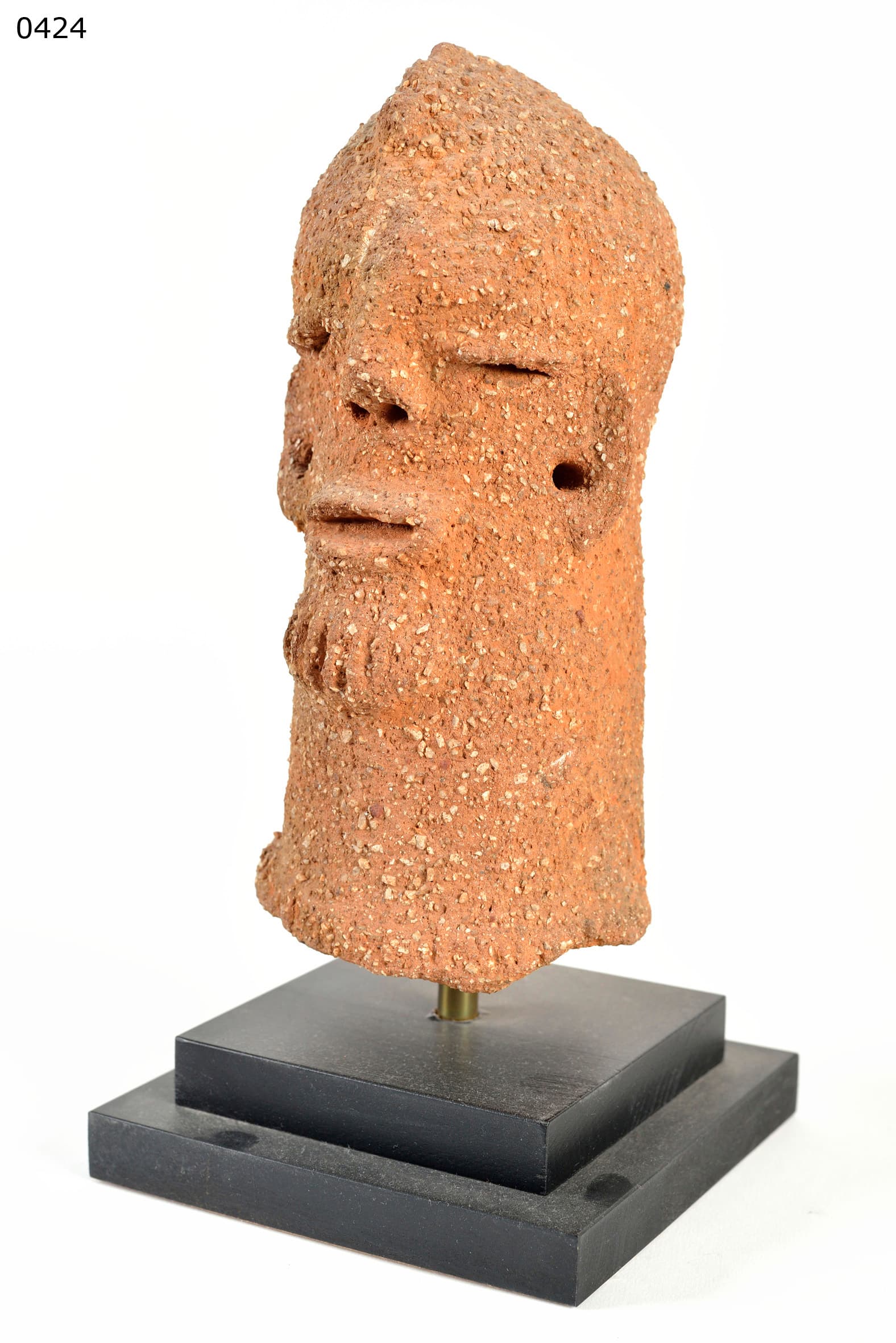
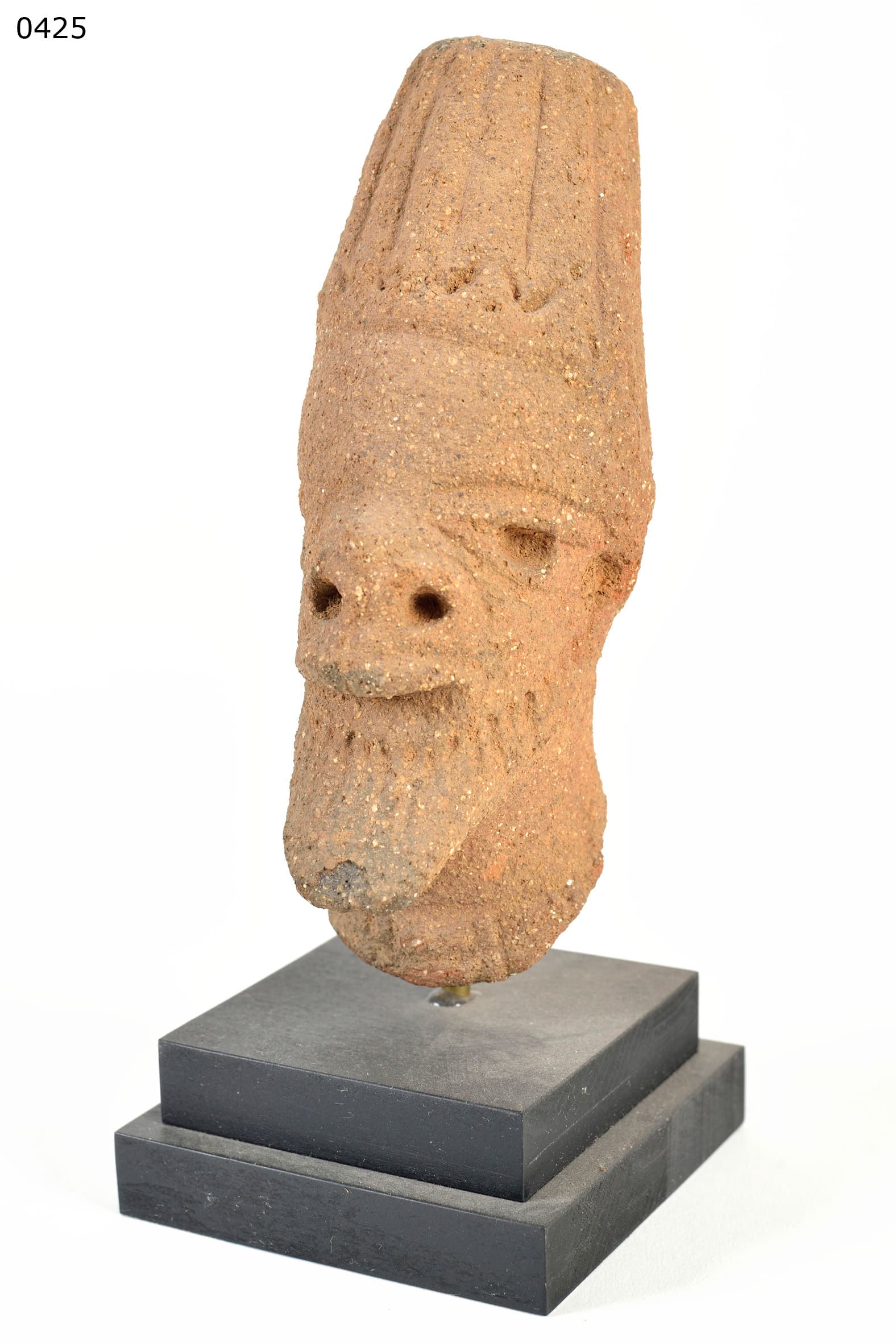
This diminutive, heavily degraded terracotta head features a sweeping, elongated profile, a distinct cap or hairline ridge, and deeply punctured, simplified holes for eyes and a mouth. The surface is entirely bereft of its original slip, appearing granular, pale, and fused with hardened archaeological soil.
1. Aesthetic style — the sokoto-yelwa stylistic matrix
Discovered in the northwestern region of Nigeria, the Yelwa (often grouped with Sokoto and Katsina) terracotta tradition represents a vital chapter in the early Iron Age of West Africa, roughly contemporaneous with the famous Nok culture. This small head is characterized by an intense, austere abstraction. Unlike the highly ornate Nok heads, Yelwa style favors severe geometric simplification — the eyes and mouth are reduced to profound, shadowy voids, and the cranium is drawn out into an elegant, sweeping arc. This minimalist approach focuses entirely on the spiritual resonance of the head rather than descriptive portraiture.
2. Ritual function — the architecture of ancient funerary shrines
The exact ritual mechanisms of the Yelwa culture remain shrouded in archaeological mystery, but heads of this type are traditionally linked to ancient mortuary practices. Terracotta figures were typically placed in specialized, sub-surface shrines, atop graves, or within sacred groves dedicated to agricultural fertility and ancestral appeasement. The deep, punctured eyes suggest a spirit that is alert and watching from the realm of the dead. These durable ceramic effigies functioned as eternal, physical nodes where the living could commune with the spirits of foundational patriarchs or earth deities.
3. Physical patina — two millennia of subterranean taphonomy
The physical condition of this 8 cm head shows wear consistent with its estimated two-thousand-year burial. The fired clay has undergone extreme mineral depletion and geochemical weathering. The original smooth slip surface has completely eroded away, leaving the inner, highly porous clay matrix exposed. This matrix has chemically bonded with the silicates and iron oxides of the Nigerian soil, creating a hard, cement-like encrustation in the recesses of the eyes and neck. This profound, granular degradation is consistent with ancient African terracotta.
Summary
A haunting and radically abstract survivor from Nigeria's early Iron Age, this Yelwa terracotta head distils the human form into pure, spiritual geometry. Its extreme archaeological degradation and estimated age make it a significant window into Africa's ancient past.
Written with AI assistance from the collection appraisal, object photography and our own research; editorially reviewed. Mistakes are possible — corrections are welcome. How we work →