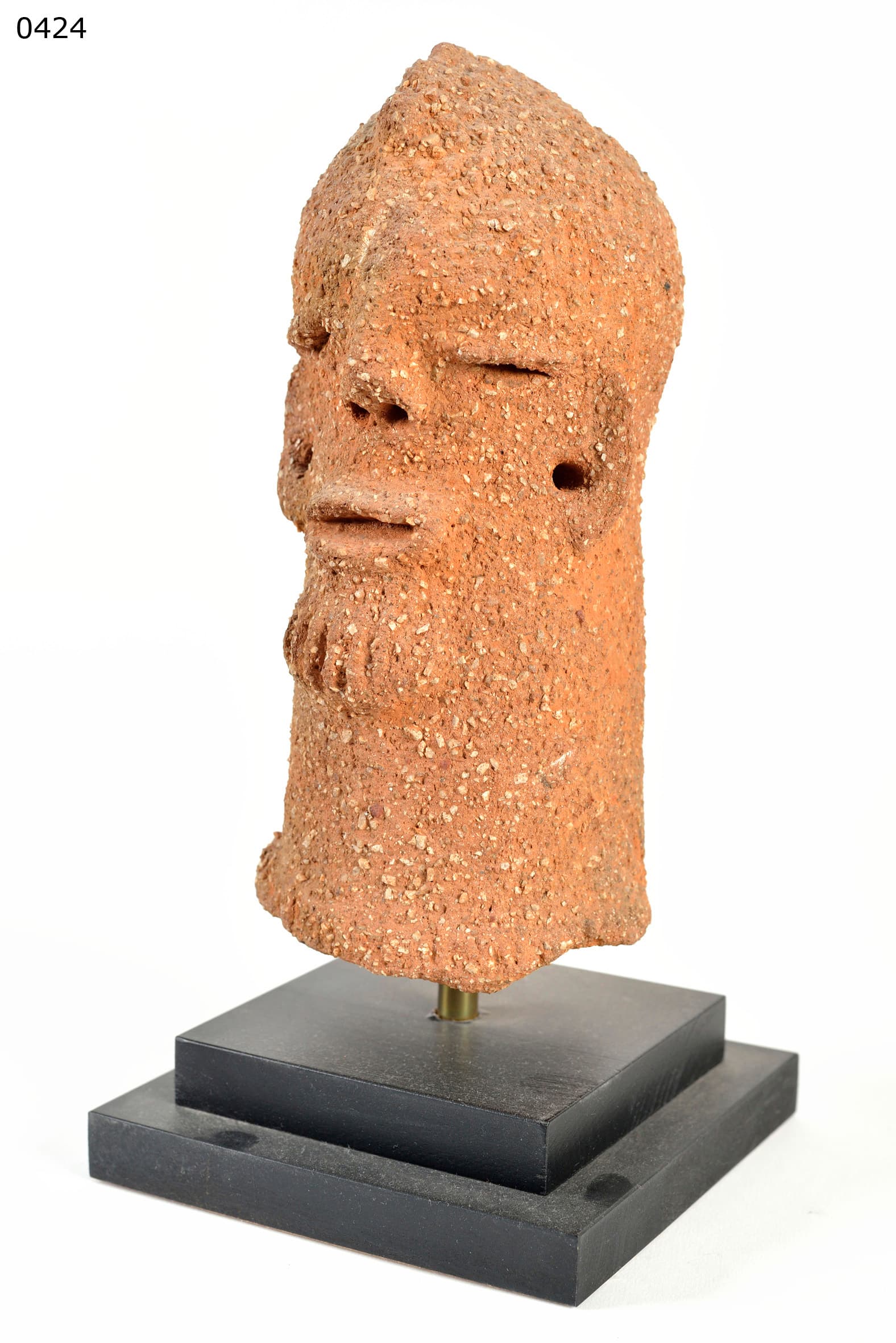
A companion ancient Yelwa / Sokoto terracotta head (traditionally dated to approximately 2,000 years old, 19 cm) from Nigeria — paired to 0424 with the same characteristic conical cranium, heavy overhanging brow, narrow slit eyes, and prominent projecting jawline or beard, heavily eroded and encrusted with coarse sandy mineral-calcified deposits.
1. The Yelwa / Sokoto iron age typology
The Yelwa terracottas represent a vital contemporary parallel to the famous Nok civilization (circa 500 BC – 200 AD).
- Austere Parallel to Nok: While Nok art is characterized by pierced triangular eyes, the Yelwa / Sokoto aesthetic is fundamentally heavier and more austere — deep overhanging brow ridges shadowing unpierced slit eyes.
- Brutalist Conical Geometry: Massive protruding jaws and steeply conical heads project unyielding silent gravity unique to this archaeological corridor.
2. Fragmentation of the divine
Like almost all Nigerian Iron Age ceramics, these heads are fragments broken from much larger torsos.
- Deities, Not Portraits: Extreme stylization indicates representations of deities, deified ancestors, or localized spirits of the land and water.
- Intentional Shrine Breaking: Placed in vast open-air agricultural shrines by early iron-smelting communities — likely intentionally broken during ceremonies to release accumulated spiritual power into the earth.
3. 2,000-Year Subterranean patination
The geological degradation is consistent with significant age.
- Quartz Grog Temper: Heavily tempered with coarse quartz grog to prevent shattering during open-pit firing.
- Crystalline Mineral Crust: Prolonged burial in the sandy acidic soils of the Niger River basin has entirely eroded the original smooth slip — surfaces are highly friable and choked with hardened crystalline white mineral calcifications and embedded earth.
Summary
The slightly smaller 19 cm companion to 0424, this Yelwa terracotta head reinforces the brutalist monumentality of the West African Iron Age pairing. Its heavy jutting geometry and geological calcification support its attribution as a significant antiquity of Nigerian history.
Written with AI assistance from the collection appraisal, object photography and our own research; editorially reviewed. Mistakes are possible — corrections are welcome. How we work →