Overview
The archaeological and art-historical survey of the so-called Yelwa culture focuses primarily on a geographically narrowly defined but historically highly dynamic area in north-western Nigeria. The epicentre of this specific cultural manifestation extends along an approximately 100-kilometre stretch of the middle Niger Valley in what is now Sokoto Province, with a strong nucleus in the immediate vicinity of the village of Yelwa. Paradoxically, scientific knowledge of this area is due to a monumental act of landscape destruction: before the large-scale flooding of the area due to the construction of the Kainji Dam (between 1966 and 1968), archaeologists were forced to carry out emergency excavations. Under the aegis of researchers such as Robert Soper, who led the initial surveys on behalf of the Federal Department of Antiquities, as well as A. J. Priddy and Donald Hartle, the Kainji Rescue Archaeological Project (KRAP) was established. This international salvage project enabled the prospection and partial excavation of around 20 sites. The most significant stratigraphic complexes uncovered include the Baha Mound, the Ulaira site and in particular the iconic Yelwa RS 63/32 site, located on the western bank of the Niger River.
The current demographic and linguistic landscape of this habitat is highly complex, deeply stratified and heavily moulded by historical assimilation processes. Precise population estimates for the autochthonous groups of the region are difficult to verify, as ethnic fluidity is high; serious estimates assume several tens of thousands of remaining native speakers of the local dialects. Linguistic classifications, which have been significantly advanced in recent decades by ethnologists and linguists such as Roger Blench, categorise the autochthonous historical groups of the Niger region as belonging to the Kainji language family, whereby a distinction is made in particular between East and West Kainji. The recent descendants or geographical heirs of this region are primarily the Gungawa (an exonymous Hausa term, while their self-designation is Reshe or Bareshe), the Yaurawa and parts of the Kamberi ethnic group. The source situation regarding the exact demographic and, above all, genetic continuity between the Iron Age creators of the Yelwa terracottas and today's Reshe speakers is ambiguous; cultural diffusion processes make linear descent models obsolete.
An essential sociological dynamic of the region, which also characterises the understanding of material culture, is the massive linguistic, cultural and political pressure exerted by the dominant Hausa culture in the north. Due to centuries of Islamisation, inter-ethnic marriages and economic assimilation pressure, the Tsuresha (the language of the Bareshe/Gungawa) is severely endangered. The traditional groups are increasingly adopting a Hausa identity, which is massively accelerating the loss of old ritual knowledge.
Socio-structurally, the historical Kainji-speaking societies of these riverine settlements differed fundamentally from the highly centralised, hierarchically organised and Islamic Hausa emirates (such as Kano or Katsina) that surrounded them. They had a largely acephalous social structure based on patrilineal kinship groups. Political power was not concentrated in monarchical institutions, but was negotiated in a decentralised manner via local shrine associations, councils of elders and ritual experts. This acephaly is a critical factor in the interpretation of art production: there were no courtly patronage systems that centralised art production, but rather local, village workshops that responded to the pragmatic ritual needs of the community.
The subsistence economy of these river settlements was historically based on a highly successful combination of intensive agriculture (with a strong focus on millet), fishing in the Niger, hunting and a highly specialised Iron Age metallurgy. The extraction and processing of iron was not only an economic foundation, but was also deeply embedded in ritual life. The archaeological findings from Yelwa RS 63/32 prove that iron was present on all strata, which indicates a flourishing, self-sufficient industrial culture.
In the art historical and archaeological world, a central controversy of classification must be explicitly highlighted at this point, as it is decisive for any museum and collection-specific contextualisation: the ontological and stylistic status of the Yelwa terracottas within the pre-colonial Nigerian art canon is the subject of a vehement academic discourse. Is Yelwa merely a peripheral expression of the classical Nok culture or a stylistic centre in its own right? First-generation excavators and some contemporary scholars, including Peter Breunig and the Frankfurt School, tend to subsume the Yelwa finds as mere derivatives, as a "Nok style of lesser quality" or as late, flattened offshoots of the Nok sphere. In contrast, the renowned Belgian art historian and expert Bernard de Grunne postulates a far more differentiated taxonomy based on strict morphological analyses. De Grunne argues emphatically for the recognition of at least four independent, coexisting or successive Middle Nigerian workshop centres: Nok (the classic core area), Sokoto, Katsina-Ala and, indeed, Yelwa. He argues that the morphological variations are too serious to be dismissed as merely qualitative variations within a singular Nok style. This systematic demarcation has far-reaching consequences for collection-specific interpretation. Renowned institutions such as the Musée du quai Branly - Jacques Chirac in Paris, which conducts in-depth provenance and style research on West African artefacts, are increasingly moving towards a more differentiated identification of geolocal style differences in the Niger Arc and an appreciation of the plurality of pre-colonial workshops instead of standardising them under an undifferentiated pan-Nigerian Nok nomenclature umbrella.
Cultural context
The religious and cosmological system that formed the ritual matrix for the production and use of Yelwa terracottas is structurally significantly different from the strongly syncretic or monotheistic practices of the neighbouring, historically dominant Hausa emirates. While precise ethnographic inferences from the recent Kainji groups to the Iron Age creators of the Yelwa artefacts harbour inherent methodological risks and are often marked by diachronic discontinuities, remnants of autochthonous religions provide reliable interpretative analogies.
A prominent example of these continuous religious substrates is provided by the Bori cult, which is strongly associated with Hausa culture today, but whose animistic roots reach deep into the practices of river peoples such as the Gungawa. At the centre of this pre-Islamic cosmology were not rigid, hierarchically structured pantheons of sky gods, but extremely localised nature spirits, chthonic entities and ancestral presences. These entities were not understood as distant, but as actively intervening forces that could be bound to or localised in the physical world through material carriers - be it trees, stones or artificial terracotta sculptures. Among the Gungawa, this has manifested itself up to the recent past in animistic practices in which sacred baobabs, for example, function as the seat of the specific spirit Inna (or Doguwa). These trees, and by analogy probably also the historical altars with terracotta figures, were divinatory consulted as oracles to heal illnesses or overcome agricultural crises.
The ritual authorities in this strictly acephalous socio-political system were therefore not institutionalised clerics supported by a royal court. Instead, they were highly individualised divinators (called Ubwa by the Gungawa), priests of local earth shrines and healers. These specialists had a monopoly on interaction with the metaphysical entities. They controlled the knowledge of the activation of the shrines, in which statuettes served as vessels or recipients for the spirit beings. The lack of a centralised orthodoxy led to a remarkable flexibility and regional diversification of rituals.
The specific role of women in these historical cults is difficult to grasp in purely archaeological terms, forcing us to make cautious extrapolations. However, ethnographic parallels from the wider Niger-Benue Basin suggest that women, especially after menopause (when they were ritually considered "cold" and thus less susceptible to spiritual contamination), assumed central functions. This relates to pottery production, which is traditionally almost exclusively a female domain in sub-Saharan Africa, and key roles in possession cults (such as the later Bori cult), where female mediums acted as primary mouthpieces for the spirits.
As regards the structural and contextual significance of the terracotta sculptures, there is an extremely sharp research controversy among experts concerning the functional core of the objects. Early British archaeologists and researchers such as Bernard Fagg, and later Angela Fagg, tended to interpret the figurative pottery of the Nok sphere and its geological offshoots primarily as instruments of an institutionalised ancestor cult. In this interpretation, the sculptures were idealised representations of the deceased, which were placed at burial sites or central family shrines in order to legitimise genealogical continuity and claims to power.
In contrast, scholars such as Frank Herreman and Jan Strybol have formed a firm counter-thesis. Based on the extensive but long unpublished records of the Benue Valley Expedition (1970-1972), which took place under the direction of Albert Maesen and whose findings were intensively analysed in the Royal Museum for Central Africa (Tervuren/RMCA), they emphasise the divinatory and apotropaic character of comparable objects in the macro-region. According to this functionalist interpretation, the sculptures served less as static representations of ancestors known by name. Rather, they were activated as dynamic tools in pragmatic healing, crisis and transition rituals. The statuettes functioned as "traps" for demons of illness or as temporary vehicles for nature spirits that were invoked to avert disaster from the community.
This functional multivalence sharply distinguishes the religion of the Yelwa region structurally from the later elite, royal shrine cults of southern Nigeria (such as in the kingdom of Benin or in Ife). Whereas in Ife, art primarily served the manifestation of royal (sacred) authority and state cosmology, the sacred was deeply decentralised in the Yelwa context. Art was in the direct service of village problem-solving, which is why the iconography often focussed less on pomp and imperial insignia and more on spiritual presence and pragmatic ritual mechanics.
Aesthetic features
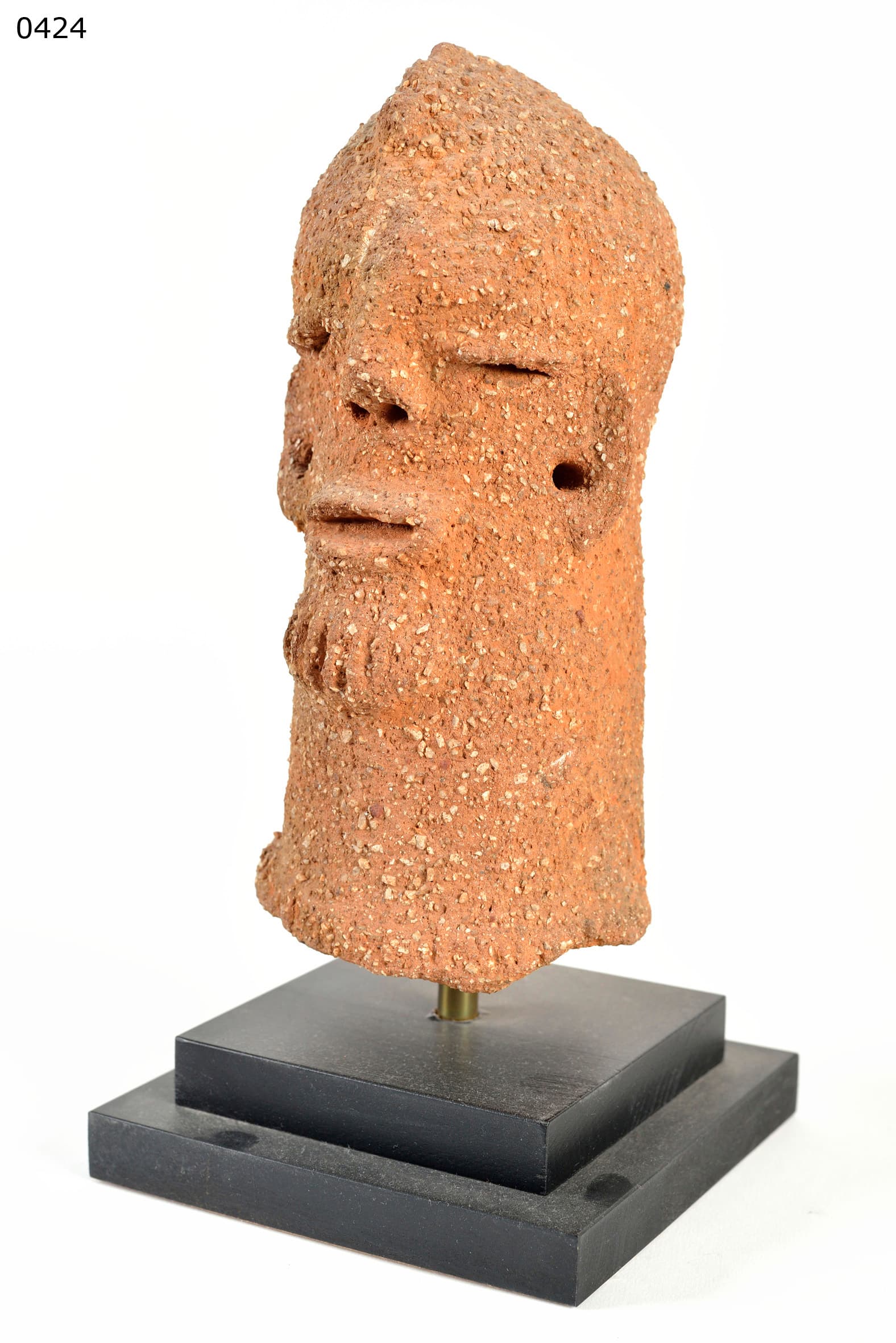
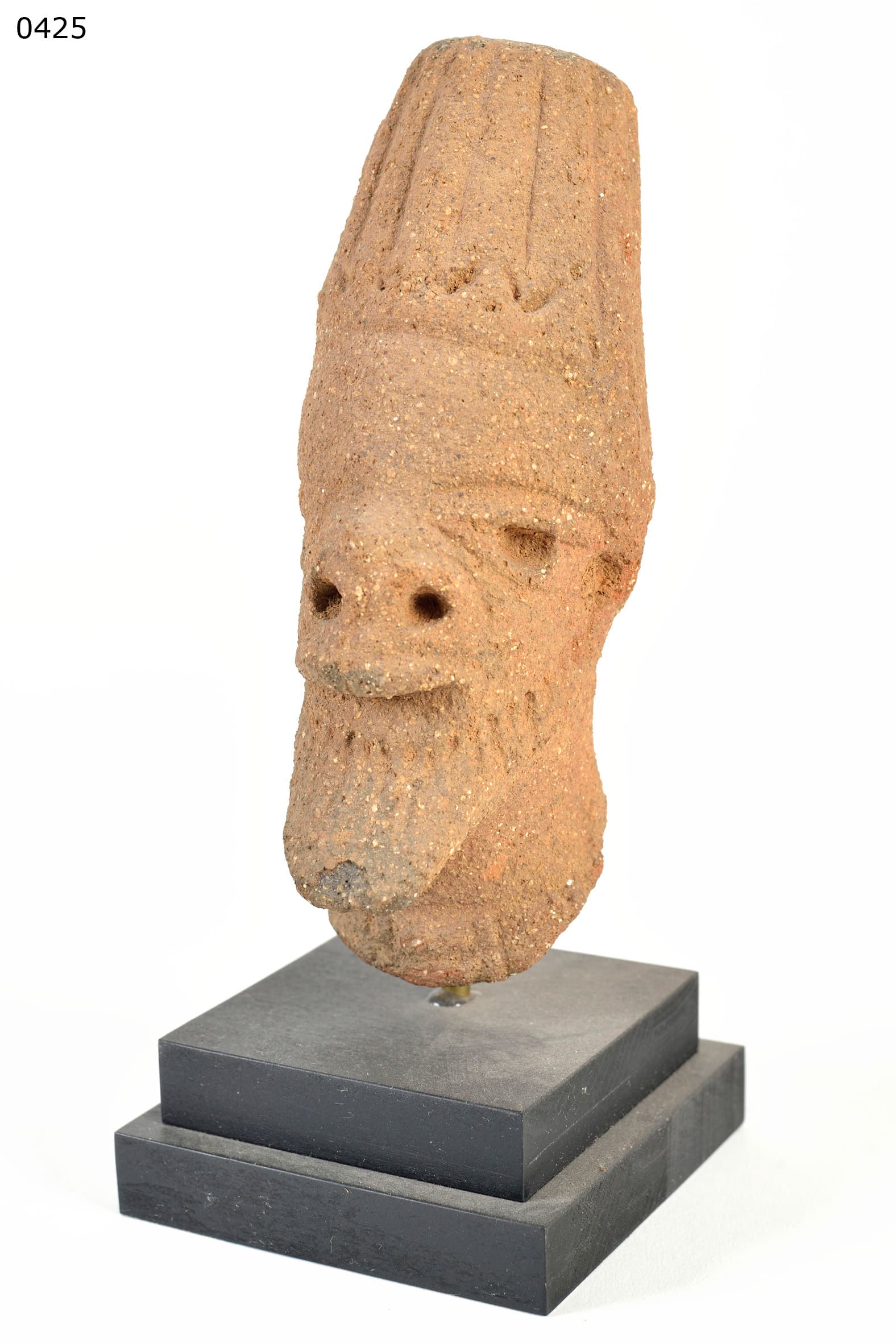
The canonical object type of the Yelwa culture manifests itself almost exclusively in the medium of unglazed terracotta sculpture. Although the documented corpus of finds is far more fragmentary compared to the classic, extensively studied Nok art and has rarely been published in monographic depth, a very clear, distinctive typology can be extrapolated since the increasing establishment of the style as an independent entity (from around the mid-2000s).
The choice of materials is subject to strict geological and technological parameters. The clay used generally consists of a coarse, massively lean matrix. Significant quantities of quartz, mica or crushed granite were added as leaning agents to prevent the sculptures from cracking during the firing process. The surfaces of the unfired figures were often coated with a fine ochre or mica schist slip (slip) and then mechanically polished (burnished) to create a dense, closed texture. The firing process was not carried out in closed domed kilns, but most likely in open field firing at relatively low temperatures (typically between 600 and 800 degrees Celsius). Today, the natural patina of authentic excavated pieces is often characterised by a dense, mineral crust - the result of centuries of storage in iron- and mineral-rich soils - which is chemically sintered to the body. Artificially removing this crust inevitably leads to damage to the original surface.
The canon of proportions of the Yelwa figurines deviates significantly in terms of morphology from the strict, sometimes mannerist parameters of the classical Nok culture and the extremely elongated forms of the neighbouring Sokoto or Katsina terracottas. The heads of the Yelwa figures are generally remarkably rounder and more compactly proportioned. They show a clear reduction in the elaborate, highly complex hairstyles and detailed beard depictions that are so typical of classic Nok heads (such as the famous Jemaa head). In addition, the limbs of the Yelwa figures are often highly abstracted, almost stumpy; findings document, among other things, very rudimentary fingers that appear almost as incisions. Another recurring, highly specific iconographic feature is the prominent and highly sculptural depiction of umbilical hernias (umbilical hernias). A few remarkable figures from the Yelwa and neighbouring Kwatakwashi corpus also feature unusual, horn-like protuberances on the head, the exact iconographic meaning of which - whether representing animal spirits, goats, monkeys or specific shaman headdresses - remains unclear.
The size spectrum of these objects is enormous and ranges from greatly reduced miniature heads (a few centimetres, possibly used as amulets or medicine stoppers) to monumental, almost life-size torsos. There are reports of figures from looting that reach dimensions of up to one metre in height, although these extremely large pieces have rarely been archaeologically documented intact in situ.
The anonymity of prehistoric societies obviously rules out any direct attribution to individual master hands. Nevertheless, Bernard de Grunne argues in his connoisseurial analysis, which is strongly modelled on Western art history, that the astonishingly coherent formal features and the virtuoso mastery of the material suggest firmly established, highly professional workshops (workshops). These workshops must have passed on traditional technical and iconographic knowledge in an institutionalised manner over generations.
The essential difference between a ritually "activated" ritual object and a profane object (such as simple utility ceramics) lay primarily in the context of the altar placement and the ritual surface treatment. Activated ritual objects often bear traces of repeated libations (sacrificial effusions that leave dark incrustations) or were ritually modified by the priest.
With regard to iconographic semantics, another essential research controversy manifests itself here: While the ethnologist Hans-Joachim Koloss interprets the African terracotta sculptures of this region (drawing on analogies from the Cross River region, such as the Njom cult) partly in the context of the depiction of wild nature spirits and feared disease demons, authors such as Bernard de Grunne rigorously interpret the figures as majestic representations of dignitaries, priest-kings or deified ancestors, based on the presence of insignia (such as sceptres) or highly complex postures.
Since the absolute majority of the Yelwa corpus reached the art market unprovenanced through looted excavations, the problem of forgery is extremely virulent. Market-relevant forgery criteria include the lack of genuine, grown mineral sintering. Forgers often use modern glues to apply earth. The presence of homogeneous firing cores produced by modern industrial furnaces also exposes the forgery, as original pieces show the typical dark reduction cores of open field firings when broken. Another massive problem is so-called pasticci - new compositions in which genuine but disjointed old shards of other people's pieces are reassembled and plastered over by forgers. Today, such hybrid forgeries can often only be detected by highly technical departments, such as the restoration laboratory at the Museum Rietberg in Zurich, or through the use of forensic computer tomography (CT scans), which make modern binding agents or supporting structures made of metal branches hidden inside visible in cross-section.
Ritual practice
The exact reconstruction of ritual practice and the performative use of objects in the Yelwa culture remains an archaeological challenge due to the lack of undisturbed contexts. Nevertheless, the sparse but scientifically highly valuable in-situ findings of the excavations from the late 1960s, in combination with ethno-archaeological analogies, allow a multi-faceted picture.
The utilisation biography - the so-called lifecycle - of a Yelwa terracotta object was cyclical and ritually highly complex. Immediately after the technically demanding firing process, the object was merely fired clay. It only acquired its sacred charge when it was transferred to a specific ritual context, typically a dedicated village altar, a shrine in the bush or a family shrine.
Detailed archaeological descriptions of excavations, particularly at the Yelwa RS 63/32 site and the nearby Baha Mound, document specific architectural structures that were heavily ritually charged. The excavators came across constructions made of hard-baked clay as well as so-called pottery pavements (potsherd pavements). In this highly specialised floor design, ceramic shards were pressed horizontally or in some cases on edge into the damp muddy soil to create a durable, resistant and probably also symbolically demarcating surface. These pavements most probably marked exclusive shrine areas or sacred altar spaces.
The statuettes were ritually "activated" on these carefully prepared altars. The activation probably took place through the recitation of incantations by the divinator (Ubwa) and the application of sacrificial matter. Historically, such offerings (libations) in West Africa usually consisted of the blood of sacrificial animals, millet beer or eggs. The use of eggs is archaeologically documented in the wider area (for example in Ghana or at the Igbo-Ukwu complex) and is understood to the present day as "food for the gods" or as a substantial sacrifice for spiritual media in shrines. The porous surface of the terracotta absorbed these liquids, which over the years led to the dense, opaque patina often valued by collectors.
| Archaeological context | Typology of findings | Material relics | Interpretation of ritual use |
|---|
| altar rooms / shrines | pottery pavements (potsherd pavements) | potsherds, clay foundations, libation remains | spatial segregation of the sacred, basis for deity figurines |
| Funerary context | elite tombs (Yelwa RS 63/32) | 21 iron bracelets, ivory, intact pottery | status representation, sepulchral ancestor cult |
| Landfills / disposal | Intentional debris fields (Dan Baure) | Smashed (shattered) terracottas | Ritual deactivation, neutralisation of spiritual power |
The excavations at Yelwa RS 63/32 also reveal the extremely close interlocking of figurative pottery and funerary practice. Four obviously high-ranking graves were uncovered in the immediate topographical vicinity of the terracottas, whose rich grave goods suggest a complex, elite ritual economy. One unique grave contained an incredible 21 massive iron bracelets and ivory in addition to intact ceramic vessels. Other contexts at the Baha Mound also featured prestige objects such as quartz lip plugs, glass crucible fragments and bronze anklets. This strongly implies that the altars and the terracottas on them did not function in isolation, but were closely integrated into a sepulchral ancestor cult that extended the status of the deceased into the afterlife.
An equally striking and often misunderstood phenomenon of ritual practice at the end of the objectlifecycle is intentional deactivation. Many statuettes, including finds from the Yelwa region and the closely neighbouring Kwatakwashi culture, exhibit massive fractures and debris structures that cannot be explained purely taphonomically (i.e. by earth pressure, roots or erosion in the soil). Rather, the fragments were deliberately smashed and then ritually deposited (a form of ritual "killing" of the material object). This indicates that an object lost its channelled power after the death of its owner, after the departure of the community or after the successful completion of a specific crisis ritual or - more dangerously - this power could remain uncontrolled, which is why it had to be neutralised through physical destruction. Such deliberately smashed and secondarily buried fragments, for example from the site of Dan Baure, are now part of the comparative collection of the Gidan Makama Museum in Kano and the National Museum in Lagos. These practices make it clear that the focus of the communities was not on the preservation of "art" for eternity, but on the temporary, ritual effectiveness of the form.
Historical context
For decades, the chronological classification of the Yelwa culture was characterised by immense dating controversies and methodological uncertainties. The archaeological sites at today's Kainji Reservoir document a deeply staggered but stratigraphically complex settlement history. Donald Hartle (1972) dates the massive Baha Mound primarily to a settlement period from 1335 to 925 BP (which corresponds roughly to the 7th to 11th centuries AD). However, it must be emphasised that deeper layers of this mound (at c. 460 cm depth) yielded radiocarbon dates (Lab No. N 824) of up to 2140 ± 110 BP (c. 200 BC), indicating a very early initial occupation. Meanwhile, A. J. Priddy and Robert Soper dated the nearby Yelwa RS 63/32 site, based on four C14 dates (N 361 to 364), to a slightly more compact phase between 1965 and 1145 BP (ca. 1st to early 9th century AD). According to this, the Yelwa tradition existed at the temporal edge of the classical late Nok culture and significantly outlasted it until well into the early African Middle Ages.
The Western reception and archaeological "discovery" of the Yelwa terracottas occurred in the late colonial and early post-colonial period, driven by ruthless industrial infrastructure projects. As already mentioned, the construction of the Kainji Dam (1966-1968) forced hasty emergency excavations. The urgency of excavation often prevented accurate micro-contouring of the stratigraphy, which meant that the Yelwa finds were lost in the academic shadows of the far more prominent Nok research for decades. Historical perception was also characterised by the colonial perspective. When Bernard Fagg published the first Nok terracottas in the 1940s, "Black Africa" was regarded in large parts of Western academia as an ahistorical space, as a "heart of darkness" without its own history of civilisation. This racist premise served to legitimise colonial subjugation. Only the indisputable C14 data from Nigeria forced Western science to recognise pre-colonial African civilisations. However, the political landscape during the colonial period (shaped by Frederick Lugard's system of Indirect Rule) consolidated the dominance of the Islamic Hausa emirates, which contributed to the further socio-political marginalisation of the indigenous Kainji peoples.
The market history of the Yelwa terracottas in the west was tumultuous in the late 20th century and is overshadowed by ethical conflicts. In the 1980s and on a massive scale in the 1990s, illegal looting flooded the international art market in Paris, Brussels and London. Farmers and professional looters recognised the monetary value of the ceramics; thousands of pieces were dug up and smuggled to Europe via transit hubs in Lomé (Togo) and Cotonou (Benin). It is estimated that up to ten terracottas were located every day during peak periods.
Large auction houses such as Sotheby's and Christie's as well as influential dealers and scholars such as Bernard de Grunne played an ambivalent key role in establishing the style on the market. Through his exhibitions and high-priced catalogues, De Grunne made a significant contribution to the emancipation of "Yelwa" as a terminology from the rudimentary Nok collector's term from around 2005 and its success as an elite quality mark of its own on the art market. The price trend reached its absolute peak in the late 1990s (for example in the context of Asian Art in London or comparable tribal art auctions), when outstanding and well-preserved African terracotta pieces realised six-figure dollar sums at international auctions (in individual cases up to USD 275,000 for supposed masterpieces).
The enormous greed of the art market inevitably led to an epidemic of forgery problems. Thermoluminescence (TL) analysis quickly became the ultimate industry standard for verifying the authenticity of antique ceramics. Scholars, collectors and high-profile institutions (such as curators at The Metropolitan Museum of Art) rely on this forensic dating method, which measures the accumulated radioactive radiation - trapped in the ceramic's quartz crystals - since the last firing to accurately determine age.
Nevertheless, a technological arms race quickly developed. Forgers in the West African region developed highly sophisticated strategies: they began to grind up old, but shapeless or insignificant archaeological shards and form them into new, spectacular "Yelwa" figures using modern binding agents (Pasticci). Even more perfidious was the method of deliberately exposing newly fired forgeries to artificial X-rays in order to simulate an advanced age in subsequent TL tests. Nowadays, such manipulations can only be detected by extremely expensive forensic computer tomography (CT scans), which check the internal structural density. The source situation regarding the legal provenance of Yelwa terracottas documented before 1970 (UNESCO Convention) therefore remains extremely precarious worldwide and requires the collector to exercise the utmost analytical scepticism.