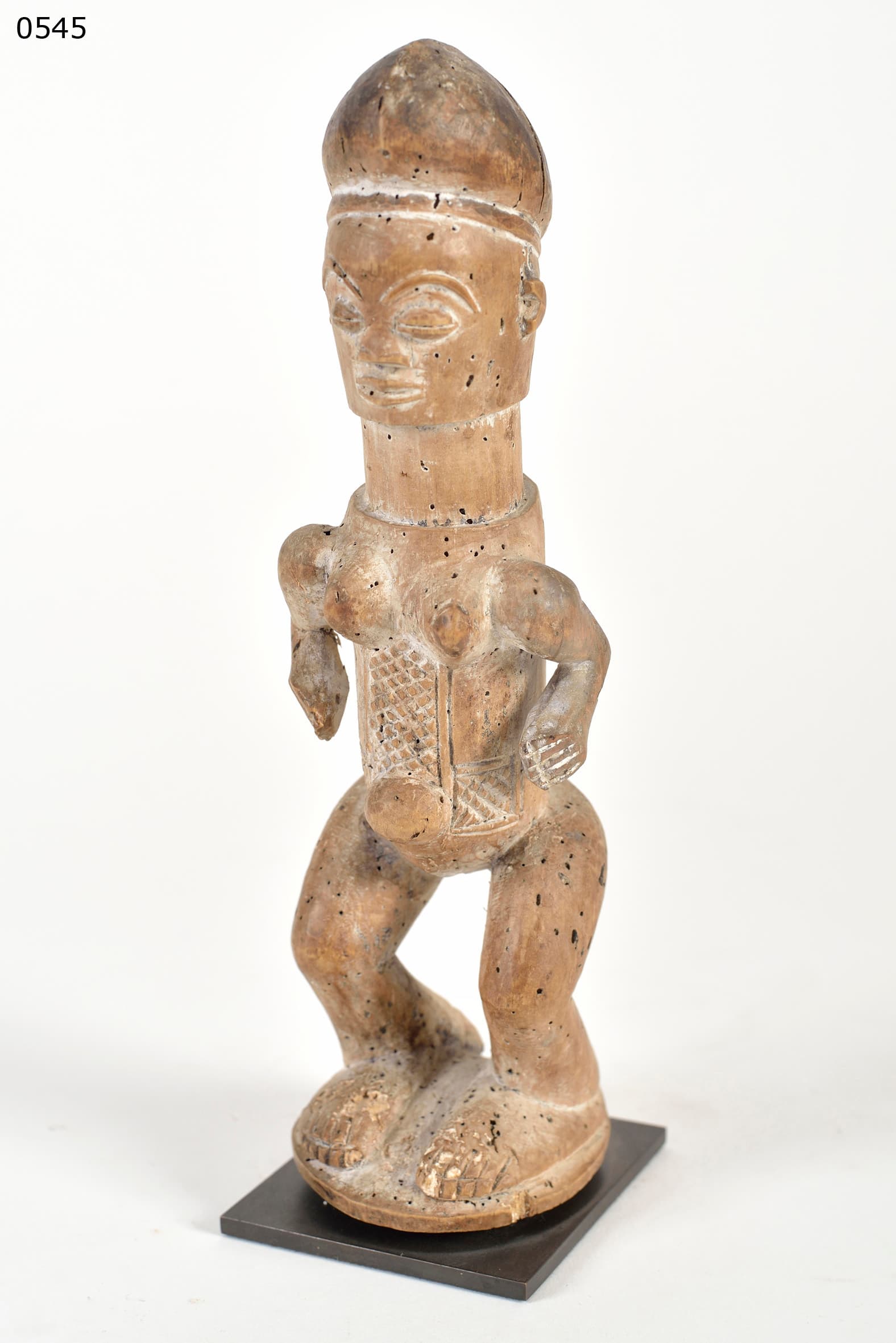
This classic Punu mask boasts a highly developed, striated sagittal crest and lateral hair lobes, with a prominent raised nine-diamond scarification cluster on the forehead. The stark white, kaolin-coated face contrasts sharply with the dark, unpainted eyes and lips, featuring a beautifully smoothed, organic aging across its surface.
1. Aesthetic style — the nabina motif and elite coiffures
This mask exemplifies the classic Punu Mukudj aesthetic, noted in the West for its influence on early Cubist sculptors. It features the quintessential nine-diamond scarification mark (nabina) prominently on the forehead, identifying the mask not just as a spirit, but as an initiate of a specific, high-status Gabonese lineage. The spectacular, voluminous coiffure, with its central striated crest and complex lateral lobes, is a meticulously carved wooden replica of the elaborate, fat-and-mud-stiffened hairstyles worn by noble Punu women in the late 19th and early 20th centuries.
2. Ritual function — the theatrical illusion of the stilt dance
To understand the power of this mask, one must contextualize it within the dizzying heights of the Okuyi dance. The performer, wrapped entirely in raffia and cloth to hide his mortal body, mounts stilts up to three meters high. Peering out only through the tiny, crescent-shaped slits of the mask's eyes, the dancer executes rapid, gravity-defying maneuvers. The mask acts as the fixed, unblinking focal point of this chaotic kinetic performance. The contrast between the frenetic energy of the dancer's body and the serene, idealized expression of this white wooden face creates a powerful theatrical illusion of a hovering ghost.
3. Physical patina — smooth kaolin rubbing and structural patina
The patination on this specific mask indicates long-term, careful ritual handling. Unlike masks left to heavily flake, the kaolin on this piece has been gently worn and smoothed down by human touch, creating a soft, almost skin-like texture over the cheeks and forehead. The highest points of the face, specifically the tip of the nose and the nabina scarification, have been rubbed entirely bare, exposing the rich, dark brown oxidation of the hardwood. This differential wear, combined with deep sweat staining on the interior bite-stick block, is consistent with a history of physical use.
Summary
This is a highly refined execution of the Punu Mukudj, balancing structural complexity in the hair with minimalist facial geometry. Its rubbed kaolin patina and deep cultural signifiers align it with classic examples of West African masquerade.
Written with AI assistance from the collection appraisal, object photography and our own research; editorially reviewed. Mistakes are possible — corrections are welcome. How we work →