Overview
The Punu (often transcribed as Pounou or Bapunu in Francophone historical literature) represent a demographically, politically and art-historically highly significant population group within the Central and Equatorial African region. Their historical and contemporary core settlement area extends primarily to the south-western and central-southern provinces of the Gabonese Republic. The geographical distribution is concentrated with the highest density in the fertile basins of the Ngounié and Nyanga rivers, which are characterised by dense gallery forests and wide savannahs. Furthermore, there are substantial extensions of this settlement area caused by historical migration dynamics, which extend transregionally into the Niari region of the neighbouring Republic of Congo (Congo-Brazzaville).
In terms of demographic quantification, historical estimates and contemporary surveys sometimes diverge drastically. While older ethnographic compendia often put the Punu population at only around 80,000 individuals, current demographic databases and linguistic projections for the years 2024 to 2026 extrapolate a significantly higher population size. According to these, the number of ethnic Punu or native speakers is around 290,000 to 320,000 individuals. Within the total population of Gabon, which is estimated at around 2.5 to 2.6 million people according to recent UN projections, the Punu (who make up an estimated 2 to 4 per cent of the total demographic) are thus one of the most culturally and politically influential entities alongside the dominant Fang in the north and the Myene on the coast. The subsistence economy in these areas was based pre-colonial and in rural regions to this day on a combination of semi-steppe shifting cultivation - primarily characterised by slash-and-burn agriculture for the cultivation of manioc, yams, taro and bananas - as well as supplementary hunting and extensive fishing.
The linguistic localisation of the Punu provides decisive indications of their migration history and ethnic kinship. The Punu language, Yipunu (occasionally listed as Puno), is clearly assigned to the large Bantu language family in philological research. In the established taxonomy of Bantu languages, which goes back to the British linguist Malcolm Guthrie (1948, 1967-1971) and is still authoritative in African studies today, Yipunu is classified under the shelfmark B.43. It thus belongs to the so-called Sira-Punu group (Zone B). This linguistic embedding is evidence of a deep, centuries-long history of assimilation and interaction, which places the people in a complex network of closely related neighbouring peoples such as the Lumbu, Vili, Vungu, Tsangui, Eshira and Sira.
The pre-colonial social structure of the Punu is fundamentally determined by a matrilineal descent and kinship system (mabila or wilu). In this specific system, blood kinship, lineage affiliation, inheritance claims to land as well as ritual and social obligations are derived exclusively through the female line (the mother line). This system gives women considerable structural, reproductive and spiritual significance, but does not function as a matriarchy in the executive sense. Historically, operational political and economic decision-making power was often in the hands of the male councils of elders, especially the mother's brother (maternal uncle), who was a far more important authority figure for young men than the biological father. Before the arrival of European colonial powers, Punu societies were politically organised in a strictly acephalous manner (free of domination in the sense of a lack of state superstructures). There were no centralised, hierarchical chiefdoms, kingdoms or dynastic empires as in the Congo Basin, for example. The highest political unit was the autonomous village or a network of local settlements, whose cohesion was maintained by complex marriage alliances, the authority of the elders and not least by the draconian power of inter-village secret societies.
However, the classification of the Punu as a static, homogeneous ethnic entity is the subject of intense theoretical debate in modern ethnographic and historical research. The source situation regarding rigid ethnic boundaries in the rainforest regions of Equatorial Africa is fundamentally ambiguous. Contemporary ethnologists emphasise that, historically speaking, the term "Punu" is in part an exonym - a foreign term that was primarily used by early European explorers and colonial officials for the administrative categorisation of what was in reality an extremely fluid, clan-based population landscape. The indigenous self-designation and primary loyalty of the actors was historically tied to the specific clan, lineage or secret society. In order to contextualise the linguistic and geographical distribution as well as the material culture of this population group for the collector, a systematic comparison with the holdings and cartographies of large institutions such as the Royal Museum for Central Africa (RMCA) in Tervuren is essential. The archives there document the complex interaction of the Punu with the Vili and other Congo peoples in the deep south, characterised by migration, trade and ritual borrowing, in excellent density.
| Demographic & Structural Parameters | Specification and Current Survey Data |
|---|
| Geographic core area | Gabon (provinces Ngounié, Nyanga), Republic of Congo (Niari) |
| Estimated total population | 290,000 - 320,000 individuals (as of approx. 2024/2026) |
| Linguistic taxonomy | Yipunu (Niger-Congo macrofamily, Bantu B.43 according to M. Guthrie) |
| Social kinship system | Matrilineal (wilu / mabila), strictly exogamous marriage practices |
| Pre-colonial political organisation | Acephalous, village autonomous, regulated by councils of elders and confederations |
| Primary subsistence strategies | Semisedentary shifting cultivation, hunting, aquatic resource utilisation |
Cultural context
The religious, ontological and philosophical system of the Punu is based on a multi-layered cosmological order that postulates a rigid separation, but at the same time permanent interaction between three spheres: the material world of the living, the transcendent domain of the ancestors and the unpredictable sphere of activity of amorphous natural and elemental beings. As with most Bantu-speaking peoples of Central Africa, there is the idea of a distant, unapproachable creator god who has faded into the background after the creation of the cosmos and no longer plays a cultic role in active ritual practice. In contrast, ancestor worship forms the absolute centre of everyday religious life. In the epistemology of the Punu, ancestors (ancestors) are not regarded as passively absent or definitively past, but intervene permanently in the daily lives of their descendants as highly active, demanding and protective actors. This ancestor complex is flanked by a strong belief in powerful nature and water spirits (bayisi ba mambe), who reside in the deep rivers, waterfalls and lagoons of the Ogooué and Ngounié basins and are believed to be responsible for agricultural and human fertility as well as for sudden disaster and drowning.
The spiritual and regulatory structure of the community was historically regulated by highly exclusive, gender-specific initiation and secret societies, which compensated for the absence of a centralised state executive. For the male population, the Mwiri confederation (also transcribed as Mwéli or Ombwiri in the specialised literature) was the absolute central authority. Entry into the Mwiri marked the elementary, life-changing rite of passage from underage boy to fully responsible, socially recognised man. This initiation process took place in the strict isolation of the forest and was characterised by extreme physical and psychological trials (including ritual ablutions, taboos and sometimes painful scarification). It symbolised the complete death of the child's ego and the subsequent social rebirth as a member of the elite brotherhood. However, the Mwiri was by no means just an esoteric community for spiritual edification, but operated as a ruthless regulatory instrument: it sanctioned theft, penalised adultery and, above all, was the primary inquisition authority against the greatest existential threat to society - witchcraft. Accusations of witchcraft were investigated by the Mwiri and sometimes penalised with drastic sanctions, including the physical elimination of the accused in the forest.
The mandatory female equivalent in this dual cosmological balance of power was the Nyembé or Ndjembe covenant. This exclusive female initiation society consolidated the spiritual monopoly of women, passed on crucial secret knowledge about reproduction, birth, medicinal plants and agriculture and served as a powerful instrument of social mediation and conflict resolution within the village. Other ritual authorities were the nganga - highly specialised priests, healers and diviners who possessed profound pharmacological knowledge. They used specific plant and mineral substances, above all the highly sacred riverbed kaolin (pemba), to make spiritual diagnoses, break curses and initiate healings.
There is a significant structural and iconographic contrast between the Punu religious system and that of their northern and eastern neighbours, in particular the Mitsogho and Fang. While the Mitsogho and Fang cults are strongly characterised by the Bwete or Byeri complex - which places the physical preservation of ancestral relics (skulls and bones) in baskets, closely guarded by anthropomorphic shrine guardian sculptures made of wood and copper, at the centre of worship - the primary ritual focus of the Punu was historically not on the preservation of relics. Rather, the Punu focussed on performative, mask-centred spirit representation and the institutional power of the Mwiri. Although parts of the Punu in the 20th century also adapted and integrated the Bwiti cult - a syncretic and initiatory secret religion that uses the ritual consumption of the psychoactive, highly dissociative root bark of the Tabernanthe iboga plant to trigger collective visions of the afterlife and to communicate directly with the ancestors - the research situation regarding the exact historical vectors of this exchange is highly controversial.
The source material on the origins of Bwiti is ambiguous. Authorities such as the Polish ethnologist Stanislaw Świderski (1965) and the modern researcher Giorgio Samorini vehemently postulate that the traditional, non-Christian Bwiti was developed exclusively by ethnic groups such as the Apindji and Mitsogho and was only adapted by groups such as the Punu in the course of later cultural exchange and transformed into a Christian syncretic form by the Fang. Other researchers, however, point to independent, indigenous precursors of the Punu cults, which existed independently of the hallucinogenic iboga complex and only later merged with it. An explicit research controversy (author vs. author) can be located here between classical diffusionists such as Świderski and representatives of local innovation models such as Julien Bonhomme (2006), who emphasise the interethnic, network-like character of the Bwiti, which cannot be monocausally reduced to an "inventor tribe". These fundamental structural divergences in the Central African cosmology are reflected with the greatest clarity in the collections of major institutions: for example, the Musée du quai Branly - Jacques Chirac regularly demonstrates in its permanent exhibitions the functional contrast between the performative Mwiri insignia of the Punu and the static, vigilant Bwete and Byeri altars of the Central Gabun region.
| Comparison of religious systems | Punu (Mwiri / Nyembé) | Mitsogho / Fang (Bwete / Byeri) |
|---|
| Central ritual object | Masks (white-faced, performative) | Reliquary baskets & guardian sculptures |
| Focus of ancestor worship | Representation of idealised spirit beings | Physical preservation of the bones |
| Pharmacological focus | Kaolin (pemba), herbal amulets | Psychoactive iboga (in the Bwiti cult) |
| Social mechanism | Gender-specific secret societies | Lineage-centred ancestor cults |
Aesthetic features
The Punu sculptural canon is almost exclusively dominated in the international connoisseur and museum landscape by the world-famous, white-faced Mukudji masks (regionally also called Okuyi, Okukwe or Mukudj, depending on the dialect). These objects are undisputedly regarded as masterpieces of Equatorial African art and manifest a formal typology of the highest naturalistic sophistication, which stands in drastic contrast to the expressionist or highly abstract cubism of neighbouring cultures (such as the Kota).
A canonical Punu mask is defined by an extremely strict canon of proportions. The face is idealised, flawless and delicately modelled, often in a clear heart shape that tapers into a pointed, fine chin. The eyes are slit, strongly almond-shaped, slightly bulging and appear almost closed due to their deep placement under the brow arch - an expression that symbolises a state of complete inner contemplation, spiritual trance or the sleep of death in Punu iconography. The most iconographically striking and eponymous feature is the bright white to cream-coloured pigmentation of the entire face, which is achieved through the rich application of pure, finely ground riverbed kaolin (pemba). In the ontological understanding of the entire region, white is not the colour of innocence in the Western sense, but unmistakably the colour of the ancestors, the spirit world, transcendent healing and clairvoyance; it clearly marks the masked entity as non-human or post-mortal.
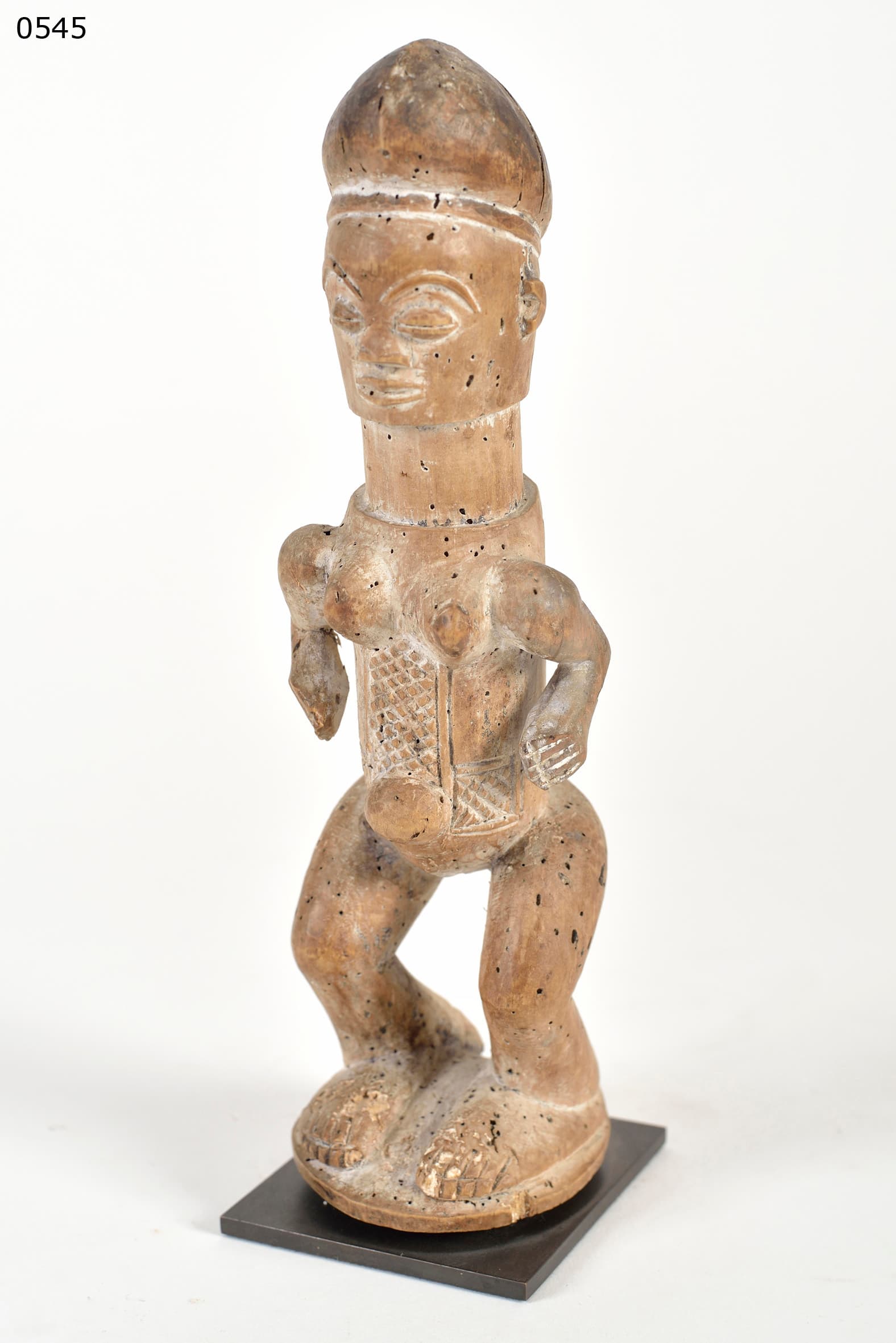
Another essential, determining feature of the canon are the raised scarifications (ornamental scars), the so-called mabinda. These are usually applied as precisely carved, diamond-shaped motifs - historically often consisting of exactly nine small, raised scales - on the centre of the forehead and on both temples. They encode specific cosmological myths of origin or refer to archaic, clan-specific affiliations. The face is crowned by an extremely elaborate, voluminous, mostly black pigmented hairstyle that imitates the real, highly complex hair braiding of 19th century Punu women in wood. Typical here is a central, towering helmet hairstyle (similar to a visor), often flanked by side braids, in so-called traditional nine-lobed compositions. The dimensions of this type of object usually vary within a narrow range between 25 and 35 centimetres in height. In addition to these highly famous masks, there are only very few sculptures in the Punu corpus, such as extremely rare tsambi shrine guardian figures or small apotropaic amulets (mwiri complex), whose formal language is, however, much more reduced and less canonised than that of the masks.
The exact ethnic attribution of these white masks in ethnographic and art-historical research is the subject of one of the most incisive controversies in African studies. As the geographically neighbouring peoples of the Lumbu, Vili, Ashira and Sira also historically carved white masks, the stylistic demarcation and taxonomic purity is the subject of intense debate in research. The renowned Gabon expert Louis Perrois argues vehemently for a strict formal separation: he assigns masks to clearly separate, isolated ethnic centres based on the morphological complexity of their hairstyle complexes (number of coils, architecture of the central ridge) and the variance of scarification. The art historian Charlotte Grand-Dufay (2015) fundamentally contradicts this methodological rigidity. She argues (author vs. author) that the search for "pure" styles is a Western illusion. Rather, the entire Ogooué basin is characterised by gradual, fluid transitions (stylistic continuums), in which Lumbu, Vili and Punu aesthetics were constantly intermingled through centuries of interethnic exchange, trade and marriage. According to Grand-Dufay, this relativises the harsh market labelling as a purebred "Punu" mask as a primarily commercially motivated construct of the art trade.
Despite the fact that the African artists are usually not known by name in the Western sense, advanced connoisseurs identify specific, highly talented master hands or supra-regional workshops on the basis of minute micromorphological details - such as the precise curve of the brow arch, the depth of the eye sockets or the incision on the chin area. One prominent research construct, for example, is the fictitiously named "Master of the Nine Scrolls", whose works display unrivalled symmetry and delicacy. The substantial ontological difference between a profane piece of wood and a ritually activated cult object lies in the choice of material and the specific formation of the patina: only the ritual application of the pemba earth and specific, secret plant ingredients by the ritual master (nganga) transforms the preferred ceiba pentandra wood (a sacred tree of the region, sacred to the Punu) into the temporary, material seat of the spirit. Forgeries, which circulate in enormous quantities on today's art market, often fail expert examination due to the purely synthetic chemical composition of the artificially applied patina and the complete lack of authentic traces of wear (deeply penetrated sweat and grease deposits, oxidation of the wood inside the mask). The Metropolitan Museum of Art (Met) in New York, curated under the expertise of Alisa LaGamma, has excellently documented pieces that set the ultimate standard for formal authenticity and the classical canon of Punu proportions.
| Morphological criteria of the canonical Punu mask | Specific expression |
|---|
| Basic shape of the face | Strictly heart-shaped, tapered chin, dominant high forehead |
| Eye area | Slit, slightly domed eyelids, almond-shaped (trance state) |
| Surface pigmentation | Pure riverbed kaolin (pemba, matt white), partly red lip pigments |
| Scarification (mabinda) | Exact diamond pattern (often nine scales) on forehead and temples |
| Hairstyle complex | Dominant, visor-like central lobe, flanking lateral scrolls (often nine scrolls) |
| Wood species | Preference for Ceiba pentandra or Marula (Sclerocarya birrea) |
Ritual practice
The ritual activation and physical performance of the white Punu masks in the village space represent a highly complex, kinaesthetic and socio-religious drama that goes far beyond the purely sculptural existence of the isolated object as seen in Western showcases. At the centre of this practice is the Mukudji dance (also Okukwe), a spectacular, terrifying and at the same time aesthetically fascinating masquerade. This is primarily initiated on occasions of profound social transitions - especially at the complex mourning ceremonies of high-ranking, influential personalities, the ceremonial conclusion of months-long initiation cycles of the Mwiri covenant or as a collective cleansing ritual to ward off epidemic crises and suspected witchcraft attacks.
The performance is linked to physically extreme, virtuoso conditions: The dancer completes his rapid, acrobatic movements on wooden stilts up to two metres high. This enormous elevation is not merely an artistic element to entertain the crowds, but fulfils a profoundly ontological function - it lifts the spirit from the profane earthly sphere, positions it literally and metaphorically above the community and emphasises the threatening, transcendent nature of the apparition from the beyond. The human body of the stilt dancer is completely and rigorously concealed under a voluminous, rustling costume made of dried bast fibres (raffia), animal skins and partly imported textile fabrics. Not a square centimetre of human skin is allowed to be visible, as this could result in the dancer's death at the hands of the enraged spirit. In its hands, the apparition often holds flywhisks made of supple cane (mwandzu), with which the dancer accentuates the rapid choreographic changes of direction and symbolically whips evil influences out of the air.
The life cycle of such a ritual object is strictly regulated in Punu society. The carving of the wooden body takes place far away from the village in the isolation of the forest, often with the artist observing strict sexual and dietary taboos. Once the work has been completed by hand, the object itself is profane. The actual, dangerous "activation" only occurs through the ritual smearing of the face with white kaolin (pemba), which is extracted by nganga priests from special, ancestor-associated riverbeds, as well as through the sprinkling of the inside of the mask with blood or palm wine offerings at hidden altars of the Mwiri covenant. The kaolin acts as a magical vector that builds a bridge to the underworld. As soon as the mask is ritually worn out through years of use, has been desecrated by a breach of taboo or has fulfilled its specific generational purpose, it is irrevocably "deactivated". This is done by scraping off the sacred overlays. The shell is then either disposed of in the scrubland, where insect damage (termites) and rapid climatic weathering return the Ceiba wood to the cycle of nature, or dumped in rivers.
In modern interpretative ethnography, there is a profound methodological research controversy regarding the gender dynamics of this performance. It is historically undisputed that the Mukudji ritual is performed exclusively by men (as selected, initiated athletes of the Mwiri covenant), but the mask itself undoubtedly represents the idealised face of a beautiful, female ancestor. The renowned curator Alisa LaGamma argues (author vs. author) that this is a highly artificial, deliberate cross-gender performance: The aggressive, masculine virtuosity on stilts actively celebrates female reproductive power, wisdom and beauty, staging an inter-gender, socio-political equalisation in the strictly matrilineal society on a ritual level. However, a much older ethnographic topos (represented by early missionaries and researchers) rejects this modern, strongly sociological interpretation and argues that the dancer completely loses his own gender identity at the moment of masking; the indigenous village community does not see a "man playing a woman", but simply an androgynous, terrifying spirit (spirit/entity), thus rejecting the concept of cross-gender representation as an anachronistic, Eurocentric projection.
In-depth archival material on the performative localisation and choreographic architecture of African dances can be found in outstanding density in the Museum Rietberg in Zurich. The contextualisation there (which often draws intercultural comparisons of masked beings) impressively illustrates the dramatic tension and difference between the static, aestheticised museum object under halogen light and the dynamic, powerful presence of the activated stilt mask in the dusty village square of the 19th century.
Historical context
The historical localisation and socio-political analysis of Punu art production is inextricably linked to the massive pre-colonial migration movements, the traumatic impact of European colonialism and the subsequent, unprecedented commodification of African aesthetics on the Western art market. Historically, the Punu are the result of the great continental Bantu migrations, which advanced southwards in successive waves from the Cameroonian highlands in the north into the dense rainforest regions of Equatorial Africa. The exact dating of the establishment of the Punu settlement area in southern Gabon is subject to considerable dating controversy in Africanist historiography; while some historians assume an early consolidation in the late 18th century, others date the final ethnogenetic formation and the displacement of indigenous pygmy groups (such as the Babongo) to the middle of the 19th century. The source situation here is naturally ambiguous due to the systemic absence of written records in pre-colonial times and is primarily based on oral traditions and linguistic glottochronology.
The physical and military colonial encounter with the French in the late 19th and early 20th centuries (during the formation of French Equatorial Africa) led to brutal disruptions in traditional ritual practice. French colonial administrators and Christian missionaries viewed the esoteric covenants - especially the sovereign executive and judicial power of the Mwiri - as a direct, unacceptable threat to the centrist, colonial monopoly of power. Under this immense administrative and police pressure, the leagues degenerated. Institutions that once served the purpose of social balance and village justice were often transformed into secret, sometimes terrorist residual organisations that operated underground. At the same time, the mukudji mask performances were stripped of their deep judicial acuity and, under pressure from the colonial administration, increasingly secularised into purely folkloric entertainment dances for Western visitors and state celebrations.
Parallel to this local ritual gutting, this era initiated the mass, systematic export of ritual artefacts to Europe. The market history of Punu masks in the West is a paradigmatic example of the enthusiastic reception of so-called primitive art (a highly problematic, evolutionist historical term from today's perspective) by the protagonists of classical modernism. In the 1920s and 1930s, white-faced masks became the ultimate aesthetic fetish of the avant-garde in the intellectual salons of Paris. Leading dealers, gallery owners and collectors such as Paul Guillaume, Charles Ratton and André Breton recognised the enormous commercial and formal appeal of these objects. The absolute breakthrough for international market development and canonisation was Charles Ratton's groundbreaking exhibition and publication "Masques Africains" in 1931, which finally elevated Punu objects from the dusty milieu of the ethnographic cabinet of curiosities to the elite rank of universal high art. The formal purity, the extreme abstraction of the facial features and the geometric rigour of the Punu masks corresponded exactly with the form-reducing ideals of contemporary Cubism and Expressionism. Significant provenances from this era can still be traced today through specific mountings, such as the customised wooden plinths by the legendary Japanese plinth maker Inagaki, who worked for Guillaume and Ratton in Paris in the 1920s.
With the exponential rise in auction prices - verified, historical Punu examples with prominent pre-war provenance now regularly realise sums in the mid-six-figure range on the global secondary market at houses such as Sotheby's or Christie's - a highly professional, globally active forgery industry inevitably developed. This industry operates primarily from carving centres in neighbouring Cameroon and from modern workshops directly in Gabon. Strict, scientifically based authenticity criteria have therefore been established for the investing private collector. Today, renowned experts rely on multimodal forensic procedures: The microscopic analysis of the wood used (which ideally must be precisely identified as Ceiba pentandra or Marula / Sclerocarya birrea), the examination of deep heartwood cracks (which provide evidence of natural drying out of the wood over decades in the tropical climate), the search for traces of indigenous termite feeding on the unpolished inner surfaces and, above all, the existence of a deep, organic patina of use. This patina must consist of a microscopically verifiable layering of human sweat, sebum, ritual oils and kaolin accumulations at the specific points of wear on the inside of the face (forehead, cheekbones) - a chemical complexity that can hardly be adequately simulated in forgery workshops by acid baths or artificial ageing.
Today, the archives of world-class institutions are primarily used for systematic comparison and the essential training of the connoisseur's eye. The Art Institute of Chicago, which acquired high-calibre Mukudji specimens via the renowned Klejman Gallery in New York as early as 1964, and the British Museum provide the ultimate reference points for verified, pre-colonial and early colonial object biographies. These museumised pieces manifest the unadulterated, archaic canon of Punu artistry before the proportions, materiality and expression of the masks were increasingly adapted to the slick, commercial tastes of Western tourists and mass collectors over the course of the 20th century.