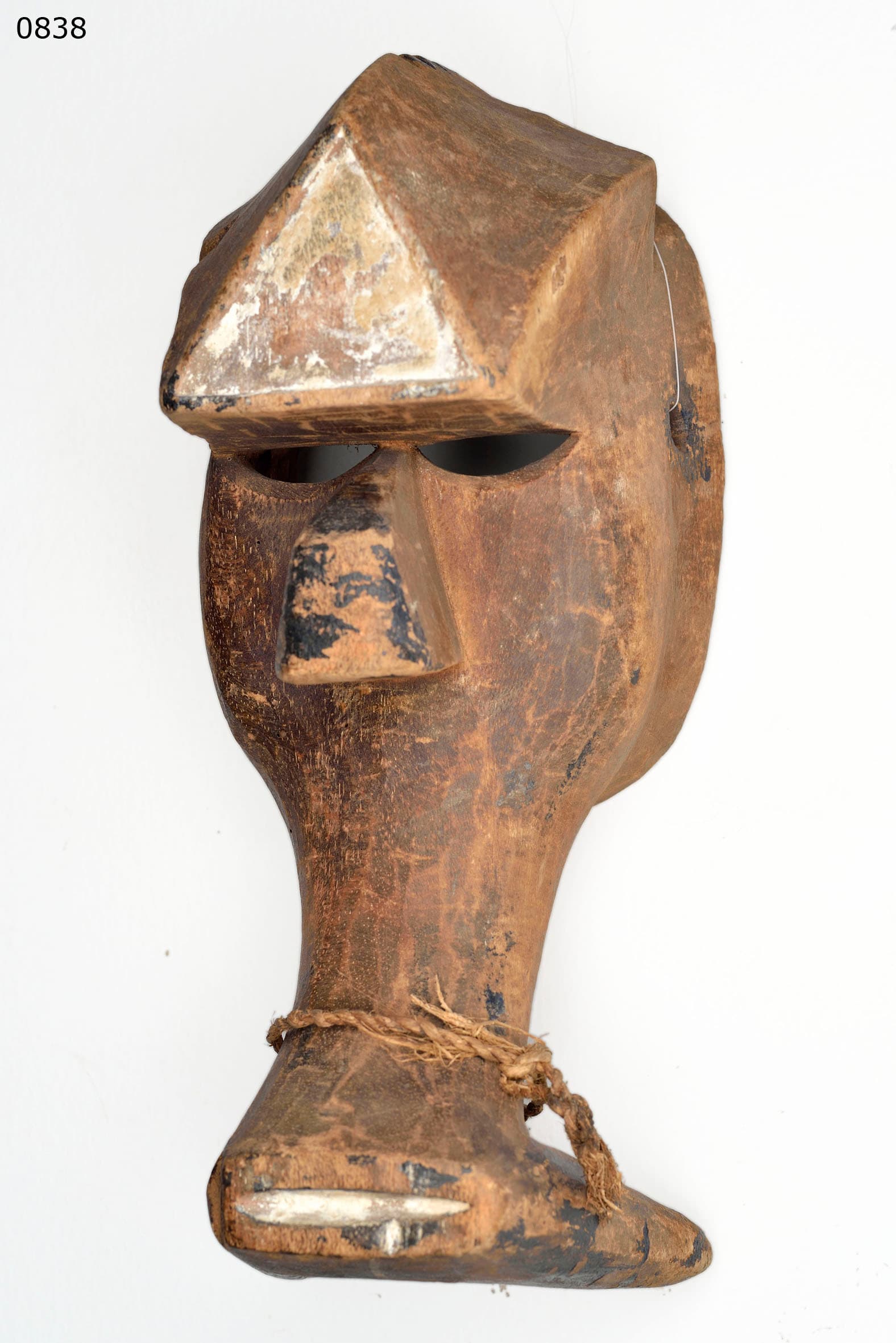
This classic heart-shaped wooden mask is defined by its delicate, recessed facial plane, sweeping arched eyebrows, and narrow, slit-like eyes. The face is painted with a stark, chalky white kaolin pigment that contrasts beautifully with the dark, oxidized wood of the perimeter and central facial features.
1. Aesthetic style — the canonical heart-shaped aesthetic
This piece is a textbook execution of the Kwele Ekuk mask, representing one of the most elegant and recognized abstractions in African art. The Kwele carver has entirely eschewed realistic human portraiture in favour of stylized, two-dimensional geometry. The face is recessed, creating a shallow concave basin bordered by sweeping, continuous curves that form a symmetrical heart shape. The tiny, triangular nose and horizontal slits for eyes complete this minimalist composition. This style deeply influenced 20th-century Cubism, suggesting that maximum emotional impact can be achieved through minimum formal elements.
2. Ritual function — Bwete cult and the spirits of the forest
Among the Kwele people, social harmony is of central importance. When a village experienced tension, poor hunting, or disease, the Bwete cult was activated to restore spiritual balance. The Ekuk (which translates to "protective forest spirits") masks were brought out from the bush to dance. Unlike the terrifying judicial masks of neighboring tribes, the Ekuk represents benign, peaceful entities. The white kaolin clay is the color of light, clarity, and the ancestral realm, radiating a calming, positive energy meant to heal social rifts and unite the community.
3. Physical patina — kaolin degradation and ritual authenticity
The surface condition of this mask is consistent with early 20th-century origins. The white kaolin slip is not a modern, synthetic paint; it is natural river clay that has dried, cracked, and rubbed off over decades. This flaking reveals the deeply oxidized, dark brown hardwood beneath, creating a beautiful, characteristic contrast. The edges of the mask, particularly where it would have been held or tied to the dancer's costume, are smoothly burnished, showing wear consistent with active use in Bwete rituals.
Summary
A classic example of minimalist African elegance, this Kwele Ekuk mask distils the human face into pure, harmonious geometry. Its flaking kaolin surface and cultural ties to the Bwete peace cult make it a significant ethnographic work.
Written with AI assistance from the collection appraisal, object photography and our own research; editorially reviewed. Mistakes are possible — corrections are welcome. How we work →