Overview
The Kwele (also referred to as Bakwele, Bekwil or Bakweele in ethnographic and linguistic literature) are a demographically small but historically and culturally significant ethnic group within the north-western Congo Basin. The geographical distribution of their recent settlement area extends predominantly over the densely forested, equatorial border regions between the north-east of the Republic of Gabon, the north-west of the Republic of Congo and the extreme south of the Republic of Cameroon. The topographical and ecological axes of this settlement area are essentially determined by the extensive river systems of the Dja and Ivindo, which functioned not only as transport routes but also as historical migration corridors. Current demographic research puts the total population of the Kwele at around 120,000 individuals. If this figure is put in relation to current macro-demographic surveys of the region, the minority status of the Kwele becomes evident. The total population of Gabon is estimated to be around 2,484,557 to 2,538,952 people in 2024, with a projected growth rate of over 2.6 million by 2026.
| Demographic indicator | Regional specification | Data basis / estimate |
|---|
| Total population Kwele | Cameroon, Gabon, Congo | ~ 120,000 individuals |
| Population Gabon (2024) | National | 2,484,557 - 2,538,952 |
| Population Gabon (2025) | National (projection) | 2,532,885 - 2,593,130 |
| Population density Gabon | National | ~ 10 persons per km² |
| Degree of urbanisation Gabon | National | ~ 83.7 % |
Linguistically, the Kwele are categorised in the extensive cluster of the Bantu language family. In the canonical classification of the so-called "Narrow Bantu languages" established by Malcolm Guthrie (1967-1971), their language, Bekwil, falls into the north-western geolinguistic zone. It is specifically assigned to cluster A80 (of the Makaa-Njem group) in older taxonomies or to cluster B85 in recent revisions. This linguistic embedding marks the Kwele as part of a historical expansion wave of Bantu-speaking populations in Central Africa. However, the classification controversies regarding the exact linguistic and ethnic demarcation have not been conclusively clarified among experts and must be explicitly highlighted. The source situation is ambiguous: while older structural linguistic studies consider the Kwele in isolation and classify them as a closed entity, more recent research argues for a highly permeable dialect and cultural continuum in the entire Sangha River basin, which has fluid transitions to the neighbouring Kota, Ndumu and the expanding Fang groups. The self-designation of the group (Bekwil) often diverges from the foreign designations (Bakwele), which were often introduced into the literature by colonial administrators or neighbouring ethnic groups. Within the Kwele language area, recent research has also identified five separate linguistic subgroups, which are classified on the basis of geographical location, migration paths, divergent political structures, ritual performance differences and varying degrees of community cohesion (Wikipedia EN, as of 2026).
The social structure of the Kwele is organised in a decidedly acephalous manner. In contrast to the highly centralised, hierarchical kingdoms of West and Central Africa (such as the Kuba or Luba), the Kwele traditionally have no overarching chiefdoms, aristocratic castes or centralised political institutions that exercise executive power beyond the immediate local level of the village community. Instead, society is segmented into patrilineal, exogamous lineages (descent groups). The kinship system operates according to a classificatory model in which reciprocity obligations, alliances and social interactions are determined by structural affiliation to the lineage segment - the so-called baaz. A baaz represents a familial, voting body that has an important say in all village matters. The pattern of residence is predominantly virilocal; after paying the bride price, the wife transfers to the residence and the social sphere of power of her husband's patrilineal group. Conflict resolution mechanisms within this acephalous structure are based on permanent negotiations between the councils of elders and on intense individual competition, which acts as a social outlet for tensions.
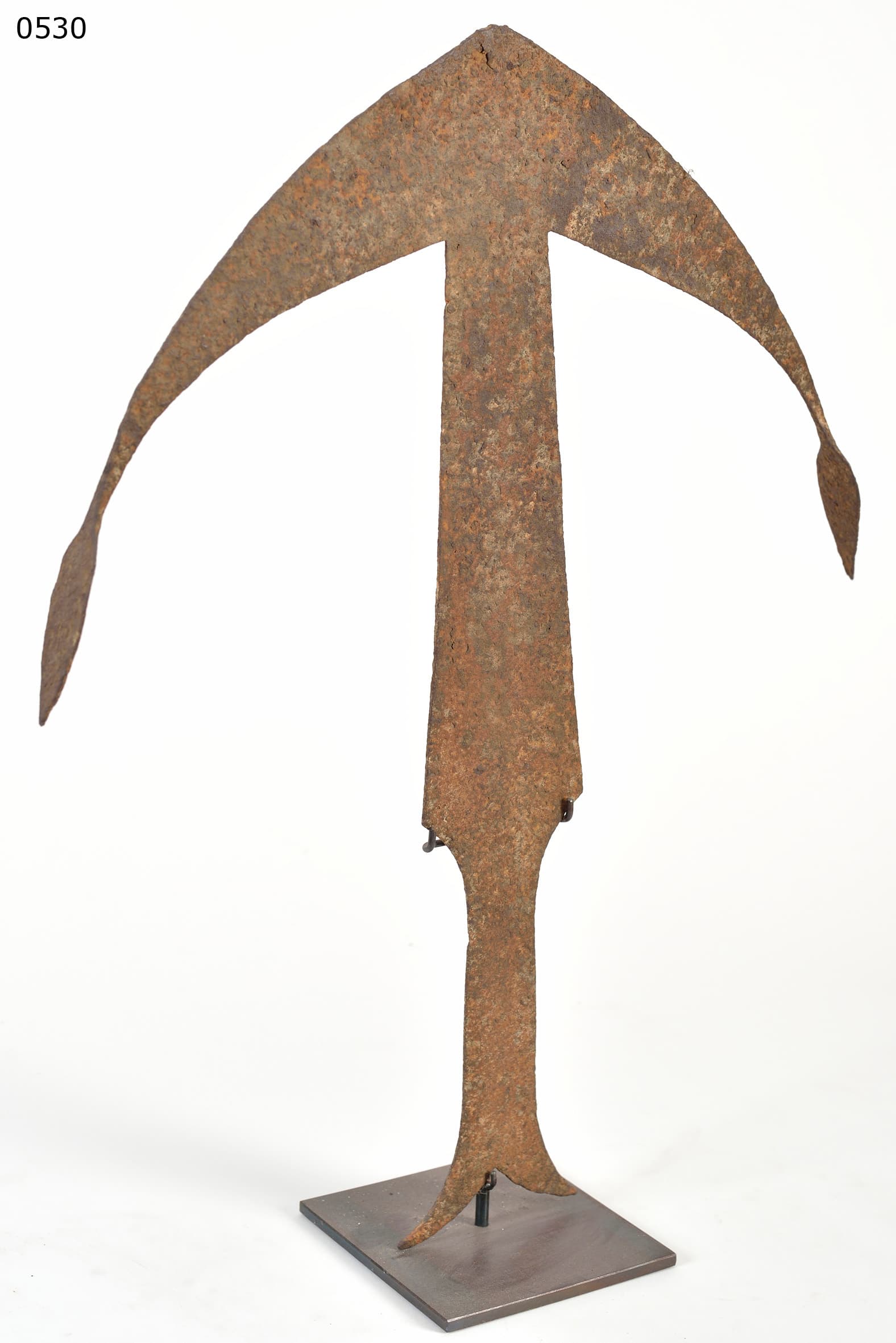
In terms of subsistence farming, the Kwele practise a dual strategy that is highly adapted to the equatorial forest. This combines semi-permanent shifting cultivation (slash-and-burn) with organised hunting expeditions. The agricultural sector, which is primarily used for calorie production, is based on the cultivation of bananas, yams, taro and manioc. However, collective net hunting is of particular sociological and ritual relevance. Historical and ethnographic sources document that male age groups often go out into the dense forest for weeks at a time to hunt antelopes (specifically the duiker) and primates in a co-operative manner. These hunting expeditions are not exclusively for the procurement of protein, but act as an essential sociological mechanism to strengthen in-group cohesion and solidarity among the males. In addition, the Kwele had specialised blacksmiths who processed iron ore into tools, weapons (spears, harpoons) and elaborate forms of currency (such as anchor-shaped iron ingots).
The relationship with the neighbouring peoples was historically characterised by a complex dialectic of symbiotic bartering and resource-related displacement processes. The Kwele maintained a clientele system with the indigenous Baka groups (pygmies), some of whom lived as semi-nomadic hunters and gatherers. The Baka supplied specific forest products and ritual expertise in return for agricultural produce and iron tools from the Kwele. In contrast, there was a competitive and often hostile relationship with the expanding Fang groups, which was exacerbated by territorial overlaps. The material culture that emerged from this dense social and ecological interdependence is a central focus of ethnographic research today. Canonical evidence of this specific acephalous social and artistic structure can be found in the prominent collections of the Musée du quai Branly - Jacques Chirac in Paris, which preserves and scientifically analyses the historical Courtois collection as a primary source for understanding Kwele culture.
Cultural context
The religious and spiritual system of the Kwele is dominated by a dualistic cosmological order that depicts the fundamental ontological contrast between the controlled, civilised space of the village and the unpredictable, entropic sphere of the equatorial forest. In agreement with numerous ethnic groups in the western Congo Basin, the Kwele postulate the existence of a distant, unapproachable creator god who, after the primary act of creation, no longer intervenes directly in the profane and spiritual concerns of people. Instead, everyday cosmological interaction focuses entirely on two central metaphysical entities: the spirits of the lineage ancestors and the localised nature and forest beings, which are conceptualised as ekuk.
The absolute ritual and social authority within Kwele society is manifested in the bwete society (often transcribed as beete in the literature). The bwete is an exclusive, initiatic male covenant that functions as the primary legal, medical and regulatory executive of the otherwise acephalous community. The primary function of the covenant is crisis intervention and metaphysical cleansing. When the community is beset by existential crises such as droughts, endemic diseases, unexplained deaths, persistent hunting failures or internal conflicts, this is interpreted epistemologically not as a natural coincidence, but as resulting from the destructive presence of witchcraft or the wrath of neglected ancestors. In such moments of social entropy, the bwete ritual is activated to restore cosmological homeostasis. The highest ritual authority is vested in the gaa beete, a highly specialised priest and divinator. The gaa beete leads the complex communication with transcendence. The individual family groups (baaz) offer their family relics - often skull fragments and ancestral bones - to the priest, whereupon the gaa beete decides in a trance or through divinatory practices whether these relics are accepted by the spiritual powers in order to authorise the ritual purification cycles.
The role of women within this cult complex is characterised by a formal institutional segregation, but at the same time by an indispensable ritual complementarity. Women are strictly excluded from the inner esoteric core of the bwete covenant, from touching the relics and wearing the masks. Nevertheless, they participate massively in the peripheral but essential ritual acts. They are responsible for the chants and dances that generate the necessary ritual "heat" and atmospheric energy to animate the village and activate the healing powers. What distinguishes this religion structurally from neighbouring peoples is the lack of strong female secret societies in the inner circle of power. While the neighbouring Mpongwe and Myene have dedicated, highly powerful female initiation societies such as Ndjembe or Ombwiri, which structure female authority and act as a counterweight to male societies, the formal cultic executive power of the Kwele is focused almost exclusively on the patriarchally controlled bwete structure.
The religious-sociological localisation of the bwete and the associated masks harbours profound research controversies. Within the academic discourse, there is a massive and still not fully consolidated dissent regarding the primary function and iconography of the kwele masks. A central research controversy (Siroto vs. Perrois) dominates the interpretation: Leon Siroto (1976) argues in his fundamental field research that the heart-faced masks of the Kwele are primarily to be read as representations of beeluu (nature and forest spirits), which are summoned by the village community in order to spiritually "heat up" the settlement area and cleanse it of witchcraft. In contrast, Louis Perrois (1979, 1985) postulates in his structuralist analyses of the art of the Ogooué basin that these objects are necessarily in the direct context of the cult of ancestors and relics. Perrois reads the masks analogously to the guardian figures of the Kota (mbulu ngulu) or the Fang (bieri) and interprets them as direct emissaries of the Lineage ancestors. More recent ethnographic revisions relativise this strict dichotomy and favour a polyvalent approach: the masks are now regarded as multifunctional ritual operators that, depending on the phase of the bwete cycle, can fluidly embody both ancestral presences and nature spirits.
Structurally and materially, the ancestral and relic system of the Kwele differs drastically from that of the Fang. While the neighbouring Fang to the west intensively carve three-dimensional, highly sculptural full figures (bieri) to physically guard cylindrical bark boxes with ancestral bones, the Kwele almost exclusively use the extremely flattened mask form to visually materialise the spiritual presence. The abstract reduction of Kwele art stems from this need for an ephemeral presentation of spirits that is not bound to a physical relic. Outstanding museum examples of this abstract ritual reduction, which document the complexity of the bwete cult, can be studied in the permanent display collection of the Museum Rietberg in Zurich, which preserves masterpieces from the historical collection of Eduard von der Heydt, among others.
Aesthetic features
The visual canon of Kwele art is characterised by an extreme formal reductionism and a stylistic abstraction that is considered unique within African art history and has significantly influenced the reception of African aesthetics in the West. The canonical object typology of the Kwele is almost exclusively dominated by flat, relief-like masks. Three-dimensional anthropomorphic full figures, as are central to the relic cults of the Fang or Hemba, are extremely rare exceptions among the Kwele. The typology of the masks can be divided primarily into two strongly conventionalised main subtypes, which carry iconographically strictly determined meanings for each subtype.
The first and internationally most prominent type is the pibibuze mask (literally translated: "human"). These masks are characterised by a concave, heart-shaped contoured facial field that is gently curved inwards. The iconography is radically reduced to the eye area, which is usually designed as narrow, almond-shaped or coffee bean-like, extremely stylised slits. In this subtype, a mouth is often missing entirely or is only hinted at as a marginal indentation at the lower edge of the heart. The canon of proportions dictates an absolute, unconditional bilateral symmetry. A concept that in the aesthetics of the north-western Congo Basin - as James Fernandez has demonstrated using the example of the bibwe proportions of the neighbouring Fang - is regarded as an unmistakable marker of cosmological balance, physical vitality and ritual perfection.
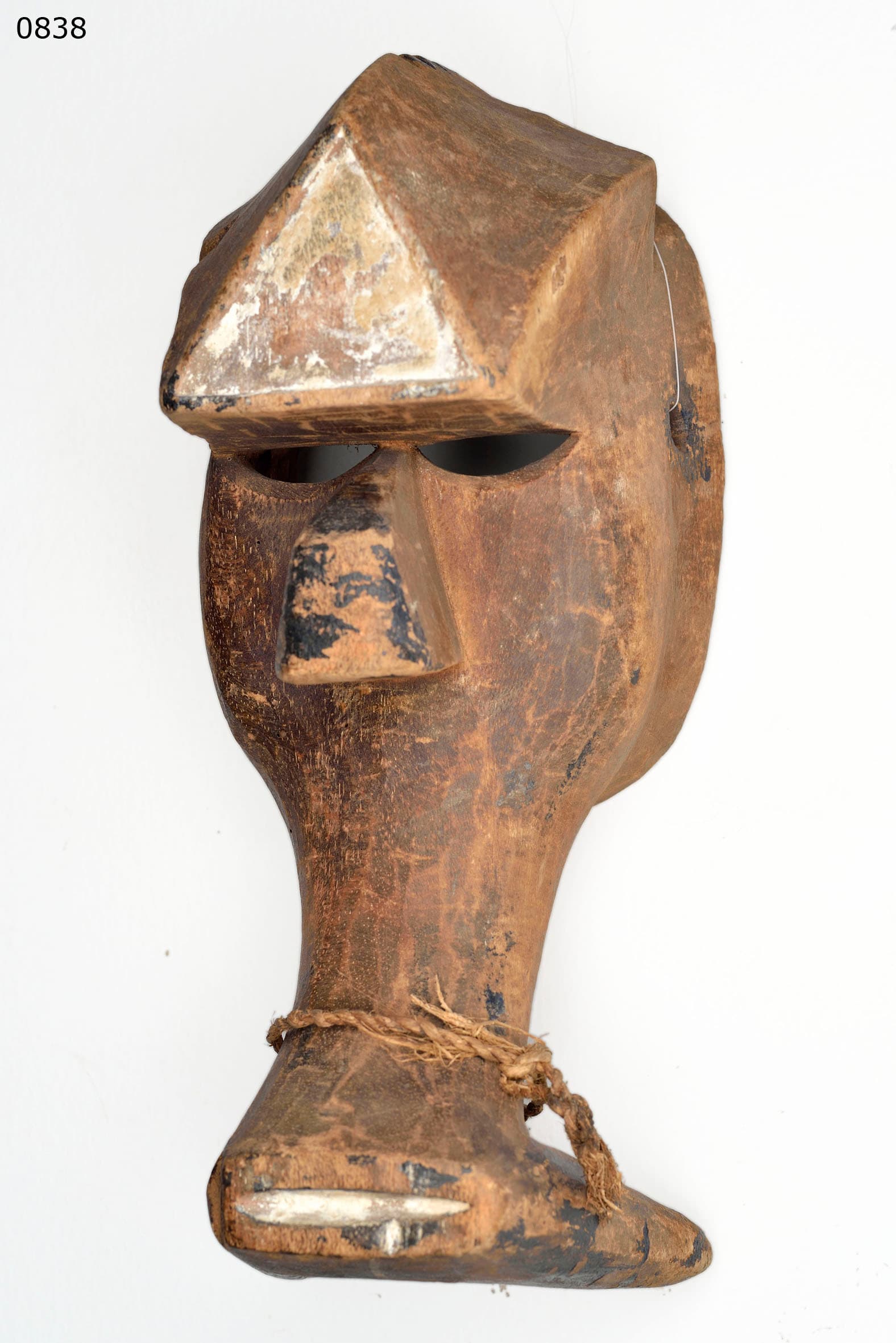
The second main type comprises the ekuk masks, which integrate zoomorphic attributes and represent specific forest spirits. The most common form within this spectrum is the antelope or ram mask (locally often called bata). Its most distinctive anatomical feature are two voluminous, highly abstracted horns that curve downwards from the upper edge of the mask and frame the entire heart face. In Kwele iconography, the horns of the duiker antelope or ram symbolise vigilance, physical endurance and the aggressive, elusive energy of the deep forest. Rarer sub-forms include the gon mask, which represents a gorilla and differs massively from the delicate, calm lines of the pibibuze due to a sagittal crest (modelled on the cranial crest of a male gorilla), a more massive nose and the suggestion of fangs. The size range of these objects typically varies between 25 and 55 centimetres vertically, depending on the volume of the horn attachments.
| Mask Type | Morphological Specification | Iconographic Meaning | Physical Attributes |
|---|
| pibibuze | human heart face | representation of civilised space / peace | strongly concave, without mouth, coffee bean-like eyes, kaolin-rimmed |
| ekuk (bata) | antelope / ram | forest spirit, bearer of ritual vitality and vigilance | encircling horned arches, tricyclic colouring |
| gon | Gorilla | Aggressive power against witchcraft | Sagittal crest, emphasised nose, fangs |
The choice of material is almost universally limited to very light, soft tropical wood (often Alstonia congensis). The choice of this wood does not result from a lack of craftsmanship, but from the need to minimise the weight for the wearer during extatic dances, often lasting several hours. The colour palette is strictly tricyclically limited and highly symbolically coded: The central heart shape of the mask is almost always thickly set with white kaolin (clay). In Kwele cosmology and among the societies of the Ogooué Basin, white is the colour of the spirits of the dead, of light, of clairvoyance in the fight against witchcraft and of ritual purity. Black (obtained from charcoal or plant juices) and red (laterite) pigments are used selectively to accentuate the outer contours of the horns or the outline of the heart face and to increase the formal tension of the architecture.
The question of documented master craftsmen or specific workshops is far more complex for the Kwele than for the highly centralised peoples. Due to the acephalous structure, there were no courtly workshops. Nevertheless, the formal analysis of works (analogous to Frans Olbrechts' methodology for the Congo) by scholars has led to the identification of specific regional style hands. Although no individuals known by name are documented for the Kwele (such as the "Master of Buli" or the "Warua Master" of the Luba), coherent workshop clusters can be precisely extrapolated in the museum taxonomy on the basis of the specific curvature of the horns and the execution of the vertical chin ridge.
A central criterion for ethnographers and collectors is the structural difference between the ritually activated ritual object and the profane, merely carved artefact. Activated masks often show a deep patina on the outer edges and especially on the back, caused by repeated use, sweat, applied palm oil and atmospheric ageing, combined with clear traces of wear on the fastening holes at the sides. Secular objects or those that were merely hung in the house as a presence object, on the other hand, may have an almost untouched reverse side.
Due to the immense market relevance of Kwele art, the problem of forgery is virulent. Market-relevant forgery criteria include the artificial ageing of the wood (often through acids that unnaturally decompose the cellulose structure), the artificial introduction of termites into fresh wood or the deliberate creation of heartwood cracks through heat treatment in drying ovens. High-quality provenance and modern material analyses (such as UV fluorescence to test the kaolin binders or radiometric analyses) are essential today. Reference objects for unequivocally authenticated Kwele art of the very highest calibre can be found in the African galleries of the Metropolitan Museum of Art (Met) in New York, which holds reference masterpieces from the Gustave Schindler Collection, among others.
Ritual practice
Kwele ritual practice represents a highly choreographed, performative system of crisis management that fuses physical objects, intense corporeality and complex social dynamics into a powerful transcendent unity. The use of the pibibuze and ekuk masks takes place primarily within the executive, large-scale bwete ceremonies. These ritual cycles are not initiated according to a rigid calendar, for example linked to sowing or harvesting, but are strictly reactive: they are the collective, spiritual response to massive disturbances in the living world, such as droughts, lack of hunting success, endemic diseases or an accumulation of deaths classified as unnatural, which epistemologically are inevitably attributed to the destructive presence of witchcraft (djemba).
The structure and activation of a bwete session follow a strict protocol that has been handed down over generations. Initiated by the gaa beete (the chief ritual specialist and priest), the process begins with the top-secret meeting of the male elders in the back of the forest. At this liminal place, the relics of the ancestors in the form of skulls, tubular bones and other mortal remains are lifted from their family containers and evaluated. At this point, the objects themselves - both the bundles of bones and the newly carved masks - are still to be regarded as de-activated matter. The actual metaphysical charging requires an immense social and physical effort: The community must generate a collective ritual "heat" (spiritual and atmospheric energy) in order to awaken the benevolent powers of the ancestors hidden in the bwete relics in the first place.
This essential "heat" is generated through day-long, often ecstatic dances in the village centre. The ekuk masks (such as the horned antelope or ram forms) emerge from the thicket of the forest into the civilised space of the village. The wearer of the mask is completely covered by a voluminous, multi-layered costume made of raffia fibres or dense leaves; his individual human identity is thus completely negated and he becomes the ephemeral, fluid body of the forest spirit. The performance of the different mask types is highly context-dependent and choreographically differentiated: The gon gorilla mask dances in a highly aggressive, expansive and erratic manner to physically illustrate the threat of witchcraft, intimidate and seek out the hidden sorcerers, while the flat, kaolin-white pibibuze human face masks often bring a calmer, observational and peacemaking presence to the rhythm of the ceremony.
One notable aspect of ritual materiality that has long puzzled researchers is the fact that many of the flat kwele masks have no functional perforated viewing slits at all. Such masks were not worn in front of the dancer's face, but were presented on the head as a kind of helmet structure (crest), carried in the hands of the dancers or simply hung in the meeting house during the climaxes of the trance to visualise the static presence of the beeluu spirits while the dancers performed in front of them.
The offerings, which must be made to pacify the ancestors and feed the activated masked spirits, primarily comprise the hard-won products of the net hunt. The meat of the duiker antelope, which is cooked into a specific ritual stew, is regarded in Kwele cosmology as a carrier of extremely strong metaphysical power. This stew is ritually consumed by the initiates to physically incorporate and renew the bond between the forest, the ancestors and the community.
The lifecycle of a ritual kwele object is characterised by a sociological pragmatism that is often difficult for Western conservation logics to understand. In contrast to European concepts of art, the masks have no inherent, lasting sanctity that extends beyond the ceremony. A newly carved object is simply wood. Only when it is coated again with fresh kaolin, sprinkled with sacrificial substances and the ritual dance does it temporarily become an active vessel of the spirit. Once the bwete ceremony has been successfully completed after days or weeks - i.e. the witchcraft has been banished, the illnesses have been banished and social order has been restored - the mask is systematically deactivated.
Spiritual disposal often means that the mask is simply hung on the wall in the hut, where it is unprotected from the smoke of the hearth fire, the weather and insect damage. If a mask was destroyed by termites or broke during a dance, it was traditionally not elaborately restored, but simply disposed of and remade by the local village carver at the next social crisis. This utilitarian lifecycle is the subject of recent anthropological controversy, as the research situation regarding the regional variants has not been conclusively clarified. One position dates the period of use of masks to a few years due to this wear and tear, while others argue that particularly powerful relic guardian masks were passed down through generations in the baaz as untouchable shrines. The discrepancy between ephemeral objects of consumption and treasured ancestral relics remains a dynamic field of discourse. Outstanding, excellently documented examples of masks whose ritual lifecycle was abruptly ended by colonial acquisition and frozen for posterity can be studied in the collections of the Royal Museum for Central Africa (RMCA) in Tervuren, which systematically presents African ritual aesthetics in the historical context of the Congo Basin.
Historical context
The historical genesis and demographic localisation of the Kwele in the 19th and early 20th centuries are inextricably linked to the massive territorial upheavals and pre-colonial conflicts in Equatorial Africa. The migration history of the Kwele can primarily be reconstructed as a forced flight. Driven by the so-called "Poupou" war - a massive, violent conflict complex triggered by the unstoppable advance of coastal peoples equipped with European firearms who participated in the lucrative transatlantic slave and ivory trade - the Kwele left their original territories in the western coastal hinterland in the 19th century. They evaded military pressure, migrated eastwards along the river systems and settled in the dense rainforests between the Dja and Ivindo rivers. In this flight, they penetrated deep into the spheres of influence of the Sangha River migrations. This historical, forced shift explains the recent linguistic and stylistic overlaps with the Fang in the west and the Kota in the south. However, it must be emphasised: The source situation is ambiguous regarding the exact dating of the initial waves of flight; one position dates the beginning of the Poupou War to the first half of the 19th century, while others place the most massive shifts only in the 1880s.
The subsequent direct colonial encounter with the French administration from the turn of the 20th century changed the socio-cultural and economic tectonics of the Kwele even more drastically. The system of French colonial administration in Afrique Équatoriale Française aimed to administratively sedentarise the previously mobile forest communities. This was accompanied by a ruthlessly coercive system of taxation, often executed through enforced rubber and ivory collection quotas, which massively disrupted the traditional subsistence economy of net hunting. The introduction of Christian missions and the establishment of European administrative structures weakened the authority of the traditional gaa beete and in the long term led to the gradual decline of the large, week-long bwete initiation rites, which were often banned by the colonial rulers as subversive or obscure.
Paradoxically, this structural colonial crisis led to the discovery and meteoric rise of kwele art in the Western market. The French colonial official Aristide Courtois, who was stationed in the Middle Congo between 1910 and 1941 (with the most intensive phases of collection and confiscation between 1930 and 1933), appropriated hundreds of ritual objects from the region. The colonial disempowerment of the confederations made it possible for the previously inaccessible masks to flow out en masse. Courtois sent these enormous collections to Paris, directly to the visionary Parisian art dealer Charles Ratton. Ratton's strategic flair for staging and aesthetics led to a ground-breaking, now legendary exhibition at the Galerie Pigalle in 1930.
The abstract, purist heart-shaped faces of the pibibuze masks perfectly captured the nervous zeitgeist of the European avant-garde in Paris. The formal reduction, the anticipated cubist refractions of volume and surface as well as the complete avoidance of naturalistic narration influenced the protagonists of classical modernism (including Picasso, Modigliani and Brâncuși) immensely and triggered an exponential price development on the early art market. A historic milestone for the final establishment of the market value of art from the Ogooué Basin was the highly acclaimed auction of Georges de Miré's collection on 16 December 1931 at the Hôtel Drouot in Paris. De Miré was one of the first intellectual connoisseurs who no longer collected tribal art as an outlandish ethnographic curiosity, but as accomplished works of art (art nègre) with an intrinsic sculptural quality. Pieces from his collection realised unprecedented record prices and were transferred to influential collections such as that of cosmetics entrepreneur Helena Rubinstein or later to William Rubin (director of the MoMA). This unbroken fascination continues to the present day: in 2015, a Kota relic figure of the same provenance achieved 5.5 million euros at Christie's, permanently establishing the art of the Kwele and their neighbours as one of the most expensive and elite segments of the global tribal art market.
This immense financial value inevitably results in a highly professionalised counterfeiting problem. Since the 1970s, the market has been continuously flooded with replicas that have been "antiquised" in workshops in Cameroon or Gabon specifically for lucrative Western tastes. Today, authenticity criteria must be verified by material science and forensics. A mere visual inspection of the patina is often not enough, as professional counterfeiters simulate oxidation using chemicals and artificially drill termite galleries into fresh wood. Forensic standards of museum practice today include the radiocarbon method (C14 dating) to determine the age of the wood, whereby the interpretation of the data requires complex calibration curves for 20th century artefacts due to the Suess effect (the massive release of fossil carbon through industrialisation and atomic bomb testing). Furthermore, pyrolysis-gas chromatography-mass spectrometry (Py-GC-MS) is used to test the exact chemical composition of the sacrificial patina (blood, palm oil, historical kaolin binders) for molecular authenticity. Excellently documented Kwele artefacts with complete Courtois provenance, which stand up to any forensic examination, today form the undisputed backbone of the world's most important private collections, as exemplified by the holdings of the Musée Barbier-Mueller in Geneva, which paradigmatically illustrate the reception and market history of African art in the West.