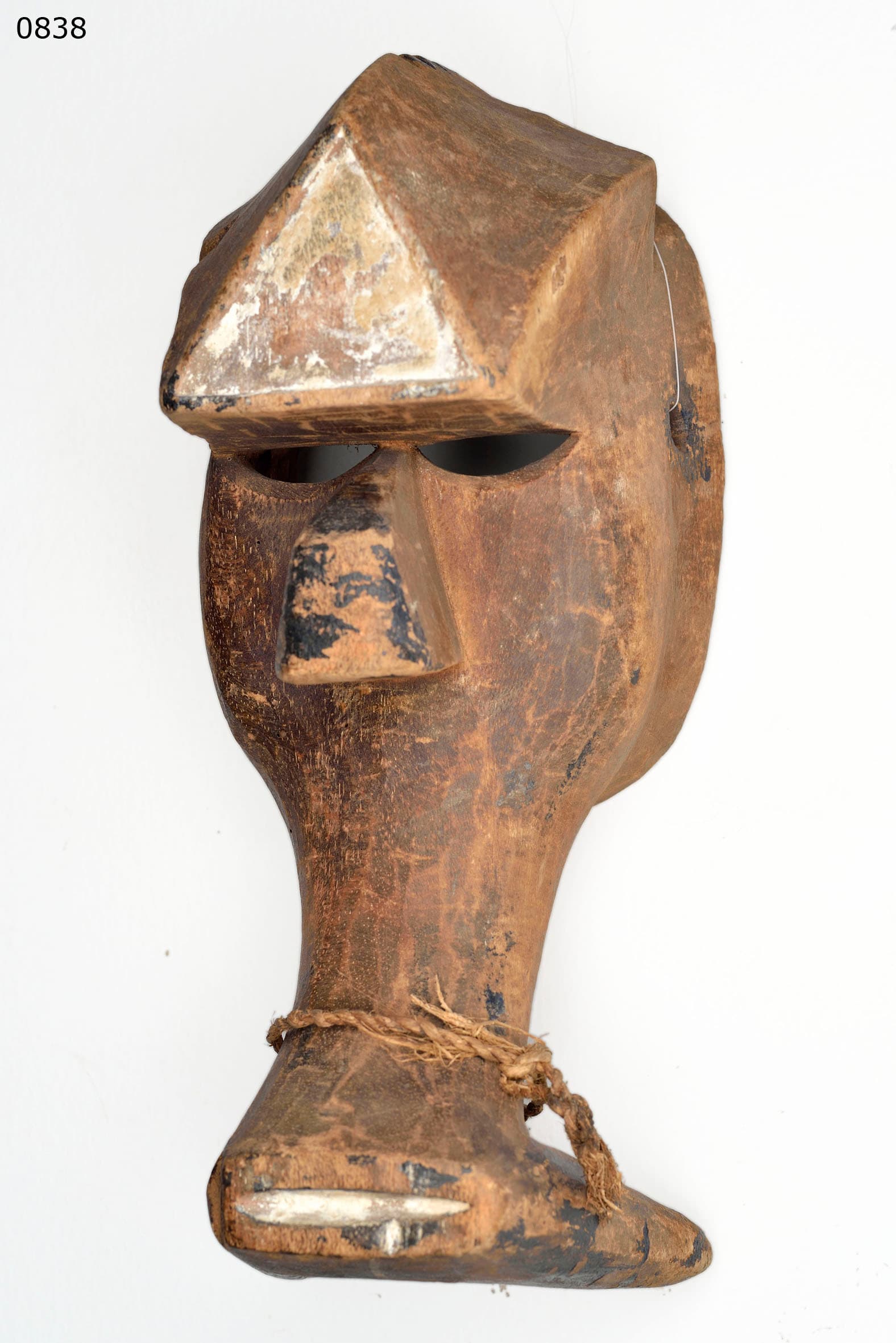
A remarkably elegant Kwele mask (1st half 20th C., 38 cm) from Gabon — a smooth pale heart-shaped face framed by two large sweeping antelope horns that curve downwards to meet at the chin, the dark wood of the horns contrasting sharply with the faded chalky white kaolin clay applied to the delicate facial plane.
1. The heart-shaped face of the equatorial forest
The Kwele of Gabon have produced one of the most universally recognized and graceful aesthetic forms in African art — the heart-shaped face.
- Ekuk, Protective Forest Spirit: This mask, known as an Ekuk, perfectly encapsulates the style.
- Balanced Positive and Negative: The artist achieves a harmonious balance between the delicate recessed facial plane and the massive sweeping positive space of the antelope horns — creating an entity of serene elegance.
2. The beete society and village harmony
The Kwele use Ekuk masks entirely for peaceful socially unifying purposes.
- Central to the Beete Cult: They are the central instruments of the Beete society — designed to maintain village harmony, stimulate hunting success, and protect the community from the devastating effects of witchcraft.
- White for Clear Vision: During multi-day Beete rituals, these masks are hung in the village or danced to activate benevolent forest spirits — the white kaolin pigment represents light, purity, and clear vision, directly counteracting the dark hidden nature of witchcraft.
3. Original kaolin and meticulous wear
The physical condition is well-preserved.
- Dry Powdery Kaolin: The white kaolin clay is dry, powdery, and heavily faded, showing subtle stains and rubbing consistent with ritual handling.
- Lustrous Dark Horns: The sweeping dark horns exhibit a smooth lustrous patina from being touched and stored — the interplay between oxidized dark wood and chalky pigment is consistent with a history of ritual use.
Summary
A classic example of Gabonese artistry, this Kwele Ekuk mask masterfully balances the iconic heart-shaped face with sweeping zoomorphic geometry. Its well-preserved kaolin patination and serene aesthetic make it a notable representation of Equatorial art.
Written with AI assistance from the collection appraisal, object photography and our own research; editorially reviewed. Mistakes are possible — corrections are welcome. How we work →