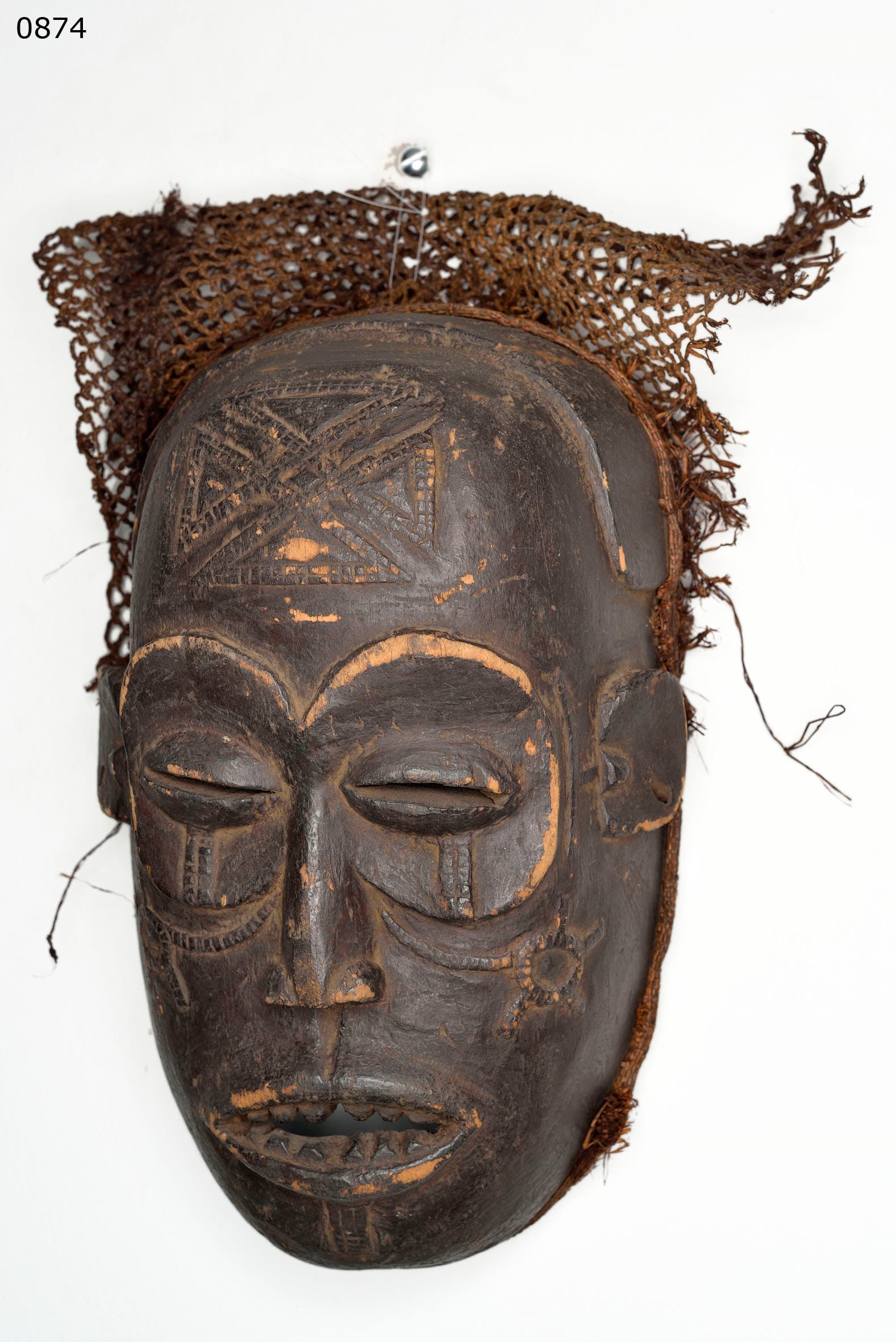
This finely carved, dark wooden mask portrays an idealized female face (Pwo) with delicate, deeply incised scarification marks around the eyes and cheeks, and closed, slit-like eyes. It is crowned with an intricate coiffure made from braided and knotted native fibers, thickly coated in red earth and oil.
1. Aesthetic style — the idealized beauty of mwana Pwo
This mask is a highly accomplished realization of the Mwana Pwo (young woman) archetype, one of the most refined and celebrated genres of Chokwe art. The sculptor has rendered the face with great delicacy: the broad, smooth forehead, the concave eye sockets, and the pursed, elegantly modeled lips all conform to Chokwe ideals of feminine beauty. The face is adorned with canonical scarification patterns (cingelyengelye), meticulously incised to represent the tears of a mother, ancestral wisdom, and the civilized, socialized status of the mature Chokwe woman.
2. Ritual function — Mukanda initiation and didactic dance
Despite its female representation, the Pwo mask is exclusively danced by men. It is a central component of the Mukanda (male initiation) and other village festivals. The dancer dresses in a full-body knitted costume with false breasts, performing graceful, elegant, and seductive movements that contrast sharply with the aggressive dances of male masks. The performance is deeply didactic; it teaches young men how to respect women and demonstrates to young women the idealized grace, fertility, and composure expected of them, cementing the matrilineal power structures of the Chokwe people.
3. Physical patina — woven fiber preservation and red tukula patina
The ethnographic integrity of this mask is notable, particularly the survival of its massive, heavy fiber coiffure. Replicating the mud-and-braid hairstyles of Chokwe women, the thick woven cords are stiffened with a dense, historic application of tukula (red camwood powder) and palm oil. The wooden face contrasts this rough texture with a deeply burnished, dark mahogany patina, achieved through decades of careful oiling and human handling. The interior edges show smoothed friction wear, consistent with use by early 20th-century dancers.
Summary
This Chokwe Pwo mask is a notable example of Angolan portraiture, balancing delicate wooden facial geometry with a massive, textural fiber headdress. Its rich, dual-textured patination and excellent state of preservation make it a highly significant ethnographic piece.
Written with AI assistance from the collection appraisal, object photography and our own research; editorially reviewed. Mistakes are possible — corrections are welcome. How we work →