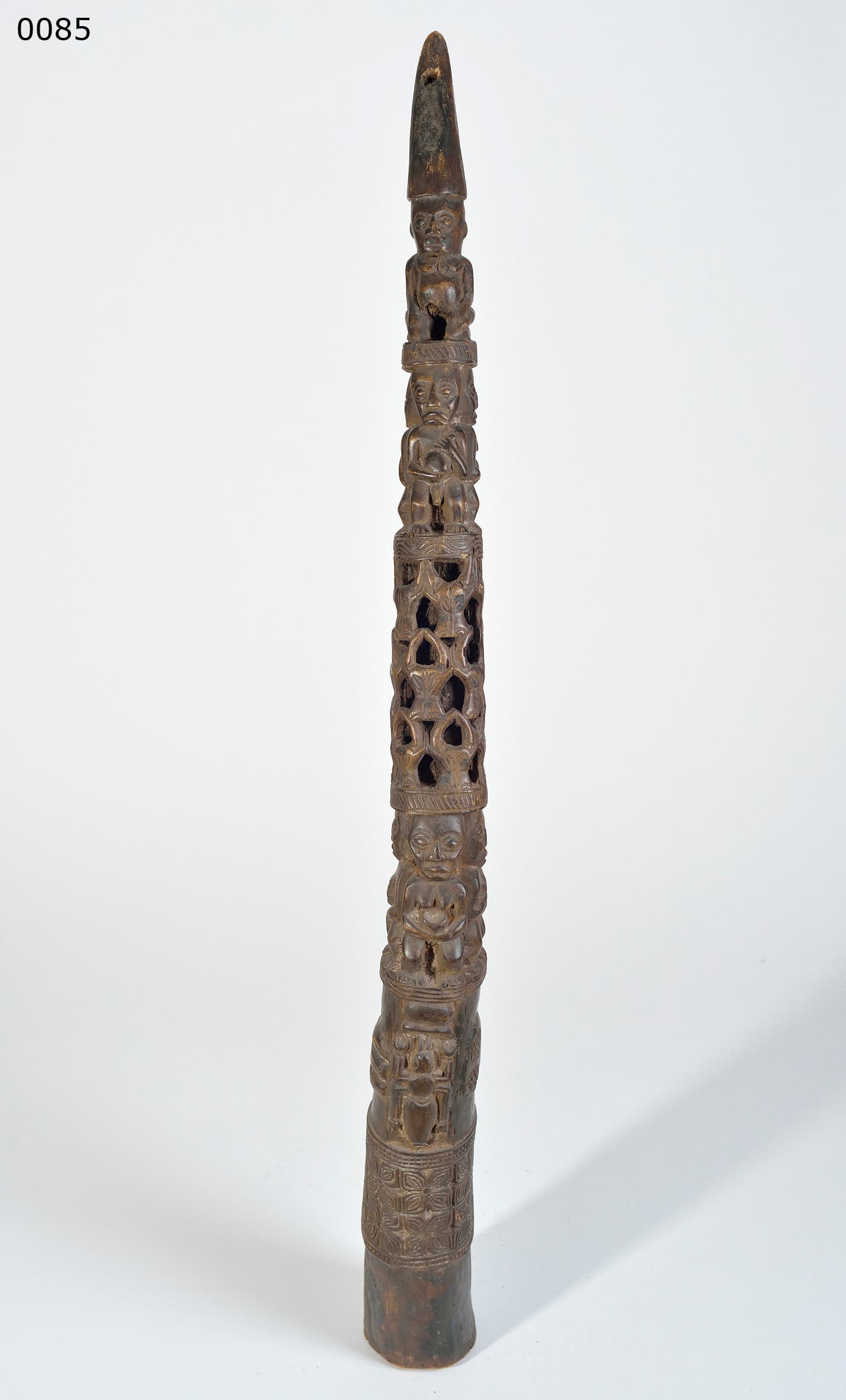
A tall vertical wooden prestige staff or representative house post (19th–20th century, 102 cm) from the Bamun of Cameroon — two stacked anthropomorphic figures, a supporting male base and a crowning female finial, both with the swollen cheeks and prominent crested coiffures typical of the Grassfields.
1. Royal iconography of the grassfields
The Bamun kingdom's aesthetic is celebrated for voluminous, highly expressive forms that emphasize vitality and courtly wealth.
- The Primordial Couple: The vertically stacked pair (male below, female above) represents the foundational royal ancestors — the Fon (king) and his primary queen — carrying the full weight of the dynasty. A crescent-shaped finial at the top serves as another classic prestige motif of the region.
- Coded Coiffure and Features: The elaborate crested hairstyles, broad facial geometries, and almond-shaped eyes, whose expressiveness is accentuated here by remnants of light pigment (likely kaolin), signal wisdom, authority, and elite rank in the Grassfields visual code.
2. Insignia of authority and court protocol
Prestige staffs and architectural sculptures were active political instruments in Bamun court life, not merely decorative objects.
- Physical Passport and Architecture: Whether held as a staff by the Fon, titleholders, or royal emissaries, or utilized as part of a palace structure for the residence of a high-ranking dignitary (Nji), the object was traditionally understood to guarantee safe passage and signaled that the bearer carried the king's authority.
- Ancestral Backing: The primordial couple invoked the founding myths of the kingdom, ensuring the bearer's words and actions were reinforced by the weight of the entire royal lineage.
3. Tactile weathering and prestigious provenance
The heavily weathered material condition and surface suggest an active service life.
- Lustrous Shaft and Patina: The polished patina on the main shaft is consistent with years of direct contact with human hands and the natural oils of skin during court ceremonies.
- Eroded Base and Matte Recesses: The deep, irregular patina with signs of oxidation and remnants of ritual or environmental encrustations is compatible with a 19th to 20th century attribution. The lower end is massively eroded, showing significant loss from weathering and insect damage — a damage profile consistent with architectural elements anchored directly in damp soil for decades.
Summary
This Bamun prestige staff is a compelling example of Cameroonian court art, merging political function with profound sculptural volume. Its handling patina and detailed depiction of the royal couple support its attribution as a significant work within this tradition.
Written with AI assistance from the collection appraisal, object photography and our own research; editorially reviewed. Mistakes are possible — corrections are welcome. How we work →
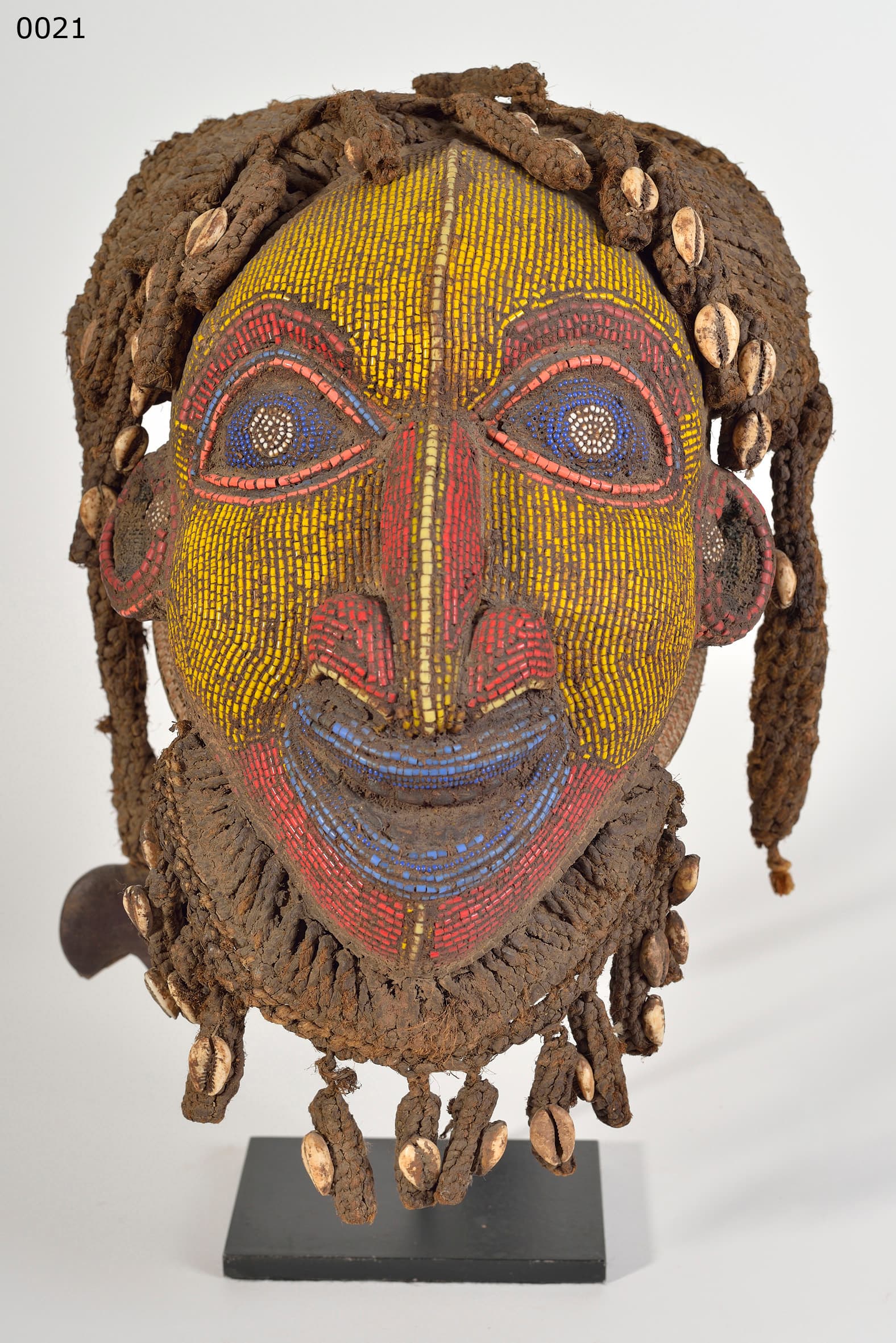
mask (covered with beads - shells on cloth)
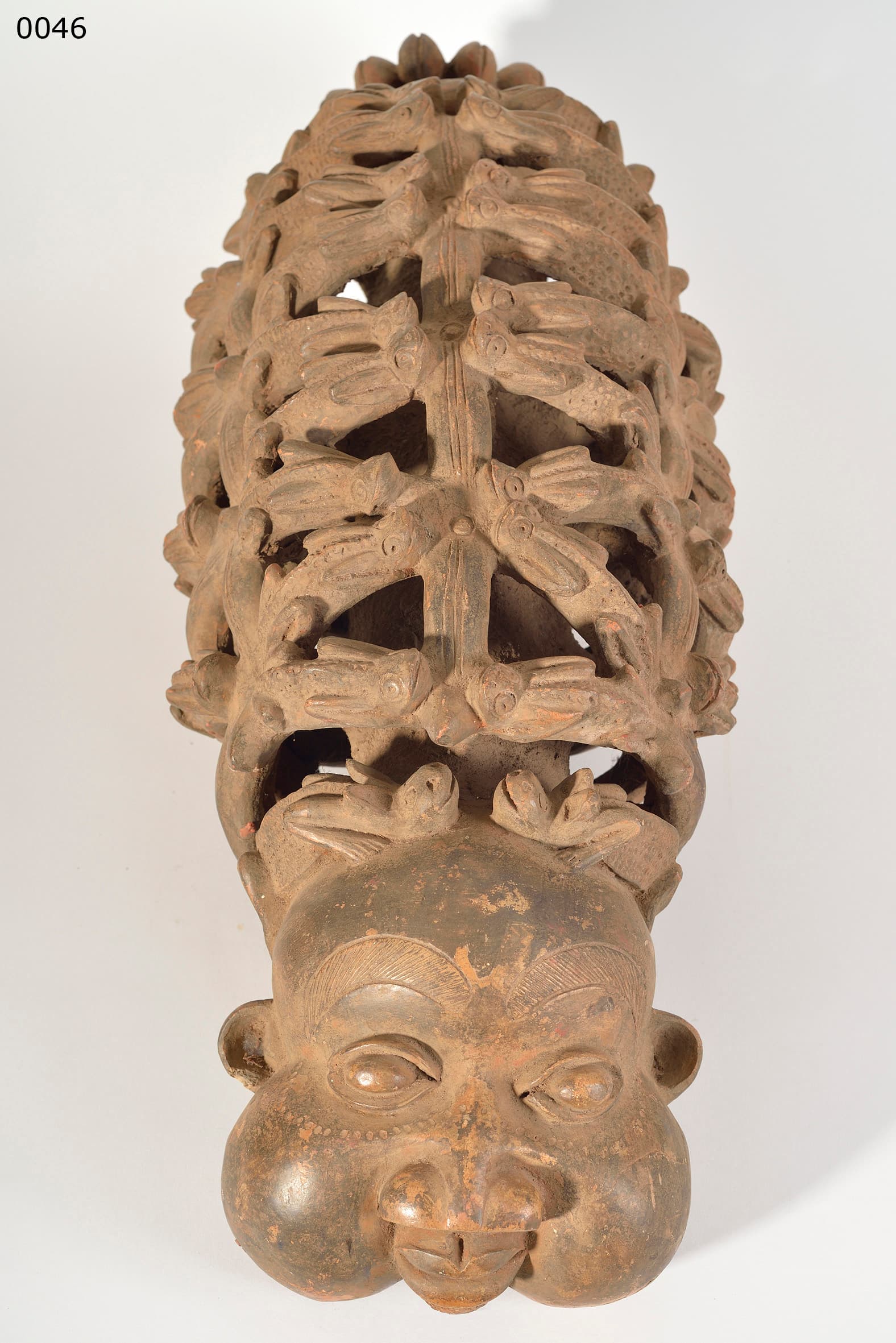
prestige pipe head
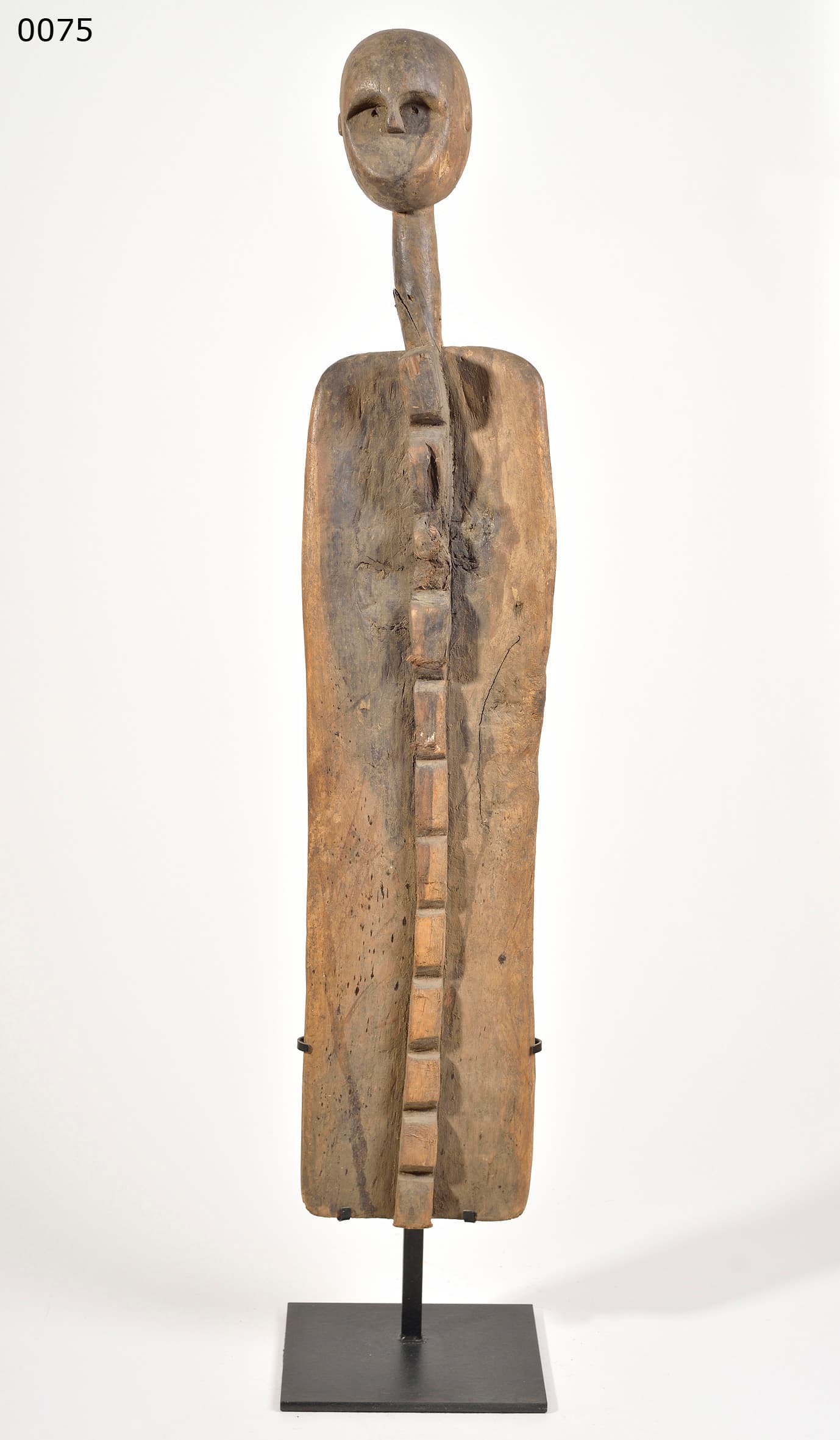
rare friction instrument