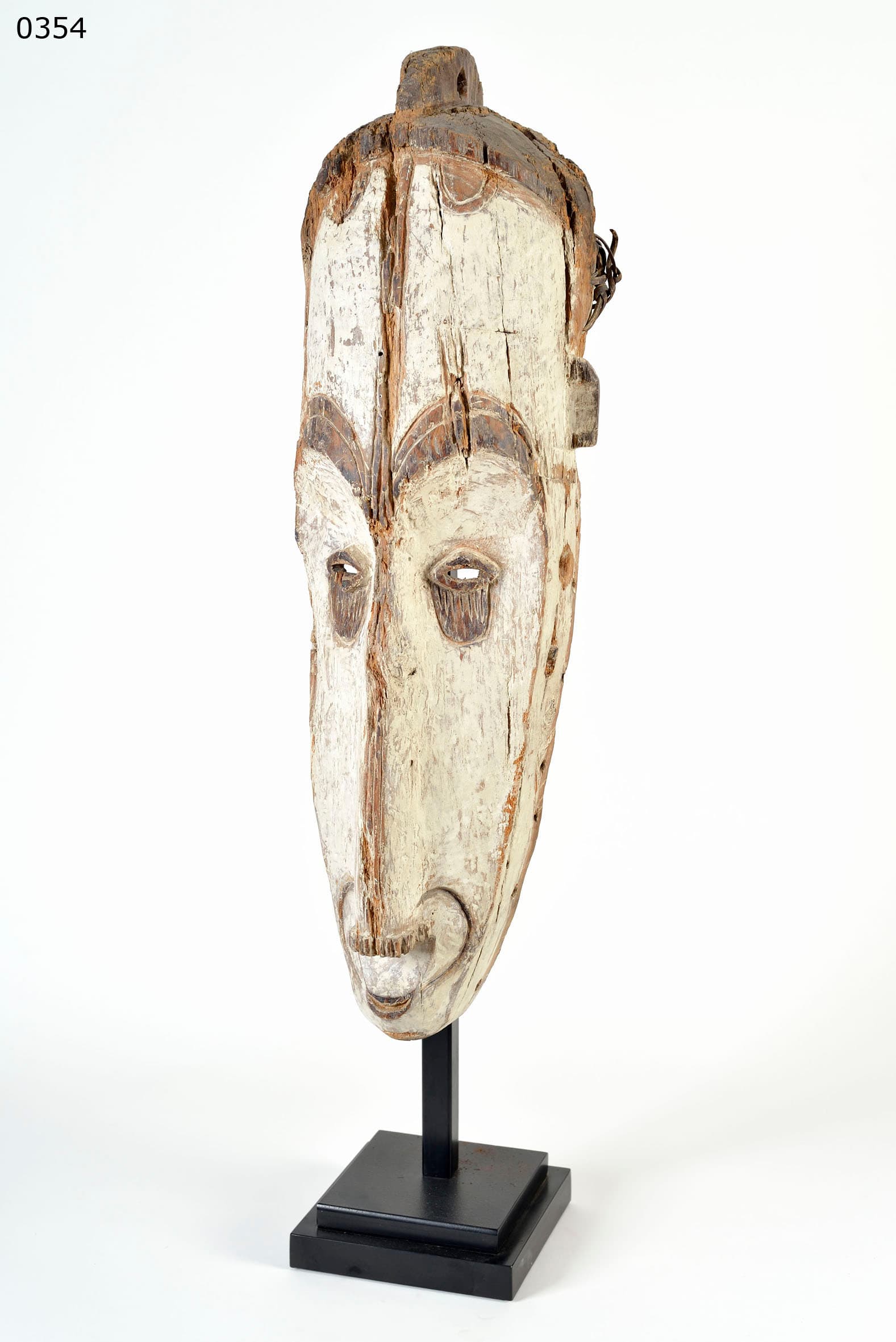
A highly elongated profoundly minimalist Fang Ngil mask (attributed to the early 20th C., 60 cm) from Gabon — coated entirely in stark white kaolin clay, with a continuous sweeping heart-shaped brow line, tiny slit eyes, and a remarkably long slender nose.
1. An expression of Gabonese minimalism
The Fang Ngil mask style represents one of the most celebrated and minimalist forms in the corpus of African art.
- Modernist Echoes: The form heavily influenced early-20th-century European Modernists including Modigliani.
- Mathematical Symmetry: The artist abandons all naturalism in favor of extreme dramatic elongation and striking symmetry — the soaring continuous line of the brow sweeping into the elongated nose creates a visage of cool unfeeling untouchable authority.
2. The terror of the Ngil society
This is a mask associated with the judicial authority of the Ngil society.
- Inquisitorial Police: The Ngil (gorilla) secret society acted as the primary police and inquisitorial force among the Fang — worn by men acting as agents of the ancestors, the masks were danced exclusively at night.
- Death-White Illumination: The stark white kaolin pigment represents the color of death and the spirit world. Emerging from pitch-black jungle illuminated only by torchlight, the mask was designed to terrify criminals, witches, and oath-breakers into immediate trembling confession.
3. Kaolin patina and wear
The surface shows characteristics consistent with traditional use.
- Rubbed Clay, Not Paint: The white pemba kaolin is not a modern thick coat of paint but a dry powdery clay rubbed deeply into the porous wood grain.
- Smoke and Sweat Staining: The pigment is heavily worn, stained by smoke, sweat, and time — particularly around the edges and the elongated nose where the mask was repeatedly handled. The dark oxidized wood showing through is consistent with traditional use.
Summary
A powerful example of African minimalist abstraction, this Fang Ngil mask recalls the dramatic instruments of traditional judicial power. Its elegant elongated geometry and smoke-stained kaolin patina make it a highly significant example of this sculptural tradition.
Written with AI assistance from the collection appraisal, object photography and our own research; editorially reviewed. Mistakes are possible — corrections are welcome. How we work →