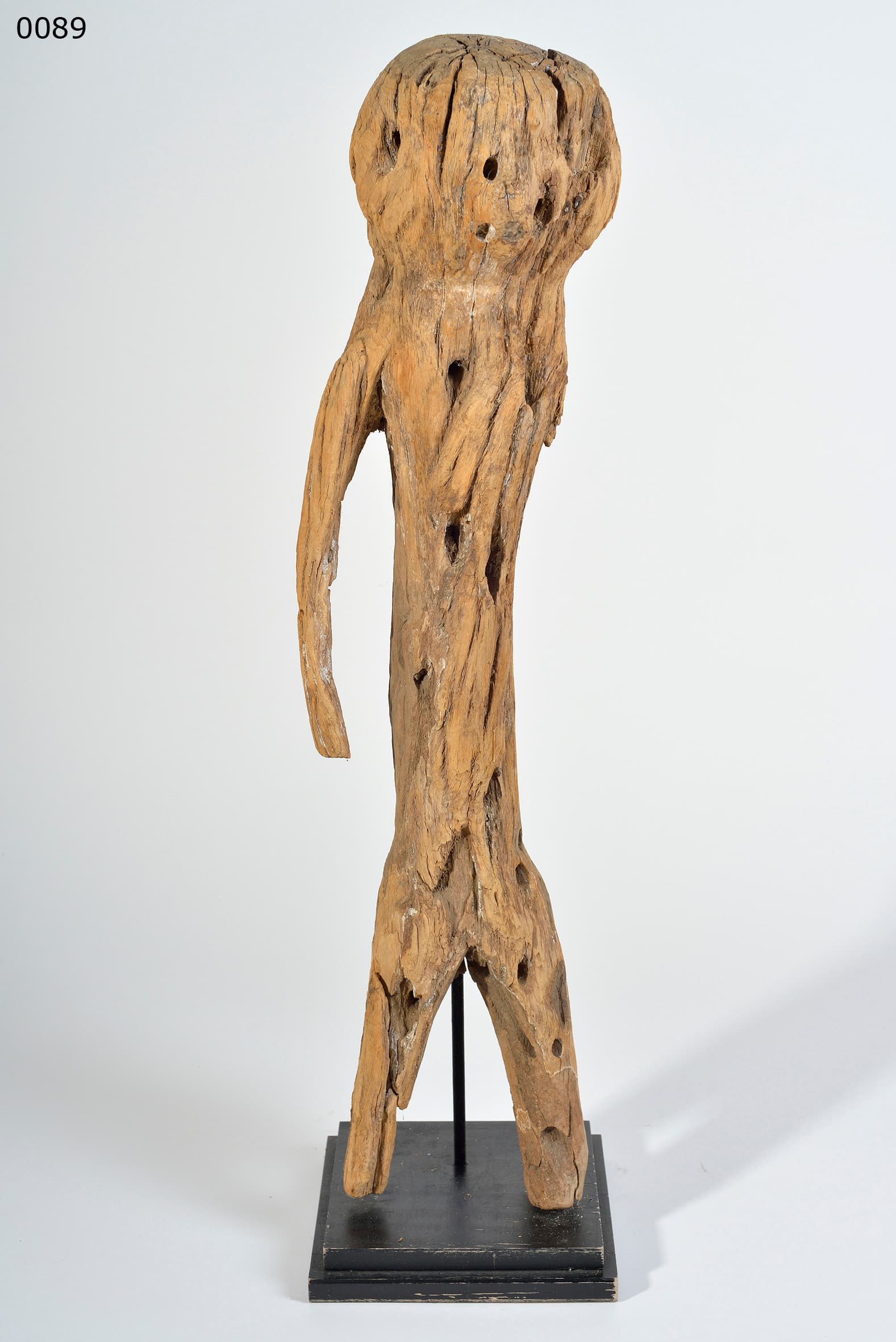
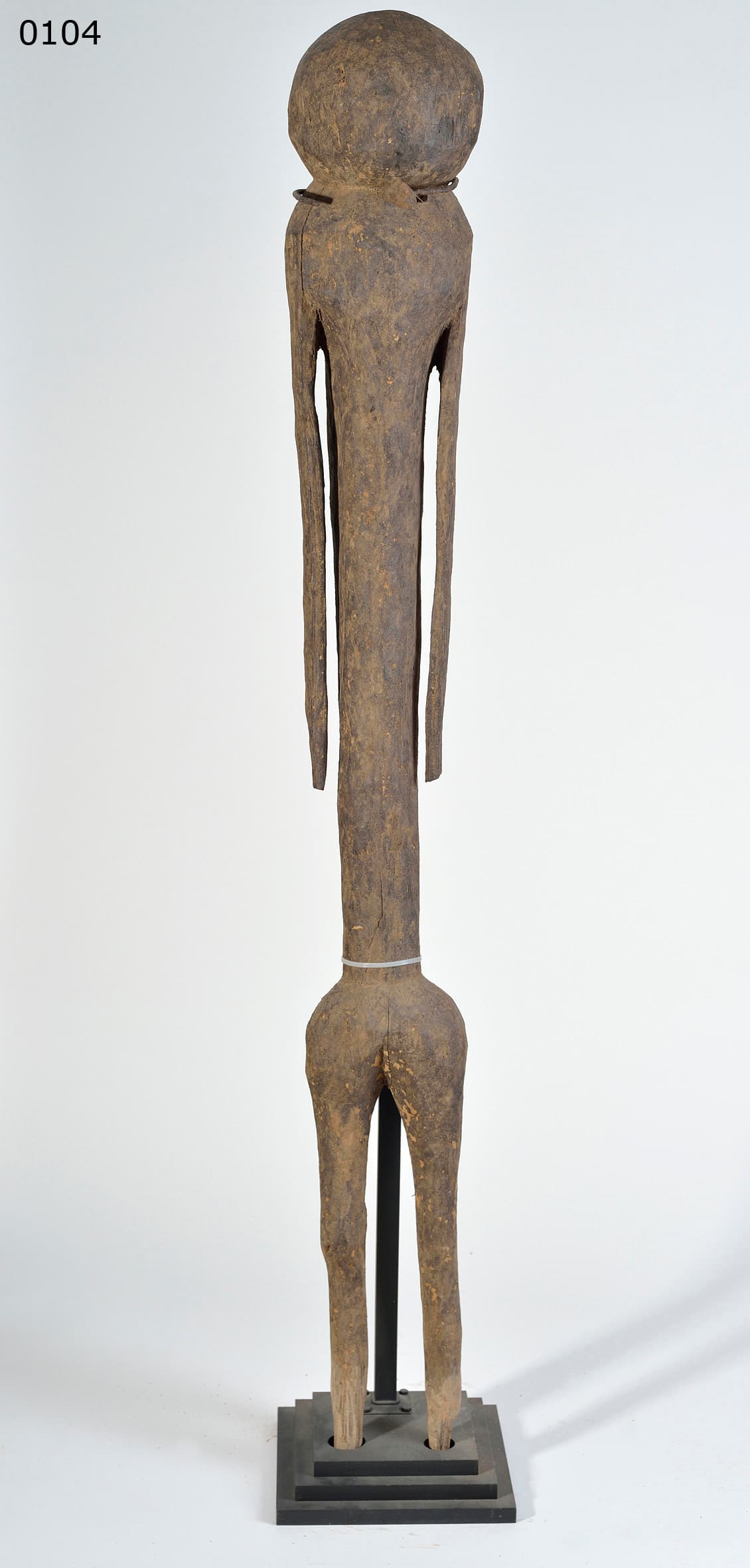
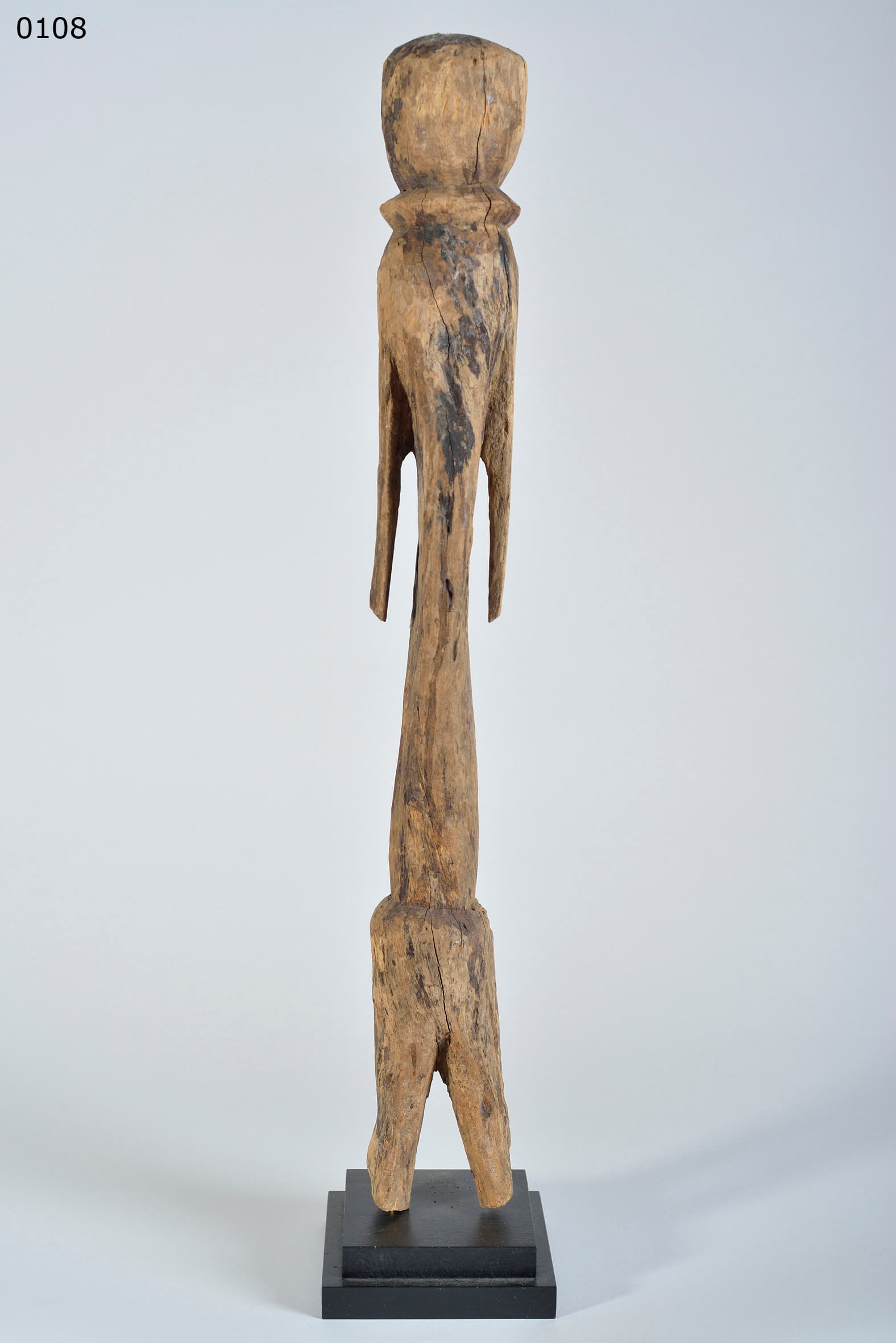
A highly abstracted Moba Tchitchiri (19th C., 72 cm) from Togo — reduced to a vertical pole with a rounded featureless head, no arms, and two simple peg-like legs divided by a central slit, the wood possessing an incredibly dry dark-brown heavily eroded 19th-century patina with severe edge loss.
1. The zenith of structural reductionism
The Moba of northern Togo produce the Tchitchiri — a form of statuary representing one of the most extreme examples of abstraction in global art history.
- All Features Rejected: The sculptor rejects all identifying human features — no eyes, no mouth, no hands, no geometric decorations.
- Essential Structural Primitives: The body is distilled into its structural essence — a sphere (head) resting on a cylinder (torso) supported by two parallel lines (legs). This radical minimalism creates a haunting universal representation of the human soul devoid of earthly identity.
2. The tchitchiri sakwa and ancestral anonymity
At 72 cm, this figure is classified as a Tchitchiri Sakwa — representing a founding clan ancestor rather than a recently deceased relative.
- Theological Anonymity: The deliberate lack of facial features is theologically necessary — the ancestor died so long ago that their human identity has dissolved into pure anonymous spiritual energy.
- Planted Family Shrine: Physically driven into the earth at family shrines — serving as a conduit for the living to petition the ancient founders for agricultural fertility, rain, and protection from supernatural forces.
3. 19th-century earthen degradation
The patina and structural integrity authenticate 19th-century origins.
- Deep Oxidation and Desiccation: The heavy dense wood is deeply oxidized and shows severe desiccation.
- Peg-Leg Erosion: The most telling forensic marker is the extreme uneven erosion on the peg-like legs — damage caused by decades of being repeatedly planted directly into the damp earth of a Togolese shrine, exposing the wood to subterranean rot and insect activity.
Summary
A breathtaking study in absolute sculptural reduction, this 19th-century Moba Tchitchiri captures the anonymous eternal essence of the human spirit. Its profound elemental erosion and stark minimalism make it an archetype of African abstract art.
Written with AI assistance from the collection appraisal, object photography and our own research; editorially reviewed. Mistakes are possible — corrections are welcome. How we work →