Overview
The ethnographic and geographical location of the Moba (often referred to as Bimoba in Anglophone literature and in Ghana) manifests itself in a complex settlement area characterised by historical migration dynamics and arbitrary colonial demarcations. Geographically, the Moba heartland is centred on the vast, flat savannah landscapes interspersed with isolated inselbergs, primarily in the northernmost region of Togo, the Savanes region around the prefecture of Tône (with the capital Dapaong), as well as in the north-eastern districts of Ghana directly to the west, namely Bunkpurugu-Yunyoo and Tempane-Garu. The topographical conditions of this wood-poor savannah, dominated by dry seasons, not only determine agricultural subsistence, but also the choice of materials and aesthetics of material culture.
With regard to demographic recording, contemporary estimates vary considerably, which can be attributed to the fluid nature of ethnic self-attributions in post-colonial West Africa. Current statistical surveys and demographic projections for the years 2024 and 2025 put the Bimoba population in Ghana at around 275,000 individuals. In Togo, where the Moba historically form the demographic centre of gravity, the population is estimated at approximately 488,000, resulting in a total population in the transnational area of over 680,000 to 760,000 people. This population is embedded in a region that is currently in phase 2 of the demographic transition model (DTM). A total fertility rate (TFR) of 3.40 children per woman (as of 2024) is recorded for the Ghanaian sector, which implies significant, albeit slightly declining, population growth and an extremely young age structure. This demographic vitality exerts permanent pressure on traditional land use rights and the authority of the clan elders.
| Demographic indicators (estimates 2024/2025) | Ghana (Bimoba) | Togo (Moba) | Transnational space |
|---|
| Estimated population | ~ 275,000 | ~ 488,000 | ~ 681,500 - 763,000 |
| Primary settlement area | Nalerigu, Bunkpurugu, Garu | Dapaong, Savanes region | Oti-Volta basin |
| Language (dialect cluster) | Bimoba (Mwaba) | Moba (Moare, mfq) | Gur language family |
| Demographic structure | Phase 2 DTM (strong growth) | Phase 2 DTM (youth surplus) | High subsistence density |
Linguistically, the Moba are undisputedly categorised in the large Niger-Congo language family, more specifically in the Gur branch (Volta languages) and within this in the Oti-Volta subgroup. This linguistic relationship documents a deep historical and cultural rootedness with neighbouring peoples such as the Gurma (Gurmanche), Mossi, Mamprusi, Konkomba, Tallensi and LoDagaa. The nomenclature of the ethnic group reveals a significant dichotomy between self-designation and external ascription. While the self-designation in their own language (Moare or Mwaba) is usually simply Moba or Moab, the term Bimoba became established in the British colonial administration of Ghana and in Anglophone ethnography. The sources on the genesis of this divergence are ambiguous; some linguists suspect a phonetic adaptation by neighbouring peoples, while others (such as the historian Allan Charles Dawson) point to the tendency of colonial administrators to cement artificial ethnic boundaries through new nomenclatures. Early German sources also refer to the self-designation as Moar or Moor (Wikipedia DE, as of 2026); in Anglophone literature, the variants Bimawba, B'Moba and Moab also appear (Wikipedia EN, as of 2026).
The classification of the social morphology of the Moba represents one of the central areas of tension in ethnographic research. Classically, Moba society was categorised as a paradigmatic "acephalous" (rule-free or stateless) society by anthropologists in the tradition of the British structural-functionalists (such as Meyer Fortes or E.E. Evans-Pritchard). This paradigm postulates a segmentary lineage system as the sole ordering principle. Society is strictly patrilineal and patriarchal in structure; individuals categorise themselves into clans that are defined by a common, real or mythical male ancestor. The clans can be scattered across different geographical locations, with authority resting with the heads of the family and clan elders.
However, the classification as purely acephalous is the subject of fierce academic controversy. In his writings, the French anthropologist Alfred Adler criticised the rigid typology of the "African Political System" established by structural-functionalist researchers. Adler and later anthropologists argued that the term "acephalous" obscured the actual power structures and often played into the hands of colonial prejudices, which attested to the political immaturity of these peoples. In fact, the Moba have institutionalised, albeit often hidden, hierarchies in the form of clan chiefs and powerful earth priests (tindana) who exercise territorial jurisdiction and administer the earth cult. Dawson (2014) points out that the supposedly acephalous societies of the West African savannah have highly complex, fluid identities in which shrines and cults act as territorial and political demarcation lines that fulfil central functions of power.
The subsistence strategy of the Moba is based on an agrarian-pastoral system that is adapted to the climatic uncertainties of the Sudan savannah. In a rotation system, they primarily cultivate sorghum, yams, beans and maize, while at the same time keeping cattle, goats and poultry. These animals are not only essential economic capital and sources of protein, but also indispensable elements of ritual practice, as the ancestor cult demands permanent blood sacrifices. The settlement structure reflects the lineage affiliation: the round mud houses with thatched roofs are arranged in circular compounds surrounded by thatched fences. One such homestead is home to a patrilineal extended family.
The historically evolved relationship with the neighbouring peoples is highly asymmetrical and characterised by an alternation of symbiosis and conflict. Contact with the centralised Mamprusi and Dagomba kingdoms in the south was particularly formative. The Moba were historically pushed northwards by the Dagomba and Mamprusi (using Chokosi/Anoufo mercenaries). At the same time, intensive assimilation took place in the border zones; the Moba mixed with the Mamprusi, resulting in new Moba lineages. In early Western reception, this complex network of relationships led to Moba artefacts that ended up in the collections of the Royal Museum of Central Africa (RMCA) in Tervuren or in the British Museum being incorrectly attributed to the Mamprusi or generically to the "Volta peoples". Towards the Konkomba, with whom they share territorial border areas, the relationship is characterised by latent distance, while the craft associations (such as blacksmiths) often transcend ethnic boundaries and function as intercultural links.
Cultural context
The religious system of the Moba presents itself as a highly structured, bipolar cosmological order, which differs fundamentally from the theistic models of the Abrahamic religions and from the erratic polytheisms of neighbouring coastal peoples. At the top of the cosmological hierarchy is the creator deity Yennu (also called Yenn or Yendu in linguistic variations), a term that in the Gur language simultaneously incorporates the concepts of "God" and "Sun". Yennu represents the ultimate, masculine principle of creation, but in everyday ritual practice it is regarded as a classic deus otiosus - an unapproachable entity beyond direct human control. The mediation between this solar macro-level and the human micro-level is the responsibility of the far-reaching ancestral complex, which forms the absolute centre of ritual life.
What distinguishes this religion structurally from the systems of neighbouring peoples is its radical reduction to the patrilineage and the ancestors. In their comparative studies, the ethnographer Judy Rosenthal and the French anthropologist Albert de Surgy (1976, 1983) observe a sharp theological dividing line between the peoples of the savannah (such as the Moba-Gurma) and the peoples of the forest/coast (such as the Ewe or Fon). While the voodoo pantheon of the Ewe (tro) is characterised by an extreme, almost confusing proliferation of nature, earth and water spirits, which have an inconstant, changeable character ("who demand this today and that tomorrow"), the ritual world of the Moba is rigid, linear and exclusively focused on the pacification and incorporation of the family lineage. Animistic nature spirits exist in the bush, but are hierarchically subordinate to the ancestors and do not serve as primary objects of worship.
The executive ritual authority does not lie with an institutionalised priestly caste in the Western sense, but is distributed among earth priests (tindana), family heads and, as absolutely central authorities, the divinators. Divination is the epistemological centrepiece of Moba society; no significant decision, no marriage alliance and above all no sculptural work of art is created without the consultation of a divinator. Albert de Surgy documented the mechanics of this divination system in detail in his fundamental monograph La divination par les huit cordelettes chez les Mwaba-Gurma (1983). The method uses eight interconnected cords. The divinator interprets the patterns of the falling cords as a complex parallelogram of forces. De Surgy identifies a cosmological dichotomy here: the centre cords represent the essence of the individual, the right-hand cords represent female generative power and heat (under the control of the solar, masculine Yennu force), while the left-hand cords represent male differentiation and the cool waters of the feminine lunar sphere.
There is a significant research controversy surrounding this interpretation. De Surgy takes a strongly structural-analytical and metaphysical position and compares the Moba divination system with Neoplatonic doctrines of emanation, in which symbols such as twins or the primordial egg reflect abstract cosmological laws. Anglo-American researchers such as Christine Mullen Kreamer (1987) criticise this approach as too theoretical and abstract and instead emphasise the sociological pragmatics of divination: for Kreamer, divination is primarily a social regulative, an instrument for conflict resolution and for maintaining the authority of the elders within the lineage. Exquisite examples of these diviners' instruments are preserved in the Laboratoire d'Ethnologie (now integrated into the catalogue of the Musée du quai Branly - Jacques Chirac), where they document the material basis of this abstract epistemic system.
Another essential pillar of the religious and social structure is the secret initiation covenant Kondi, which regulates the rites of passage of the Moba and was scientifically analysed by the profound field research of Kreamer (1995). The Kondi initiation reveals the highly complex role of women in the Moba cult. In extreme contrast to many highly gender-segregated West African secret societies (such as the Poro society in Liberia/Sierra Leone), Kondi is a voluntary association that is explicitly open to both men and women. The initiation typically lasts three months and is characterised by the fact that boys and girls go through large parts of the rigorous rite unseparated ("ambigender").
The ritual follows the classic anthropological triad of separation, transition (liminality) and reintegration. It utilises the spatial separation between the cultivated space of the village and the wild space of the bush (the wilderness) inhabited by spirits in order to transform the status of the initiate from newborn to fully-fledged adult capable of social action. A central element of this transformation is the acquisition of a specific secret language (initiation language), which may only be spoken by Kondi members and acts as a linguistic password for esoteric knowledge and spiritual assistance. By successfully completing the initiation, both women and men gain a significant degree of social power and ritual authority, as they are now regarded as the bearers of knowledge sanctioned by the ancestors. This structural inclusion of women in the highest spheres of secret knowledge transmission is a remarkable specificity of Moba society, which sets it sharply apart from the patriarchal-exclusive alliances of the surrounding regions.
Aesthetic features
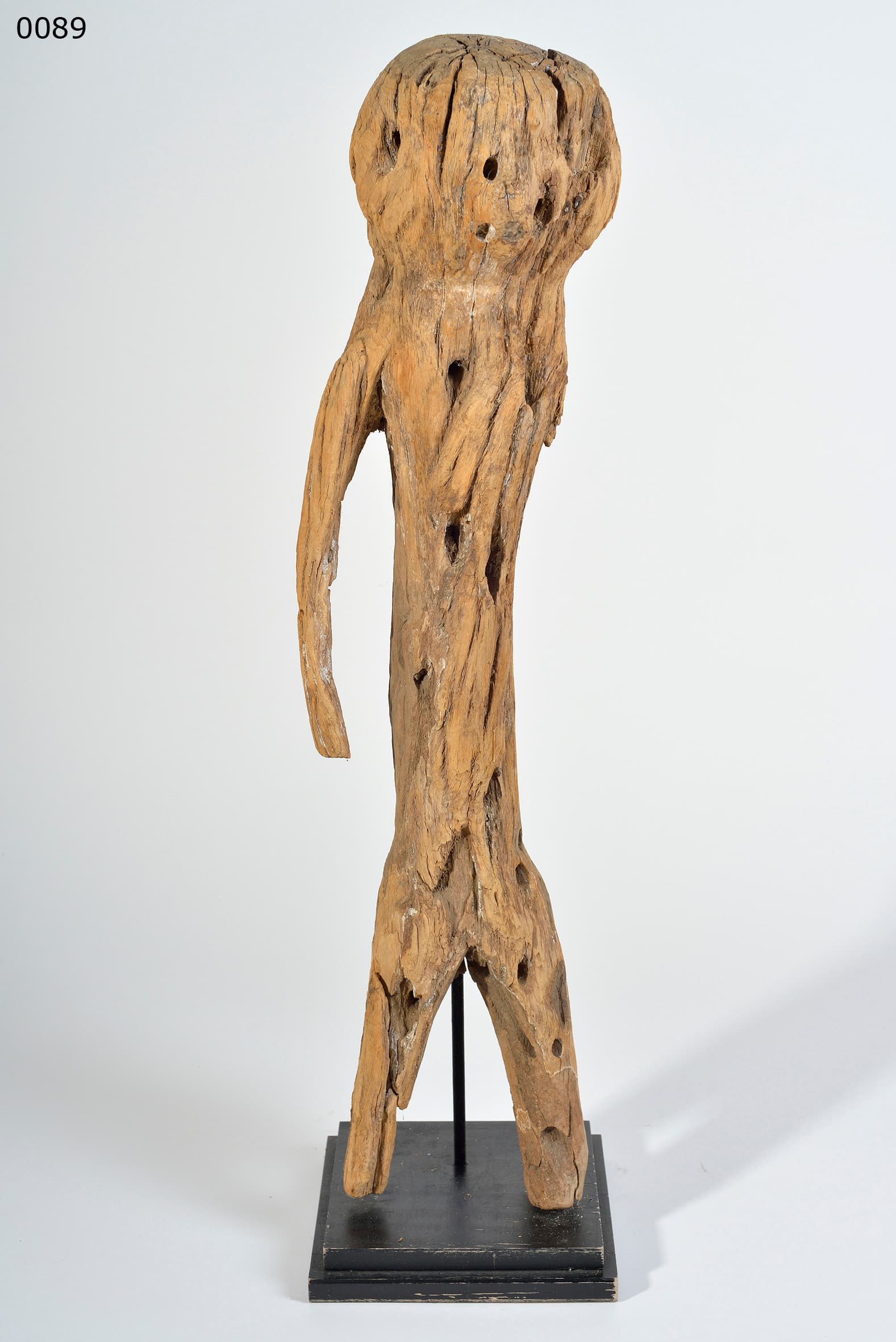
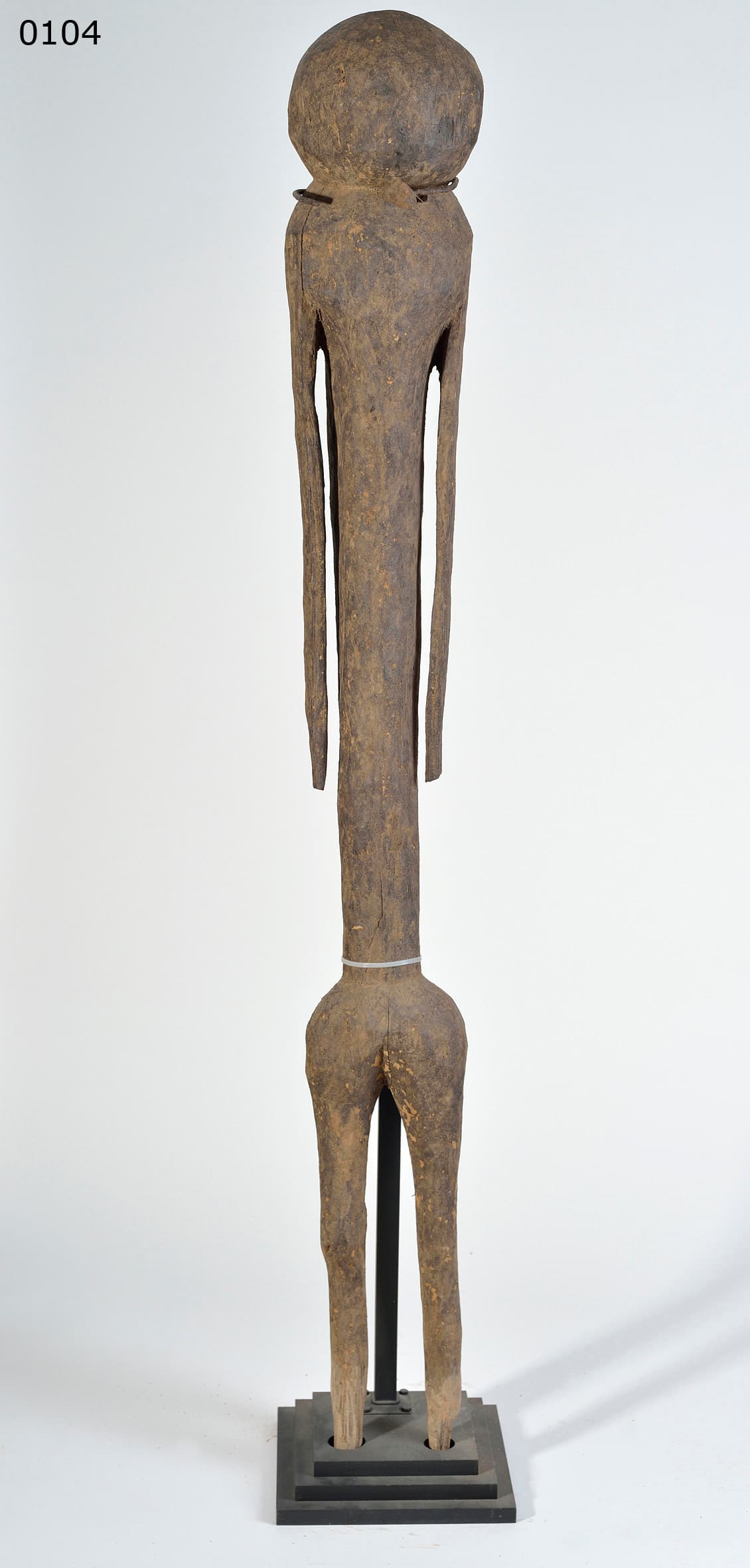
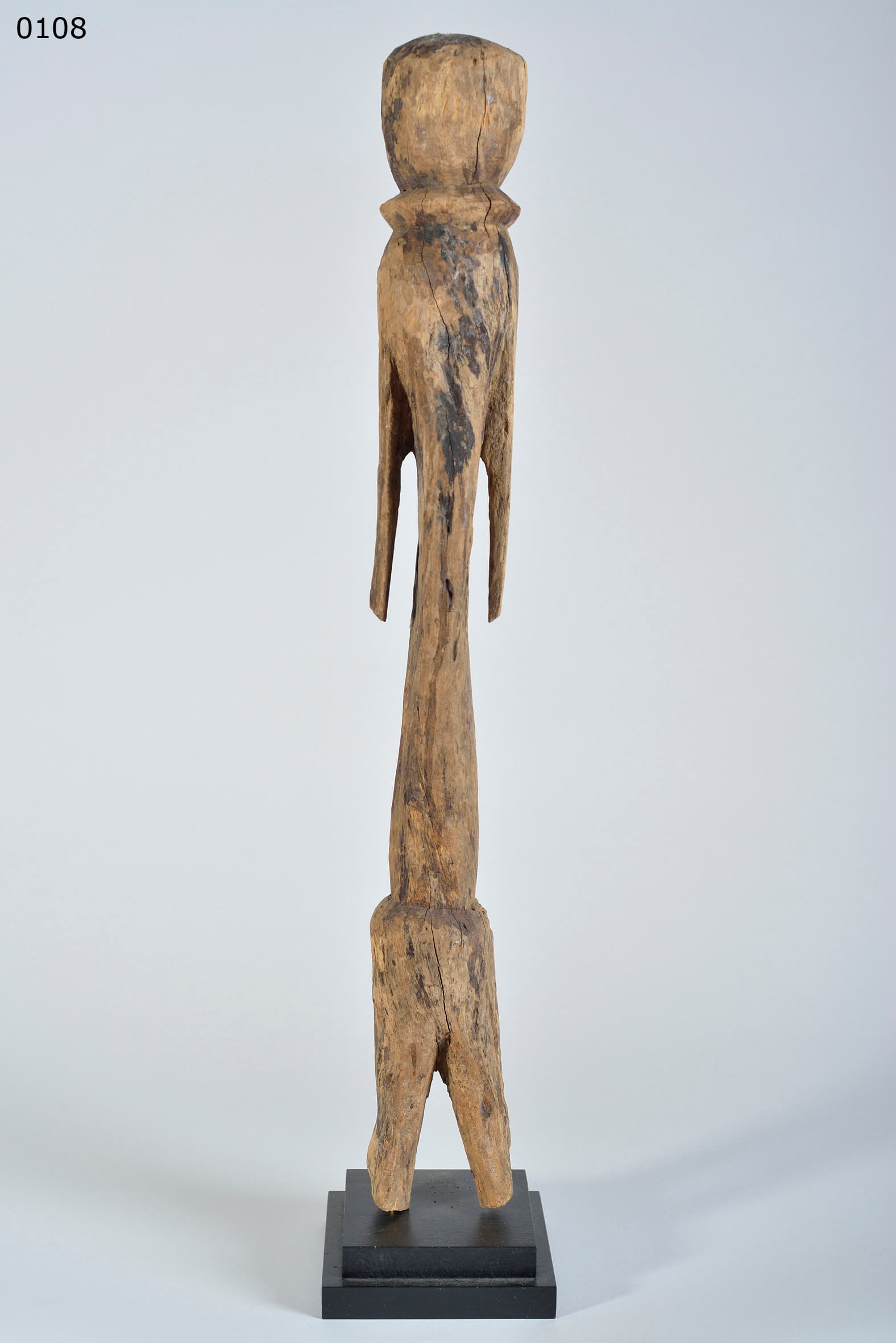
The aesthetic vocabulary of Moba culminates in a specific, globally received canonical object typology: the Tchitcheri ancestral post figures. These sculptures, often carved from a single branch or trunk of hard African wood, are now regarded in Western art historiography as the undisputed icons of "minimal sculpture" in the West African tradition. The morphological structure of these figures defies any naturalistic representation. The canon of proportions dictates an extremely reduced, cylindrical form. A minimal, almost knob-shaped, round head sits on a strongly elongated torso. The neck constriction is usually only faintly hinted at or absent altogether. The arms, if present, fall closely parallel to the torso and are often only separated from the torso by a rudimentary vertical notch. The legs are disproportionately short compared to the torso and often look like a horseshoe-shaped base.
The consistent omission is particularly significant: elaborate facial features (eyes, nose, mouth), hands and feet are completely missing in the canonical form. Similarly, the depiction of sexual characteristics is dispensed with almost without exception, lending the sculptures a universal, androgynous quality. This radical abstraction serves a specific purpose: the figure is not intended to depict the earthly appearance of the deceased, but to materialise the pure, concentrated spiritual essence (tokora) of the ancestral lineage.
The iconography of the Tchitcheri is strictly systematised and correlates directly with a precise size spectrum that determines the social and ritual function of the subtype, as confirmed by the analyses of Mullen Kreamer (1987) and the catalogues of Koloss (1973).
| Subtype (classification) | Average size | Spatial placement | Social/ritual function |
|---|
| Yendu tchitcheri | Small (~20 - 30 cm) | Within the living space / house shrine | Personal protection, intimate communication with yennu and close ancestors |
| Bawoong tchitcheri | Medium (~25 - 90 cm) | Vestibule of the homestead / lineage shrine | Represents a close ancestor of the current patriarch; focus of family sacrifice |
| Sakwa / Sakap tchitcheri | Large (~100 cm to >200 cm) | Outdoor area / Freestanding in the homestead | Represents the mythical or historical clan founder; centre of collective ceremonies |
The formal reduction of the sculptures has provoked an ongoing and intense iconographic controversy in research. The debate centres on the aesthetic genealogy of Moba art. On the one hand, researchers such as Bernard Liechti argue that the Tchitcheri should by no means be viewed in isolation, but rather represent the most extreme, abstract endpoint of a far-reaching "voltaic pillar ancestral tradition". This hypothesis postulates a stylistic and historical relationship to the morphologically similar Tellem ancestral figures from Mali, the abstracted Bateba figures of the Lobi (Burkina Faso) and the earth pillars of the Kasena. On the other side are scholars such as Hans-Joachim Koloss, who view the emergence of the Tchitcheri as an isolated, independent innovation that developed exclusively from the pragmatic restrictions of Moba divination and the taboo of imagery. The source situation here is extremely ambiguous, as the humid climate of West Africa and the omnipresent termite infestation have completely destroyed prehistoric wooden precursors that could serve as a "missing link".
Documented master craftsmen or workshops known by name, such as those of the Yoruba (e.g. Olowe of Ise), are completely absent from the Moba tradition. The production of the figures is not primarily an artistic, but a deeply spiritual act. The woodcarvers (tikpierroa) operate in strict anonymity and are subject to rigid taboos.
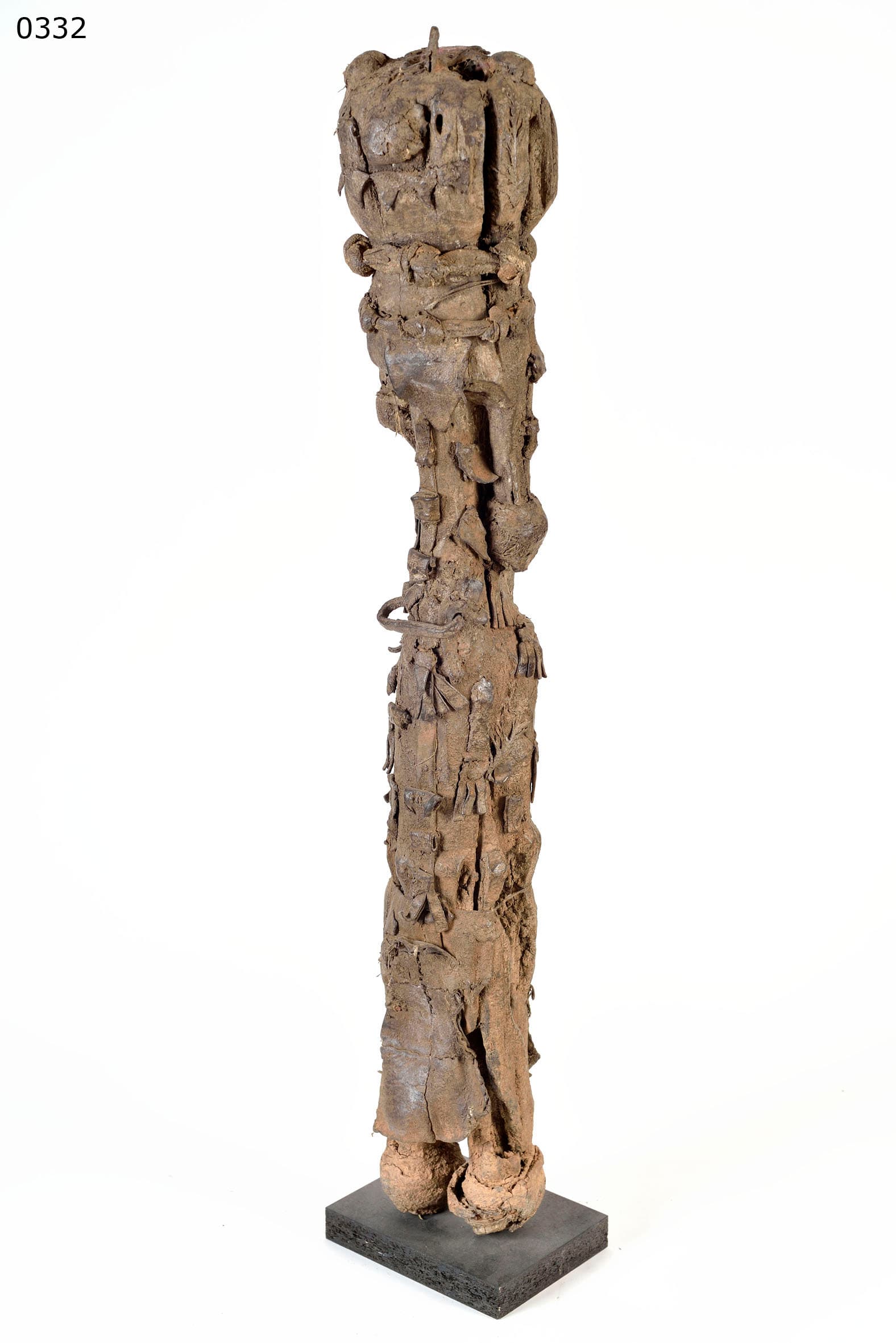
The ontological difference between an activated ritual object and a profane piece of wood manifests itself exclusively in the ritual patina development. A freshly carved tchitcheri does not yet possess any power. Only through consecration and the successive application of sacrificial matter (millet porridge, animal blood) to the head and torso does a dense, encrusted patina build up. Due to the fact that they are placed outdoors or in semi-open vestibules, the wood is also exposed to the effects of the weather (rain, UV radiation, drying out), which leads to characteristic deep cracks in the heartwood and surface erosion. Outstanding reference pieces of this weathering process can be found today in the collections of the Museum Rietberg in Zurich (such as Inv. RAF 306, which shows deep traces of weathering), as well as in the Musée du quai Branly (e.g. inventory numbers of series 70, which combine a saising modernity of lines with a deep ritual crust).
Today, this specific patina is the central forgery criterion. As the minimalist form of the tchitcheri can be easily and quickly reproduced by West African forgery workshops, the market has seen a flood of replicas since the 1980s. However, market-relevant forgeries usually fail due to the forensic reproduction of the patina: while authentic ritual objects show deep, slow weathering, natural oxidation processes of the wood and irregular feeding by soil termites (Macrotermes) on the base area, forgeries often only show superficially applied clay-ash crusts ("baked patina") with chemical binders or artificially simulated insect damage with tools.
Ritual practice
The ritual operationalisation of Moba art follows a precisely choreographed sequence that is closely linked to the metaphysical crises of the community. The lifecycle of a Tchitcheri never begins as an expression of creative urge, but always reactively. An individual or head of a family seeks out the divinator in times of existential distress - be it illness, infertility, lack of rain or a series of deaths. During the session, the Divinator strikes his cords to determine the unseen causes. Often the diagnosis is that a specific ancestor (either of the paternal line or the founder of the clan) feels neglected and requests a physical manifestation on a shrine in order to better receive the offerings of the living. Only after this unequivocal divinatory instruction may the order be given to a carver.
The act of carving is surrounded by spiritual dangers. The tikpierroa use an adze (cross axe) as their primary tool, an instrument that is reserved exclusively for carving sacred objects in many West African cultures. There is a strict taboo that only the sons of divinators are allowed to make tchitcheri, as only they have the necessary spiritual shield due to their lineage. Although in rare exceptional cases men without this lineage are permitted to carve, they put themselves in extreme danger and must first protect themselves with extremely strong, often physically applied protective medicines (amulets, liniments). This emphasises the Moba epistemology, according to which the wood is not sacred in itself, but becomes a magnet for erratic spirit forces through the working process.
The ritual activation and the actual performance take place at the altar, as the Moba almost exclusively use sacred altar sculptures and virtually no worn dance masks for their ancestor worship. The construction of the altar (shrine) varies depending on the size of the sculpture. Small yendu figures are pressed into simple, bowl-shaped depressions made of clay in the inner living area, while the monumental sakwa are firmly buried in the earth of the courtyard, often surrounded by smaller stones or shards of clay.
Activation takes place through the sacrificial ritual. Moba society regularly practises complex blood sacrifices to maintain the balance between the community and the ancestral world. Albert de Surgy (1976) provides a meticulous ethnographic description of this sacrificial practice. Primarily goats, cattle or dogs are used as sacrificial animals. The highest formal precision is observed during the slaughter: a goat is cut up together with its hide, whereby the head and hooves are separated as an explicit portion of the spirits (spirits' portion) and carried to the altar. The priest or the head of the family pours the animal's blood directly over the head of the Tchitcheri figure, followed by libations of millet beer and water. Further pieces of meat are thrown into the courtyard as an offering to the spirits of the earth (matna).
Once a year, the divinna renewal ritual also takes place, in which specific animals (such as two young dogs or symbolic straw dogs) are released or sacrificed in the bush together with an egg, as a metaphysical barter for the life of the patriarch and his descendants. De Surgy interprets this act philosophically: by sacrificing only "unbitter" animals without human reason, the Moba distance the ritual from murder. The sacrifice is thus the "refusal of homicide"; it banishes the uncontrollable life force (tokora) of the killed animal and transforms it into a protective energy for the ancestors. Regional variants of this rite can be found in the eastern fringes of Gurma culture, where more complex altars with integrated clay vessels are occasionally used, which indicates a stronger assimilation of earth spirit cults.
The deactivation and disposal process of the Tchitcheri reflects the stoic pragmatism of African animism. A ritual object is not a work of art for eternity, but a temporary vessel. Once the figure has rotted through the massive use of sacrificial liquids, been hollowed out by subterranean termites or split by the harsh climate of the savannah, it loses its energetic function. There are no elaborate deconsecration rituals. The decayed piece of wood is either simply left on the shrine until it turns to dust or disposed of in the bush, while a new tchitcheri is commissioned after renewed divination. This natural decay is not seen as a loss, but as a legitimate return of the material shell to the cycle of nature (yennu). In Western collections, such as the excellently documented PLU African Art Collection or the holdings of the Fowler Museum at UCLA, precisely those specimens that show strong signs of wood deterioration, flaking on the rudimentary arms and holes on the head are highly valued, as these traces testify to the completed cycle of ritual use in the open air.
Historical context
The historiography of the Moba is marked by centuries of flight, subjugation by imperial powers and, in more recent times, the radical commercialisation of its sacred art in the West. The migration history of the Moba is the subject of intense and sometimes controversial debate in research. The prevailing oral history and early ethnographic sources postulate that the ancestors of the Moba (and Bimoba) migrated south in the course of the collapse of the powerful kingdom of Fada-N'Gourma in present-day Burkina Faso around 1420. However, there is disagreement among researchers regarding the homogeneity of this movement. Some historians argue that the Moba only split off from the Gurma in the late 17th or early 18th century in order to escape pressure from enemy empires. During this phase, they advanced further south, but were pushed back into their present, more barren settlement areas in northern Ghana and Togo by the expansionist endeavours of the Dagomba and Mamprusi, who made use of the military clout of Chokosi mercenaries. Other theories based on linguistic stratification favour the theory that the area was already populated by autochthonous Moba groups, which were merely overlaid and assimilated by a militarily superior Gurma elite in the 15th century.
The colonial encounter decisively shaped the modern fate of the Moba. With the proclamation of the Deutsch-Togo protectorate (1884), the Moba settlement area around Dapaong (then Mango district) came under German military administration. After the First World War and the division of the German colony into League of Nations mandates, the Moba territory was unnaturally and brutally carved up by the demarcation between French Togo and British Togoland (now Ghana), which cemented the division into Moba (Francophone) and Bimoba (Anglophone) that continues to this day. Colonial history, coupled with the arrival of Western missionaries, exerted massive pressure on art production. Missionaries from the Assemblies of God, such as John Hall, who translated the New Testament into the Moba language in Dapaong in 1959, engaged in aggressive proselytisation. Traditional ancestor worship was demonised as "pagan", shrines were partially destroyed or abandoned. This led to a significant reduction in the production of the monumental, highly visible sakwa figures, while the small, private yendu figures lived on in the secrecy of the huts.
The market history of moba art in the West is a phenomenon of late discovery. While early colonial actors, such as the German naval lieutenant Wunderlich, who collected the first Moba objects for the Weltmuseum in Vienna and the RMCA in Tervuren between 1914 and 1916, classified the figures primarily as ethnological curiosities (often incorrectly categorised as Tabwa or Ijij), Moba art remained unknown to the broader Western art market for a long time. The commercial and aesthetic breakthrough only came in the post-war era, fuelled by two museum milestones. The exhibition Pictures of Man in Foreign Cultures at the Linden-Museum Stuttgart (1973), curated by Hans-Joachim Koloss, presented the Tchitcheri to a wide audience for the first time as masterpieces in their own right. A short time later, Christine Mullen Kreamer's groundbreaking publication in the journal African Arts (1987) provided the much-needed ethnographic foundation.
The reception in the West was characterised by a profound aesthetic paradigm shift. Private collectors in Paris, Brussels and New York (such as the Malcolm Collection, exhibited at the Metropolitan Museum of Art) recognised striking parallels to the European avant-garde and minimal art (especially to artists such as Constantin Brâncuși or Alberto Giacometti) in the radical, smooth reduction of the Tchitcheri. This formal affinity sparked an enormous surge in demand, which has caused prices to rise exponentially since the late 1980s. Exceptional pieces now routinely realise five-figure sums at auctions (e.g. Zemanek-Münster, Millon).
Parallel to the price explosion, however, the problem of forgery escalated. Local workshops in Lomé and Accra recognised the market potential and began to produce large quantities of tchitcheri imitations for export. As the minimalist design required hardly any craftsmanship, the evaluation of authenticity criteria shifted almost entirely to the field of material science forensics. Renowned institutions such as the Musée du quai Branly or the Museum Rietberg, which curate important reference collections, now base their authentication on microscopy and chemical analyses. An authentic Tchitcheri that has stood on a shrine for decades shows oxidised blood that has penetrated deep into the lignin, radial cracks in the heartwood caused by decades of thermal expansion and specific feeding galleries of savannah termites on the base resting in the ground. The modern forgery, on the other hand, betrays itself through chemically induced, superficial ageing, grooves artificially created with wire brushes or a "baked" patina of clay and industrial binders that immediately disintegrates when tested with solvents. This rigorous forensic dividing line between ritually charged history and commercial copy defines the highly specialised collectors' market for Moba art today.