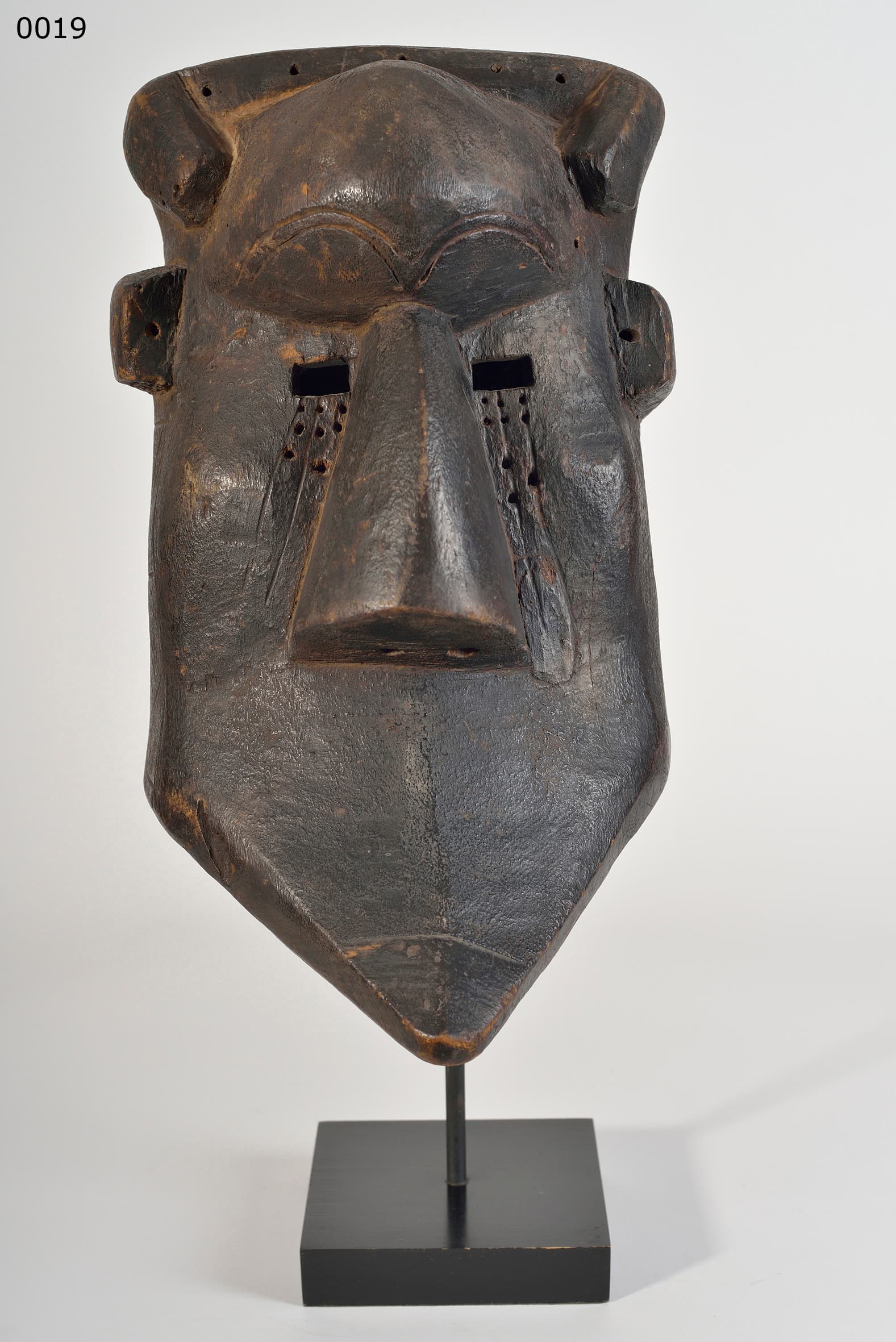
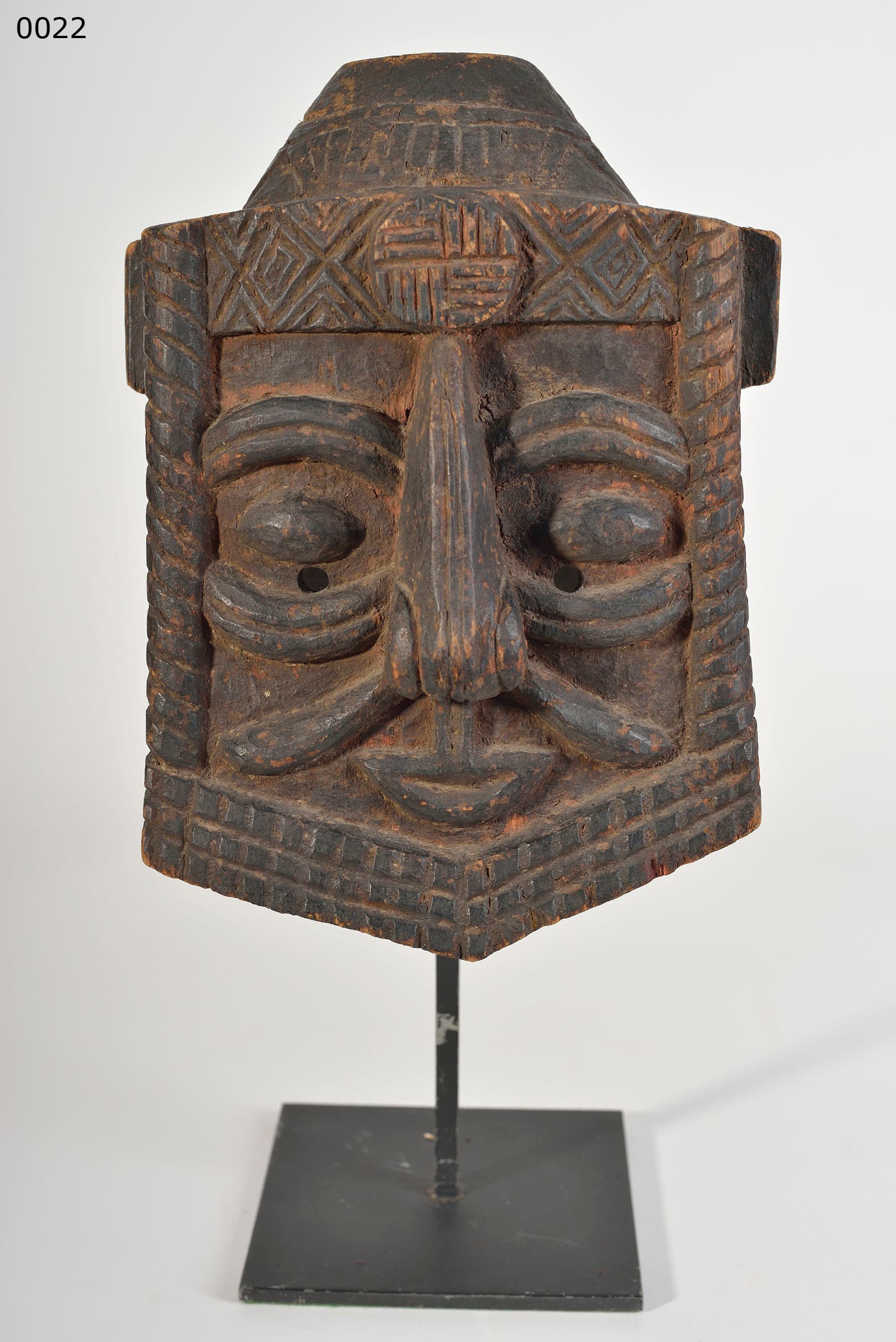
A dramatic heavy Kuba Bwoom mask (1st half 20th C., 30 cm) from DR Congo — a massively bulging oversized hydrocephalic forehead, a broad flat nose, and a jutting jaw. Facial planes heavily outlined with deep geometric incisions. The dense wood possesses a rich dark patina overlaid with highly faded oxidized traces of red and white polychrome pigments.
1. The Bwoom typology and royal hydrocephaly
The Kuba Kingdom utilizes a highly formalized royal masquerade triad — this mask represents the iconic Bwoom character.
- Bulging Cranial Volume: Universally identifiable by its aggressive bulging oversized forehead and strong jutting jawline — the artist has deliberately distorted the cranial volume to visually project intense overwhelming potentially dangerous intellectual or supernatural weight.
- Obsessive Surface Geometry: The deep meticulous geometric tracking carved into the cheeks and nose demonstrates the Kuba obsession with complex surface pattern and structural design.
2. The royal triad and the subterranean spirit
In Kuba royal performances, the Bwoom dances alongside Mwaash aMbooy (the king) and Ngady aMwaash (the royal sister/wife).
- Antagonist of Royal Authority: Bwoom represents the commoners, the original Pygmy/Twa inhabitants of the land, or a powerful untamed subterranean nature spirit.
- Theatrical Political Tension: During spectacular royal festivals, the Bwoom dancer acts aggressively and proudly, challenging the king mask — a highly codified theatrical re-enactment of Kuba mythology balancing royal authority with acknowledgment of the fierce independent spirit of the common people.
3. Performance friction and pigment oxidation
The physical condition shows wear consistent with active ceremonial use.
- Pigment Trace in Incisions: The original vibrant paints have deeply faded, leaving only oxidized traces of red and white deep within the geometric incisions.
- Lustrous Handling Polish + Sweat Interior: The high bulging forehead and prominent nose exhibit a lustrous handling polish from decades of physical friction and palm-oil application during storage; the heavy sweat-stained oxidation on the interior is consistent with its history as a danced royal artifact.
Summary
A bold, expressive example of Kuba royal masquerade, this Bwoom mask captures the intellectual weight and tension of the Congolese court. Its faded polychrome tracking and handling polish make it a notable ethnographic object.
Written with AI assistance from the collection appraisal, object photography and our own research; editorially reviewed. Mistakes are possible — corrections are welcome. How we work →