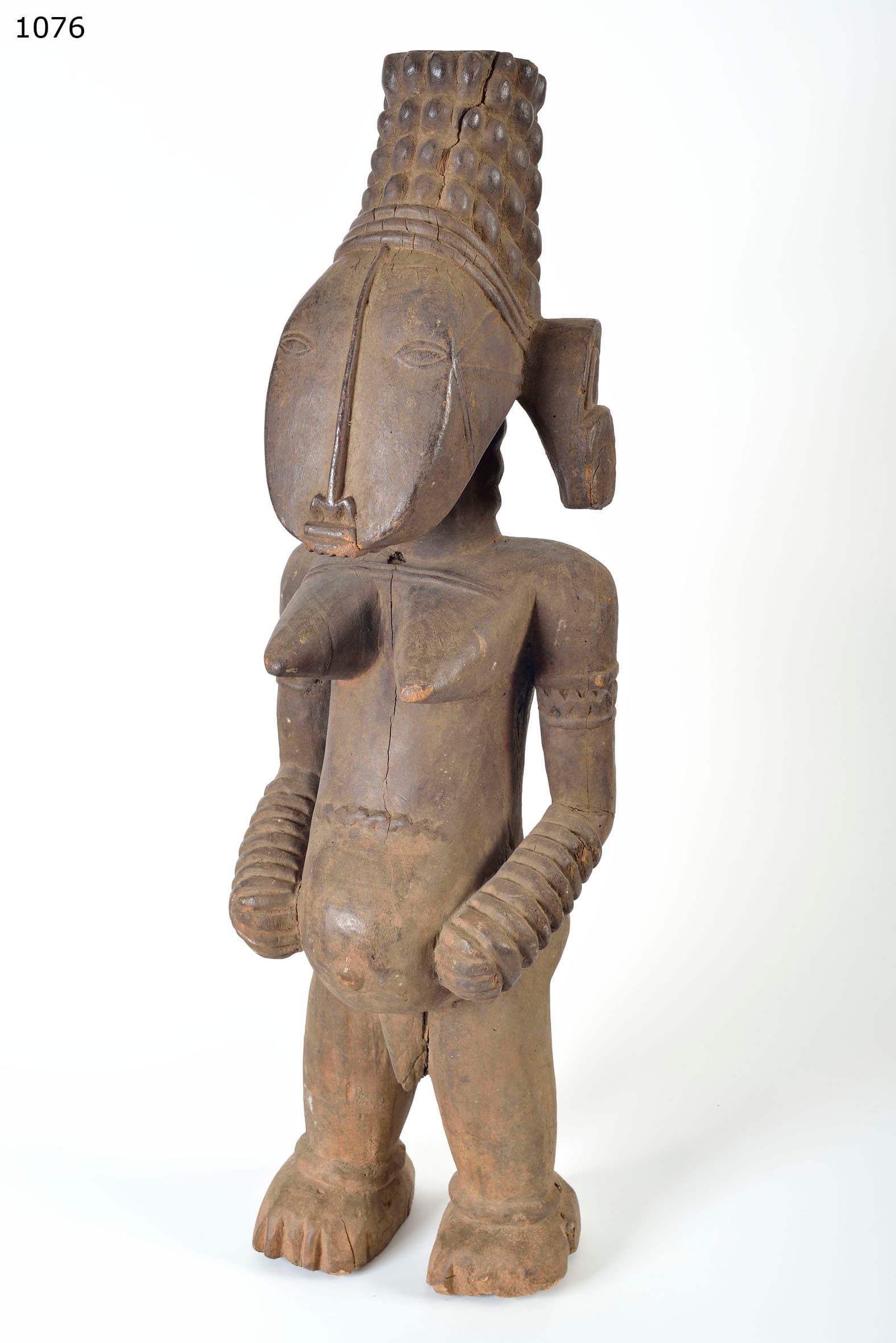
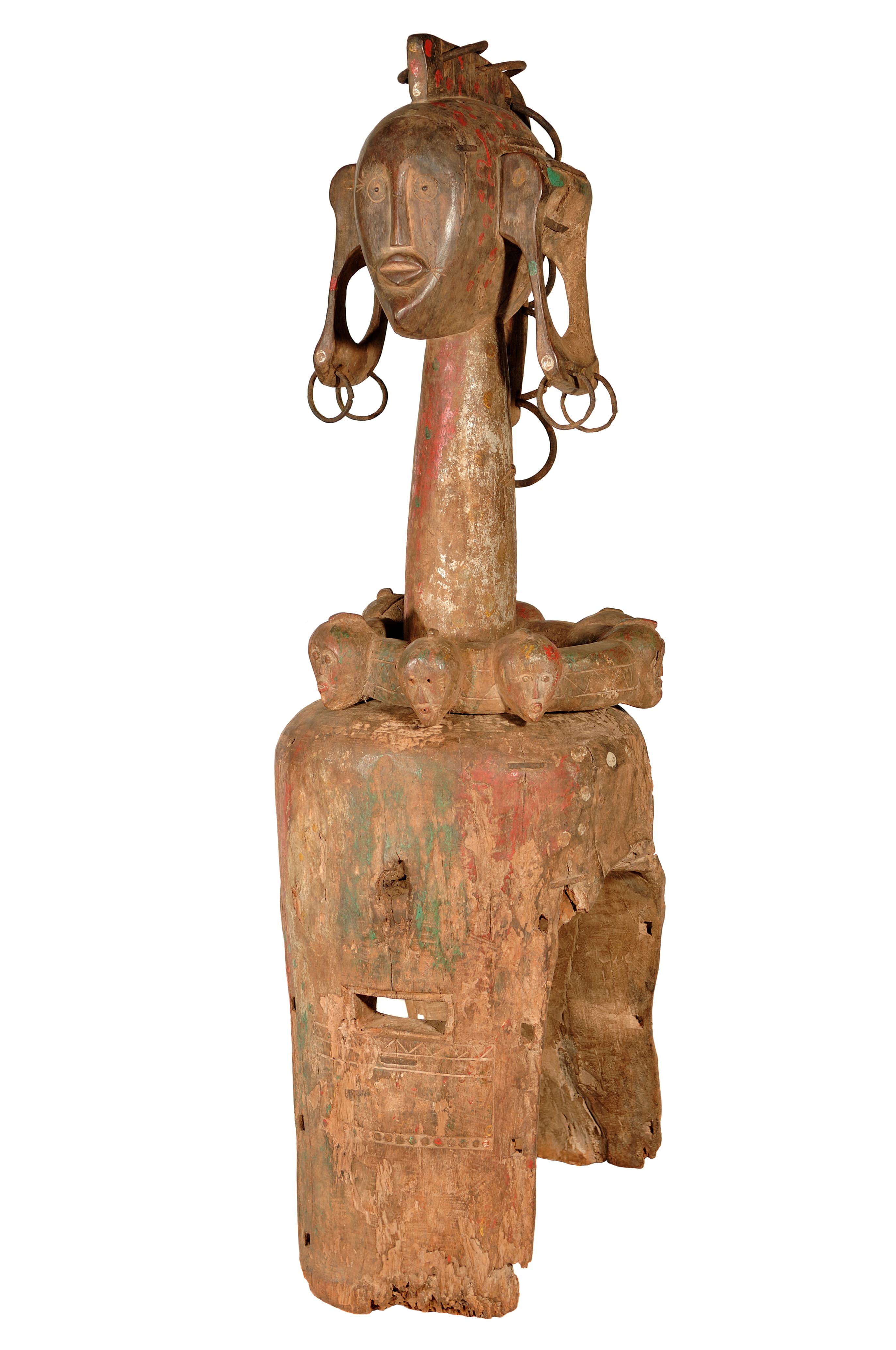
A highly abstracted dark Jukun crest mask (attributed to circa 1908, 55 cm) from Nigeria — a flat elongated paddle-like upper horizontal plane supported by an intricate vertically tiered and geometrically complex neck and base structure, completely lacking recognizable facial features. The exceedingly dense timber exhibits a deep blackened heavily encrusted handling patina. Scientific testing supports an age dating to circa 1908.
1. Benue valley abstraction
The Jukun of the Benue River Valley (who historically commanded the powerful Kwararafa Empire) produce the Aku Onu or Akuma headcrests — representing a highly developed tradition of non-representational abstraction in Nigerian art.
- Pure Architectural Form: The sculptor has entirely eliminated human or animal anatomy — reducing the mask to pure architectural form: an overarching flat horizontal "roof" balanced upon a complex multi-tiered vertical pillar.
- Alien Supernatural Structure: This radical geometry forces the viewer to interact with the object purely as an alien supernatural structure rather than a relatable worldly entity.
2. The akuma cult and royal authority
Masks of this abstract style are traditionally guarded instruments of the Akuma cult — intrinsically linked to Jukun divine kingship (Aku Uka).
- Controllers of Rain and Fertility: The Akuma spirits control the rain, agricultural fertility, and the overall prosperity of the Jukun state.
- Landing Pad for Descending Spirits: Danced horizontally atop the head during highly restricted elite ceremonies — the crest acts as a physical landing pad for descending spirits; by utilizing an object devoid of human form, the Jukun visually reinforce that their king and protecting deities are fundamentally elevated above and separate from the mundane human world.
3. Scientific testing and surface crust
Highly notable for scientific testing indicating an age consistent with a date of circa 1908.
- Pre-WWI Origin Supported by Crust: An early twentieth-century origin is consistent with the physical patina — completely encased in a thick dark coagulated crust.
- Generations of Sacrifices: Hardened accumulation consistent with generations of ritual offerings (millet beer, palm oil, blood) poured over the crest to "feed" the Akuma spirit; deep oxidation of the underlying wood and glossy frictional wear on the base suggest extensive ritual use.
Summary
A rare example of pure Nigerian geometric abstraction, this Jukun crest mask is a significant representation of Akuma cult worship. Its age, indicated by scientific testing to date to circa 1908, and its thick sacrificial crust make it an important object of historical interest.
Written with AI assistance from the collection appraisal, object photography and our own research; editorially reviewed. Mistakes are possible — corrections are welcome. How we work →