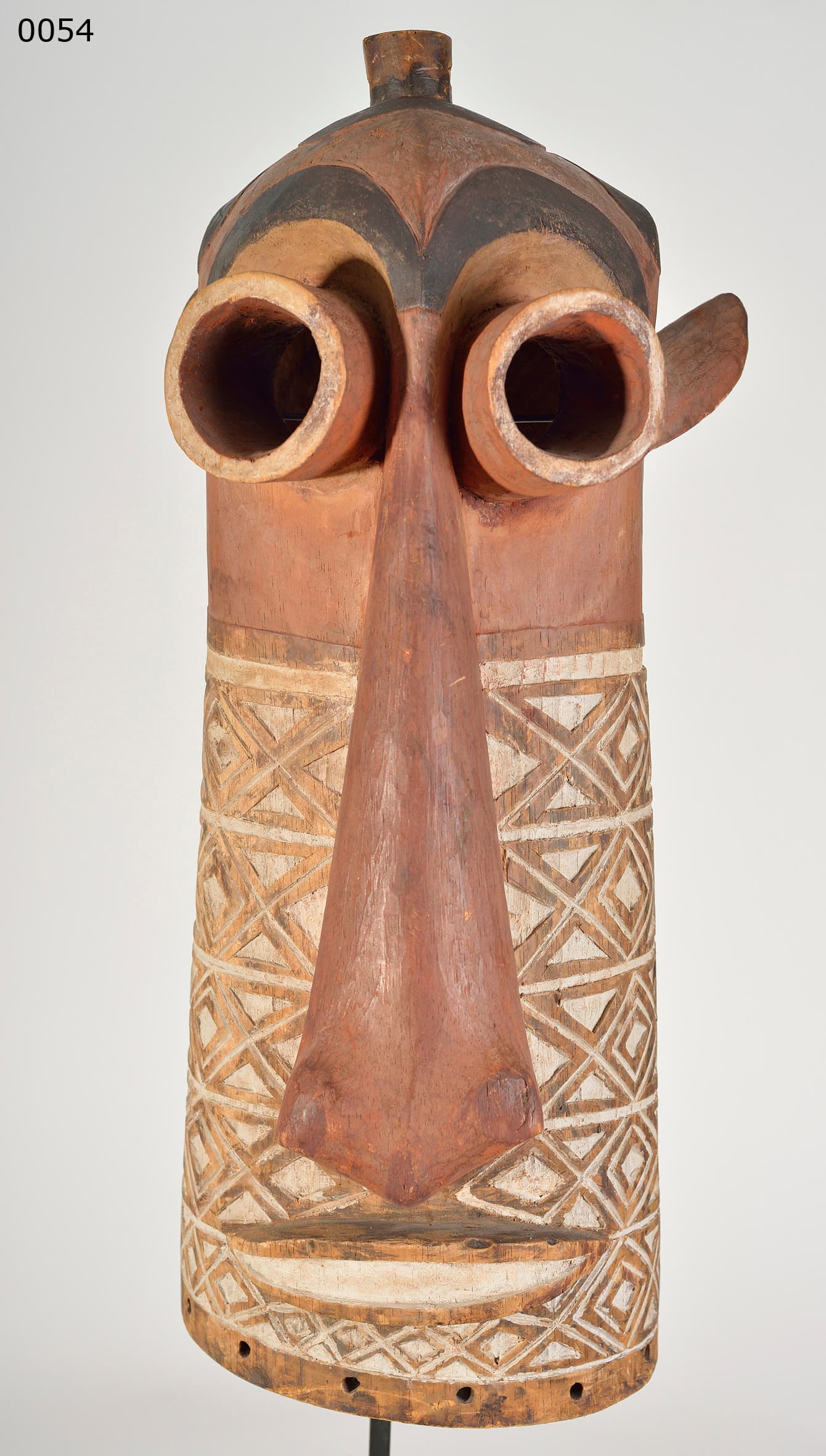
This is an Eastern Pende crest mask from the Democratic Republic of the Congo.
While the Western Pende are famous for their naturalistic, triangular "Mbuya" face masks, the Eastern Pende (living along the Kasai River) are known for more volumetric, geometric, and zoomorphic (animal-like) helmet and crest masks.
1. Zoomorphic identity: The bush pig
This mask represents a Bush Pig (known locally as ngulu or nshiba). In the art of the Eastern Pende, the bush pig is a common and powerful motif.
- The Snout: The most prominent feature is the forward-thrusting, flat-ended snout with two distinct nostrils.
- Symbolism: The bush pig is respected for its strength and wildness. In a masquerade context, it often represents a "wild" or "uncivilized" character from the forest, used as a foil to more "civilized" human characters.
2. Eastern Pende stylistic markers
The mask displays several features that are consistent with the Eastern Pende style:
- Coffee-Bean Eyes: The large, heavy-lidded eyes with a horizontal slit are a classic Pende trait, but in the East, they are carved with more volume and sharper edges.
- Geometric Decoration: Look at the carved "diamond" or "zigzag" band encircling the base. This geometric precision is a hallmark of Eastern Pende craftsmanship, often mirrored in their architecture and textiles.
- Color Palette: The use of red camwood pigment (tukula) on the face, contrasted with the dark blackened wood of the rim and top, creates a striking visual balance. The three small white lines under each eye are traditional scarification marks.
3. Function: The crest mask
Unlike many of the masks you have shared previously, this is a crest mask (or kapu):
- Position: It was not worn over the face. Instead, it was attached to a woven wicker framework and worn on top of the head.
- The Top Peg: The small wooden knob at the very top was used to secure a large bundle of feathers or animal hair, which would dance and sway as the masquerader moved.
- Visibility: Because it sat high on the head, the dancer could be seen from a great distance, making it ideal for large village festivals.
4. Cultural context: Mukanda and chiefs
- Initiation: These masks are frequently used during the Mukanda (boys' initiation rites). They appear at the end of the ceremony to celebrate the boys' transition into manhood.
- Chiefly Power: Some zoomorphic crests are also associated with the authority of the village chief. They represent the "strength of the forest" that the chief harnesses to protect his people.
Summary
This mask is an example of Eastern Pende formalist art. It distills the features of a wild animal into a highly structured, geometric form. It captures the "wild" spirit of the bush pig while maintaining the strict aesthetic rules of one of the Congo's most celebrated carving traditions.
Written with AI assistance from the collection appraisal, object photography and our own research; editorially reviewed. Mistakes are possible — corrections are welcome. How we work →