Overview
Nomenclatural and geographical delimitation
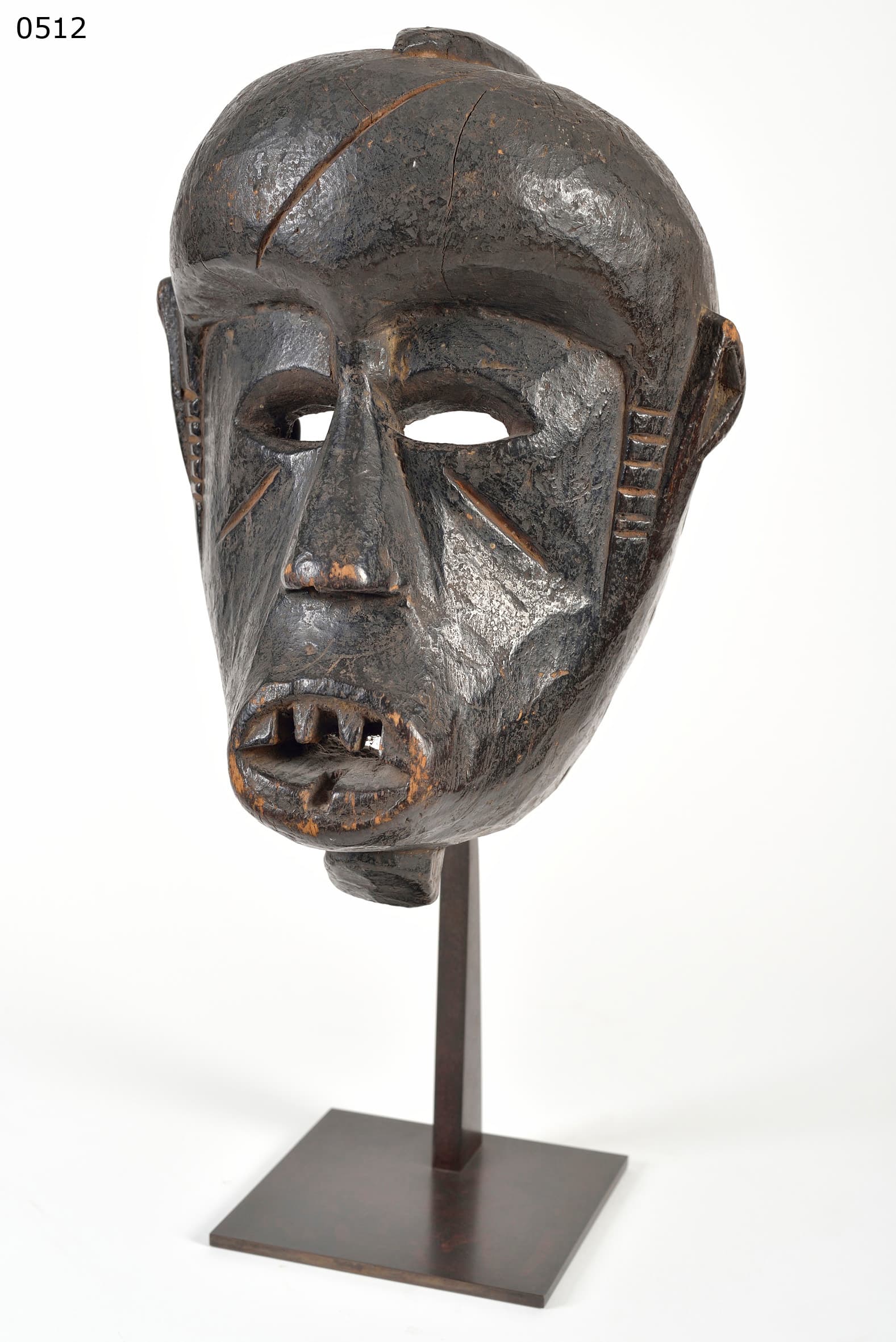
The ethnographic and art historical classification of the Bembe in African art history is characterised by a fundamental nomenclatural and geographical duality, which in the past, especially in older colonial collections, has led to considerable misattributions and academic misunderstandings. The source situation is sometimes ambiguous, as two completely distinct, genetically and linguistically unrelated Bantu-speaking peoples are subsumed under the ethnonym "Bembe" (in plural form also Babembe). On the one hand, there are the so-called Eastern Bembe, who primarily live in the east of the Democratic Republic of the Congo (particularly in the province of South Kivu and in the territory of Fizi) and along the western shores of Lake Tanganyika in Tanzania. These Eastern Bembe are culturally, stylistically and ritually closely related to the Lega and the so-called pre-Bembe hunters (Basikasingo, Boyo) and have adopted the highly complex, hierarchical Bwami initiation system. Eastern Bembe art is characterised by highly abstract, geometric face masks (often anthropo-zoomorphic) and cubist statuettes that fulfil completely different ritual functions to those in the West.
However, this dossier focuses exclusively on the Western Bembe, who are geographically located in the Republic of Congo (Congo-Brazzaville), primarily in the southern regions of Mouyondzi and the fertile valley of the Niari River, north of the capital Brazzaville and the historic Stanley Pool. This population is culturally firmly anchored in the overarching Congo cultural area (BaKongo) and shares significant stylistic and religious substrates with neighbouring peoples such as the Vili, Kongo, Yombe and Teke. For a private collector, this distinction is of essential importance, as the canonical "Bembe statuary", which fetches top prices on the international art market (small, detailed ancestor figures with porcelain eyes and scarred tattoos), almost without exception originates from the production of the West Bembe.
Demography and linguistic classification
Current and reliable population estimates for the West Bembe are extremely difficult to obtain. National census data for the Republic of Congo often summarises ethnic groups under superordinate linguistic meta-categories, which is why specific figures for the West Bembe are usually subsumed into estimates for the larger Bakongo population. Historically and linguistically, the West Bembe speak Kibembe (or Beembe), a Bantu language closely related to the Kikongo dialect continuum. In linguistic taxonomy, this language is assigned to the H-zones of the Bantu languages, which indicates a deep historical rootedness in the West-Central African region. The self-designation of the group varies depending on the local lineage, while the foreign designation "Babembe" was coined and standardised by colonial administrators and neighbouring groups. The identity of the West-Bembe is therefore not to be understood as a monolithic block, but as a fluid network of clans that define themselves through common language roots and similar ritual practices (in particular the cult of the Butti ancestral figures).
Social structure and subsistence economy
In contrast to the highly centralised and hierarchically organised kingdoms of West Africa or the historical core of the Congo kingdom, the social structure of the West Bembe is largely acephalous and decentralised. Authority is not vested in an absolutist monarch or centralised chief, but is concentrated at local level in the hands of the clan elders and ritual specialists (the Nganga). This gerontocratic and spiritual distribution of authority is directly reflected in the production of art: objects are not created as insignia of power for a royal court (as is the case with the Kuba or Luba), but as individualised, family or clan-specific ancestral vessels for decentralised use.
The kinship system has complex, primarily patrilineal features, although there are overlaps with the matrilineal traditions of neighbouring Congo groups, which makes the inheritance of land rights and ritual titles a highly complex process that requires negotiation. The subsistence economy was traditionally based on a gender-divided system: women were responsible for shifting cultivation, which was primarily focussed on the cultivation of manioc, maize, beans and bananas, while men devoted themselves to hunting, fishing and trading. This division has iconographic consequences: Male ancestral figures are often depicted with the insignia of their subsistence and status roles (guns, knives), while female figures often appear in maternité compositions (mother with child), symbolising fertility and agricultural abundance.
Neighbourly relations and classification controversies
The relationship between the West Bembe and their neighbouring peoples (Teke, Bwende, Sundi, Lari, Vili) was historically characterised by an intensive, permeable exchange. Extensive ritual assimilations took place along the geographical border zones. Classification is controversial: classification controversies regularly arise in the museum context and must be explicitly marked. For example, the documentation history of the Musée royal de l'Afrique centrale (RMCA/Tervuren) indicates that colonial collectors in the late 19th and early 20th centuries often inventoried objects from the West Bembe as "Congo" or erroneously as "Bateke". The boundaries between a Teke-Fumu and a Bembe-Butti are blurred in the border regions of the Stanley Pool.
| Criterion | East Bembe (DRC / Tanzania) | West Bembe (Republic of Congo) |
|---|
| Linguistic basis | Lega-associated Bantu language | Kikongo dialect continuum |
| Central cult form | Bwami initiation society | Ancestral and Minkisi cults (Butti, Nkiba) |
| Stylistic features | Cubist, highly abstracted, anthropo-zoomorphic | Geometric realism, porcelain eyes, scars |
| Canonical objects | Bwami masks (wood/kaolin), Alubamba figures | Small ancestor figures (Butti), Nsiba instruments |
| Related groups | Lega, Boyo, Basikasingo, Hemba | Teke, Vili, Yombe, Bwende, Sundi |
It was not until field research-based style criticism in the 1970s that a differentiated, albeit still debatable, separation of the corpora began. A dossier for the art market must address this ambiguity, as the exact ethnic attribution is often less a question of absolute truth than of stylistic probability.
Cultural context
The Cosmological Order: Nzambi and the Spiritual Hierarchy
The religious system of the West-Bembe is based on an elaborate cosmological order that has fundamental structural similarities with the superordinate Congo cultural area, but is highly localised in its ritual performance and use of objects. At the top of the spiritual hierarchy and cosmology is an omnipotent creator god, Nzambi (or Nzambi Mpungu). In the African theology of the region, Nzambi is the architect of the universe, but a classical Deus otiosus: After the creation of the world, he withdrew to a far distance from the sphere of human beings. He no longer intervenes in profane, everyday events, does not punish directly and does not reward directly. For this reason, Nzambi receives no direct worship in the traditional Bembe religion, and there are no sculptural representations or shrines dedicated to him. The anthropomorphic statuary of the West Bembe never represents the creator god.
The active spiritual vacuum between the distant Nzambi and the living people is filled by a dense, polyvalent pantheon of nature spirits (Bisi) and, above all, the ancestors (Bakulu). In contrast to some West African systems (such as the Orisha of the Yoruba), in which a firmly defined pantheon of personalised, mythologically differentiated deities prevails, the religion of the West Bembe is primarily a pronounced form of ancestor veneration, coupled with the pragmatic, magical-medical manipulation of spiritual energies (minkisi). The ancestors are the real actors in the life of the Bembe. They watch over the observance of social norms, the protection of the land and success in harvesting and hunting. Illness, infertility or social imbalance are almost invariably interpreted as a discrepancy between the living and the ancestors or as an attack by enemy witchcraft.
Ritual authorities: The Nganga and the cult societies
The central ritual authority is vested in the Nganga (plural: Banganga). The nganga combines the functions of a priest, healer, divinator and spiritual exorcist. He acts as an essential mediator between the mundane world of this world and the spiritual dimension of the ancestors beyond. If an individual or a clan is afflicted by misfortune, it is the task of the Nganga to identify the metaphysical cause through complex divination techniques and to order the consultation of specific protective and healing cults.
The central, well-known cult groups of the West Bembe include Mpodi, Ngombo and Nkondi.
- The Mpodi cult is primarily therapeutic and divinatory in nature.
- The Ngombo cult serves to identify witchcraft and restore social harmony.
- The Nkondi cult has a judicial, often martial function involving the tracking down of offenders, the sealing of contracts and the punishment of perjurers. (It should be noted here that while the Western Bembe share the concept of the Nkondi, historically they did not produce the monumental Nkisi-Nkonde fetishes studded with hundreds of nails that are typical of the Vili or Yombe on the coast; Bembe statues remain intimate and miniaturised).
The ancestral statues, usually referred to as Butti or Nkiba, do not serve as mere profane portraits of the deceased in the Western sense. Rather, they are physical vessels (apparatuses) into which the spirit essence of a specific ancestor summoned by the nganga can temporarily descend, provided the object has been correctly ritually charged.
The role of women and rites of passage
The role of women in the cult of the Western Bembe is complex and ambivalent. Although the wood carvers (the producers of the profane form) and the leading banganga (the activators of the spiritual form) are almost invariably male, women play an irreplaceable role in the ritual performance. Women often act as mediums for spirits and are responsible for maintaining agricultural and demographic fertility. This significance is explicitly reflected in the iconography: female ancestor figures, often realised as mother-child compositions (maternité), are among the most intimate and powerful objects of the Bembe corpus and were used to ensure the protection of the ancestors through the female reproductive capacity.
A central rite of passage for men is ritual circumcision, followed by an extremely rigid initiation period in the bush (similar to the mukanda system of other Congolese groups). During this liminal phase, the novices are taught the complex keloid scars (scarification) on the abdomen, back and shoulders that are so characteristic of the Bembe. This painful modification of the body is an act of civilisation: it marks the irrevocable transition from the unfinished "natural state" of the child to the cultivated, social state of an adult, procreative full member of society. These scarifications are later transferred precisely to the ancestor statues in order to validate their identity as initiated, respectable ancestors.
Research controversies and structural differences (author vs. author)
What is the structural difference between the religion of the Western Bembe and that of the neighbouring peoples? The primary difference lies in the methodical application of the magical charge. While the neighbouring Teke often encase their ancestor figures (Biteke) with enormous, cylindrical masses of clay and medicine (Bilongo) that almost completely conceal the wooden body, the Western Bembe usually integrate these substances (Bonga) discreetly into an intercrural cavity (located between the legs), thus preserving the sculptural aesthetics of the figure.
There are significant research controversies in ethnography (author vs. author). The doyen of Congo art, Raoul Lehuard (1974), postulates in Statuaire du Stanley-Pool that the Nkiba cults of the West-Bembe were massively assimilated by the Bateke-Fumu and thus represent a hybrid, almost derived religious practice. Lehuard argues in favour of a cultural transfer from East to West. More recent research, however, discussed among others by Patricia Wachsmann and implicitly by Bernard de Grunne, emphasises an independent development of Bembe ritualism originating genuinely from the Niari Valley, which adopted stylistic tropes from the Teke, but structured the theological conception of the bonga system independently. The source situation is ambiguous in this respect, as extensive migratory movements in the late 18th and 19th centuries led to strong overlaps. Major institutions such as the Metropolitan Museum of Art (Met) explicitly reflect this academic ambiguity in their catalogues by carefully double-classifying certain ancestral figures as "Teke-Fumu or Kongo-Bembe".
Aesthetic features
The canonical object typology and the canon of proportions
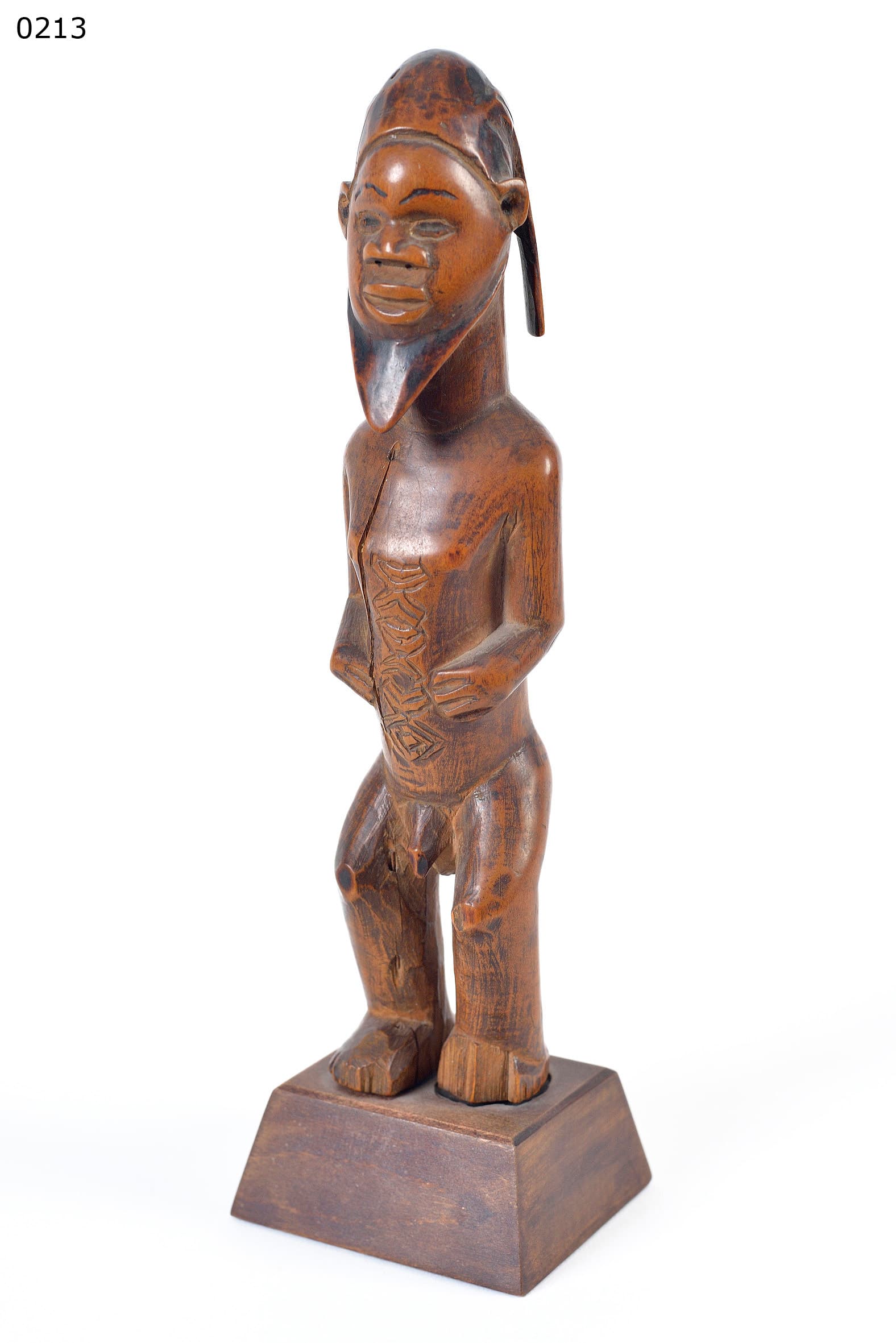
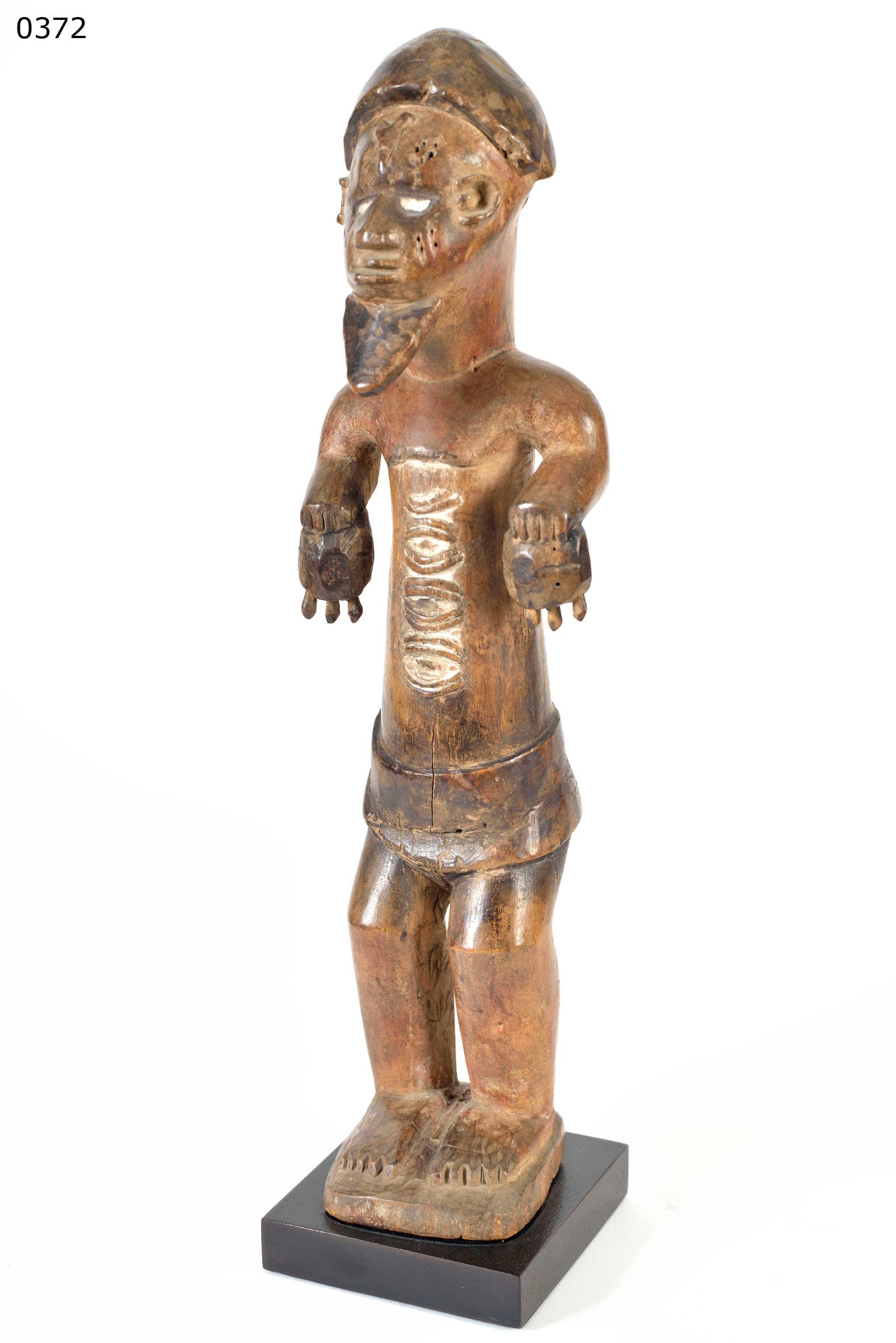
The canonical object typology of the Western Bembe has acquired a singular status in African art history through an extremely standardised, elaborate, but always miniaturised canon of proportions. The absolute formal centre of the corpus is formed by small, free-standing (more rarely seated) male ancestor figures (butti), the vast majority of which oscillate in size between a compact 15 and 25 centimetres. Larger sculptures are an absolute rarity.
A characteristic feature of these statuettes is the geometric rigour and muscular tension of the body forms. The canon of proportions is typically anti-naturalistic in Africa: the head is disproportionately large in relation to the body (often a third of the total length), which marks the head as the seat of spiritual identity and will. The torso is often massive and cylindrically elongated. The knees are held in the classic, dynamic bent position, the large feet with carefully carved toes resting flat on the plinth. This knee bend is not a sign of weakness, but an Africa-wide iconographic topos for readiness for action, vitality and "suspension" - the ancestor is ready to intervene in this world. Another distinctive feature is the asymmetry of the arm and hand position. The hands of male sculptures are often turned asymmetrically in front of the body and hold specific insignia that encode the ancestor's earthly profession or status: Guns (for hunters or warriors), knives, calabashes (for healers/banganga) or bells.
Iconographic specialities: Beard, eyes and scarification
The face is of the highest iconographic relevance and a primary identification feature for collectors. The chin area is extremely pronounced, almost square, and inevitably ends in a deep, rectangular or wedge-shaped beard on male figures. This reveals a cultural-historical paradox that is pointedly emphasised by Met: Although men in Central Africa historically almost never wore thick full beards (beards were often ritually plucked), the Bembe figures exhibit these beards "invariably". The beard is therefore not a naturalistic portrait feature, but a purely conceptual iconography: it symbolises the wisdom, advanced age and gerontocratic authority of the ancestor in the spirit world.
The eyes of the figures form the magnetic centre of ritual and aesthetic attention. They usually consist of deeply hollowed cavities into which light-coloured, often reflective materials such as European faience, porcelain shards, glass or pieces of cowrie shells are inlaid. The contrast between the dark wood and the bright white eyes is of profound cosmological significance. White (often associated with pemba/kaolin) is the colour of the dead, purity and the afterlife in the Congo region. The oversized, wide-open porcelain eyes symbolise the transformed state of the ancestor and his supernatural, all-seeing vigilance (Clairvoyance), with which he watches over the living without being blinded himself.
The deeply cut, complex keloid scar tattoos on the torso, abdomen and sometimes the back are just as precise and detailed as the eyes. These scarifications meticulously document the sitter's initiation status and civilisational rank.
Materiality, patina and the bonga system
The material of choice is almost invariably hard, dense-pored, time-resistant heartwood. The development of the patina is the result of decades of ritual handling: constant touching, anointing with palm oil and tukula powder (Pterocarpus soyauxii) as well as storage in the smoky interiors of the huts give the figures a deep, shiny, dark or crusty patina.
However, the absolute culminating difference between a profane, purely secular object (a pure piece of wood) and an activated ritual object lies in the anatomical preparation of the figure: the carver usually integrates a small, deep cavity in the perineal area (between the legs, often anatomically covering the anus or genitals). As long as this cavity is empty, the figure is profane. Only when this cavity is filled with the magical bonga charge (see section "Ritual practice") by the nganga does the sculpture become a fetish.
Master hands vs. regional workshops (iconographic controversy)
The attribution of these objects to specific carvers represents the greatest iconographic controversy in research on Bembe art (author vs. author). Historically, the approach of Raoul Lehuard (1974, 2010), who published by far the largest corpus of statuary in his standard work Statuaire Babembe, has dominated. Lehuard classified the objects almost exclusively geographically according to regional workshop zones (Stanley Pool, Niari Valley) and defined broad sub-styles, such as the famous, extremely powerful Gangala style. In Lehuard's reading, the stylistic variations are due to regional traditions and not to individual geniuses.
However, more recent art historical research, discussed by Patricia Wachsmann and methodologically advanced by Bernard de Grunne, among others, attempts to transfer the Master Carver hypotheses (originally developed by Frans Olbrechts for Luba art, e.g. the "Master of Buli") to the West Bembe. De Grunne and other scholars argue that highly individual artist personalities can be identified within the huge anonymous corpus through micro-morphological comparisons (for example in the specific cut of the ears or the scars). A prominent example of this is the isolation of the work of the so-called "Master of the wedge-shaped beard", whose works are attributed to the Teke/Bembe border region and fetch top prices at international auctions. However, the sources for the identification of known masters among the West Bembe remain extremely thin. Historically, the carver (the profane craftsman) took a back seat to the nganga (the spiritual priest), who only made the object functional through his consecration. The Musée du quai Branly - Jacques Chirac and the Museum Rietberg Zurich are increasingly relying on these morphology-based master hand analyses for their exhibitions.
Forgery criteria
Due to the astronomical market prices (cf. the Gangala figure in the Pellequer/Caput Collection, which fetches six-figure euro sums), strict forgery criteria are relevant to the market. Although forgeries (often from workshops in Cameroon or Kinshasa) brilliantly imitate the external cubist form, they often fail in terms of forensic consistency. Criteria for forgeries include:
- Lack of patina layering in the deep cavities of the scarification tattoos (in genuine pieces, remnants of kaolin and soot accumulate there asymmetrically).
- The creation of the intercrural bonga cavity, which in fakes is often too precise and mechanised (with modern drills).
- The lack of authentic traces of wear at the base of the feet and the asymmetry of genuine, hand-carved tool marks.
Ritual practice
The lifecycle of the object: from newly carved to active ritual object
The ritual practice of the Western Bembe radically eludes common Western notions of a static, purely contemplative altar cult. Instead, the use of an ancestor statuette resembles a performative, dynamic life cycle in which the spiritual object goes through phases of conception, activation, saturation and finally decay. The cycle of a butti figure begins in the profane space of the carver's workshop, often secluded at the edge of the village or in the bush. Here, the hard heartwood is often carved while still wet, without excessive ritual restrictions. At this stage, the object has no intrinsic power; it is a perfectly crafted but empty and "numb" vessel.
Activation by the nganga and the bonga
The ontological metamorphosis from a mere wooden sculpture to an active, power-laden ritual object takes place exclusively through the nganga in a strictly formalised activation ceremony that is often held in secret. The absolute centrepiece of this process is the insertion of the bonga - the magical-medicinal substances - into the prepared perineal cavity between the legs or in the torso of the figure. The exact botanical, mineral and zoological composition of these bonga charges was a closely guarded, esoteric knowledge of the ritual specialists. They were metonymic assemblages aimed at transferring the properties of the ingredients to the ancestor. They often contained earth from the grave of the specific ancestor (as a direct spatial link to the underworld), white kaolin (pemba, as a symbol of the afterlife), pulverised bones of predators (for strength), hair or nails. A highly specific element of Bembe ritualism, as documented by conservation research on the holdings of the Metropolitan Museum of Art (Met), is the addition of human whiskers. These symbolised virility and the transfer of gerontocratic wisdom to the wooden figure. Once filled, the cavity was sealed with a tight plug of resin or cloth to irrevocably seal the spirit essence inside.
Altar use, offerings and libation rites
As soon as the figurine was consecrated, it was handed over to the patron and kept in the domestic altar area. The altar was usually a separate, dark and sheltered part of the hut, close to the central hearth where the smoke preserved the wood. In order to maintain the ancestor's favour and willingness to act, the figure required constant ritual attention. The ancestors were considered demanding; they had to be "fed" and "heated up". This was primarily done through so-called spat-libations (the ritual spitting on the figure). The nganga or owner chewed specific substances - in Bembe culture in particular the extremely bitter, stimulating juice of the kola nut - and sprayed this in a fine mist directly onto the face and torso of the sculpture. This hydration served to activate the sculpture's inherent powers. At the same time, on important occasions (before hunting, during family crises or healing ceremonies), the figures were rubbed intensively with red tukula powder (crushed pterocarpus wood) and palm oil, which not only represented an offering but also led to the deep, crusty red patina that collectors appreciate today.
In certain regional variants, especially in the border zones with the central Congo culture (such as the Fumu-Teke and Bembe subgroups), the practice existed of wrapping the free-standing wooden figures tightly in layers of cotton textiles or bast cloth. This ritual wrapping was far more than simple protection against environmental influences. It exactly imitates the real, ceremonial wrapping of high-ranking male corpses at the time of death (the so-called Niombo bundles of the Bwende/Bembe). By wrapping the statue in fabric, the wooden object was definitively and visually coded as a representative of a revered spirit of the dead.
The ritual practice of the Western Bembe was not limited to static altar figures. The so-called Nsiba are a fascinating, performative regional variant. These are anthropomorphic wind instruments (flutes/trumpets) carved from wood, which are visually designed like small statues or dolls. These Nsiba often represented a complete nuclear spirit family: the father (Mampongui-nguembo), the mother (Nsoni-boungou), the daughter (Lembe-nsoni) and the son (Mpandi-nsoni). During complex funeral rites, these figures/instruments were played by specialised musician-performers. The performer carried the figure so that he blew into an opening in the back of the sculpture, with the musician's body often covered by grass or raffia fringes, so that only the legs of the wooden ancestor puppet appeared to dance visibly through the village for onlookers. This fusion of musical instrument, puppet and ancestor figure demonstrates the distinct multimedia nature of African performance art. The Musée du quai Branly manages excellent historical collections of such hybrid performance objects.
Deactivation, disposal and reconstitution
The life cycle of a ritual object did not necessarily end with the death of its owner, but could be interrupted by spiritual failure. The deactivation of a ritual object usually occurred when the figure permanently lost its attributed effectiveness - for example when catastrophes, illnesses or crop failures could not be averted despite correct offerings and libations. In such cases, the spirit was considered to have escaped or to be angry. The figure was profaned by the nganga forcibly scraping the magical bonga charge out of the cavity. The empty wooden shell was then ritually disposed of, often simply thrown into the bush and left to the termites, emphasising the African principle that it is not the art form but the invisible force that is worthy of worship.
Nevertheless, material and forensic analyses (by the Met, among others) have documented that deactivated but technically outstanding and still intact sculptures could be reconsecrated by a new nganga for a new owner (or after the death of the previous owner for the heir). During such a reconsecration, a new bonga charge was introduced. This practice leads to a stratigraphically highly complex overlapping of different patina and sacrificial rhythms in antique pieces. An object could thus go through multiple cycles of activation, death and resurrection in its history before it was acquired by colonial collectors and finally transferred to museum (and thus permanently profane) dormancy.
Historical context
Migration history and dating problems
The historical localisation of the West Bembe is deeply embedded in the turbulent macro-regional migratory movements of the Central African Congo Basin. Linguistic data, oral traditions of clan elders and early colonial chronicles convergently indicate that the populations that today constitute the West Bembe ethnic group were originally organic components of the large BaKongo diaspora network. In the wake of the slow political erosion and definitive disintegration of the once powerful Congo kingdom (which was destabilised by Portuguese intervention, the transatlantic slave trade and internal civil wars in the 15th and 16th centuries), breakaway groups migrated steadily to the northwest in the late 16th and 17th centuries. These waves of migration led the Proto-Bembe from the Angolan-Congolese border region across the Congo River deep into the Mouyondzi region and the Niari Valley, where intensive acculturation with the Teke groups already indigenous to the area took place over the following centuries.
Dating controversies regarding the earliest preserved wooden sculptures are omnipresent and evident in research. The climatic conditions of equatorial Africa (high humidity, fungal infestation) and the endogenous destroyers (especially wood-eating xylophages such as termites) limit the preservation of soft and even extremely hard wood inventory in situ to a maximum of one and a half to two centuries. Consequently, the oldest canonical butti objects in Western collections date almost exclusively from the late 19th and early 20th centuries, despite the much older iconographic tradition to which they refer. Reliable absolute dating before 1850 is an extreme rarity in the Bembe corpus and the subject of harsh C14 radiocarbon debates, as the methodology often yields ranges of +/- 50 years, which is insufficient for precise attribution to colonial periods.
The colonial encounter and its influence on art production
The direct colonial encounter with the French administration manifested itself massively from the late 1880s onwards in the course of the establishment of French Equatorial Africa (Moyen-Congo). Pierre Savorgnan de Brazza and subsequent colonial officials penetrated the area north of the Stanley Pool. This administrative and later military access radically changed the socio-religious structure of the West Bembe. The state power was flanked by an intensive Christian missionary zeal (Catholic and Protestant). The missionaries fundamentally attacked the traditional belief system: ancestor worship was defamed as pagan, and the banganga (the ritual specialists and healers) were legally persecuted and forced underground as part of anti-witchcraft campaigns.
This pressure had direct, paradoxical effects on art production. On the one hand, the destruction of traditional shrines led to a drastic reduction in sacred monumental sculpture; hundreds of fetishes were publicly burnt or confiscated. On the other hand, this very presence of colonial officials, military personnel and traders stimulated an early, flourishing curiosity market. African carvers, deprived of their traditional indigenous patrons, quickly began to produce profane copies of their own masterpieces for barter with the Europeans. In these early "souvenir" pieces, the cavity for the magical bonga was deliberately omitted, not drilled out or only superficially indicated, as the figures were not intended to have any spiritual value for the white buyer, but only an exotic display value.
Market history in the West: From ethnography to "fine art"
The reception and market history of West Bembe art in Europe and the USA reads like a concise paradigm for the transformation of African artefacts from ethnographic curiosities to celebrated classics of world art. The discovery and aesthetic revaluation of the babembe statuary took place primarily in the 1920s and 1930s in the epicentre of the Western avant-garde: Paris. During this phase, visionary dealers, gallery owners and intellectuals such as Charles Ratton, André Level and Stephen Chauvet (author of early overviews of indigenous art) began to propagate the geometric perfection and formal rigour of the Bembe miniatures. They removed the objects from their dusty museum-ethnographic context and presented them on white plinths as "Art Nègre" - on a par with works by Picasso or Modigliani.
| Epoch | Event / Actor | Significance for the market |
|---|
| Before 1900 | First missionaries & military | Acquisition as curiosities, confiscation of fetishes. No monetary art market valuation. |
| 1920s | Max Pellequer, André Level, Charles Ratton | Beginning of aesthetic formal analysis in Paris. Bembe art is collected in artistic circles. |
| 1935 | MoMA exhibition "African Negro Art" | Accolade to "Fine Art". Works (including loans from Chauvet) reach an audience of millions in the US. |
| 1974 | Raoul Lehuard publishes Statuaire du Stanley-Pool | First systematic, academic typologisation. Establishment of regional style classifications. |
| 2010s+ | Auction house records (e.g. Coll. Caput) | Specific sub-styles (Gangala) exceed estimates of 100,000 euros at auction. |
The legendary exhibition African Negro Art curated by James Johnson Sweeney at the Museum of Modern Art (MoMA) in New York in 1935 was an absolute breakthrough on the international stage. This exhibition, which decisively defined the canon of African world art, presented works by Bembe and Teke masters (including pieces from the collection of Stephen Chauvet), among others. This recognition culminated in steadily rising auction prices over the following decades. Today, Bembe art is one of the most lucrative and prestigious categories for private connoisseurs. High-calibre pieces, such as ancestor figures in the rare Gangala style with perfect provenance (e.g. from the historical collections of Max Pellequer or Patrick Caput), regularly achieve six-figure euro sums at major auction houses.
Forgery problems and scientific authenticity criteria
It was precisely this astronomical price development that caused a drastic and highly professional forgery problem in the late 20th and early 21st centuries. Forgery workshops on the West African coast or in Kinshasa are now able to imitate the pure morphology and optical patina of historical works deceptively realistically. Criteria for authenticity today are therefore based on a compelling combination of traditional stylistic connoisseurship (connoisseurship) and state-of-the-art scientific forensics.
Traditional appraisal pays attention to the microdynamics of the carving marks, the asymmetrical wear of the edges and the structural integrity of the wood. A primary authenticity criterion is the presence of deep-seated heartwood cracks. These cracks are inevitably caused by the slow, decades-long drying out of the wood and are very difficult to simulate artificially in the kiln. Another criterion is termite feeding: genuine colonial pieces often have feeding galleries integrated into the old patina; counterfeiters often artificially re-drill these galleries, which can be recognised under the microscope by the lack of enzymatic feeding traces of the insects.
Forensics is increasingly resorting to high-tech methods. Large institutions such as the Musée du quai Branly or the Metropolitan Museum of Art (Met) routinely use medical computed tomography (CT) and X-rays. These scans examine the inside of the externally sealed bonga cavities non-destructively. If the CT scan reveals the remains of authentic animal bones, shell fragments, genuine resins or historical textiles, this is regarded by researchers as irrefutable, veritable seal of primary ritual use. Such forensic evidence underpins the sacred authenticity and provenance of a Bembe masterpiece far more strongly than mere, often falsified dealer pedigrees. UV fluorescence analyses round off the assessment, as fresh patina layers artificially applied with shoe polish or bitumen reflect light completely differently than historically grown, organically polymerised layers of hand white, palm oil and ritual tukula anointing.