Overview
The Pende (often referred to in the literature as the Bapende) are a significant Bantu-speaking ethnic group whose primary area of settlement lies in the south-west of what is now the Democratic Republic of the Congo. Geographically, the population is concentrated in the provinces of Kwilu, Kwango and Kasaï. Traditionally and ethnographically, the people are divided into two main groups that are distinct in terms of culture, language and style: the Western Pende, who live in the Kwilu region along the river of the same name and to the west of it, and the Eastern Pende, whose territory extends further east to the western bank of the Kasaï River and the Loange River. This geographical division is the direct result of historical migratory movements and has led to a remarkable internal diversity, which is reflected not least in the material culture and the objects present in the collection.
Linguistically, the Pende belong to the Central Bantu language family. Their language, Kipende, is spoken in various dialects, with linguistic surveys from the mid-20th century distinguishing between western, central and eastern dialect groups, which differ, among other things, in the phonological treatment of certain consonants. The population size of the Pende is estimated differently in current ethnographic and demographic literature. Conservative estimates, which refer strictly to the core of cultural identity and historical censuses, assume a figure of around 400,000 individuals. More comprehensive linguistic and demographic databases, which record all speakers of Kipende, estimate the number today at over 1.2 million people.
The basic social structure of the Pende is strictly matrilineal. This means that descent, inheritance and social affiliation are passed down exclusively through the maternal line. The central social and political unit is the clan. Within this structure, the eldest maternal uncle usually acts as the head of the lineage. He bears responsibility for the physical and spiritual well-being of the extended family, the resolution of internal conflicts, and the maintenance of the essential ritual relationships with the ancestors.
Within their extensive settlement area, the Pende are integrated into a complex network of neighbouring peoples, with whom they have historically been linked through trade and strategic alliances as well as through violent conflicts. To the west, they border the Yaka and Suku, with whom they share certain ritual institutions and mask traditions. To the east and south, the Chokwe (also Cokwe) and Lunda are their historical neighbours, whose expansionist policies significantly shaped the Pende in the past and forced them into territorial shifts. To the north, they have historically maintained close ties with the Mbun, with whom they sought refuge during pre-colonial times of crisis and with whom they coexist in the northern regions, partly in mixed villages, leading to a fruitful cultural exchange.
Cultural Context
The religious cosmology of the Pende is based on a deeply rooted animistic worldview, centred on the continuous and vital interaction between the living and the dead. Although a distant creator god (Maweze) exists in the myths as the origin of all things, he scarcely intervenes in people’s mundane daily lives. Far more decisive for daily life is the omnipresent presence of the Mvumbi – the ancestral spirits. The Pende believe that death does not mark the end of existence, but rather a transition into a spiritual realm (Kalunga), from which the ancestors watch over the observance of moral and social order as invisible guardians. The Mvumbi can bestow prosperity, agricultural fertility and health, but also inflict illness and misfortune if social norms are violated or ritual duties neglected.
As already mentioned, the social order is matrilineal, which ensures that women play an essential role in the transmission of identity, land rights and social status. Nevertheless, formal political power and the exercise of the most important ritual offices usually lie in the hands of men. Society is strongly stratified by age and gender, with respect for the elders being an inviolable fundamental principle. Gender roles are clearly defined in everyday economic and ritual life: women bear the main responsibility for agriculture, which forms the core of the subsistence economy. They cultivate millet, maize, plantains and peanuts and dominate local trade in the markets. Men are responsible for clearing the fields, hunting, fishing in the numerous local rivers, and for craft activities such as carving wooden objects and forging iron.
Historically, the Pende’s economic base was not solely focused on subsistence, but also on integration into extensive regional trade networks. Even in pre-colonial times, they traded extensively with peoples such as the Lele and Kuba. An important medium of exchange in this context were woven raffia fabrics, as well as iron tools and weapons, which the Pende exported. This economic exchange also promoted the dissemination of aesthetic and ritual concepts across ethnic boundaries.
Relations with neighbouring peoples are strongly shaped by historical patterns of migration and conflict. The Pende originally hail from the area of the Cuanza and Kwango rivers in present-day Angola. In the 17th century, the military expansion of the Lunda Empire forced them to migrate northwards to their current settlement area in the Congo. In the late 19th century, the eastern Pende in particular were subjected to massive raids and slave hunts by the expanding Chokwe. These traumatic experiences led to a further shift in settlement areas and the forging of strategic alliances, for example with the Mbun. These historical dynamics of flight, adaptation and cultural exchange have profoundly shaped Pende society and are reflected in a remarkable cultural resilience that has enabled them to preserve their identity despite massive external pressure.
Aesthetic Characteristics
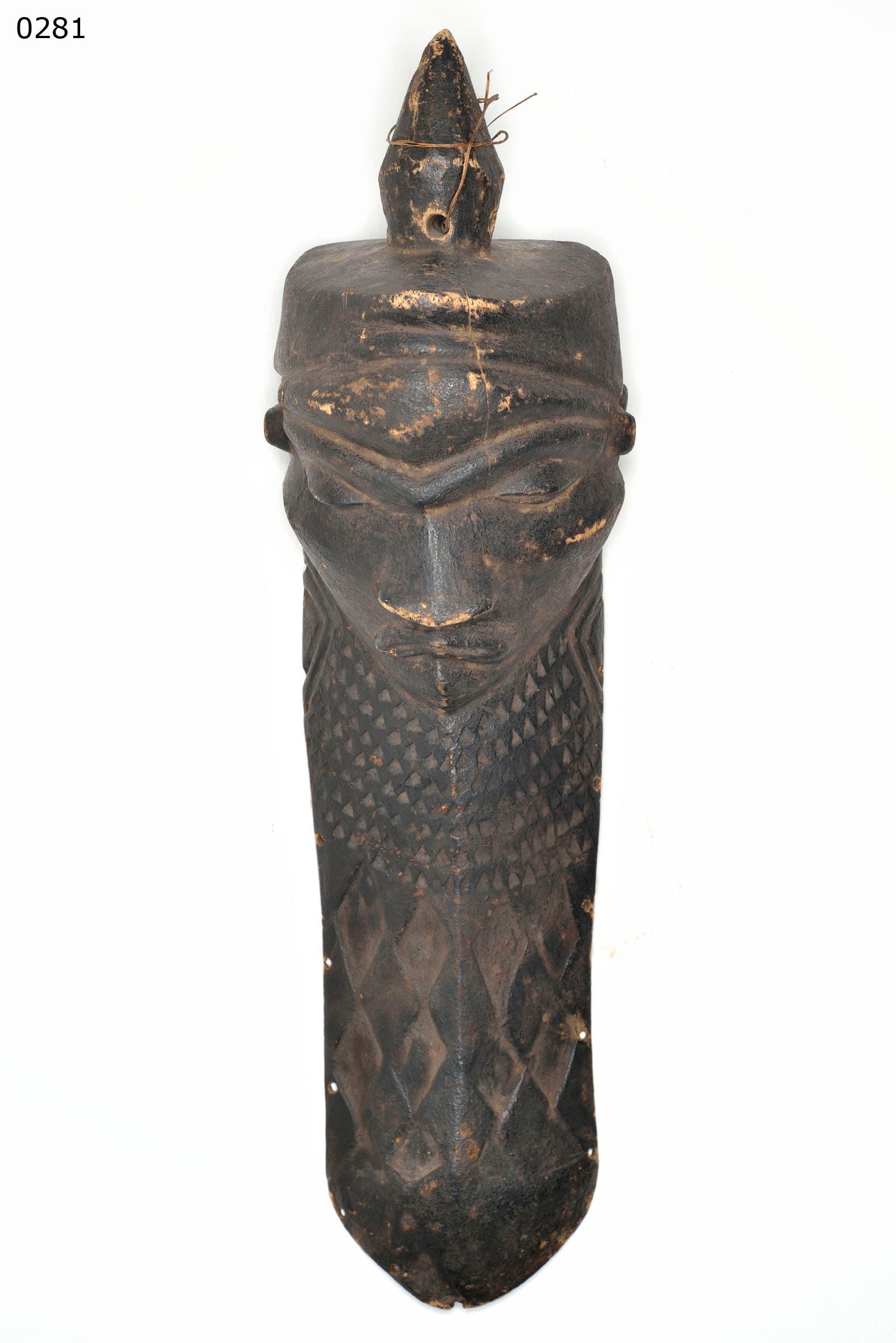
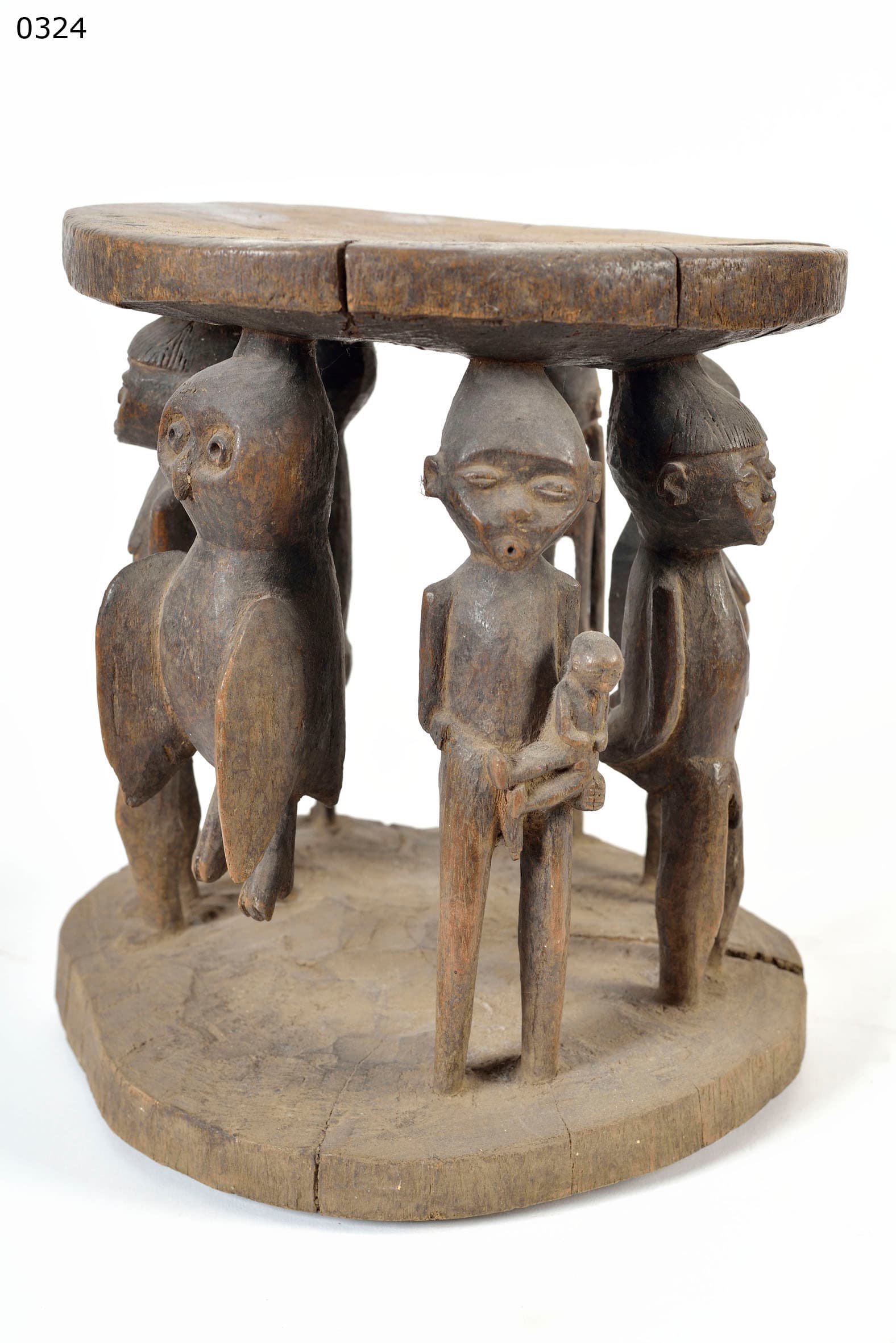
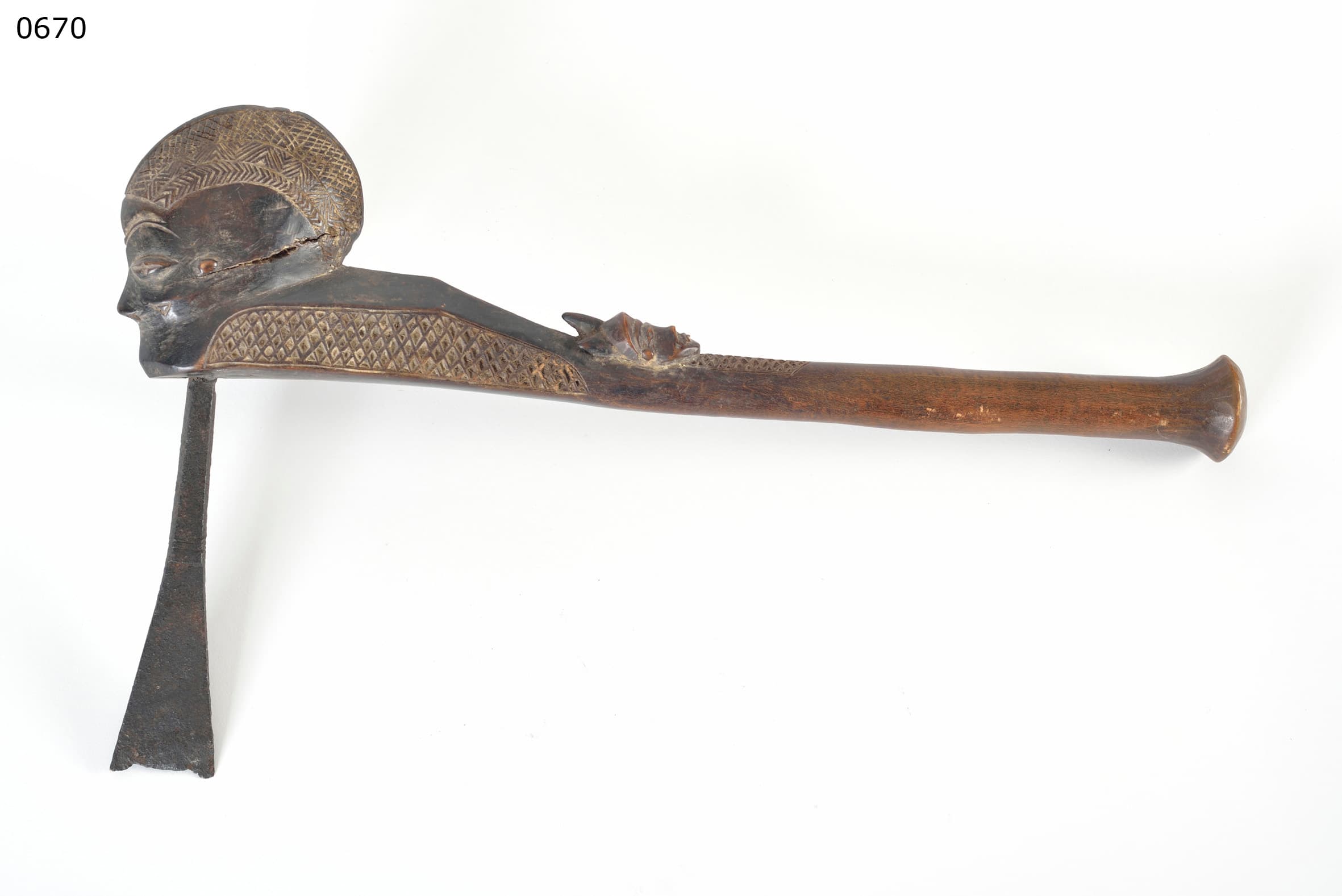
Pende art is one of the most expressive and diverse traditions in Central Africa and serves primarily as a visual vocabulary for social, political and spiritual concepts. The defining feature of their material culture is the immense variety of masks. It is estimated that the Pende repertoire comprises over twenty different mask characters and several specific power masks. In addition to masks, professional master carvers (Songi) also produce architectural elements such as carved panels, ritual stools, ceremonial axes and shrine figures. The present collection represents this spectrum excellently with masks (Nos. 0281, 0492), a panel (No. 0490), a stool (No. 0324) and an axe (No. 0670).
Stylistically and geographically, two dominant schools can be distinguished, which stem from the historical division of the people. The western Pende (Kwilu region) are famous for their Mbuya masks. These are characterised by a melancholic, introverted facial expression. Typical features include a strongly emphasised, often continuous eyebrow line, heavy, half-closed eyelids, prominent cheekbones and a mouth that is often slightly open and turned downwards. The face is usually triangular in shape. These masks often embody an idealised concept of beauty and radiate a dignified calm. In contrast, the style of the eastern Pende (Kasaï region) is significantly more geometric, abstract and colourful. Here, polychrome decorations dominate, particularly red and black triangular patterns on an ochre background. The eastern Pende are also known for their large-scale architectural carvings, such as doorposts or panels featuring mask motifs (see object no. 0490), which adorn the chiefs’ houses and visually reinforce their authority.
Another central element of Pende aesthetics is the preference for materials and pigments. Wood forms the framework of most permanent objects, but it is the application of natural pigments – red ochre, white kaolin and black vegetable dyes – that lends them their ritual efficacy. White often represents the world of the ancestors and spiritual purity, whilst red is associated with vitality, blood and rites of passage. Alongside wood, organic materials play a decisive role. The Minganji masks, which represent the ancestors, consist almost entirely of woven raffia fibres and do not feature detailed wooden faces. Even in wooden masks and body masks (such as object no. 0903), fibres, fabrics and animal skins are frequently incorporated to materialise the spirit’s presence in the dance.
Specific types of masks display highly coded features. The Kipoko mask, a helmet mask reserved for the chief, is characterised by strongly exaggerated facial features. Huge eyes and ears symbolise the leader’s duty to be vigilant and to see and hear everything that is happening in the community. The tiny mouth, on the other hand, serves as a reminder to speak little and instead to shine through deeds and care. Scarifications, which in reality were carved into the skin as signs of maturity and social status, are reflected as fine reliefs on the masks and figures, bearing witness to the mastery of the regional carving schools.
Ritual Practice
The ritual practice of the Pende is a dynamic system comprising performance, initiation and ancestor worship, in which artefacts are not passive objects to be viewed, but active, spiritually charged agents. The most important ritual foundation of the society is the Mukanda, the initiation camp for adolescent boys. This ritual marks the essential transition from childhood to adulthood and is of central importance for the reproduction of the social order. Boys aged between approximately 8 and 12 are separated from the female sphere for several weeks (historically often months or even years) in an isolated bush camp. There they undergo circumcision and receive instruction from masters such as the Nganga Mukanda in resilience, hunting techniques, myths, moral conduct and the secrets of the masks.
During the Mukanda and at the concluding celebrations, the masks make their appearance. The Minganji masks, made of raffia, embody the impersonal, fearsome power of the ancestors and death; they guard the camp and discipline the community. They are the ultimate figures of authority. In contrast are the wooden Mbuya masks, which function as ‘village masks’. They appear at festivals marking the end of initiation, the millet harvest or the installation of a chief. The Mbuya dancers portray a wide spectrum of human and superhuman characters: the chief, the soothsayer, the beautiful young woman, but also the madman, the epileptic or the executioner. Through satirical and didactic dances, they hold up a mirror to society, impart moral lessons and channel social tensions.
Ancestor worship permeates everyday life and demands constant ritual attention. The chief and the lineage elders act as mediators between the living and the Mvumbi. In this context, objects such as ritual stools (object no. 0324) and ceremonial axes (object no. 0670) play a pivotal role. A chief’s stool is not merely a mundane piece of seating furniture, but an altar and a physical point of contact with the earth and the ancestors. It legitimises the ruler’s power. The ceremonial axe, often masterfully crafted from wood and iron, is carried during dances and ritual addresses. It is a symbol of the leader’s ability to ‘cut through’ problems, to administer justice and to defend the community.
Female figures and body masks (such as object no. 0903) are also deeply embedded in ritual practice. Although the mask dancers are almost exclusively men, many masks represent female ancestors or ideals of female beauty and fertility. They honour the essential role of women in matrilineal society. Dance mask altar figures (such as Object No. 1127) often serve as stationary representations of the mask spirits in the chiefs’ shrines. They receive offerings and prayers when the actual masks are not being danced, thereby ensuring the permanent presence of the protective spiritual forces in the village.
Historical Context
The history of the Pende is a complex narrative of migration, resistance and cultural affirmation. As oral tradition and historical research show, their pre-colonial origins lie in the Cuanza River basin in what is now Angola. Pressure from the expanding Lunda Empire in the 17th century and subsequent devastating slave raids by the Chokwe in the late 19th century forced them into painful resettlements in what is now the Congo. These traumatic periods shaped a strong collective consciousness and the need to stabilise their own identity through ritual institutions such as the Mukanda and a highly differentiated mask culture.
The colonial period under Belgian rule represented a massive and violent turning point. The Pende were forced into an exploitative system of forced labour, which primarily served palm oil production (for the Huileries du Congo Belge) and cotton cultivation. Economic exploitation, coupled with oppressive taxes and the brutal suppression of local structures, culminated in 1931 in the historic Pende Revolt (also known as the Kwango Revolt). Led by charismatic figures such as Mundele Funji, the Pende rose up against the colonial order and capitalist monopolism. The uprising was crushed with extreme brutality by the Belgian Force Publique, resulting in hundreds of deaths (officially 344, unofficially far more) and the destruction of numerous villages. During this period, many ritual objects were looted, destroyed or taken to Europe as trophies.
Following the Congo’s independence in 1960 and during the Mobutu era, the Pende experienced a period of political instability, but also of cultural revival. Today, the state of tradition is ambivalent: urbanisation and socio-economic crises have transformed the practice of traditional rituals in some areas. Nevertheless, the culture proves to be extremely vibrant. An outstanding example of preservation initiatives is the Gungu Festival. Originally founded in 1925 and revived in 1998, it now serves as a central forum where the Pende celebrate their masked dances, myths and social identity, and pass them on to younger generations.
In the context of modern museum practice and private collections, the debate on provenance and restitution is increasingly coming into focus. Objects dating from the ‘first half of the 20th century’ – such as the seven pieces in this collection – fall precisely within the period of violent colonial consolidation and the brutal suppression of the Pende revolt of 1931. It is of crucial curatorial and ethical importance to critically examine the circumstances surrounding the acquisition of such objects. They are not only aesthetic masterpieces, but also material witnesses to a history of oppression and survival. Recognising this historical context is an indispensable step towards engaging with the Pende and their cultural heritage on an equal footing and with the respect they deserve.