Overview
The geographical distribution area of the Congo peoples (usually referred to as Bakongo in the ethnographic literature) extends over a transnational, topographically heterogeneous zone in western Central Africa. The historical and demographic heartland comprises the western Democratic Republic of the Congo (in particular the province of Congo Central), the south-western Republic of the Congo, the Angolan exclave of Cabinda and the north-western provinces of Angola down to Luanda. Ecologically, this area is characterised by the equatorial river basin of the Congo River, dense tropical rainforests, alluvial plains and drier plateaus in the south, whereby a bimodal climate system with distinct rainy and dry seasons determines the agricultural cycles.
The current population of the Democratic Republic of the Congo is estimated at 112.8 million and 116.4 million inhabitants for the years 2025 and 2026 respectively, which represents an enormous demographic dynamic with an annual growth rate of around 3.2 per cent. Within this macrocosm, the Bakongo form one of the three largest ethnic macrogroups alongside the Luba and Mongo. Estimates put the total number of Bakongo in the region at 10 to 15 million individuals, with Kikongo being used as a lingua franca by over 6 million native speakers and a further 5 million second language speakers. The urbanisation rate in the DR Congo is over 45 per cent, which has led to an increasing deterritorialisation of traditional clan structures in megacities such as Kinshasa.
Linguistically, Kikongo belongs to the Benue-Congo subgroup of the Niger-Congo language family. According to Malcolm Guthrie's classification, it falls into the Bantu zone H10. More recent phylogenetic analyses summarise the language more precisely as the Kikongo Language Cluster (KLC). This cluster operates as a complex dialect continuum of over 40 varieties (including Yombe, Ndibu, Ntandu), which is divided into four main geographical branches (North, South, East, West). Geographical barriers such as the Congo River and the Inkisi River have contributed significantly to the internal linguistic diversification of this cluster. The autonymic self-designation of an individual is MuKongo, the plural BaKongo, while the geographical-conceptual centre is simply referred to as Congo.
The pre-colonial subsistence economy was based on a system of agriculture (traditionally yams and taro, supplemented by manioc and maize after transatlantic contact), hunting, fishing and extensive trade networks. Due to their strategic geographical position, the Bakongo controlled the lucrative trade between the interior of the country and the Atlantic coast, whereby they entered into an intensive exchange relationship with neighbouring peoples such as the Teke (Tio) in the north at the Pool Malebo.
With regard to the social structure, the classification of the kinship system is the subject of intensive academic discourse. The sources are ambiguous and characterised by conflicting interpretations. The historian Anne Hilton dates the matrilineally organised clan structure (kanda) as an indigenous, pre-colonial relic of Congo society. Kajsa Ekholm and Jan Vansina, on the other hand, argue that matrilineality, as recorded ethnographically, is a secondary, historical adaptation. Vansina dates the consolidation of matrilineality in regions such as Mayombe as a socio-economic reaction to the dislocations of the Atlantic slave trade, in which the accumulation of women and slaves served to secure alliances and prestige within a primarily patrilineal base, while Hilton insists on linguistic evidence in early dictionaries. Notwithstanding this controversy over the micro-social kinship lineage, the macro-structure manifested itself in a highly hierarchical, centralised state structure: the Kingdom of Kongo. In contrast to the acephalous societies of many African ethnic groups, the Mwene Kongo (or Manikongo) ruled from the capital Mbanza Kongo over a network of twelve provinces administered by appointed governors. Collections of historical documents mapping this social structure are now systematically archived, particularly at the Royal Museum for Central Africa (RMCA) in Tervuren.
| Demographic & Linguistic Parameters | Specification of the Congo Region |
|---|
| Classification of the language family | Niger-Congo > Benue-Congo > Bantu (Zone H10 according to Guthrie) |
| Linguistic macrostructure | Kikongo Language Cluster (KLC) with >40 varieties (Yombe, Ntandu, Ndibu) |
| Population estimate DR Congo (total) ~112.8 million (2025) to ~116.4 million (2026) | |
| Bakongo population estimate | ~10 to 15 million in DRC, Angola, Republic of Congo, Gabon |
| Core social unit | Kanda (clan/lineage) - debate about primary matrilineality vs. patrilineality |
Cultural context
The Bakongo religious system, often subsumed under the term Bukongo, presents a highly complex, structured ontology that interweaves material and immaterial dimensions within a rigid cosmological framework. At the top of the cosmic hierarchy is the creator god Nzambi Mpungu (often invoked in duality with a female entity, Nzambici). Nzambi Mpungu is regarded as the absolute origin of all life and all energy. Nevertheless, in everyday ritual practice he takes on the role of a deus otiosus (a distant, dormant god) who is not invoked directly through shrines or sacrifices. Instead, the operative centre of the religion lies with two categories of intermediaries: the ancestors (bakulu) and the nature or water spirits (bisimbi, singular: simbi).
The architecture of this metaphysical system is graphically depicted by the dikenga dia Kongo (also known as the yowa cross), the Kongo cosmogram. This cosmogram acts as the ultimate blueprint for understanding life, death and ritual empowerment. It divides the universe into two symmetrical hemispheres by a horizontal boundary line, the Kalûnga line: The upper half represents the physical world of the living (ku nseke), while the lower half represents the spiritual world of the dead and spirits (ku mpèmba). The human soul passes through the four moments of the sun in a permanent cyclical rotation: Kala (dawn, birth), Tukula (zenith, maturity and flowering), Luvemba (dusk, physical death) and Musoni (midnight, reorganisation in the ancestral realm). The forest zones (mfinda) and aquatic spaces serve as transitional spheres in which the bisimbi escort the souls as they cross the border.
The executive exercise of ritual power within this cosmology is the responsibility of the nganga (plural: banganga). The nganga acts multivalently as priest, divinator, healer and legal actor, whose authority is based on a profound knowledge of the dikenga cycles and the manipulation of spiritual substances. A structural peculiarity of the Congo religion, which sets it massively apart from neighbouring ethnic groups, is the institutionalisation of power through extensive, syncretic secret societies and initiation academies such as Lemba, Kimpasi and Nkimba.
An iconographic and sociological controversy in research centres around the interpretation of these societies. In the early 20th century, the early Belgian ethnologist Edward DeJonghe analysed these confederations almost exclusively through the paradigm of evolutionist anthropology as psychological puberty and rebirth rites, based on the models of James Frazer. Anthropologist John M. Janzen, on the other hand, dates and interprets the Lemba Confederacy as a highly developed socio-economic response to the destabilisation caused by the transatlantic slave trade in the 17th century. Janzen argues that Lemba was not an archaic fertility sect, but a transregional regulatory body of the elite that oversaw markets, marriage alliances and trade, and monopolised social wealth through therapeutic and legal rites.
The role of women in the Bakongo cult is significant and reflects the at least partial matrilineality. Women not only acted as founders of lineages, which was cultically honoured in the Pfemba cult, but also held high ranks in the secret societies (such as Mama Mbondo or Mama Kongo in the Nkimba). Outstanding historical figures such as Dona Beatriz Kimpa Vita began their religious careers as Nganga marinda (prophetess and healer) in the Kimpasi cult, which practised ritual "deaths" and "rebirths" in water-filled cross-shaped trenches.
Structurally, this system differs significantly from the religions of its eastern neighbours, such as the Luba. While the spiritual power of the Luba is deeply tied to the genealogy of royal blood and immobile, localised earth spirits, the Congo religion is based on portable spiritual technology (minkisi) and an initiation-based meritocracy. This structural portability enabled the survival of Kongo cosmology (and the dikenga concept) in the transatlantic slave trade, which laid the foundations for Afro-Atlantic diasporic religions such as Vodou, Palo Mayombe and Hoodoo. Artefacts from these secret societies and cosmological models are now central research objects in the Fowler Museum at UCLA.
| Cosmological phase (Dikenga) | Solar position | Existential cycle | Spiritual connotation |
|---|
| Kala | dawn | birth / new beginning | manifestation in the physical world (ku nseke) |
| Tukula | zenith | maturity / flowering | highest physical power, associated with red padouk pigment |
| Luvemba* | Twilight | Old age / death | Crossing the Kalûnga line, white kaolin pigment |
| Musoni | midnight | spiritual existence | reorganisation in the ancestral realm (ku mpèmba), invisible sphere |
Aesthetic features
The canonical object corpus of the Congo peoples is defined by an aesthetic that is consistently subordinated to ritual operativity. In this context, the term art is a Western construct; for the Bakongo, it is an instrument of spiritual technology. The typology can be summarised in four primary, iconographically sharply defined subcategories: minkisi nkondi (nail figurines), pfemba (mother-and-child statuettes), mintadi (steatite memorial figurines) and nkangi kiditu (syncretic crucifixes).
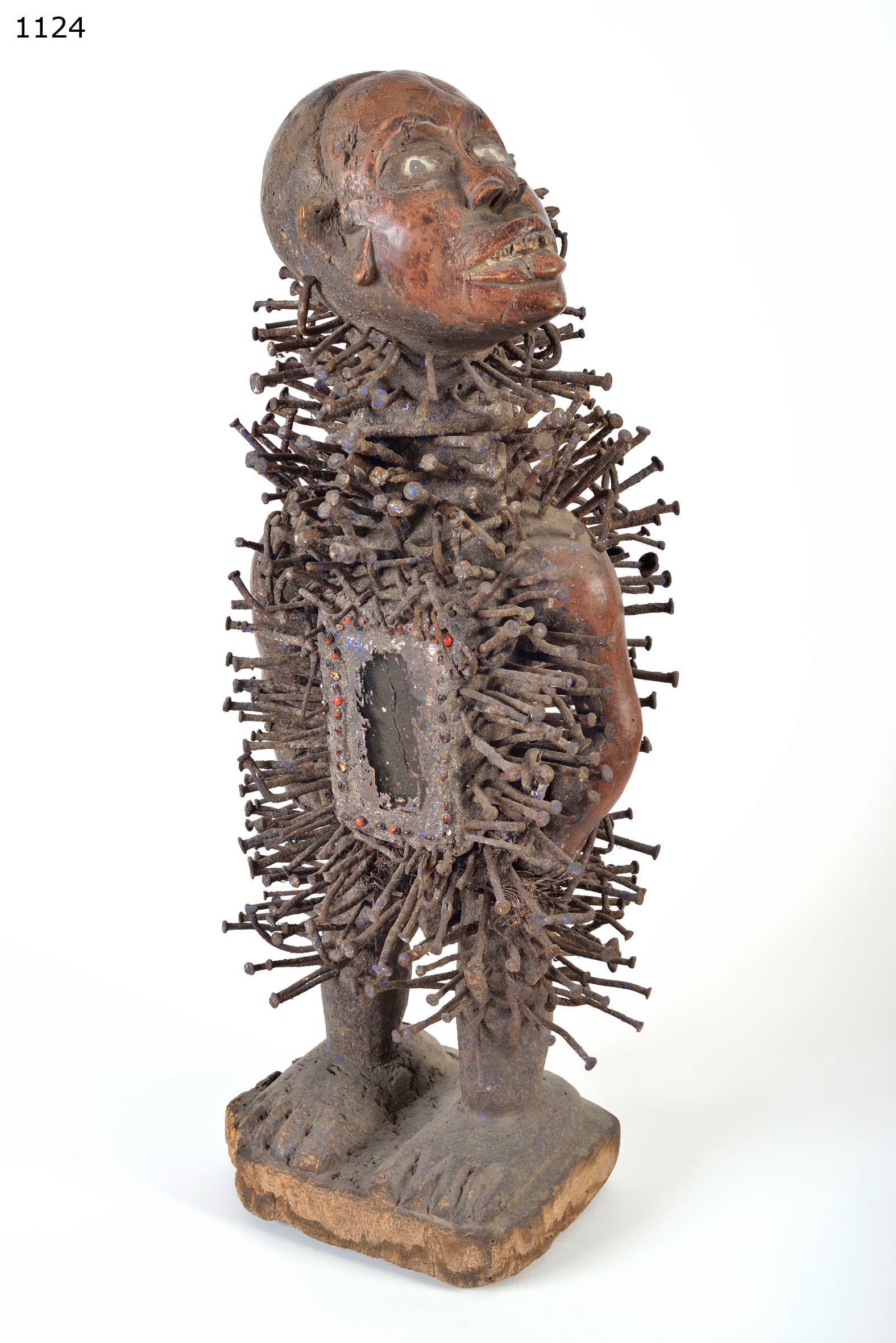
The most prominent group of objects are the minkisi nkondi (singular: nkisi nkondi), whose morphology is designed for pure intimidation and aggressive vigilance. The mostly anthropomorphic (sometimes worked as two-headed dogs, kozo) wooden sculptures display an extreme canon of proportions in which the head and abdomen - as seats of perception and vitality - are depicted hypertrophied. Standard iconographic features include the pakalala pose (hands on hips or a raised, spear-wielding arm), bared, partially filed teeth and wide-open eyes inlaid with white glass or porcelain. This piercing gaze indicates the spirit's ability to penetrate the invisible and detect witchcraft (kindoki). The size spectrum of these objects is considerable and varies from twenty centimetre small amulets to monumental community figures of the mangaaka class over 115 centimetres high, the best-known examples of which are now in the Metropolitan Museum of Art (Met) and the Rietberg in Zurich.
The pfemba maternity figures form the opposite pole in terms of form and content. These wooden statuettes epitomise the ideals of contemplation, fertility and aristocratic dignity. The canon of proportions is much more naturalistic here. The figures show a woman sitting cross-legged (funda nkata) on a pedestal and holding a child. The iconographic density is enormous: the complex mphemba hairstyle (a kind of mitre), precise breast and back scarification (marking tactile and erotic value) and filed teeth identify the subject as a clan founder or elite midwife.
The mintadi (singular: ntadi) are a unique material in Central Africa, as they are made of steatite (soapstone). These figures, which are up to 60 centimetres high, were not used as active power objects, but as permanent, memorial grave monuments for high-ranking chiefs in the Boma region. Iconographically, poses of reflection and wisdom dominate here, such as the fumani pose (the head resting slightly asymmetrically on the hand), often complemented by insignia such as the mpu hat or leopard claws. The fourth category, the nkangi kiditu, documents the material fusion of European brass casting and African formal language. These Christian crucifixes show an Africanised body of Christ with flattened hands and feet, often clothed in a traditional raffia cloth, and are framed by secondary assistant figures (ancestors or mourners).
The choice of material for the wooden objects and the development of the patina are chemical indicators of ritual practice. A sculpture freshly delivered by the carver is a purely profane piece of wood; only the intervention of the nganga completes the transformation into an activated ritual object. The patina consists of layers of ritual offerings and pigments, especially tukula (red padouk wood), which marks blood relations and liminal states, as well as white kaolin and charcoal.
Although the indigenous names of the sculptors are largely lost, art historical research has been able to identify specific master craftsmen and workshops on the basis of stylistic analyses. There is an absolute authorship dichotomy between the Master of Kasadi and the Master of Boma-Vonde. While the Master of Kasadi (known for Pfemba and Nganga masks) created figures with emaciated, severe facial features and a psychological and spatial distance between mother and child, the Master of Boma-Vonde is characterised by voluminous, soft forms and a harmonious physical integration of the infant into the mother's body.
Due to the massive market relevance of Congo art, forgery criteria are essential for private collectors. Forensics today is based on several parameters: The examination of heartwood cracks differentiates between natural ageing over decades and artificial kiln drying. The patina of forgeries is often structurally uniform and lacks the microscopic, diachronic layering of genuine offerings (in addition, solvent or artificial smoke odours reveal modern manipulations). Genuine insect feeding marks (termites) exhibit complex systems of passages congruent with the ageing process of the wood, while forgers often drill mechanical holes. However, the absolute gold standard of authentication for minkisi is computer tomography (CT), which can detect verified, undisturbed bilongo complexes in the interior (such as octahedral magnetite crystals or exotic bird bones).
| Stylistic & Iconographic Characteristics | Favoured Motifs | Workshop / Master Hand |
|---|
| Master of Kasadi | Emaciated faces, experimental forms, analytical distance, spatial separation of figures | Pfemba (Maternity), Nganga masks |
| Master of Boma-Vonde | naturalism, soft curvatures, proportional emphasis on the head, tender intimacy | Pfemba (Maternity), memorial sticks |
| Bamboma stone carving | Asymmetrical posture, Fumani (thinker) pose, Funda Nkata (cross-legged) | Mintadi (steatite memorial figures) |
Ritual practice
The ritual practice that transforms a Bakongo artwork from a profane artefact into a numinous centre of social power is a highly orchestrated performance. The lifecycle of a nkisi - from its initiation to its disposal - is controlled solely by the nganga (ritual specialist).
After the carver has completed the wooden corpus, the object is merely empty matter in Kongo cosmology. Activation begins with the insertion of the bilongo (the sacred medicine) into the designated cavities (mooyo), which are usually located in the abdomen, but sometimes also in the head of the figure. The bilongo is a complex composition of animal, mineral and botanical elements, the selection of which is based on metaphorical and linguistic correspondences (puns in Kikongo). Earth from ancestral graves (to bind the spirit of the dead), bird claws (to "pull out" diseases) or magnetite crystals (to "attract" and render harmless enemy magic) are used. This charge is often sealed behind a mirror, glass or cowrie shell. The mirror not only acts as an apotropaic reflector, warding off the harmful gaze of sorcerers (ndoki), but also serves the nganga in trance as a divinatory interface to look into the world beyond (ku mpèmba).
The active use phase, especially with the minkisi nkondi, is characterised by ritual aggression and formalised interaction with the community. The figures function as communal altars for social justice, healing or the signing of contracts. During the performance, the nganga provokes the spirit residing in the nkisi by invoking the figure with incantations, feeding it with palm wine or awakening it with small explosions of gunpowder. The offerings usually consist of chewing tobacco, regionally brewed alcoholic macerates or, in exceptional cases, animal blood, which is rubbed over the blades or into the figure's open mouth.
The act of striking metal parts (koma nloko) is the physical manifestation of the ritual. Here, the material nature of the hardware is highly semantically charged: A heavy, square iron nail (nsonso) is driven deep into the wood to atone for serious crimes such as murder or to seal existential oaths. Lighter blades or wedges (baaku) are used for minor disputes, curing illnesses or protecting against theft. To make the pact irrevocable, petitioners must often wet the blade with saliva before striking it, binding their physical and verbal intent to the nkondi.
There is a wide-ranging research controversy in African studies regarding the exact iconographic function of these nails. Wyatt MacGaffey argues that the nails primarily represent legal and contractual documents; the nkisi nkondi functions as a visual and legal archive of the community, in which each nail represents a reified oath or a concluded contract. Robert Farris Thompson, on the other hand, sees the nails less as legal records and more as aggressive markers of ritual hunting. For Thompson, the ncondi is the ultimate avenger ("hunter"), and the hammering of the nail is a performative provocation that incites the spirit to aggression against enemies.
The life cycle of a nkisi is organically limited. When the object loses its ritual effectiveness, the social crisis to be resolved has ended or the nganga responsible dies without leaving a successor, the nkisi is ritually deactivated. Simply disposing of it is strictly taboo due to its inherent power. The deactivation, or "killing" of the object, is achieved by destroying the reflective surface and physically removing the bilongo from the body cavity. Without this spiritual charge, the once mighty sculpture regresses back to a simple piece of wood. The fact that many of the exquisite mangaaka figures in Western collections today - such as those in the Musée du quai Branly or the Met - have empty abdominal cavities is often not the result of European vandalism, but testifies to a controlled, ritual deconsecration by the Congolese themselves before they handed over the now powerless shells to colonial traders. On the other hand, numerous intact objects were simply burnt at the stake in iconoclastic actions by missionaries and converts during the imposition of Christianity.
| Hardware typology | Material composition | Ritual semantics and occasion |
|---|
| Nsonso | Heavy, square iron nails or large spikes | Marking serious offences (murder), existential oaths, severe curses |
| Baaku* | Flat blades, wedges or pointed pieces of metal | Treatment of illnesses, settling minor social disputes |
| Bilongo | Medicine (magnetite, burial earth, claws, ashes) | Activation of the spirit, anchoring the ancestral sphere, defence against witchcraft |
Historical context
The historical chronology of the Congo peoples and the evolution of their material culture are characterised by an unprecedented transcontinental exchange that began long before European colonialism proper in the 19th century. The archaeological and linguistic history of migration dates the consolidation of the first proto-Congolese communities south of the Congo River to the 13th-14th centuries, where small chiefdoms merged to form the powerful Kongo Kingdom.
The historical paradigm shift that revolutionised the art and cult history of Central Africa took place in 1482 with the arrival of the Portuguese fleet under Diogo Cão at the mouth of the Congo River. As early as 1491, the reigning Manikongo Nzinga a Nkuwu voluntarily allowed himself to be baptised Catholic under the name João I. This early colonial encounter initiated a profound visual and theological transformation. In her groundbreaking monograph The Art of Conversion (2014), Cécile Fromont demonstrates in detail that the Christianisation of the Congo was not a passive process enforced by European armies. Rather, the Congo elite used Christianity strategically as a diplomatic weapon to consolidate international alliances with Portugal and the Vatican. Local art production assimilated European iconographies: the Christian cross was synchronised with the traditional dikenga cosmogram; crucifixes (nkangi kiditu) were reinterpreted as the highest insignia of power and at the same time as protective amulets (minkisi) against witchcraft. This theological Africanisation reached its radical climax in the early 18th century in the Antonianism movement led by Dona Beatriz Kimpa Vita.
Despite this adaptive feat, the kingdom imploded from the 17th century onwards. The transatlantic slave trade, in which the Congo elite were deeply involved as brokers, led to extreme demographic depopulation and bloody civil wars (such as the Battle of Mbwila in 1655). When the territory was formally divided into Belgian, French and Portuguese colonial possessions in the course of the Berlin Congo Conference (1885), the systematic plundering and extraction of the material culture began.
This colonial seizure marked the beginning of the Western market history of Congo art. In the late 1880s and early 1900s, traders, colonial officials and ethnographers acted as the primary agents of art transfer. Figures such as the German merchant Robert Visser, who shipped huge quantities of ivory carvings and minkisi from the Chiloango region to Europe between 1882 and 1904, or Belgian missionaries such as Léo Bittremieux (who collected the works of the Kasadi workshop), laid the foundations for the large museum collections in Berlin, Leipzig and Tervuren. Initially degraded in ethnological cabinets of curiosities as "fetishes" and evidence of "pagan superstition", their reception only changed in the second half of the 20th century. Groundbreaking exhibitions, in particular The Four Moments of the Sun (1981, National Gallery of Art) by Robert Farris Thompson and the more recent retrospective Congo: Power and Majesty (2015, Met), definitively transferred the objects into the canon of global high art. This paradigm shift was reflected in an explosion of prices on the art market, where rare, well-documented Pfemba figures now fetch top prices, as evidenced by the sale of a specimen from the Rubin collection at Sotheby's in 2011 for 1.87 million US dollars.
This price trend is now causing a massive problem of forgery. The authenticity test (as already explained in Aesthetic characteristics) is based on forensic procedures: The analysis of the heartwood must show natural shrinkage cracks, the patina must confirm the chemical layering of palm kernel oil, tukula wood dust and kaolin, and the feeding marks of termites must not reveal mechanical drilling. Computer tomography to verify unopened mooyo cavities is essential.
The most complex and topical historical caesura, however, is the institutional restitution debate. Belgium, which holds around 120,000 African objects through the Royal Museum for Central Africa (RMCA) in Tervuren, passed an unprecedented restitution law on 30 June 2022. This law explicitly recognises the alienability of state colonial holdings. Objects that were demonstrably acquired by force, violence or looting between the Berlin Conference (1885) and Congolese independence (1960) can be restituted to the Democratic Republic of the Congo after examination by an equal, scientific joint commission. The legal controversy here lies in the separation between ownership and physical possession: while the legal ownership rights can be transferred to the DRC, many objects will initially remain physically in Belgian institutions as "loans on deposit" until adequate conservation infrastructures have been established in the DRC. This law sets a precedent that forces private collectors to proactively and completely document the acquisition history of their Congo artefacts in order to withstand legal and ethical challenges.
Sources & References
This dossier draws on standard scholarship in Kongo studies. For deeper reading and image archives, see:
Inline citations in this dossier refer to canonical scholarly works on Kongo art; full bibliographic resolution is pending a researcher pass.