Overview
The geographical distribution of the Kuyu (mostly documented as Kouyou in Francophone and Anglophone literature) is centred on the northern territory of the present-day Republic of Congo (Congo-Brazzaville). Their historical and current core settlement area extends specifically over the administrative Cuvette region, where they traditionally inhabit the dense equatorial riparian zones of the eponymous Kuyu River - a central tributary of the Likouala-Mossaka within the extensive Congo basin (Poupon 1918: 78). The linguistic categorisation of the Kuyu is clear: they belong to the macro-family of Central African Bantu languages, which places them in the overarching context of the continent's historical Bantu migrations (Ethnologue 2016: 1). In contemporary ethnographic records, the self-designation of the ethnic group largely coincides with the foreign designation by neighbouring groups, although the spellings vary.
With regard to demographic recording and the exact classification of population size, there are glaring discrepancies in research, which can be attributed to different ethnological categorisation criteria. The source situation is ambiguous in that recent demographic data fluctuates massively.
| Publication / Institution | Demographic Estimation | Classification Method |
|---|
| Joshua Project (2016) | approx. 1,800 individuals | Strict isolation as an independent, linguistically separate Koyo core group |
| Baquart (1998) | > 40,000 individuals | Macro-classification including neighbouring Mbochi subgroups |
| Bénézech (2021) | Minority (without exact number) | Definition as historical core group marginalised by Mbochi assimilation |
| World Bank / Census (2024) | 316,599 (total Cuvette) | Purely administrative, transethnic census of the Cuvette department |
These diverging figures reveal a fundamental controversy of classification: while older administrative reports of the French colonial period postulated fluid, barely separable transitions between the Kuyu and their direct neighbours (especially the Mbochi and Makua), modern art historians argue for a sharp separation. Bénézech argues strongly in favour of a strict ethno-stylistic separation, as the Kuyu, as a formerly dominant group, became a minority through Muslim penetration and Mbochi assimilation, but their material culture remained highly distinctive (Bénézech 2021: 11). The Royal Museum of Central Africa (RMCA) in Tervuren reflects this blurring by often subsuming Kuyu artefacts in its historical archival holdings under regional Mbochi or indeterminate 'Congo Basin' categorisations (RMCA Archives 2009: 124).
The social structure of the Kuyu is strictly acephalous and is based on a complex, decentralised kinship system (Bénézech 2021: 11). In sharp contrast to the highly hierarchical, centralised monarchies of neighbouring cultures (such as the pre-colonial Kuba empire or the Luba), the Kuyu have no overarching chief or king who exercises far-reaching territorial power. Political, legal and ritual authority is maintained at local village level by councils of elders and powerful cross-lineage secret societies (Siroto 1969: 1). The kinship lineage and succession is primarily patrilineal in structure, although at a fundamental level society is divided into two mythically based main clans, represented by the totem animals panther and snake (Baquart 1998: 1). The subsistence economy of the Kuyu is primarily based on intensive fishing in the river systems, supplemented by hunting in the rainforest and a rudimentary subsistence agriculture based on manioc and yams, which is adapted to the precarious ecological conditions of the Cuvette region (Poupon 1918: 210).
Cultural context
The Kuyu religious system operates within a deeply rooted animistic cosmology, the undisputed centre of which is the so-called Djo cult (also documented as the Ebongo cult). The cosmological order is structured by the omnipotent creation principle of the serpent. The creator god and mythical serpent ancestor Djo - specifically visualised as a viper in Kuyu iconography - is regarded as the absolute origin of all life, from which the primordial ancestral couple of humanity emerged (Bénézech 2021: 124). This genesis manifests itself in the ritual through specific, ever-present ancestral and spiritual beings: Ebotita represents the maternal, nurturing guardian spirit, Djoku embodies the chastising, paternal spirit, and these are flanked by a multitude of Euya. The latter are transcendent serpent people who act as ritual messengers between the sphere of the living and the ancestors (ROM Catalog 2022: 1).
The maintenance of this complex cosmological order and the ritual authority are not the responsibility of individual priests or divinators, but of the collective initiation covenants. The exclusive Otwere society (sometimes referred to as Ottoté society in the older literature), which regulates the social cohesion of the acephalous society, preserves esoteric knowledge and executes legal sanctions, holds the absolute supremacy (Baquart 1998: 1). In structural contrast to the patriarchally dominated, exclusively male ancestor cults of neighbouring peoples such as the Teke or Fang, the Kuyu religious system exhibits a remarkable gender duality. Initiation into cosmology is mandatory for both sexes in order to attain the status of a fully-fledged member of the ethnic group; however, the cycles are sharply separated spatially. Male initiates spend months, historically sometimes years, in complete isolation in the equatorial forest to learn survival techniques and the hermetic secret knowledge of the Otwere covenant. Female initiates, on the other hand, are isolated in specifically decorated huts in the village association, where they are physically and spiritually prepared for their social role (ROM Catalog 2022: 1). Both cycles culminate in the joint, public performance of the Kebe-Kebe rite of passage.
There are profound research controversies in the ethnographic literature regarding the primary ritual authority and authorship of this central cult of women and men. Poupon (1918: 55) argues, based on initial Western observations, that a woman revealed the initial secret of the snake dance to a Kuyu chief, whereupon the men monopolised the cult. In diametric contrast, Bénézech (2021: 124), drawing on deeper oral traditions of the Nuguilima and Ngaé, argues that the Kebe-Kebe was created by women for exclusive female ritual alliances before it was usurped and patriarchally restructured through violent social conflict. The Royal Ontario Museum (ROM), which curates a significant collection of Otwere initiation objects, explicitly refers in its object analyses to the identity-creating function of these rituals in society as a whole, which relativises a purely male hegemony and confirms the role of women in the cult as elementary (ROM Catalog 2022: 1). What structurally distinguishes this religion from neighbouring peoples is the uncompromising focus on the snake metaphor as an all-encompassing, both destructive and life-giving principle, while neighbouring groups (such as the Kwele) cultivate far more diversified forest spirit pantheons (Siroto 1969: 1).
Aesthetic features
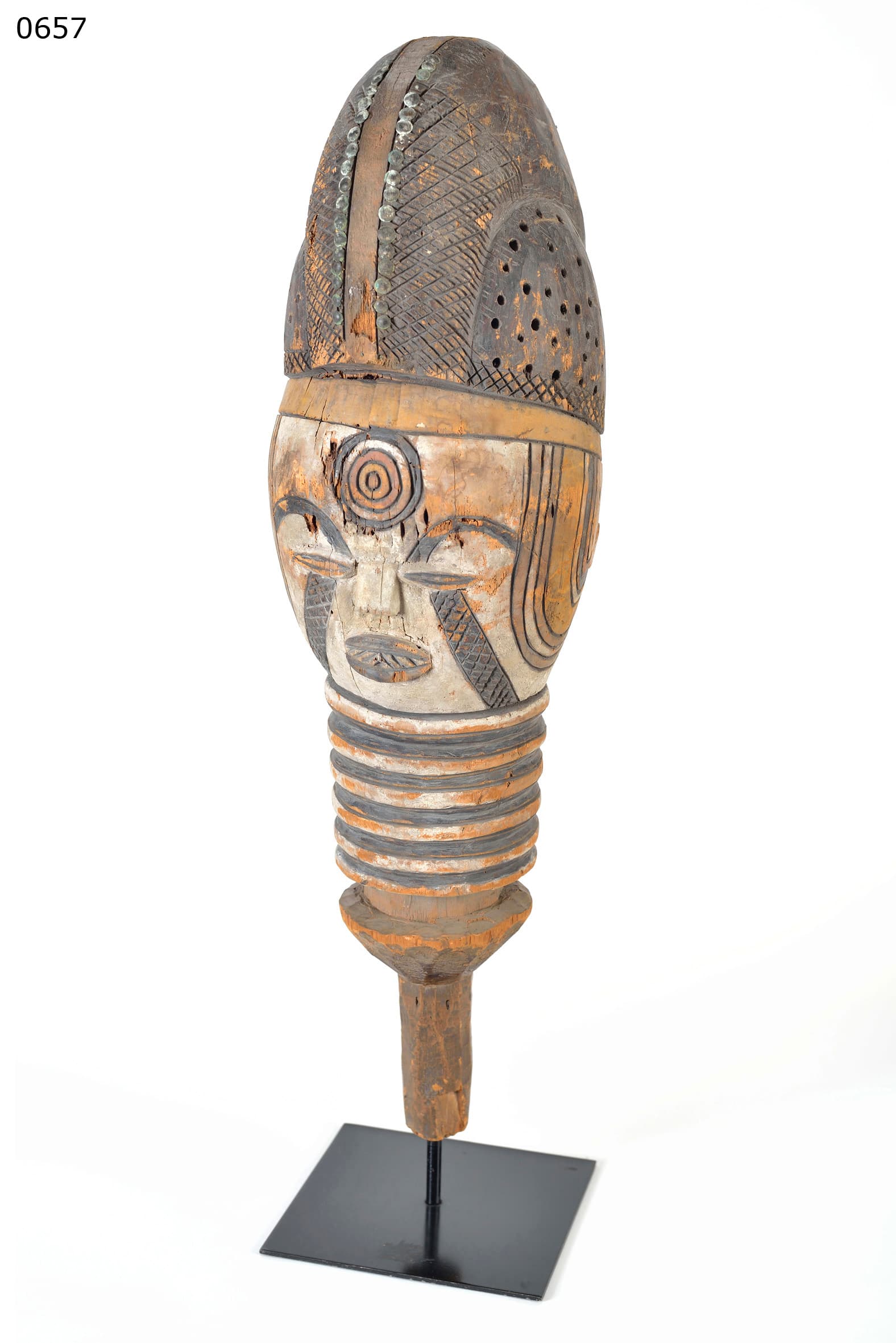
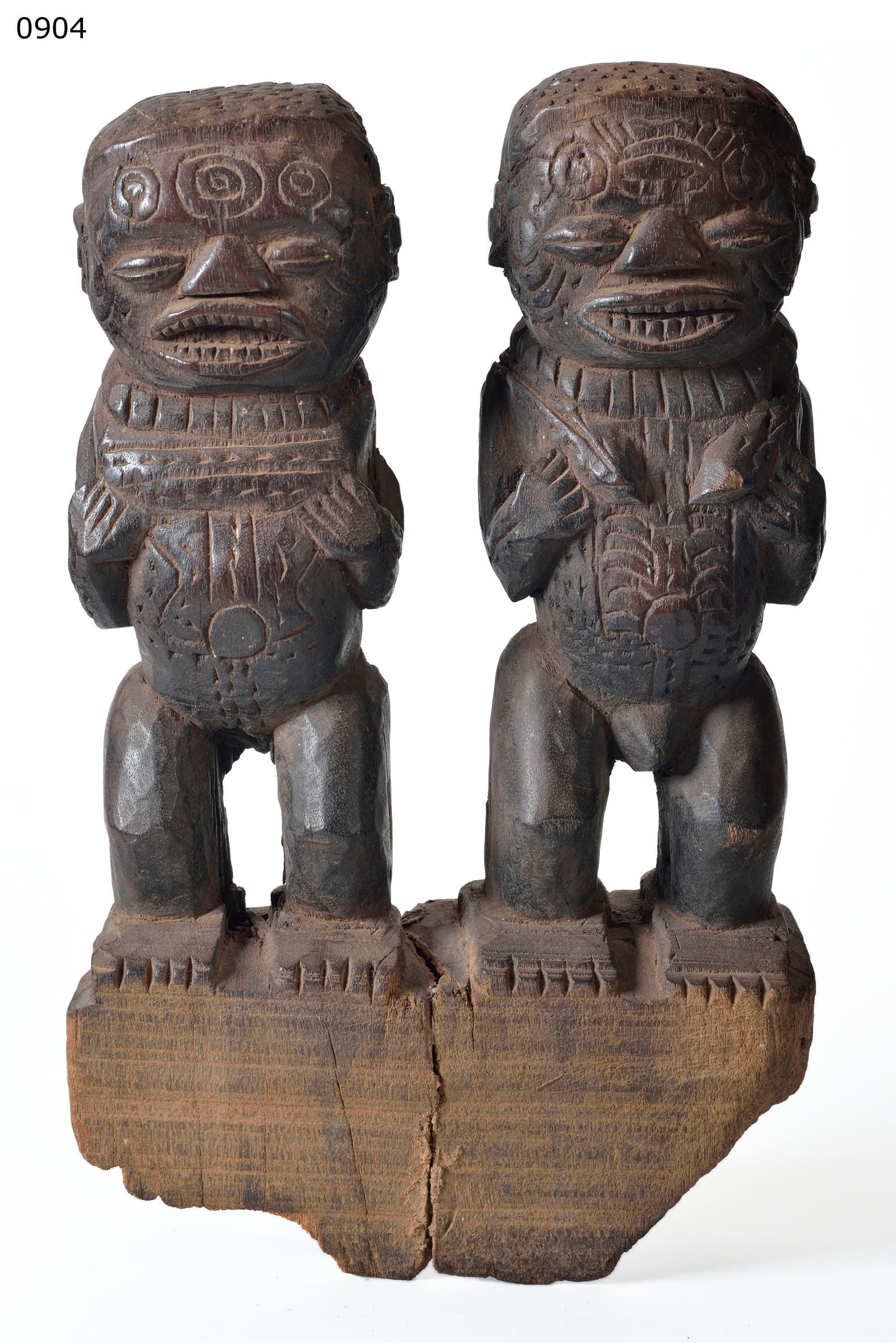
The canonical object typology of the Kuyu is almost without exception dominated by the characteristic dance sticks (marottes), which are used in the Kebe-Kebe dance. These sculptures, consisting of an expressively carved anthropomorphic head resting on a long, cylindrical wooden shaft often measuring over 50 centimetres, form the main sculptural work of the ethnic group (Metropolitan Museum 2006.447). This spectrum is complemented by extremely rare, freestanding wooden statues with masculine, feminine or androgynous fused features, whose exact ritual embedding apart from the snake cult is, however, only fragmentarily documented (Bénézech 1988: 53).
A distinctive, strict canon of proportions characterises the physiognomy of all Kuyu objects. The faces are mostly oval to slightly conical in shape and show deep, geometrically precisely arranged scarification marks running horizontally across the cheeks (ROM Catalog 2022: 1). A central iconographic feature is the almost always slightly open lips, which expose pointedly filed teeth - a locally documented ideal of female beauty and visual proof of a successfully completed initiation (ROM Catalog 2022: 1). The head is finished off with extremely elaborate, mostly bilobed (two-lobed) or conically towering hairstyles, which are crowned with animal symbols such as chameleons, lizards or snakes in high-ranking pieces in order to visualise the connection to the Djo cult (Baquart 1998: 1). The material used is predominantly soft, light-coloured tropical wood (mostly alstonia), which is given an intense, all-over polychromy. Kaolin white, deep red ochre and black and yellow natural pigments dominate (Bénézech 2021: 27).
Bénézech (2021: 9) divides the known corpus into three phases based on chronological and morphological criteria. The first two phases, which can be attributed exclusively to the Kuyu ethnic group, comprise extremely rare, old pieces (pre-1900) with restrained colouring. The third style phase comprises Kuyu and later Mbochi works, forms quantitatively the largest surviving sculptural corpus and is characterised by iconic, garish polychromy. It is precisely this morphological development that ignites the most central iconographic controversy in Kuyu research: the influential trader Jacques Kerchache (1971) and the ethnologist Léon Siroto (1976: 103) viewed and publicised the Kuyu staffs primarily as "abstract heads" through a strongly modernist, Western lens. They isolated the design from its mythical context and interpreted them as pure formal masterpieces of geometric abstraction, in keeping with the taste of the Western avant-garde. In direct contradiction to this, Bénézech (1988: 56), drawing on the early field notes of Poupon (1918: 78), argues that this Western reading is blatantly deficient. Bénézech demonstrates that these objects are not profane "abstract studies of form", but literal narratives of snake cosmology: the geometric patterns of the scarification represent snake scales, the phallic symbolism of the shaft symbolises procreative power, and the overall form manifests the origin myth of the Djo cult.
An activated ritual object staff differs fundamentally from a profane representational object. The Metropolitan Museum of Art preserves an outstanding example of this typology (a three-headed male figure, inv. 2006.447), which documents the complex craftsmanship of master workshops that are no longer known by name. With regard to the art market, there are strict and market-relevant forgery criteria. Authentic, ritually used sticks (pre-1930) reveal an organically grown "dance patina": the wood on the shaft has been deeply smoothed over decades by sweat, palm oil and the dancers' frictional handling ("gripped wood"), while the polychromy shows authentic traces of abrasion in layers.
Ritual practice
The physical performance of the Kebe-Kebe dance represents the absolute ritual zenith of Kuyu culture. This complex performative act bridges the profane sphere of the village community with the sacred world of the ancestral spirits. In the ritual structure of the masquerade, the human form of the dancer is completely negated. The performer is concealed under a massive, tent-like cloak made of tightly woven raffia, which is explicitly referred to as "snake skin" in the ritual terminology of the Otwere covenant (Fowler/UCLA Archives 1964: 84).
The ergonomic and kinetic mechanics of this performance are unique in Central Africa. The dancer grips the cylindrical shaft of the wooden marotte from below, deep inside this heavy raffia garment. He stretches the polychrome sculpted head far above his own head and supports the entire construction by exerting enormous physical force to keep the object in balance. This specific vertical handling enables the dancer to create the optical illusion of a gigantic, rearing snake. The rapid raising and lowering of the shaft under the fabric can evoke drastic and abrupt changes in size - the figure can shoot up from a crouched position close to the ground to a height of over two metres in a fraction of a second (Poupon 1918: 78).
The object is not activated by a singular, static priestly consecration or the application of fetish materials (as with the neighbouring Teke), but purely performatively through the dancer's kinetic energy and the driving, rhythmic chants of the surrounding audience. This auditory and physical symbiosis puts the dancer in a state of trance, whereby the spirit of Djo enters the object. The choreographic movement sequences are strictly codified and serve to somatically imitate the snake's morphology: the dancer crawls, writhes, performs rapid, wave-like rotational movements and whirls around his own axis until the bast cape swings out horizontally like a massive snake's body (Poupon 1918: 78). Offerings and libatory acts (such as the spilling of palm wine or the offering of food to the ancestors) do not usually take place during this frenetic public spectacle, but primarily in advance, in secret at unfigurative altars of the Otwere covenant, in order to appease the spirits.
The institutional "lifecycle" of a Kuyu object is characterised by continuous transformation. It begins with the carving in secret by master hands from light-coloured wood, followed by the ritual charging through the initial application of the polychrome pigments, which themselves possess magical properties (Bénézech 1988: 56). The sources are ambiguous as to exactly when the transition from a top-secret cult object to a public dance prop took place. Bénézech dates the definitive peak of this purely sacred and hermetic use to the decades strictly before 1920, while later field observations show that the objects were not necessarily ritually disposed of, ritually burnt or left to decay in the forest after their ritual 'deactivation' in the secret society (Bénézech 2021: 11).
Instead, they were reused in an increasingly profane context. Today, the process of ritual deactivation is fluid: the once deadly sacred initiation complex has given way to social secularisation in large parts of the region. The kebe-kebe dance has been transformed from the esoteric spiritual medium of the Otwere society into a central component of folkloric entertainment. In these regional variants of modernity, not only snake deities are danced today, but often satirical caricatures of politicians, soldiers, police officers or historical colonial officials in order to reduce social tensions (Quai Branly Catalogue 2008). Collections such as that of the Musée du quai Branly impressively document this performative transformation from sacred creation narrative to public spectacle using objects from different eras.
Historical context
The historical development of Kuyu art production, its reception and its global market value is inextricably linked to French colonial history and Western market mechanics. Geographically isolated in the dense equatorial forest, the ethnic group initially remained only marginally influenced by the pre-colonial Islamic advance and early Western colonisation (Bénézech 2021: 11). The migration history of the Bantu-speaking Kuyu is dated by linguists and historians to the late first millennium, although profound dating controversies regarding the exact chronological separation from the Mbochi tribal group remain unresolved in research to this day (Ethnologue 2016).
The direct, administrative colonial encounter at the beginning of the 20th century brought the first significant objects to the West. The French colonial administrator Aristide Courtois, who was stationed in the so-called Middle Congo in the interwar period (ca. 1920s to 1930s), acted as a decisive catalyst for the export of Kuyu art. He was the first systematic collector to compile a comprehensive corpus of the oldest and highest quality Kuyu works, which today form the core of many museum collections (Bénézech 2017: 92). Colonial history influenced art production to the extent that the presence of the administrators was soon integrated into the iconography of the Kebe-Kebe, as evidenced by the satirical recreations described by Poupon (1918).
Despite its undeniable aesthetic power, Kuyu art was initially largely ignored in the early Western art market in Paris. The influential cubist artists of the avant-garde, who otherwise greedily assimilated African art (such as Picasso with Wobe, Punu and Fang masks), rejected the works of the Kuyu. The highly expressive, colourful polychromy fundamentally contradicted the Western ideal of a reduced, monochrome formal rigour that was attributed to 'primitive' art at the time (Bénézech 2021: 11).
The actual market and museum breakthrough only occurred with a massive time delay in the late 1960s and 1970s. This breakthrough was largely orchestrated by the Parisian trader, researcher and visionary Jacques Kerchache. Kerchache recognised the untapped aesthetic potential of the fads, displayed the objects prominently in exhibitions at his gallery on the Rue de Seine (1971) in Paris, liberated them from their purely ethnographic shadowy existence and firmly established them in the elite canon of the Arts Premiers (Kerchache Gallery Archives 1971). His private, high-calibre Kuyu collection, which today, thanks to subsequent donations, forms a qualitative core collection of the Musée du quai Branly - Jacques Chirac (Quai Branly Provenance Archives), subsequently led to a rapid and speculative price development at international auctions, which continues to this day.
This sudden explosion in monetary market value inevitably provoked a massive forgery problem from the 1980s onwards. Modern Central African woodcarving workshops began to produce replicas of the third Kuyu style (the colourful Kuyu/Mbochi phase) in large numbers explicitly for export to the West (Wilk 2017: 15). In order to differentiate these pure market products from authentic originals, forensic authenticity criteria are essential today.
| Forensic criterion | Authentic Kuyu object (pre-1930) | Modern forgery / workshop replica (post-1980) |
|---|
| Organic, smooth "dance patina", deeply penetrated into the wood by sweat and palm oil over decades | Dry, often artificially darkened with chemical acid patina, colour peeling in hot water test | |
| Pigmentation | Microscopically detectable, historical kaolin layers, natural and irregular abrasion at contact points | Uniformly applied industrial or acrylic colours, artificially sanded ("sandpaper effect") |
| Wood structure | Natural ageing cracks, often asymmetrical | Intentionally induced heartwood cracks due to excessively rapid kiln drying |
| Traces of destruction | Genuine, extensive insect infestation that occurred before painting or during ritual use | Fake termite infestation (mechanically drilled) or insect infestation after painting to simulate ageing |
True pre-1930 originals from the Courtois era (such as those in the Rietberg Zurich or Quai Branly) are characterised by this deep, organic ageing and a flawless, ritualistic mastery of geometric proportions that modern forgers, driven by profit, rarely achieve (Bénézech 2017: 92).