Overview
The geographical distribution of the Teke (also referred to as Tio, Anziku or Bateke in historical and ethnographic literature) extends over a wide, ecologically highly diverse territory in the Central African region. The primary settlement area comprises the savannah plateaus north of the Stanley Pool (now Pool Malebo) on the Congo River and extends transnationally across three modern state territories: the Democratic Republic of the Congo (DRC), the Republic of the Congo (Congo-Brazzaville) and the south-eastern provinces of the Gabonese Republic. Historical reconstructions of the Tio kingdom from the late pre-colonial phase (around 1880-1892) by the historian Jan Vansina put the territorial extent at that time at around 80,000 to 90,000 square kilometres.
The demographic recording of the Teke population is traditionally subject to considerable statistical inaccuracies, which can be attributed to the porous national borders, the high mobility in the border regions and the fluid ethnic identity attributions in post-colonial Central Africa. While Vansina estimated a population of only around 82,000 inhabitants for the end of the 19th century - which corresponded to an extremely low population density of around one person per square kilometre - modern demographic projections show a significantly higher, albeit fragmented, picture. Today, the total population is estimated at approximately 500,000 to 600,000 individuals, with isolated counts for specific subgroups such as the eastern Teke alone totalling around 222,000 members (of which around 147,000 are in the Democratic Republic of the Congo and 75,000 in the Republic of the Congo).
| Demographic parameters | Historical estimate (approx. 1880) | Current projection (2024/2025) | Geographical distribution |
|---|
| Total population | ~82,000 | ~500,000 - 600,000 | DRC, Republic of Congo, Gabon |
| Territorial extent | ~80,000 km² | > 90,000 km² | Savannah plateaus, Congo Basin |
| Population density | ~1 person / km² | Variable (densification in urban centres) | Pool Malebo, Zanaga region |
The linguistic categorisation of the Teke languages is the subject of ongoing methodological controversy within African linguistics. In the referential Bantu classification by Malcolm Guthrie (1948, 1967-1971), the Teke languages are geographically coherently categorised in the B70 group (with overlaps to the B80 group). This classification, which was long regarded as the scientific standard, is increasingly being called into question by more recent lexicon-based phylogenies. The source situation regarding the genetic relationship is ambiguous: it is linguistically disputed whether the languages of the B70 and B80 groups form a true monophyletic community of descent (i.e. go back to a common protolanguage) or whether they are paraphyletic groups. The latter would mean that the documented linguistic similarities - such as the phonological drop of the proto-Bantu word ending *ŋg - are not due to descent, but to intensive, contact-induced innovations between neighbouring but originally distinct language groups. The self-designation of the groups varies greatly (e.g. Fumu, Tsaye, Laali, Kukuya), while the exonym "Teke" was historically coined by neighbouring Bakongo groups. Etymologically, "Teke" can be traced back to the term for "to buy" or "to trade", which precisely describes the centuries-long socio-economic function of this people.
From a historical perspective, the social structure of the Teke oscillates between highly decentralised, almost acephalous lineage systems on the periphery and the macro-political hierarchy of the Tio kingdom at the centre. At the centre of political power was the Makoko (king), who ruled from his capital Mbé. The kinship system was primarily based on the patrilineal principle, with the ndzo (the house or lineage) forming the fundamental social cohesion unit of society. The makoko delegated power to regional feudal lords, dignitaries and clan chiefs, who were politically and spiritually legitimised through the possession of specific sacred objects (the nkobi boxes).
The subsistence strategy of the Teke is diversified and organised according to a gender-specific division of labour. Agriculture, which focuses on the cultivation of maize, millet, manioc and tobacco, is traditionally managed by women's cooperatives, while men have historically been responsible for clearing the forests, hunting, fishing on the major rivers and extensive long-distance trade. Relations with neighbouring peoples - particularly the Kuba in the east, the Fang and Kota in the north and the various Kongo groups in the south and west - were always characterised by a complex network of trade alliances, cultural exchange and ritual competition. As intermediaries, the Tekish traders controlled the lucrative access to the Stanley Pool and acted as guardians of the internal markets that connected the central Congo Basin with the Atlantic coast (Loango).
This intercultural network is clearly reflected in museum collections. For example, inventory and provenance research at the Royal Museum for Central Africa (RMCA) in Tervuren shows that objects with clear stylistic characteristics of the Teke were often collected in the peripheral zones of the Congo or Yanzi peoples. This manifests the permeable cultural and physical boundaries of these groups and emphasises the need to interpret Teke art not as an isolated phenomenon, but as part of a far-reaching intercultural network in the lower reaches of the Congo.
Cultural context
The Teke religious system is a deeply rooted, multidimensional construct in which the visible material world interacts seamlessly with an invisible spiritual dimension. At the top of the cosmological hierarchy is the creator god Nzambi (or Nzambi a Mpungu), an omnipotent, but primarily enraptured entity. Nzambi is understood as the architect of the universe and the origin of the elemental forces (bakisi), but hardly appears as a directly addressed power in everyday ritual practice and in sculptural art. Instead, the ancestors (bifwa) and an extremely complex hierarchy of nature, bush and local spirits residing in rivers, gallery forests and earth caves form the operative spiritual centre of the Teke religion. These spirits directly influence prosperity, fertility, hunting success and the physical and mental health of the community and require permanent ritual appeasement and channelling.
Ritual authorities among the Teke are strictly hierarchical and highly specialised. The nganga (plural banganga) acts as the central priest, healer and divinator. He is the indispensable mediator between the spheres; only he possesses the esoteric knowledge to bind the unspecific spiritual powers of the ancestors into the material world. He is the master of matter who activates the wooden power figures (biteki) and composes their highly specific magical charges (bilongo).
These individual ritual specialists are flanked by institutionalised secret societies that ensure social cohesion and the control of critical phases of life. The all-male Kidumu society (also Tsaaye or Tsaye society), which is dominant among the north-western Teke, orchestrates the great rites of passage, funerals and initiations of adults and appears through abstract masked performances. Parallel to this exists the Mungala covenant, which is led by clan chiefs and divinators. This confederation controls the initiation and circumcision of the male youth (satsi rites) and ensures the educational transmission of the indispensable ancestral knowledge, thereby guaranteeing the social reproduction of the community.
The role of women in the sacred and political structure of the Teke is often marginalised in older, colonial literature, but according to more recent ethnographic findings it is of eminent structural importance. Women are not only essential for agrarian subsistence, but also hold the highest ritual offices. The so-called Nkobi dignitaries act as official mediators during ecological or social crises such as droughts, epidemics or famines. During these phases, they communicate directly with the spirits of nature and the creator being via the Nkobi totem. In the immediate environment of the Makoko royal court, women had specific, institutionalised ritual functions: The so-called ritual wives of the king, who were responsible for brewing the sacred beer, and especially the king's ritual mother exercised significant political and spiritual influence and were constitutive for the maintenance of the sacred royal dignity.
Structurally, the Teke religion differs from many neighbouring Central African peoples in its extreme condensation and personification of power in mobile containers. Unlike peoples with extensive, stationary shrine architecture, the sacred power of the Teke is highly portable and bound to specific wooden sculptures (butti) or cylindrical reliquary boxes (nkobi). This practice leads to a striking research controversy regarding the historical direction of spiritual and material transfer in the region. The sources are still ambiguous to this day.
The anthropologist Wyatt MacGaffey (1986, 1990) argues emphatically that the Congolese system of minkisi (power objects of the Bakongo) forms the historical and conceptual core of the region, from which the Teke were significantly influenced. He regards the Teke power figures as northern derivatives of a cosmological practice primarily originating in the Congo. The ethnographer Marie-Claude Dupré (1997) vehemently contradicts this thesis and postulates a parallel, if not primary, history of the development of the Teke power figures on the Batéké plateaus. Dupré relies on archaeological findings on early metallurgy on the plateaus and argues that the combination of material transformation (blacksmithing) and political-spiritual power had its own historical origin among the Teke and was exported to the neighbouring regions in the form of the nkobi and biteki.
This profound conceptual interweaving manifests itself physically in the collections of major institutions. In the Metropolitan Museum of Art (Met), particularly in the Michael C. Rockefeller Wing, there are relic guardians and power figures that are curatorially classified as "Fumu-Teke or Bembe-Kongo". This double attribution demonstrates the morphological and ritual intersection that makes a clear ethnic distinction impossible and allows the scientific categorisation debate between MacGaffey and Dupré to become tangible in concrete objects.
Aesthetic features
The canonical typology of Teke art is essentially dominated by two central object types, which are represented in almost all important private collections and museums: the strongly formalised anthropomorphic power figures (butti or biteki) and the distinct, abstract-geometric mask complex (kidumu) of the Tsaye-Teke subgroup.
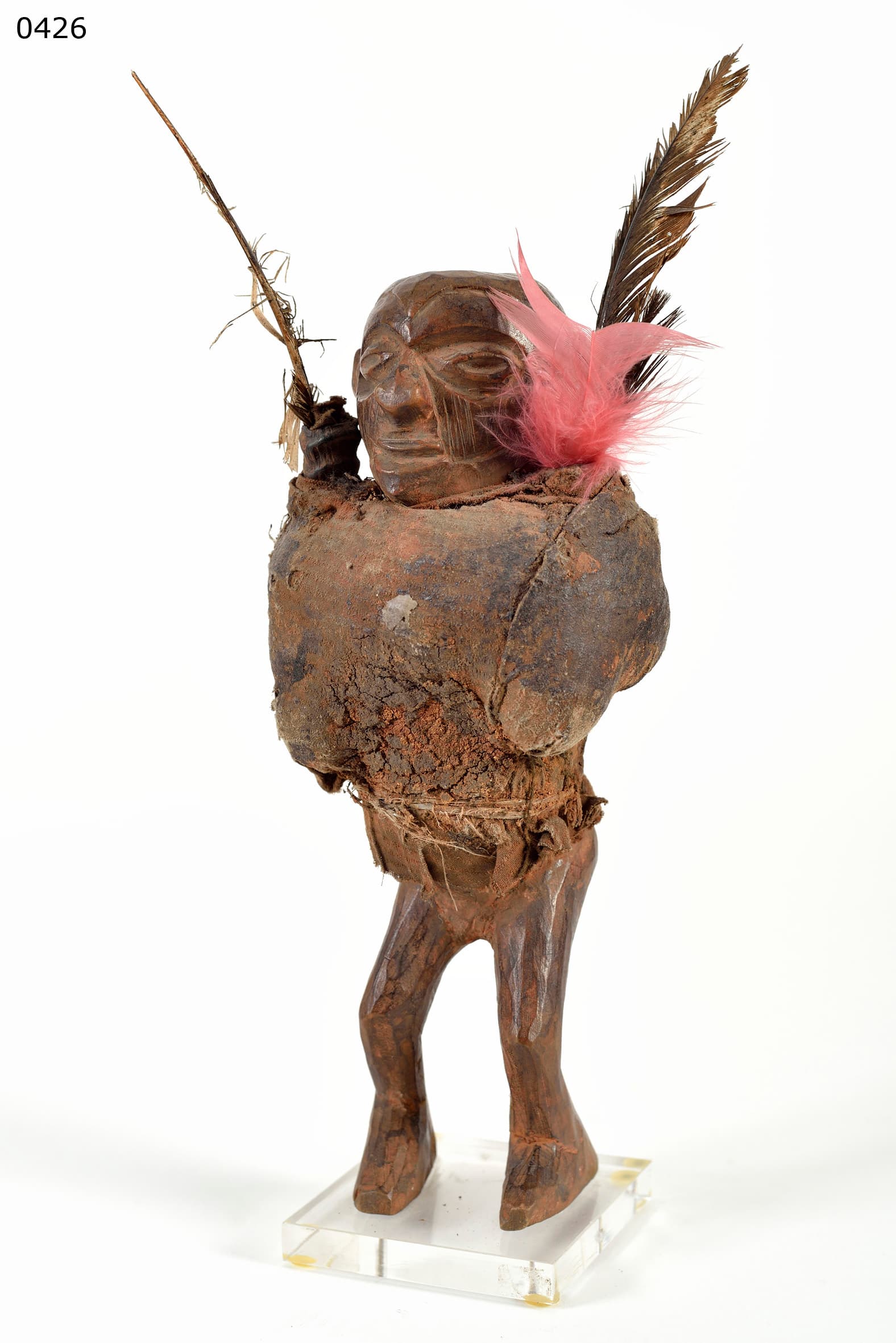
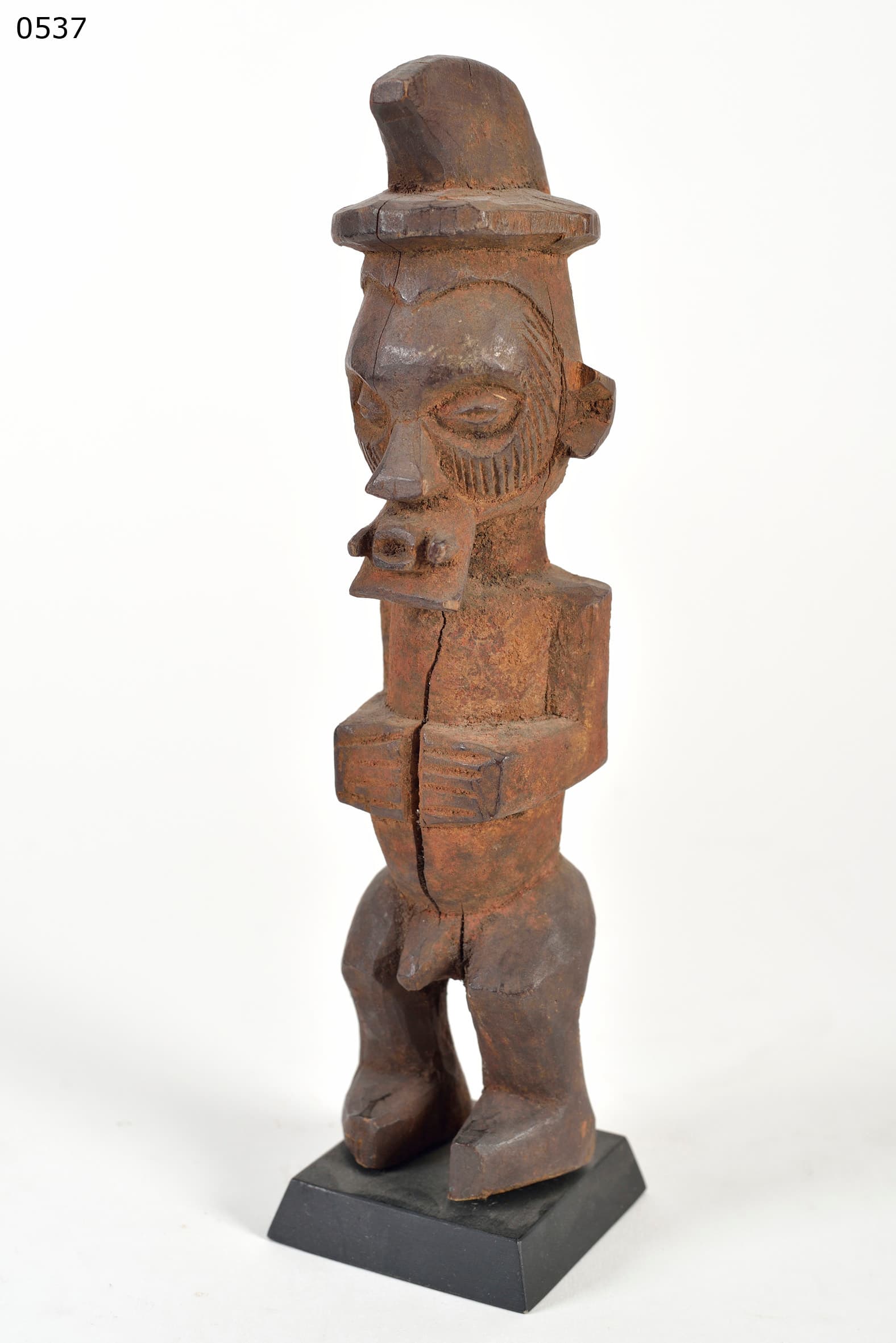
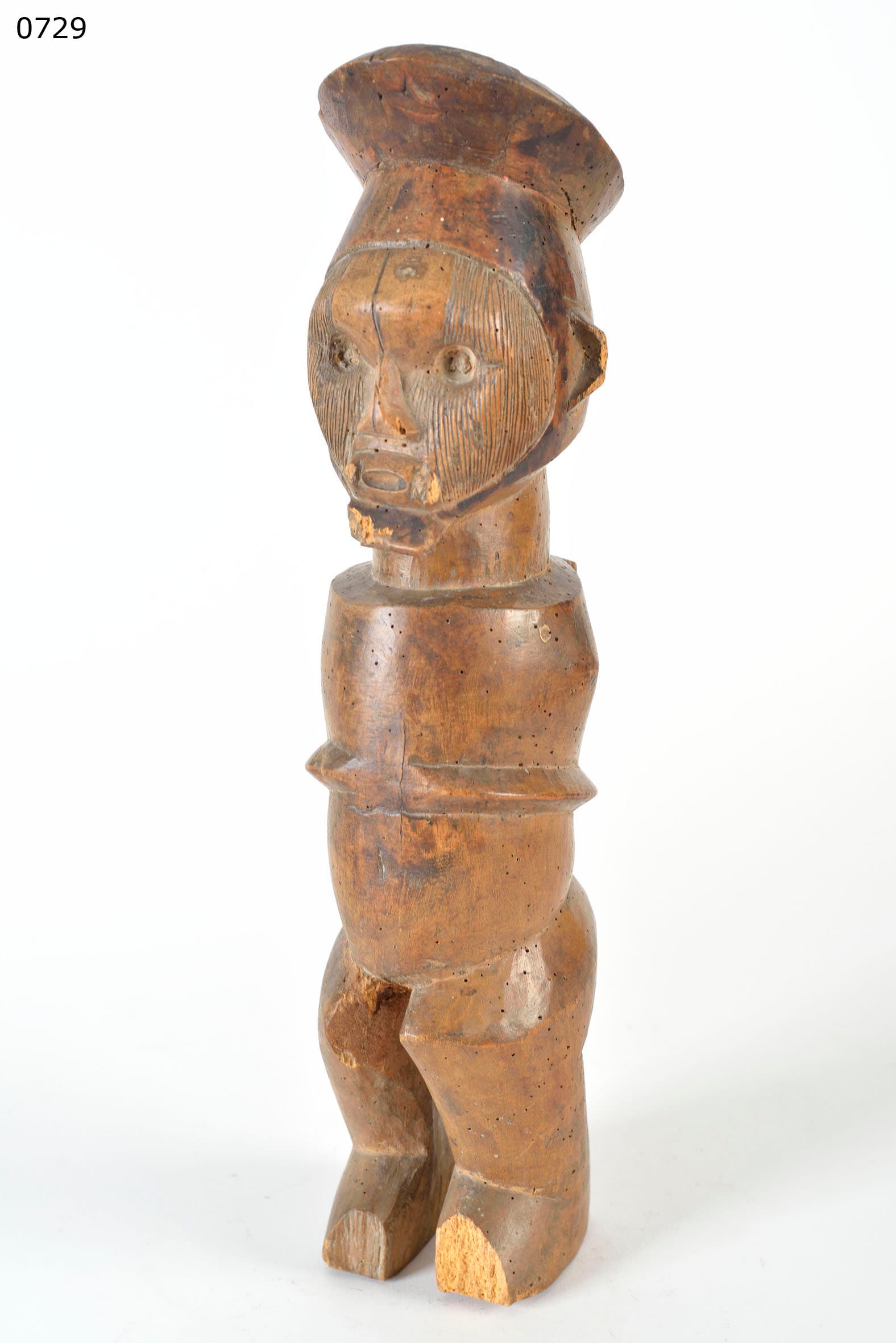
The iconography of the sculptures is subject to a rigorous canon of proportions. The figures invariably stand in a frontal pose on a base, their legs characteristically bent slightly at the knees, suggesting a posture of ritual presence and potential action. The torso is usually cylindrical or convex, the arms are close to the torso and often strongly stylised. The face, the morphological centre of identification, is characterised by parallel, fine vertical scarification marks (the so-called "teke tears"). The head often has a flat, helmet-like hairstyle (often referred to as onlua) and the chin of many masculine figures tapers into a distinctive, trapezoidal goatee.
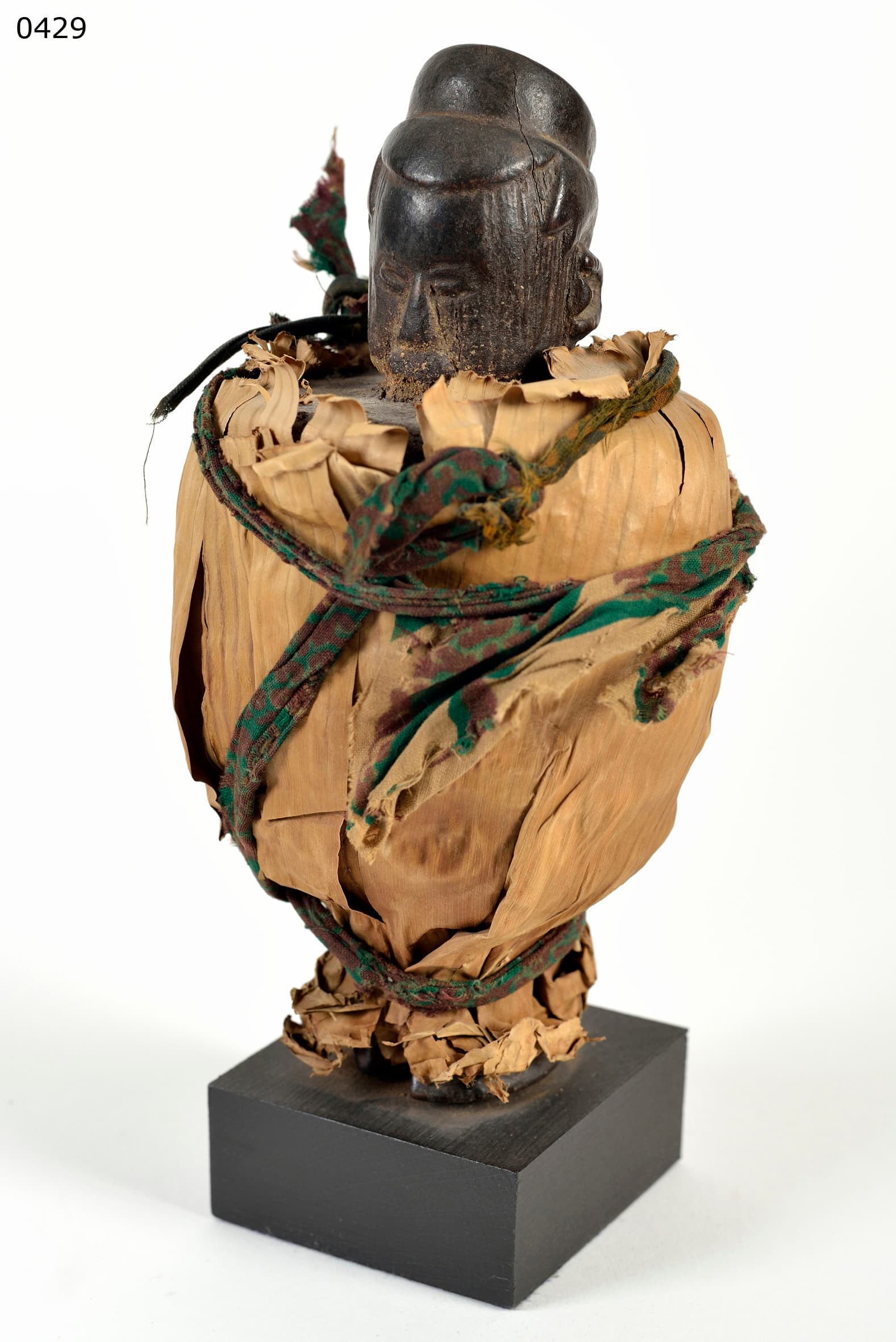
The nomenclature of these power figures has been differentiated by the scholar Raoul Lehuard (1996), who wrote the fundamental reference work on Teke art. Lehuard differentiates ancestor figures (bifwa) into two antagonistic categories: bankaga (representing positive, protective spirits) and mupfu (representing negative, potentially destructive or sorcerous forces). These types are further subdivided structurally into nkiba (pure wooden sculptures without any magical additions or cavities) and the central, far more powerful butti (or biteki). A butti is defined by its function as an accumulator: it is characterised by a prepared cavity in the abdomen into which the magical charge is placed.
The Teke sculptors' choice of material reflects the primarily utilitarian character of the objects. The heartwood used (locally called ngasu or mulong) merely serves as a passive support material. From the Teke's point of view, a freshly carved figure is a profane object without any power. The ritual significance, and thus also the voluminous bark patina that is so essential for collectors, is only created in the process of activation through the application of the bilongo. The bilongo is a viscous, resinous mass of earth that is mixed with kaolin, crushed bones, human hair, palm oil and specific ritual plants. This mass often envelops the entire torso of the wooden figure and seals the abdominal cavity, making the original fine carvings of the wooden body completely invisible under an amorphous crust.
A decisive paradigm shift in the study of Teke art is the overcoming of the topos of "anonymous tribal art". Through precise morphological analyses, researchers have succeeded in isolating specific master hands and studios. The most prominent example of this is the "Master of the Wedge Beard" (Maître de la barbe cunéiforme) identified by Raoul Lehuard and Bruno Claessens. The work of this sculptor, who was probably active in the late 19th century, is characterised by extremely narrow slit eyes, elegant, flowing arcs of tension in the arms and rigorous geometric abstraction. One of his most famous works, formerly in the collection of Stephen Chauvet, was shown as early as 1935 in the groundbreaking exhibition African Negro Art at the Museum of Modern Art in New York. Other exquisite works by this master are documented in the Musée d'Ethnographie de Genève (MEG) and the Musée du quai Branly, whereby the range between authentic use and Western aestheticisation can be seen in these museum objects - some of which are still completely encrusted with offerings, others ritually "cleansed".
Due to the price development in the high-end auction segment, forgery criteria for Teke objects have become highly relevant to the market. Patina is the absolute bottleneck of expertise here. Authentic ritual objects have an organically grown encrustation that has migrated deep into the cell structure of the wood and contains microscopic traces of sacrificial blood, palm oil and ash. Forgeries imitate this effect superficially with artificial resin mixtures, bitumen or thermal ageing. Forensic examinations, such as polarised light microscopy, can detect anachronistic pigments (such as titanium white in the paint produced after 1921). Absolute age determination is increasingly carried out using the radiocarbon method (C14 dating). Wood forgeries carved after 1950 can be unequivocally identified as modern by detecting atmospheric radioactive carbon from nuclear bomb tests (the so-called Bomb Effect), even if the style and patina are perfectly imitated. X-rays of the abdominal cavity also provide information: if, instead of the complex organic relic structure, only homogeneous filler materials or recent metal parts are found, the object is considered compromised.
Ritual practice
The ritual practice of the Teke is subject to a strictly utilitarian and procedural paradigm. As outlined in the aesthetic discourse, the carved object in its raw state - the moment it leaves the woodcarver's workshop - has no inherent magical, metaphysical or spiritual validity. The fundamental turning point in the life cycle of a butti is the act of activation by the nganga (priest and ritual specialist).
This activation process is a hermetically sealed ritual in which the profane wooden vehicle is transformed into an active accumulator. The nganga places the carefully composed bilongo precisely on and in the figure's abdomen. This anatomical location is not arbitrary, but deeply rooted in the cosmology of the Teke: the abdomen and the digestive system are considered the seat of transformative magic, where the accumulated spiritual wisdom and power are literally "swallowed" and preserved.
The composition of the bilongo is a physical representation of the social and cosmic order. Each ingredient carries a specific semiotic meaning that determines the purpose of the figure. In the following structure, the primary ingredients and their ritual equivalents are classified as they are also used in the broader regional context (for example in the related Lemba cult):
| Ingredient of Bilongo | Symbolic / ritual connotation | Social reference |
|---|
| Palm kernels / palm fibres | wealth, oil, trade, textiles | integration of the individual into the productive and economic sphere |
| ashes | hearth, family continuity | obligation of the man to found and maintain a household (ndzo) |
| charcoal | discretion, concealment of intentions | ability to invisibly ward off witchcraft attacks or disguise one's own tactics |
| Menstrual blood / exuviae | Maximum fertility, vitality | Promotion of biological reproduction and transfer of ancestral power |
After the complex application of these substances, the figure is sealed with offerings. Historically documented is the ritual bathing of the butti in the blood of a sacrificed animal (often a pig or chicken) in order to establish the transcendent connection to the bifwa (ancestors). The activated figure is then kept in the granaries, at the sleeping places or on the private altars of the respective lineage, where it then watches over harvests, wards off diseases or neutralises witchcraft influences.
The mask performance of the Tsaye-Teke offers a completely different ritual setting. The formal rigour of the round, flat, board-like kidumu mask, whose silhouette inevitably evokes the moon, is closely linked to the philosophy of the community. The mask is strictly divided geometrically by a striking horizontal band. According to the profound field research of Marie-Claude Dupré (1991), this division refers to the dualistic cosmology of the Teke - the separation and simultaneous unity of the living and the dead, heaven and earth. The colours applied (kaolin white, black, blue, ochre red) represent specific emotional states and spheres of the ancestral world.
In the ritual performance, the mask dancer always acts as a soloist, accompanied by an orchestra, but separated from the group of initiates. He enters the village from the dense forest vegetation and functions at this moment as the physical incarnation of the bush spirit Nkita. The choreography is highly acrobatic: the dancer, whose body is completely concealed under a massive, voluminous costume made of woven raffia fibres, animal skins and feathers - which is attached directly to the wooden mask by perforations around the edges - performs energetic, cartwheeling movements. His spatial orientation is extremely limited; he acts blindly, guided only by the rhythm of the drums and two tiny visual slits that are skilfully integrated into the abstract geometry of the mask to make the wearer invisible. The ritual ends as abruptly as it began, with the Nkita retreating into the forest.
The life cycle of the objects ends with a remarkably pragmatic acceptance of physical decay. The deactivation and disposal of a ritual object is neither mystified nor subject to strict taboos among the Teke. If a kidumu mask breaks during a wild dance or a butti figure in the storage altar is structurally destroyed by insects or termites, this is not considered a metaphysical catastrophe. The material carrier object has simply passed its functional zenith. The spiritual energy is considered to have been transferred or extinguished. The physical remains are returned to the elemental cycle of the forest, ritually burnt or disposed of in rivers, whereupon the nganga or a skilful local carver immediately produces an adequate replacement. Ethnological collections, such as that of the Museum Rietberg in Zurich, sometimes keep fragments of such objects in their depots, which document precisely these late stages of natural deactivation due to insect infestation or weathering and thus allow an unembellished view of the final "end-of-life" of African sacred art beyond Western conservation paradigms.
Historical context
The historical development of Teke societies and their material culture is inextricably linked to the complex migration history of the Bantu-speaking peoples and the geopolitical upheavals in the Congo Basin. Archaeological, ethnological and linguistic data allow the well-founded conclusion that the Tekophone populations were already firmly established in the heartland of the savannah plateaus north of Brazzaville in the early 16th century, around the year 1500. However, the exact genesis of the historical Anziku kingdom (the kingdom of Makoko) is the subject of ongoing historiographical dating controversies. Early 16th century Portuguese chroniclers, relying on reports from coastal intermediaries, often mythicised the 'Anziquos' as a warlike and barbaric entity in the deep hinterland. In fact, the Teke were massively exposed to the effects of the transatlantic slave trade in the 16th century, suffered from systematic slave hunts, but soon positioned themselves as indispensable, powerful middlemen (brokers) on the inland markets of the Stanley Pool. They controlled the flow of ivory, copper from the Niari region and slaves towards the allied Loango coast.
The late European penetration of Central Africa fundamentally changed the region at the end of the 19th century. A historic turning point was the expedition of the French explorer Pierre Savorgnan de Brazza in 1880, when Brazza signed a treaty (often referred to as a "protection treaty") with Makoko Iloo I, incorporating the territory into the French sphere of influence. This historic act, which laid the foundation for the later French Equatorial Africa, is impressively documented in the iconic photographs taken by Jacques de Brazza in 1884 at the court of Mbé, which visualise the insignia and habitus of the Teke elites at the time.
The imposition of the French colonial administration did not lead to an immediate halt in ritual art production, but it did drastically transform the social framework. The colonial authorities regarded the indigenous secret societies as a political threat and subversive potential. As a result, institutions such as the Kidumu society were suppressed and their ceremonies were rigorously regulated, limited or forced underground between 1880 and 1960. At the same time, contact with Western actors stimulated new formats: Some biteki figures were stripped of their ritual context in the early colonial period, "cleansed" of their bilongo charges and sold as curious souvenirs to administrators and missionaries, while at the same time highly potent, fully activated power figures were confiscated and flowed off to the ever-growing ethnological ethnographic museums of Europe.
The reception of Teke art in the West underwent a rapid paradigm shift in the early 20th century, elevating the objects from ethnographic curiosities to high-priced masterpieces of global art history. Pioneers of the emerging tribal art market in Paris, above all the influential dealer Charles Ratton, began in the 1920s and 1930s to remove African sculptures from the dusty depots of ethnological museums and - in dialogue with Cubism and Surrealism - to stage them as formal revelations of the avant-garde.
A decisive breakthrough for the international recognition of Teke sculpture was the groundbreaking exhibition African Negro Art at the Museum of Modern Art (MoMA) in New York in 1935, where an outstanding Teke figure (on loan from the collection of Stephen Chauvet), which was later attributed to the "Master of the Wedge Beard", was presented to a broad Western audience as a masterpiece of abstraction. Since this ennoblement, the market for Teke antiques has experienced exponential price growth. Excellent, historically documented works from renowned Teke ateliers or masks with complete provenance now fetch prices in the high five- to six-figure euro range at major auctions (Sotheby's, Christie's) and international fairs (TEFAF, Parcours des Mondes).
The market explosion and the establishment of high monetary values inevitably exacerbated the problem of forgery, which has elevated the field of authentication to a highly complex science. Today, modern authenticity criteria are based on a bundle of interdisciplinary methods, as purely stylistic expertise (classic connoisseurship based on a sense of form) is considered to be prone to error.
Material forensics has become indispensable. When examining the ageing of wood, experts analyse the drying cracks (heartwood cracks). In authentic objects that have aged over decades in a climatic rhythm, the edges of the cracks are softly patinated and encrusted with dirt particles, while cracks that have been artificially accelerated in climate chambers have hard, sharp fracture edges. Forensic investigations of termite feeding are also relevant: Natural feeding marks follow the biological pathways of the wood and show fine patina traces on the inside, which are almost impossible to imitate mechanically. However, the ultimate forensic gold standard for age determination is the radiocarbon method (C14 dating) of microsamples of the wood or the bilongo. Forgeries made from wood felled after 1950 can be unmistakably identified as modern by the detection of significantly increased amounts of atmospheric radioactive carbon (caused by the global nuclear bomb tests, the so-called Bomb Effect), even if the morphological carving and the artificial surface treatment appear flawless.
At the same time, leading institutions are investing considerable research funds in the complete documentation of object biographies. For example, the Royal Museum for Central Africa (RMCA) in Tervuren has recently carried out extensive provenance research in its archives in order to provide a historically precise account of the often violent acquisition contexts (for example, in the case of looted objects such as the Kitumba statute, catalogue no. EO.0.0.7943). In 2022, this work culminated in the symbolic handover of a detailed inventory of over 85,000 objects by the Belgian state to the government of the Democratic Republic of the Congo, an act that fundamentally restructured the debate on restitution and the ethical safekeeping of artworks from the Teke region. Museums such as the British Museum are also intensifying these efforts, steadily liberating the image of classical Central African art from romanticising collector myths and placing it in a strictly empirical, decolonial context.